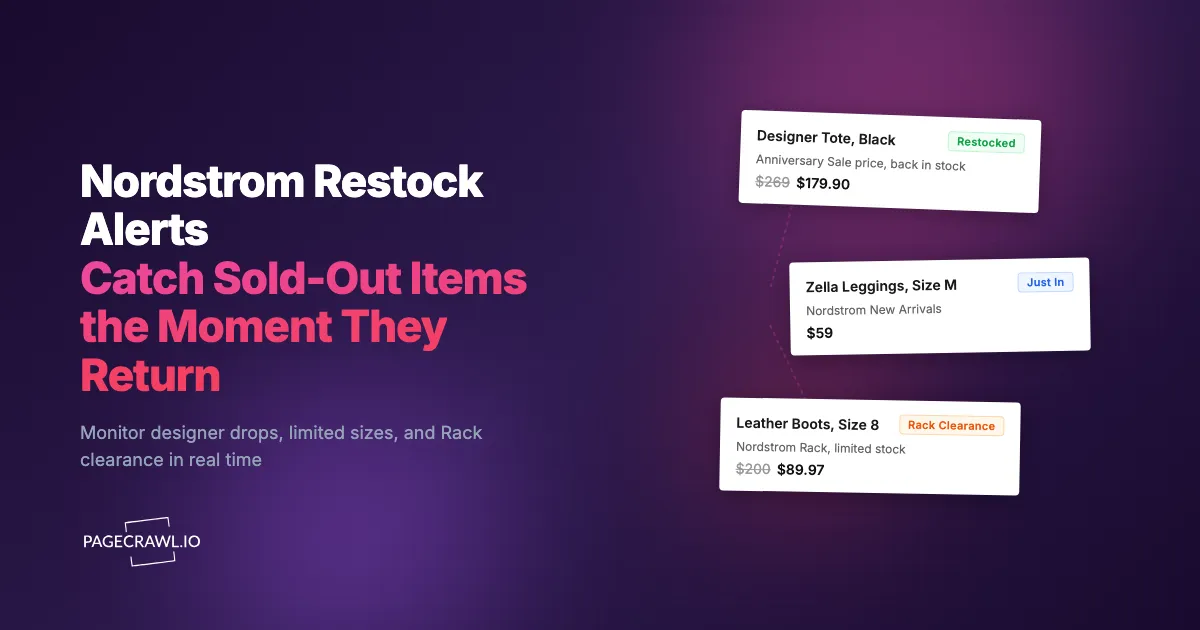
The designer boots you wanted went out of stock in a size 8 sometime overnight. You added them to your cart on Sunday, got distracted, and by Monday morning the size picker showed every size greyed out except 5 and 11. Two days later they were back, sold through in your size by lunch, and gone again by dinner. Nordstrom never emailed you, even though you tapped "Notify Me" the first time.
Nordstrom runs two very different inventory engines. Nordstrom.com sells full-price designer and contemporary brands where popular sizes sell through fast and restock on no fixed schedule. Nordstrom Rack runs on constant clearance churn, where individual units appear, sell, and vanish within hours. Layer the Anniversary Sale (NSale) on top, with its tiered early access and temporary prices, and you have a retailer where timing is everything and manual checking almost always loses.
This guide covers why Nordstrom items sell out, what to monitor across both sites, where the brand's own "Notify Me" falls short, and how to set up automated alerts that reach your phone as soon as a check finds your size and price back on the page.
Why does Nordstrom sell out so fast?
Nordstrom sells out fast because it blends curated designer scarcity with single-unit clearance inventory. On Nordstrom.com, mid-range sizes in popular brands receive small allocations and restock unpredictably. On Nordstrom Rack, most clearance listings are one or two units that disappear permanently once sold. Demand consistently outruns supply for the pieces shoppers actually want.
Limited designer allocations
Nordstrom is a department store, but it buys designer and contemporary brands in tightly controlled quantities. A specific color and size of a popular handbag, boot, or jacket might arrive in single-digit units per store plus a modest online allocation. When those sell, the item shows as unavailable until Nordstrom processes a return, receives a new shipment, or reallocates between stores. None of that follows a public calendar, so the only way to catch the window is to watch the page continuously. The same dynamic drives designer resale listings on The RealReal and Vestiaire, where scarce inventory moves within hours of appearing.
Nordstrom Rack clearance churn
Nordstrom Rack inventory turns over constantly. Items move from full-line stores to the Rack as clearance, get listed online, and sell as individual units. A boot in your size at 60% off is frequently the only one in the system. Rack also runs flash "Clear the Rack" events that drop already-reduced prices further for a few days, emptying popular sizes almost immediately. Monitoring is the only practical way to catch a specific Rack unit before someone else does.
Size distribution that favors the extremes
Nordstrom allocates inventory along a bell curve. Women's sizes 4 to 10, men's M and L, and mid-range shoe sizes sell out first because that is where demand concentrates. The smallest and largest sizes linger longer but receive smaller initial buys. If your size sits in the high-demand middle, you are competing with the largest pool of shoppers for the smallest relative share, which makes size-specific monitoring essential, the same edge that catches Uniqlo's sold-out core sizes in Heattech and Airism.
Permanent versus temporary sellouts
Some Nordstrom sellouts are temporary (a return is coming, a shipment is in transit) and some are permanent (the color was discontinued, the Rack unit was the last one). You usually cannot tell which from the product page, and that uncertainty is exactly why an alert matters: you cannot assume an item will return, so you want to hear about it on the first check that sees it back.
What should you monitor on Nordstrom and Nordstrom Rack?
Monitor four kinds of pages: individual product URLs for the exact size and color you want, brand and designer pages for new drops, "Just In" new arrivals feeds, and Nordstrom Rack clearance pages for your category. The most reliable approach combines one targeted product monitor per must-have item with a few broader discovery monitors.
Individual product pages by size and color
The most precise approach watches the specific product page for the item, color, and size you want. Nordstrom product pages render size availability as selectable buttons, with out-of-stock sizes greyed out or struck through. When your size comes back, that button becomes active again, and that change is exactly what automated stock availability monitoring detects. Use the URL for the exact color variant rather than a generic product link. For a full overview of availability tracking across any retailer, see our out-of-stock monitoring guide.
Brand and designer pages
If you want anything new from a particular designer or brand regardless of specific item, monitor that brand's landing page on Nordstrom. When Nordstrom adds a new product or color from that label, the page changes and you get alerted. This is broader than a single product URL, and it surfaces releases you did not know were coming, which is how the best buyers reach limited designer drops before they sell through, the same way they catch Urban Outfitters exclusives on the first check after they land.
The "Just In" and New Arrivals feeds
Nordstrom adds new product throughout the week, surfaced on its "Just In" and New Arrivals pages. Monitoring a category-level New Arrivals page alerts you as soon as a check spots fresh inventory, which matters most for highly anticipated launches teased on social media. Hearing about a launch on the next check gives you the best shot at your size before the crowd arrives. The same tactic works across fashion retailers like Aritzia, Free People, and Anthropologie.
Nordstrom Rack clearance pages
Nordstrom Rack is where price and availability collide hardest. Monitor the Rack category page you care about (women's boots, men's outerwear, designer handbags) with content tracking so you catch newly added clearance units and "Clear the Rack" price drops. Because Rack units are often singular, fast notification is the difference between checkout and "sold out." If you also shop fast-fashion restocks, our guide to ASOS back-in-stock and sale alerts covers the same churn pattern.
How reliable is Nordstrom's own "Notify Me" alert?
Nordstrom's "Notify Me" is better than nothing but unreliable as your primary strategy. It is email-only, frequently batched, inconsistent about your exact size, and absent entirely on Nordstrom Rack clearance and most price drops. For fast-moving sizes, the gap between an actual restock and the email landing in your inbox is often long enough to miss the item.
The emails arrive late
The "Notify Me" email does not go out as soon as an item restocks. These messages are batched and sent on Nordstrom's schedule. By the time the email arrives and you reach checkout, a popular size may already be gone again. For high-demand items, even a short delay regularly means missing the restock.
Size handling is inconsistent
The basic alert does not always pin to your exact size. You might get a "back in stock" notification, rush to the page, and find only sizes you cannot wear. Your size never actually returned, but the alert fired anyway, training you to ignore the notifications that matter.
One channel, no Rack, no price drops
Nordstrom's alert is email only. There is no push to your phone, no Slack message, no webhook into an automation, and email is the slowest channel for time-sensitive restocks. Worse, Nordstrom does not alert you when an item moves to clearance, when Nordstrom Rack adds a unit in your size, or when a "Clear the Rack" event drops the price. You can only find those by checking manually or with external monitoring.
How do you set up Nordstrom restock alerts with PageCrawl?
PageCrawl monitors the actual Nordstrom and Nordstrom Rack pages and alerts you through your preferred channel as soon as a check detects a size, status, or price change. Checks run as often as every 2 minutes on paid plans and hourly on the free plan, so your alert lag is your check interval rather than someone else's batching schedule. It overcomes the email-only, no-Rack limits of Nordstrom's system. Setup takes a few minutes per item, and the free tier covers a focused wishlist.

Basic restock monitoring setup
Step 1: Open the Nordstrom or Nordstrom Rack product page for the exact item and color you want. Select your size if the URL or page state reflects it, then copy the URL. Make sure you are on the specific color variant, not a generic product link showing all colors.
Step 2: Add the URL to PageCrawl. For a product page, use availability tracking mode so PageCrawl identifies stock-status indicators, or price mode if you also want to track the price. PageCrawl analyzes the page and locks onto the relevant content. If you are unsure which mode fits an item, the reference on available tracked element types compares availability, price, number, and full-page tracking side by side.
Step 3: Set your check frequency. For hot items (limited designer sizes, popular Rack clearance, Anniversary Sale pieces), check every 1 to 2 hours, since restocks can land any time and sell out within hours. For lower-competition items, every 4 to 6 hours is plenty.
Step 4: Configure notifications. For time-sensitive restocks you want browser and phone push alerts or Telegram and Discord messages rather than email; the setup steps are in the guide to web push notifications for change alerts. If a team or household shares a wishlist, route alerts into Slack so everyone sees them at once.
Step 5: Enable screenshot capture. Nordstrom pages show size availability visually, so a screenshot lets you confirm which sizes are live as soon as the alert reaches you, without opening the site.
Combining availability and price thresholds
Some Nordstrom items are available but at full price, and you would rather wait for the Anniversary Sale or a Rack markdown. For these, monitor the product page in your size and use price monitoring with a target threshold so you are only alerted when the price crosses your number. Our guide to conditional price, keyword, and threshold rules walks through building "only alert me under $150" logic so you hear only about the drops that matter.
Monitoring a full wishlist
Most Nordstrom shoppers want several pieces in a specific size. A typical list might look like:
- Designer ankle boot in Black, size 8, on Nordstrom.com
- Zella leggings in Navy, size M, New Arrivals
- Contemporary blazer in Camel, size 6
- A men's outerwear clearance unit on Nordstrom Rack
Each item gets its own monitor at the exact variant URL. Group them in a PageCrawl folder called "Nordstrom Wishlist" so you can review and update the list over time. A focused list of 4 to 6 items fits the free tier completely. The same wishlist pattern works for Lululemon restocks and beyond.
How should you monitor the Nordstrom Anniversary Sale (NSale)?
The Anniversary Sale is Nordstrom's biggest event, typically in July, offering brand-new fall product at temporary lower prices before the price goes up when the sale ends. Access opens in tiers by cardmember status (Icon, Ambassador, Influencer) before going public, so the most-wanted sizes routinely sell out during early access. Monitor specific NSale product URLs and the brand pages you care about.
Early access creates the real scarcity
Because cardmember tiers shop the NSale days before the public, the catalog can look picked-over by the time general access opens. Many shoppers experience the sale as a long run of sold-out sizes punctuated by sporadic restocks as inventory is replenished and orders are canceled. Monitoring specific product pages through the whole sale window catches those mid-sale restocks on the next check, which is often your only realistic shot at a sold-out size at the sale price.
Watch the price reset at sale end
NSale prices revert when the sale closes. If you are tracking an item for value rather than scarcity, set a price monitor so you have a record of the sale price and an alert if it returns to a markdown later in the season. Pairing price and availability monitors means you hear both "your size is back" and "it dropped to the price you wanted," the two conditions that actually trigger a purchase.
Beauty and gift-with-purchase events
Nordstrom's beauty events and the NSale beauty section move fast on popular sets and gift-with-purchase offers, so monitor the relevant brand or event page to catch restocks and new GWP thresholds early. Our Sephora sale and restock alerts guide covers the same approach for prestige beauty.
When do Nordstrom restocks and drops happen?
Nordstrom does not publish a restock calendar, but useful patterns exist. New arrivals flow in throughout the week with larger refreshes early on. Restocks of sold-out sizes often appear in early-morning hours as returns and shipments process. Nordstrom Rack adds clearance continuously, with "Clear the Rack" flash events spiking activity. The Anniversary Sale runs in July, when you should raise must-have items to every 1 to 2 hours.
Early-morning restocks
Sold-out sizes frequently reappear in the early morning, when inventory systems process returns and incoming shipments. An item unavailable at midnight may show as available at 6am and sell out again by 10am. Automated monitoring is most valuable here, because it catches the windows that open while you are asleep.
How do you build a complete Nordstrom monitoring strategy?
Build it in tiers so your most-wanted items get the fastest checks and your discovery monitors stay broad. Tier 1 is your must-have items (exact product, color, and size) checked every 1 to 2 hours with push notifications. Tier 2 is nice-to-have pieces checked every 4 to 6 hours. Tier 3 is discovery (brand pages, New Arrivals, and Rack clearance pages) on the same slower cadence, so your fastest checks stay on what matters most while you still catch opportunities across both sites.
Filtering out page noise
Nordstrom and Nordstrom Rack pages include elements that change constantly without reflecting real stock: "recently viewed," recommendation carousels, rotating promotional banners, and review counts. PageCrawl loads the full page, including content that appears only after it finishes rendering, before capturing anything, and its noise filtering lets you click any detected change to ignore it going forward. After a check or two, you only hear about genuine availability and price changes.
What are the common challenges with Nordstrom monitoring?
The main challenges are dynamically loaded availability, single-unit Rack inventory, naming inconsistencies, and periodic page redesigns. None of them prevent reliable monitoring, but each shapes how you set up your monitors. Targeting exact variant URLs with availability or price mode handles the large majority of cases.
Single-unit and cart-hold availability
Nordstrom holds items in carts for a period after they are added, so a unit can show out of stock while it sits in an abandoned cart. When that hold expires, the item briefly becomes available again. On Nordstrom Rack, where many listings are a single unit, these micro-restocks are real but very short-lived. High-frequency monitoring catches some of these windows, unpredictable as they are.
Variant URLs and color naming
Nordstrom uses distinct URLs for color variants, which is good, but seasonal color names shift and similar shades carry different names across collections. Always monitor by the exact product URL rather than by color name, since the URL uniquely identifies the variant you want. The same rule keeps Zara and H&M style fast-fashion monitors accurate.
Periodic page redesigns
Nordstrom and Nordstrom Rack update their layouts periodically, which can shift how stock indicators appear. PageCrawl's content analysis adapts to most layout changes automatically. If a major redesign ever breaks a specific monitor, recreating it against the updated page resolves it in a minute.
Choosing your PageCrawl plan
PageCrawl's Free plan lets you monitor 6 pages with 220 checks per month, which is enough to validate the approach on your most critical pages. Most teams graduate to a paid plan once they see the value.
| Plan | Price | Pages | Checks / month | Frequency |
|---|---|---|---|---|
| Free | $0 | 6 | 220 | every 60 min |
| Standard | $8/mo or $80/yr | 100 | 15,000 | every 15 min |
| Enterprise | $30/mo or $300/yr | 500 | 100,000 | every 5 min |
| Ultimate | $99/mo or $999/yr | 1,000 | 100,000 | every 2 min |
Annual billing saves two months across every paid tier. Enterprise and Ultimate scale up to 100x if you need thousands of pages or multi-team access.
Nordstrom designer pieces routinely run $150 to $600, so a single sold-out size caught at the Anniversary Sale price can be worth more than a year of monitoring. The free tier covers a tight wishlist of 6 items. Standard at $80/year covers 100 pages, enough for a full wishlist plus brand pages, New Arrivals, and several Rack clearance categories. Enterprise at $300/year handles 500 pages for personal shoppers and resellers tracking broad catalogs.
Getting Started
Pick the one Nordstrom item you want most right now. Open the page for your exact size and color, copy the URL, and set up an availability monitor in PageCrawl with Telegram or Discord push notifications so restocks reach your phone on the next check. Run it for a week and watch how often availability actually shifts, even on a popular item.
Then expand. Add your full wishlist, point a monitor at the brand pages and New Arrivals feeds you care about, and set up a Nordstrom Rack clearance monitor for your category before the next "Clear the Rack" event. Come July, raise the frequency on your Anniversary Sale picks and let early-access restocks come to you.
Stop refreshing Nordstrom. Let the alerts do the watching.