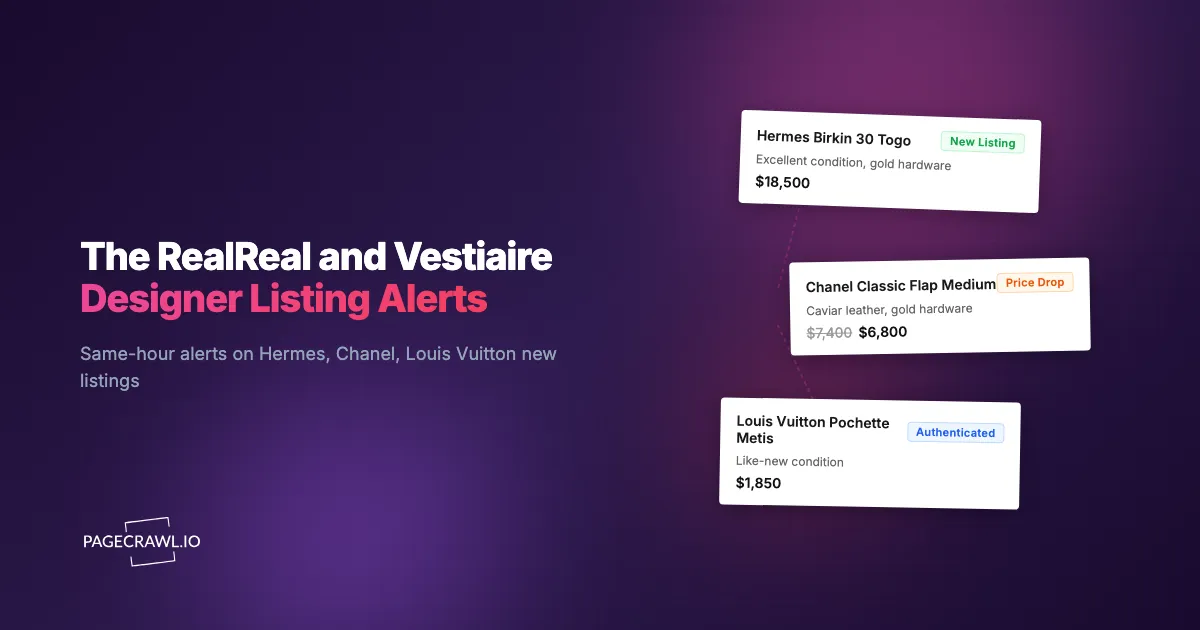
A Hermes Birkin 30 in Etoupe Togo with palladium hardware listed on The RealReal at close to boutique retail on a Saturday morning in October 2024, well under what the same bag in the same condition asks at specialist Hermes resellers. The listing was bought inside 45 minutes. The buyer was almost certainly one of the small number of resellers and collectors who run continuous monitors on TRR's Hermes search results, because there is no other way to be paying attention on a Saturday morning to a single listing that drops in price for the first time in months.
The RealReal and Vestiaire Collective are two of the largest authenticated designer resale platforms in the world. Specific designers, sizes, and styles produce extremely thin inventory, especially in the most-collected categories (Hermes Birkins and Kellys, Chanel Classic Flap, Louis Vuitton Pochette Metis, Cartier love bracelets). When a piece in your target spec lists at a fair price, you have minutes to hours, not days, before someone else buys it. Manual refresh is impossible at any reasonable cadence. Saved-search emails on both platforms are slow and unreliable. A continuous monitor on the exact filtered URL of your target search is the only practical way to be first on new listings.
This guide covers how TRR and Vestiaire publish search results, what patterns drive the best buys, and how to set up monitors that surface new listings and price drops within an hour of going live.
Why are designer resale platforms worth monitoring continuously?
Because inventory is one-of-one and extremely thin. A specific Hermes spec may have only a handful of active listings across both platforms at once, price drops on sitting listings are bought out within hours, and pop-up sale activations are never announced in advance. The structural facts of authenticated designer resale make monitoring valuable in ways that few other categories can match.
Thin Inventory Means The First Buyer Wins
For high-demand styles, the number of pieces in circulation at any given moment is small. A specific Hermes Birkin spec might have 1-3 listings active across both platforms combined at any time. Price drops on existing listings or new listings of preferred specs are bought within hours.
Price Drops On Listings Are Bought Out Within The Hour
When a seller drops the price on a sitting listing by 10-20%, the listing becomes attractive to buyers who passed at the higher price. Both platforms surface price drops weakly in their default sort, so a continuous monitor catches them when the platform's own surfacing does not.
Pop-Up Sale Activations Apply Site-Wide Discounts
Both platforms run periodic pop-up sales (10-20% off select categories or designers) that activate on the search results page or category landing. Monitoring catches the activation and lets you act on saved listings before the sale ages out.
Authenticated Condition Variation Drives Pricing
Inventory is one-of-one. Two listings of the same style with the same color can vary in price by 30-50% based on condition. New listings in your condition spec at fair prices are precisely the targets worth monitoring.
Cross-Platform Spreads Exist And Persist
The same designer piece can list at meaningfully different prices on TRR vs Vestiaire because of buyer composition, fee structure, and authenticator differences. Monitoring both surfaces the cross-platform opportunities.
How do The RealReal and Vestiaire structure search results?
Both keep every filter in the URL, so a filtered search has its own stable, monitorable address. New listings matching the filter add rows to the result set and price drops rewrite the displayed price, which means one monitor on one URL catches both. The patterns look like this:
https://www.therealreal.com/products/women/handbags/{filter-params}
https://www.vestiairecollective.com/women-bags/{filter-params}
Each filter combination has its own URL. New listings matching the filter add rows to the result set. Price drops on existing listings update the displayed price. PageCrawl tracks the page contents and flags both new rows and price changes.
For maximum signal, build narrow filters: brand + style + color + condition + size (where applicable) + price range. A search filtered to "Hermes Birkin 30 Etoupe excellent condition under $12,000" returns 0-3 listings at any time. New entries are high-signal events.
Which approach catches designer listings fastest?
Monitoring the filtered search URL directly. Native saved-search emails on both platforms cap notifications, trail by hours, and ignore price drops on existing listings. Manual refreshing only works while you are at the keyboard, and reseller group chats depend on someone else choosing to share.
| Approach | Cost | Latency | Coverage | Best For |
|---|---|---|---|---|
| Native saved-search emails | Free | Hours to days | Per saved search | Light watchers |
| Manual refresh | Free | Minutes when active | Per session | Active hunters |
| WhatsApp groups and reseller circles | Free / Invite-only | Variable | Crowd-sourced | Insiders |
| Custom scraping | Engineering time | Minutes | Any URL | Technical buyers |
| PageCrawl on filtered URLs | Free tier to $80/year | 15 minutes to hours | Any filter | Active collectors and resellers |
Native saved-search alerts on both platforms exist but cap notifications, trail by hours, and miss price drops on existing listings entirely. Direct monitoring of the filtered URL captures both new listings and price changes with no caps and minimal latency.
Setting Up Resale Monitoring

Step 1: Build narrow saved searches on each platform
For each style and condition spec you actually buy, build the filter on each platform. Narrow filters (brand + style + color + condition + size + price range) produce 0-5 results at a time and high-signal alerts.
Step 2: Copy the URLs after applying filters
Both platforms preserve filters in the URL. Copy the URL after the filter is applied. The URL is what you monitor.
Step 3: Add as content monitors with screenshots
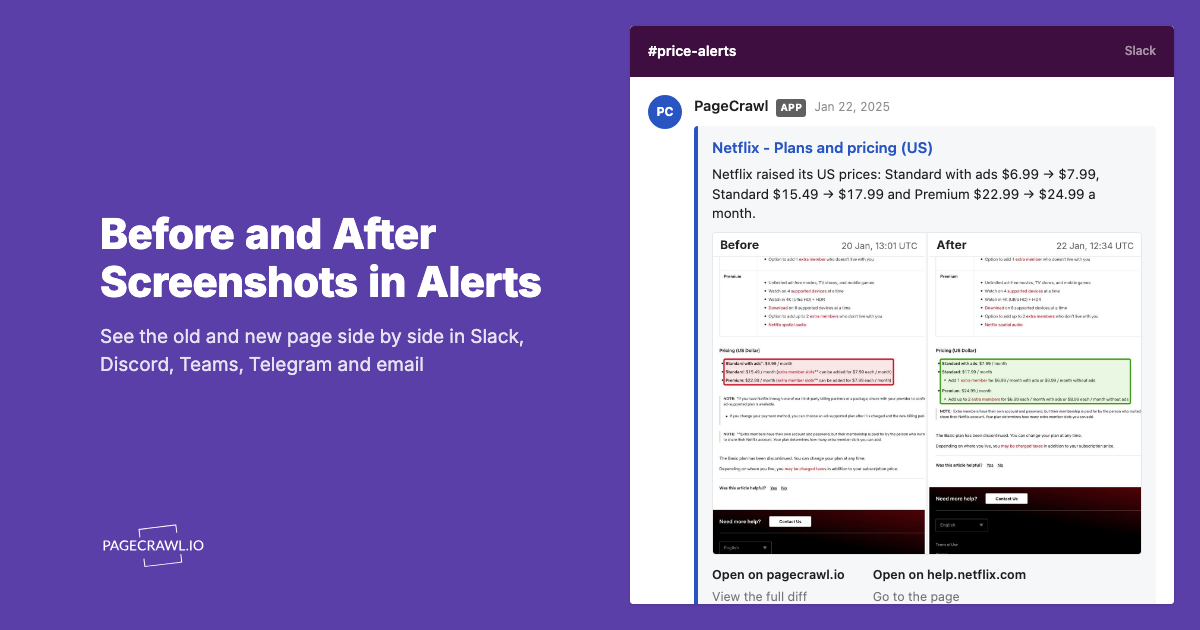
Add each URL with content monitoring and screenshots enabled. Screenshots are particularly useful because authenticated resale is visual and a screenshot diff confirms a new listing card has appeared.
Step 4: Configure check frequency by demand level
For hot specs (Hermes Birkin, Chanel Classic Flap), hourly or 15-minute checks (Standard plan) catch new listings within the window where they remain bought. For lower-demand specs, daily checks are enough.
Step 5: Route alerts to Telegram or Discord
Designer resale is mobile and time-sensitive. A Telegram or Discord alert lands on your phone as soon as a check spots the listing and lets you act from anywhere. Email adds its own delivery lag on top, which is too slow for the hot listings.
Step 6: Tag and group into designer folders
Create folders per designer (Hermes, Chanel, Louis Vuitton, Cartier), following the guide to labels, folders and workspaces. The folder view rolls up the watchlist on a single page and helps you spot cross-platform spreads or designer-wide pricing softness.
Worked Example: A Hermes Hunter's Setup
A long-time Hermes collector wants to acquire a Kelly 28 in Sellier or Retourne in specific neutral colors at a fair price. The setup:
- Build a TRR search filtered to "Hermes Kelly 28, color in (Etoupe, Gold, Black), excellent condition, under $14,000".
- Build the matching Vestiaire search.
- Add both URLs as content monitors with hourly checks.
- Tag both
hermes-kelly. - Route alerts to Telegram for mobile delivery.
Four weeks in, the TRR alert fires: a Kelly 28 in Gold Sellier in excellent condition lists at $12,800. The collector buys it within 20 minutes of the alert, several thousand dollars below what a specialist Hermes reseller would have asked for the same spec. Total cost: $80/year for Standard plan, recovered many times over on that single acquisition.
Which resale patterns are worth watching?
Six repeat reliably: new listings matching a narrow spec, price drops of 10 percent or more on sitting listings, pop-up sale activations, cross-platform spreads between the two sites, condition-label variation on otherwise identical pieces, and sellers relisting an unsold item at a lower price.
New listings matching narrow specs. The basic acquisition signal. Narrow filters produce high-signal alerts.
Price drops on existing listings. Sellers periodically reduce prices on sitting listings, which is exactly what price and availability monitoring is built to catch. A 10%+ drop on a piece in your spec is buy-worthy.
Pop-up sale activations. 10-20% off site-wide or category sales activate on search pages. Monitoring catches the activation in time to act on saved listings.
Cross-platform spreads. The same style at meaningfully different prices on TRR vs Vestiaire. Monitor both for arbitrage or for finding the cheaper listing.
Authenticator quality variations. Different condition labels on similar pieces produce different prices. Filtered searches by condition surface the best-condition listings at the lowest prices.
Pre-relisting moments. Some sellers relist sitting items at lower prices after a few weeks. Monitoring catches the relisting at the lower price.
Combining Resale Alerts With Other Signals
Pair with sneaker resale monitoring. The same monitoring principle applies. See the StockX and GOAT price monitoring guide for the sneaker resale parallel.
Pair with boutique inventory pages. For lower-tier designer pieces, boutique pages sometimes carry new inventory. Monitoring boutique stockists adds depth to the watchlist.
Pair with luxury retailer sale pages. Saks, Bergdorf Goodman, Net-a-Porter, and Mytheresa all run sales periodically. Monitoring sale pages alongside resale platforms catches the rare moments when retail goes below resale.
Pair with auction calendars. Christie's and Sotheby's handbag and accessory auctions clear designer pieces periodically. Monitoring the auction catalog pages catches lots in your spec.
Pair with social signal. Designer collector communities on Instagram and Discord surface listing alerts informally. PageCrawl handles the platform side; community channels are the supplemental signal.
Use Cases
Designer collectors. Same-hour awareness of new inventory in target styles is the operating norm for serious collectors. The patience of waiting weeks or months for the right spec at the right price pays off when you actually catch the listing.
Resellers. Buy-side intelligence on under-priced listings is the core of resale arbitrage. Continuous monitoring on the platforms you arbitrage between is the price of admission for that business.
Stylists. Hard-to-find pieces for client requests. A stylist with a client looking for a specific Chanel jacket in a specific size monitors the right filters and acts as soon as an alert shows the piece has been listed.
Vintage enthusiasts. Specific era and brand monitoring. Vintage Hermes scarves, vintage Cartier Tank watches, vintage Chanel jewelry all have thin inventory and benefit from continuous monitoring.
Personal shoppers. Per-client watchlists with the styles each client wants, alerts routed to the shopper's email. Saves hours of manual checking per client.
Investment-grade collectors. Treating designer pieces as alternative assets requires market data. The monitoring archive becomes a personal price history database.
Frequently Asked Questions
How thin is inventory for hot specs? For Hermes Birkin in popular colors and sizes, often 1-3 active listings across both platforms combined. For Chanel Classic Flap in a specific size and condition, often 5-15. For less-collected designers, more.
Will PageCrawl detect authenticity issues? PageCrawl monitors the page content. Authentication itself is handled by the platforms. Both TRR and Vestiaire authenticate pieces before listing.
Can I monitor specific sellers? TRR does not expose per-seller URLs in most cases. Vestiaire does allow seller-specific monitoring on some sellers. The filtered-search approach captures the relevant signal regardless of seller.
What about emerging platforms (Rebag, Fashionphile)? Same approach works. Any platform with stable filtered-search URLs can be monitored the same way, including peer-to-peer marketplaces like Poshmark.
How fast are alerts on hot listings? On hourly checks, within an hour. On 15-minute checks (Standard plan), within 15 minutes. For the hottest specs (Hermes Birkin, certain Chanel), 15-minute checks are the minimum viable cadence.
Do I need a paid plan for resale monitoring? Casual collectors can fit 6 high-priority searches on the free tier. Active collectors and resellers move to Standard at $80/year for 100 monitors and 15-minute checks.
Can you line up the same designer piece across every resale platform in one view?
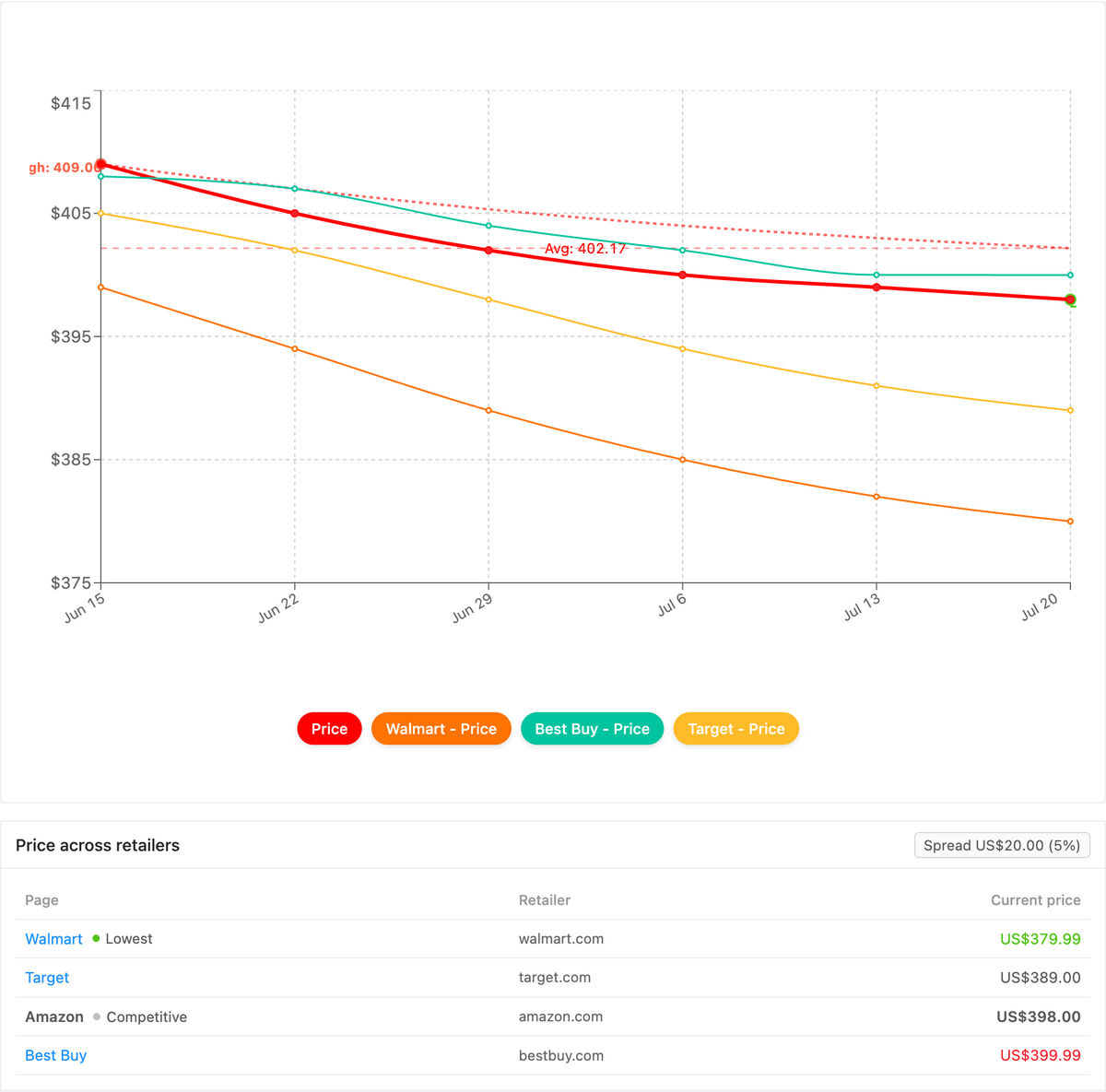
Yes. PageCrawl's Product Comparison capability groups the monitors for one designer piece across every platform into a single view, highlights the cheapest advertised listing, and tracks the spread between the lowest and highest seller. Instead of eyeballing TRR against Vestiaire tab by tab, the cheapest fair-condition listing in your spec stands out and the cross-platform gap becomes an obvious, live number.
Once your per-search price monitors are running, Product Comparison stitches together the ones tracking the same style and spec (matched by brand, reference tag, or the spec you saved) into one grouped comparison. A Kelly 28 in Gold Sellier lines up side by side across The RealReal, Vestiaire Collective, Rebag, and Fashionphile, the lowest listing is flagged, and the spread between cheapest and most expensive stays live. When one platform undercuts the others, a cheapest-price or spread-threshold alert surfaces on the next check, routed to email, Slack, or a webhook, and you can export the whole grid as a spreadsheet. The full walkthrough lives in the cross-retailer price comparison guide, and Product Comparison is a custom capability we enable on request.
Choosing your PageCrawl plan
PageCrawl's Free plan lets you monitor 6 pages with 220 checks per month, which is enough to validate the approach on your most critical pages. Most teams graduate to a paid plan once they see the value.
| Plan | Price | Pages | Checks / month | Frequency |
|---|---|---|---|---|
| Free | $0 | 6 | 220 | every 60 min |
| Standard | $8/mo or $80/yr | 100 | 15,000 | every 15 min |
| Enterprise | $30/mo or $300/yr | 500 | 100,000 | every 5 min |
| Ultimate | $99/mo or $999/yr | 1,000 | 100,000 | every 2 min |
Annual billing saves two months across every paid tier. Enterprise and Ultimate scale up to 100x if you need thousands of pages or multi-team access.
The math is straightforward. Standard at $80/year covers 100 product pages. If monitoring catches one $20 price drop, one mispriced competitor SKU, or one restock you would otherwise miss each month, the plan has paid for itself roughly four times over in the first year.
Getting Started
Build saved searches on The RealReal and Vestiaire Collective, copy the URLs, and add to PageCrawl on hourly checks. Create a free account and the next matching listing will arrive in your inbox within an hour.