
Regulatory Intelligence Without the Manual Reading
Watch every regulator that matters, in every jurisdiction your business operates in. PageCrawl reads agency pages, court dockets, and policy publications as they update, then turns the signal into a weekly brief your team can actually use.
No credit card required. 6 monitors free forever.
Trusted by 5,000+ teams including Microsoft, NYT, Deloitte, and more
200+
agencies and policy bodies covered out of the box
Next check
from a regulator publishing to your team seeing it
Weekly
AI digest with importance scores and themes
Web Archives for the Pages That Need One
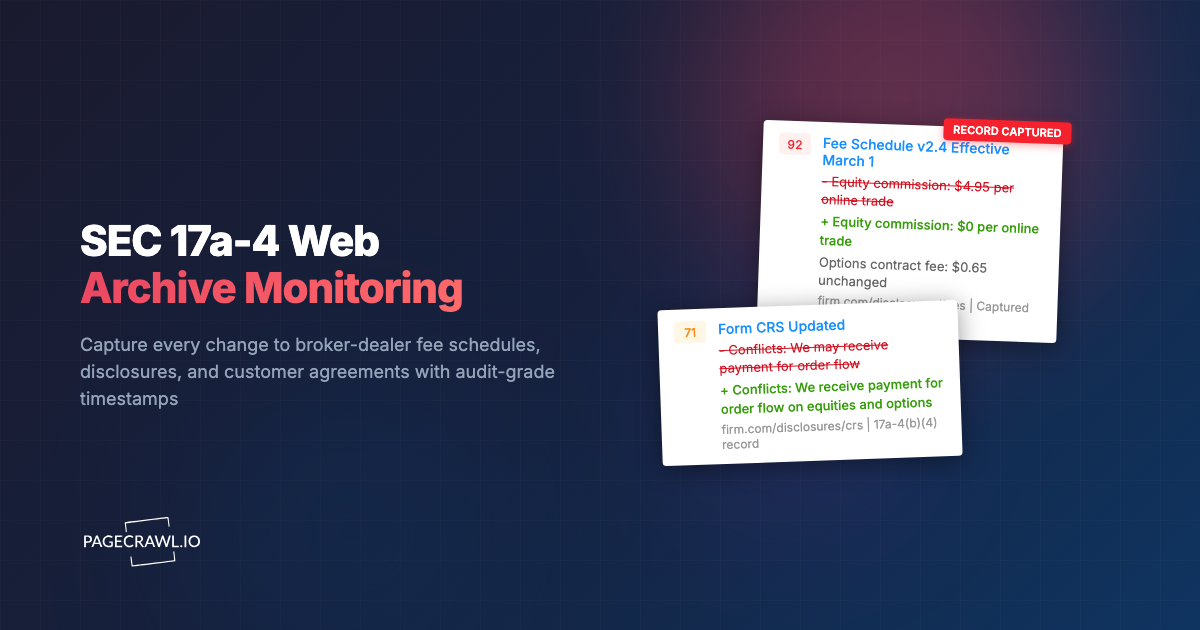
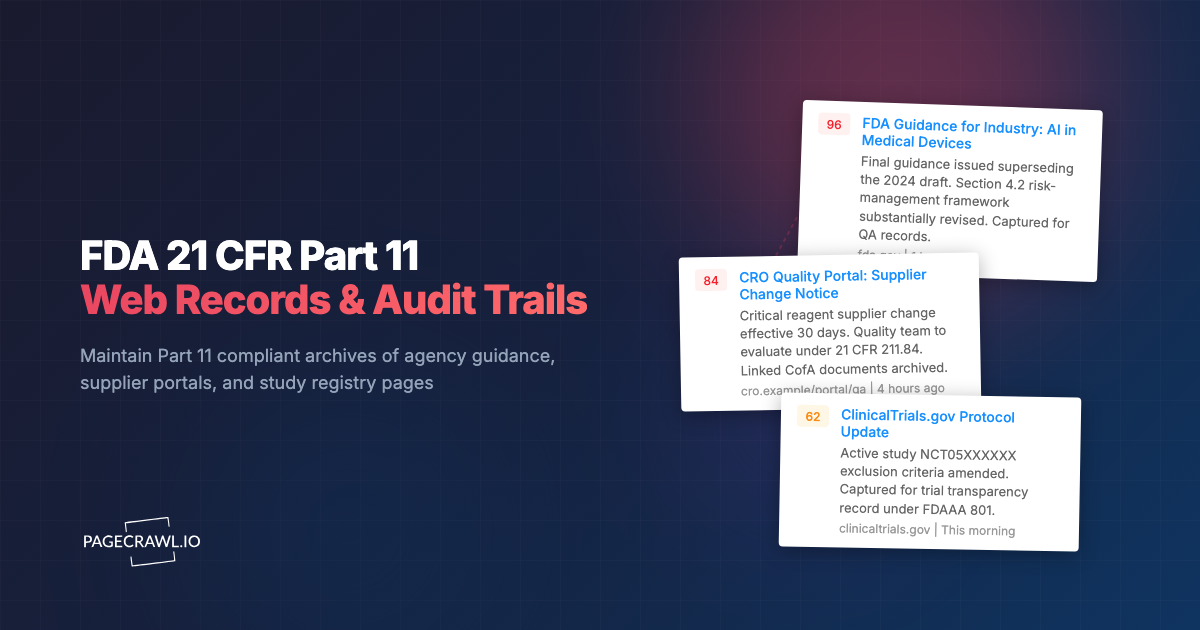
Available on Ultimate plans. Turn on WACZ archive capture for the pages that need an evidentiary record, one by one or for a whole workspace. Each detected change on an archived page produces an archive sealed by three independent providers, and Record every check can also keep the checks where nothing changed.
When a regulator quietly updates guidance and later denies it, the archive is the record.
Domain-identity signature
Each WACZ archive is signed with a Let's Encrypt certificate bound to the page's domain. The signature proves the bytes came from the page you were monitoring.
RFC 3161 timestamp
A cryptographic timestamp from a commercial Trust Service Provider attests the exact moment the archive was sealed. No PageCrawl trust required.
Bitcoin blockchain anchor
OpenTimestamps anchors a hash of the archive in the Bitcoin blockchain. Any modification, even a single byte, invalidates all three seals at once.
Optional eIDAS qualified RFC 3161 timestamps from a QTSP on the EU Trusted List available on Custom plans (Article 41 legal presumption). See how WACZ archives work →
Why Teams Choose PageCrawl
Cross-jurisdictional coverage
Track US federal agencies, state regulators, EU institutions, UK FCA and PRA, APAC bodies, and international standards organizations from one workspace. No per-jurisdiction add-ons.
AI synthesis, not just diffs
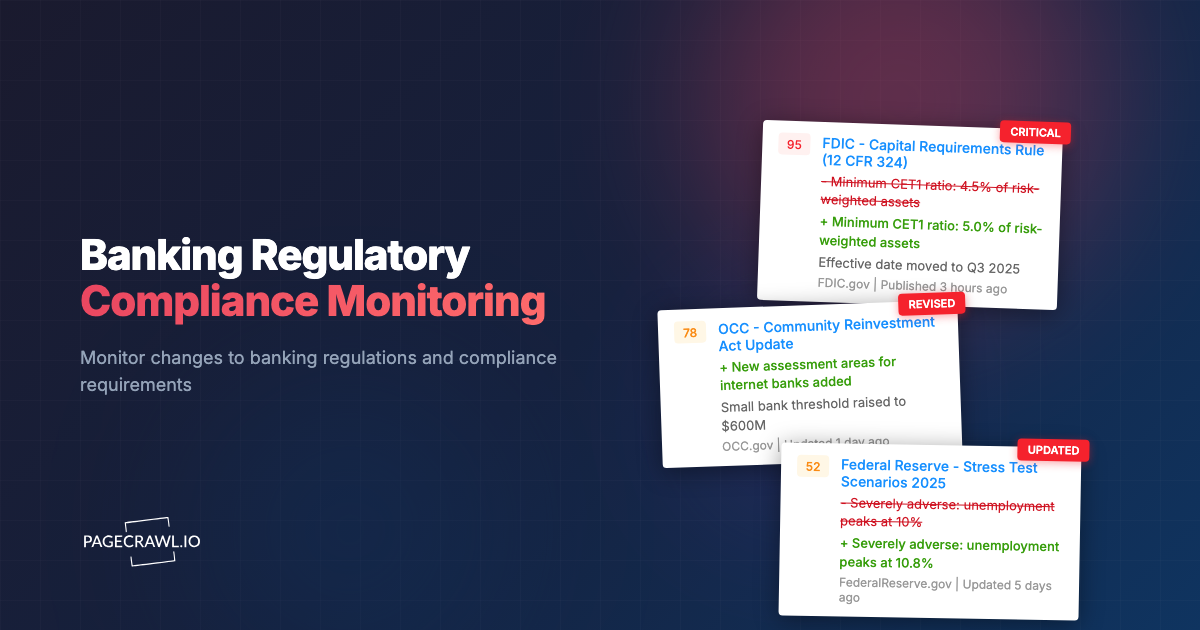
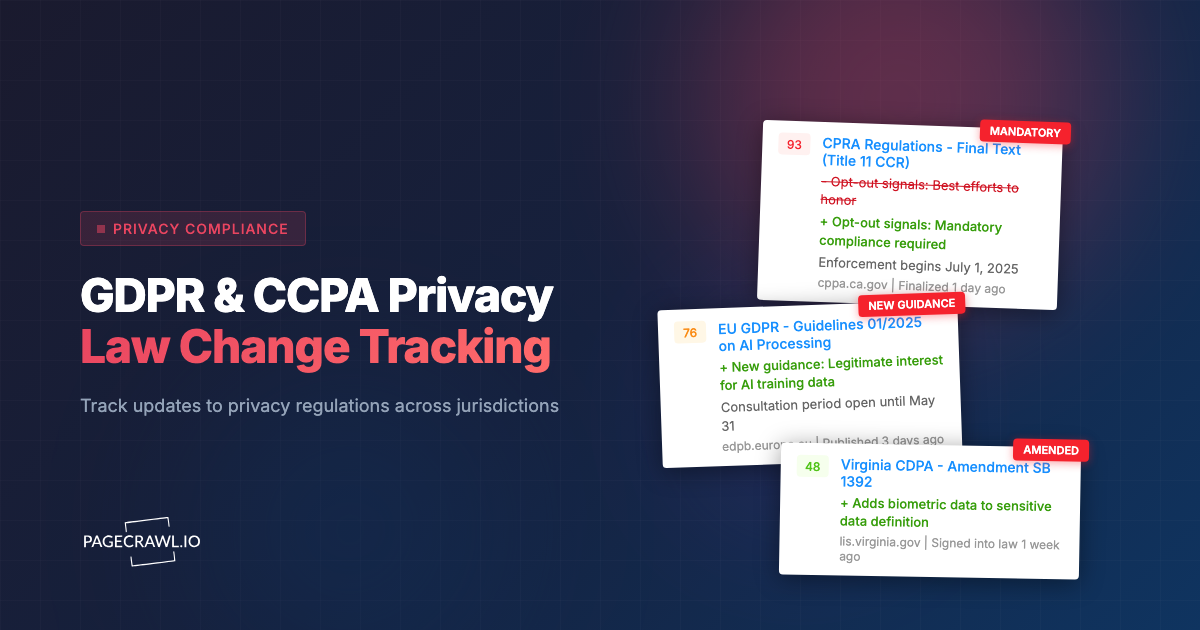
Every detected change comes with a plain-language summary explaining what shifted and why it matters for your practice area. Importance scoring filters routine updates from substantive moves.
Tune to your portfolio
Workspace instructions tell PageCrawl what your team actually cares about. Summaries and priority scores adapt to match. The same agency page produces a different brief for a banking team than a healthcare team.
Weekly digest your team will read
Daily, weekly, or monthly digests grouped by theme and ranked by importance. Send them to your policy team, an exec, or a client. White-label or share read-only with stakeholders.
Beyond web pages
Monitor PDFs, Excel files, and Word documents that agencies publish. When a guidance document or rulemaking PDF is replaced, you hear it from PageCrawl, not from the trade press.
Review boards for committee sign-off
Move detected changes through Kanban-style review boards. Compliance, legal, and policy teams mark items reviewed, attach internal notes, and produce a clean record for the next committee meeting.
Cross-Jurisdictional Policy Briefs Your Team Will Actually Read
Regulatory affairs teams used to spend Monday mornings flipping through EDPB updates, ESA joint opinions, FDA guidance dockets, and Federal Register entries by hand. PageCrawl produces a single digest grouped by jurisdiction and topic, with importance scoring tuned to your portfolio. High-priority items still get an alert of their own; the weekly brief gives the wider team enough context to know what to bring forward at the next committee.
AI-written briefings, 8 stylesPick the style each audience prefers: headline, patterns, action briefing, detailed, bullets, changelog, risk assessment, or brief.
Group by tag, folder, or domainOne report for competitor pricing, another for compliance pages, another for product launches.
Daily, weekly, or monthly cadenceEach audience picks the rhythm that fits. Marketing on Mondays, legal on the first of the month.
Deliver to anyoneEmail digests to stakeholders, clients, or execs. No PageCrawl account required for recipients.
Print-ready briefingsEvery digest is print-optimized. Open it, hit print, and you have a clean briefing for board decks or quarterly reviews.
PDF and Excel exportExport any digest as PDF or Excel for archives, audits, or pasting straight into a deck.
Comments and feedback inlineStakeholders can flag noise, ask questions, or escalate items without leaving the digest.
Priority escalation channelsHigh-priority changes still hit Slack, Teams, email, Discord, Telegram, and webhooks without waiting for the next digest.
Built For
In-house counsel
Track regulators relevant to your products, contracts, and disputes without hiring an external monitoring service.
Government relations
Watch legislators, executive agencies, and political committees across the jurisdictions you lobby. Build briefs in minutes, not days.
Regulatory affairs
Monitor FDA, EMA, MHRA, Health Canada, TGA and the agencies your products clear. Detect new guidance, draft rules, and enforcement actions on the day they post.
Policy and ESG teams
Horizon-scan emerging policy themes (AI governance, climate disclosure, supply chain due diligence) across every body that publishes.
Frequently Asked Questions
Other Use Cases
Competitive Intelligence→Price & Stock Monitoring→Compliance & Regulatory→Banking Intelligence→Legal & Court Monitoring→Media Monitoring→Investment Intelligence→SEO Monitoring→Brand & Reputation→Website QA & Regression→API & Docs Monitoring→Government & Public Records→Legal & Policy Tracking→Job Listings→Product Pages→Real Estate Listings→Supply Chain→News & Media→Content Monitoring→Patent Filings→Stock Availability→Event Schedules→Regulatory Filings→Academic Research→Travel & Flights→Release Notes→Grants & Funding→
How It Works
1
Add any URL: pages, prices, numbers, PDFs, login-walled portals
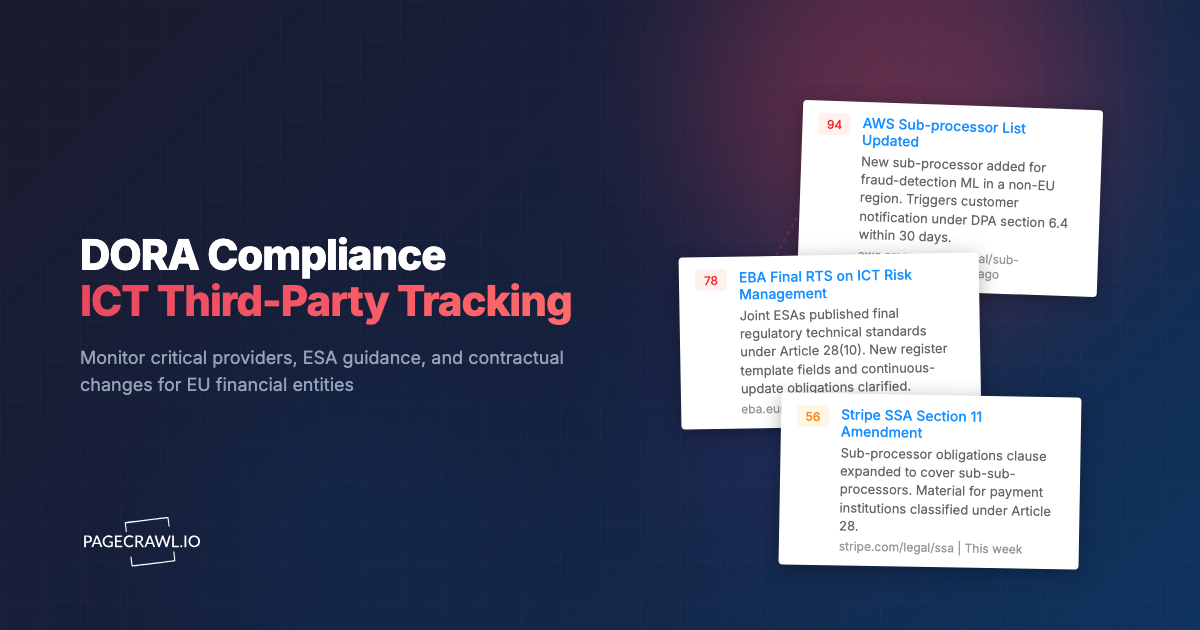
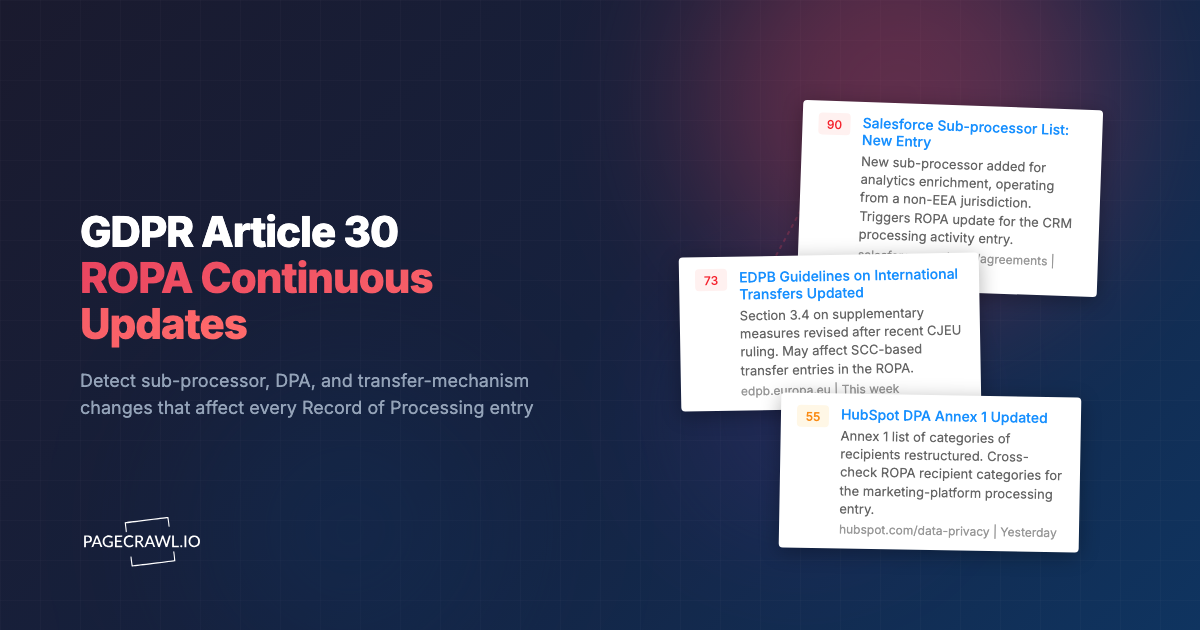
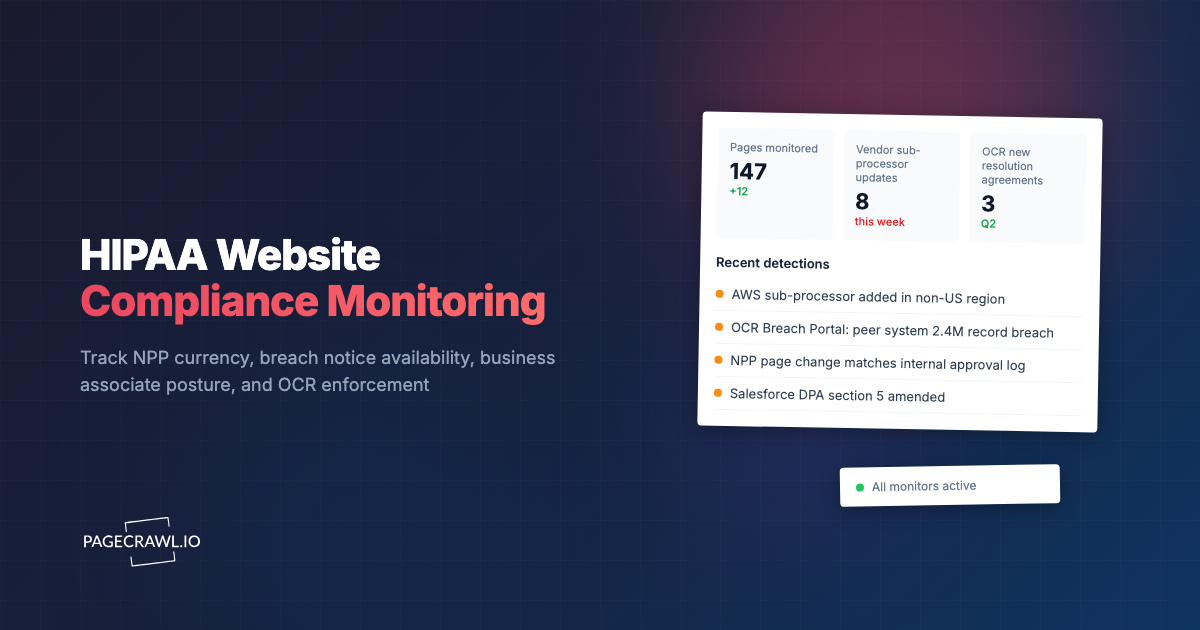
Paste a competitor page, a vendor DPA, a product listing, or a government docket. PageCrawl handles JavaScript-heavy pages, cookie banners, login walls, and PDFs out of the box. Track the whole page, a specific element, a price, a stock status, or a number. The choice is yours per monitor.
2
PageCrawl detects what changed and how much it matters
For text-heavy pages, an AI summary explains in plain English what shifted and assigns a 0 to 100 importance score. For numbers, prices, and stock counts, you get the raw value, no summary needed. Pick what makes sense per monitor; AI is on tap when you want it, off when you do not.
3
Alerts only when something is actually urgent
Time-sensitive changes (price drops, restocks, new filings) hit Slack, Teams, email, Discord, Telegram, or webhook. Less urgent changes (terms updates, content drift) skip the ping and wait for the morning digest. You decide which folders and tags trigger which channels.
4
Roll the rest up into reports stakeholders actually read
Changes that do not need an alert of their own flow into AI-written digests grouped by tag, folder, or domain. Daily for ops, weekly for marketing, monthly for compliance. Each audience picks the cadence and report style (patterns, action briefing, risk assessment, or six others) that fits how they work.
Start monitoring for free
6 monitors, 220 checks/month, all integrations included. No credit card required.