The European Data Protection Board published updated guidelines on consent under GDPR on a Thursday afternoon in March. The guidelines clarified that cookie walls, where a website blocks access unless the user accepts all cookies, are not valid forms of consent. Companies relying on cookie walls had a narrow window to update their consent mechanisms before enforcement actions followed. The organizations that knew about the change the day it was published had weeks to adapt. The ones that discovered it during an audit months later faced fines and rushed remediation.
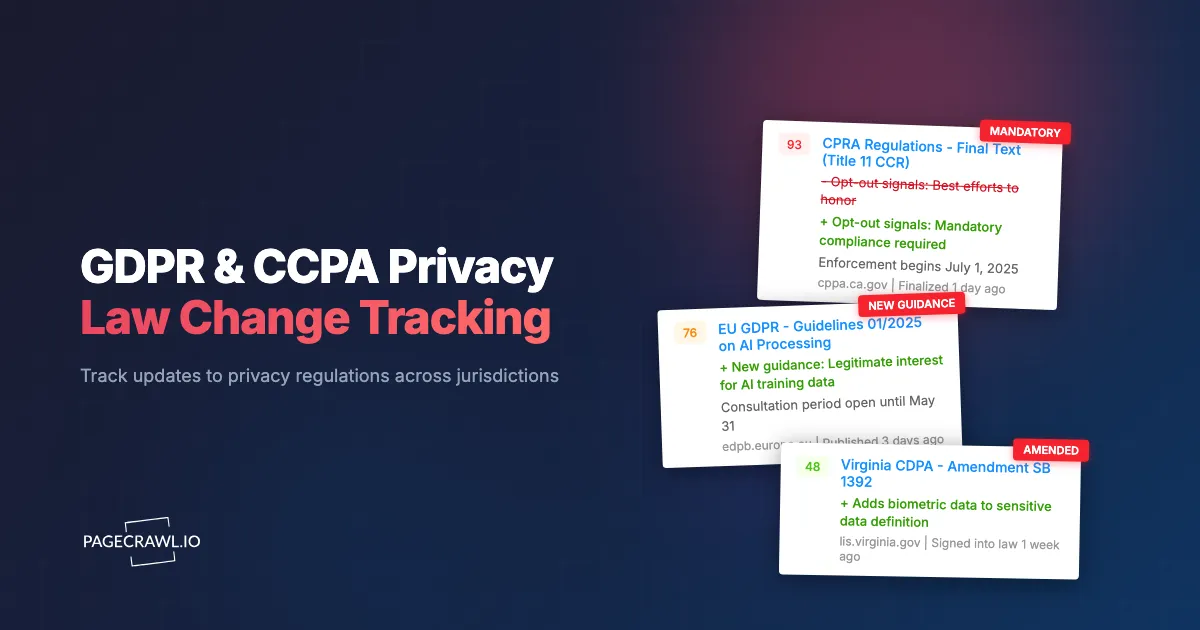
Privacy law is moving faster than most organizations can track it manually. GDPR has generated thousands of pages of guidance, enforcement decisions, and regulatory opinions since taking effect in 2018. California's CCPA was amended by CPRA, with new rulemaking that continues to evolve. Meanwhile, new privacy laws are emerging across US states, South American countries, and the Asia-Pacific region at a rate that makes it impossible for any individual to monitor every relevant source.
The challenge is not just volume. Privacy regulations are published across dozens of separate websites, in multiple languages, by regulatory authorities with different publishing schedules and formats. A company operating in the EU, US, and Asia-Pacific might need to monitor 20 or more regulatory authority websites to maintain compliance.
This guide covers the global privacy law landscape, which regulatory sources to monitor, how to set up automated tracking for privacy law changes across jurisdictions, and how to build workflows that translate monitoring alerts into compliance action.
What does the global privacy law landscape look like?
It is four overlapping layers: GDPR and the guidance built on top of it in the EU, California's CCPA as amended by CPRA, a growing patchwork of other US state laws, and a widening set of national regimes from Brazil to India. Understanding that scope helps you prioritize monitoring. Here is the current state of the major frameworks.
GDPR (European Union)
The General Data Protection Regulation remains the most comprehensive and influential privacy law globally. It applies to any organization that processes personal data of EU residents, regardless of where the organization is based.
GDPR itself is a fixed legal text, but the regulatory environment around it is constantly evolving:
European Data Protection Board (EDPB) guidelines. The EDPB publishes binding guidelines on GDPR interpretation. These guidelines clarify how specific provisions apply in practice: consent requirements, data transfer mechanisms, data protection impact assessments, and more. When the EDPB publishes new guidelines, they effectively create new compliance obligations even though the underlying regulation text has not changed.
National Data Protection Authority (DPA) decisions. Each EU member state has its own DPA that enforces GDPR within its jurisdiction. DPA enforcement decisions create precedent and reveal enforcement priorities. The Irish DPC's decisions on Big Tech companies, France's CNIL guidance on cookies, and Germany's state-level DPA actions all create compliance implications.
Court decisions. EU courts, particularly the Court of Justice of the European Union (CJEU), issue rulings that reshape GDPR interpretation. The Schrems II decision invalidated the EU-US Privacy Shield and transformed international data transfer practices overnight. Monitoring court decisions and dockets is as important as monitoring regulatory guidance.
Adequacy decisions. The European Commission's adequacy decisions determine which non-EU countries have privacy protections sufficient for data transfers. Changes to adequacy status (like the transition from Privacy Shield to the EU-US Data Privacy Framework) directly affect how companies transfer data internationally.
CCPA/CPRA (California)
California's privacy law has gone through significant evolution:
CCPA (2018). The California Consumer Privacy Act established baseline privacy rights for California residents: the right to know, delete, and opt out of the sale of personal information.
CPRA (2020 ballot measure, effective 2023). The California Privacy Rights Act amended and expanded CCPA significantly. It created the California Privacy Protection Agency (CPPA), added the right to correct and the right to limit sensitive personal information use, and introduced new data minimization requirements.
CPPA rulemaking. The California Privacy Protection Agency continues to issue regulations that interpret and implement CPRA. Final rulemaking on automated decision-making, cybersecurity audits, and risk assessments adds new compliance requirements. Each new rulemaking round creates obligations that were not in the original statute. Always confirm the operative text on the regulator's own page; this article is informational, not legal advice.
Attorney General enforcement. California's Attorney General enforces CCPA/CPRA alongside the CPPA. Enforcement actions and opinion letters reveal how the law is being applied in practice.
US State Privacy Laws
The US privacy landscape has fragmented into a growing patchwork of state laws:
Enacted and effective. Virginia (VCDPA), Colorado (CPA), Connecticut (CTDPA), Utah (UCPA), Texas (TDPSA), Oregon (OCPA), Montana (MCDPA), Iowa (ICDPA), Delaware, New Hampshire, New Jersey, Nebraska, Tennessee, Minnesota, and Maryland have all enacted comprehensive privacy laws with varying effective dates and requirements.
Pending and proposed. Additional states have privacy bills in various stages of the legislative process. New laws continue to pass each legislative session.
Each state law has its own definitions, thresholds, rights, and enforcement mechanisms. While many share common elements, the differences create compliance complexity. Monitoring legislative activity across all 50 states is essential for organizations with a national US presence.
International Privacy Laws
Privacy regulation extends well beyond the EU and US:
Brazil (LGPD). Brazil's General Data Protection Law is modeled on GDPR and enforced by the ANPD (National Data Protection Authority). The ANPD continues to publish implementing regulations and guidance.
China (PIPL). China's Personal Information Protection Law imposes strict requirements on cross-border data transfers and has significant penalties for non-compliance. Implementing regulations and sector-specific guidance continue to emerge.
Canada (PIPEDA and provincial laws). Canada's federal privacy law coexists with provincial privacy laws (Quebec's Law 25, Alberta's PIPA, BC's PIPA). Quebec's Law 25 introduced significant GDPR-like requirements.
India (DPDPA). India's Digital Personal Data Protection Act was passed in 2023, with implementing rules being developed.
Japan, South Korea, Australia, and others. Each has its own privacy framework with ongoing regulatory development.
What should you monitor for privacy law changes?
Four source types carry almost all the signal: regulatory authority publication pages, legislative trackers and bill status pages, enforcement decision sections, and guidance documents such as codes of conduct and FAQs. Effective privacy monitoring means tracking those four across every jurisdiction that applies to you.
Regulatory Authority Websites
Every privacy regulatory authority publishes guidance, decisions, and news on its website. These are your primary monitoring targets.
EDPB (edpb.europa.eu). Guidelines, opinions, consistency findings, and news. The EDPB's guidelines page is the most important single source for GDPR compliance teams.
National DPAs. Each EU member state DPA publishes on its own website:
- CNIL (France): cnil.fr
- BfDI (Germany): bfdi.bund.de
- DPC (Ireland): dataprotection.ie
- Garante (Italy): garanteprivacy.it
- AEPD (Spain): aepd.es
CPPA (California). cppa.ca.gov publishes proposed and final regulations, meeting agendas, and enforcement updates.
State Attorney General offices. For US state privacy laws, the state AG typically publishes enforcement actions, opinion letters, and guidance.
ANPD (Brazil). gov.br/anpd publishes LGPD implementing regulations and guidance in Portuguese.
CAC (China). The Cyberspace Administration of China publishes PIPL implementing regulations, though monitoring may require Chinese language capability.
Legislative Sources
New privacy laws start as legislative proposals. Monitoring legislative activity gives you advance warning of upcoming requirements.
US state legislatures. Track privacy bills across state legislatures. The International Association of Privacy Professionals (IAPP) maintains legislative tracking pages that aggregate this information.
EU legislative process. New EU digital regulations (the EU AI Act, Digital Services Act, Data Act) interact with GDPR and create additional compliance obligations. Monitor the European Commission and European Parliament for legislative proposals and amendments, including those affecting broader compliance regimes like the European Accessibility Act.
National legislatures. Countries considering new privacy laws or amendments to existing ones publish legislative activity through their parliamentary websites.
Enforcement Decisions
Enforcement decisions reveal how regulators interpret and apply privacy laws in practice.
GDPR enforcement tracker. Several organizations track GDPR fines and enforcement decisions across EU DPAs. Monitor these aggregation pages or the individual DPA enforcement sections.
CCPA/CPRA enforcement. California publishes enforcement actions through both the CPPA and the Attorney General's office.
International enforcement. Major privacy enforcement actions from any jurisdiction can signal trends that affect compliance priorities globally.
Guidance Documents
Regulatory authorities publish guidance that clarifies how they interpret and apply privacy laws:
Codes of conduct. Industry-specific codes approved by DPAs that detail how GDPR applies to particular sectors.
FAQs and opinions. Regulatory authorities publish answers to common questions that reveal their enforcement perspective.
Technical guidance. Recommendations on specific compliance mechanisms (encryption standards, anonymization techniques, DPIA methodologies).
Setting Up PageCrawl for Privacy Law Monitoring
PageCrawl monitors regulatory authority web pages and alerts you when content changes. Here is how to build a comprehensive privacy monitoring system.

Building Your Monitoring List
Start by identifying which jurisdictions matter to your organization. A company that processes EU personal data and operates in California needs at minimum:
- EDPB guidelines and news page
- Relevant national DPA pages (at least the DPA for your EU establishment and the DPAs for jurisdictions where you have significant activity)
- CPPA rulemaking and news page
- California AG privacy enforcement page
A global company adds: 5. Additional EU DPA pages for each country of operation 6. US state AG pages for states where relevant privacy laws apply 7. International authority pages (ANPD, CAC, etc.) as applicable
For a mid-size company operating in the EU and US, 15-30 monitors typically covers the essential sources.
Configuring Monitors
Step 1: Add regulatory authority URLs. For each source, identify the specific page that lists new publications. This is typically a news page, guidelines page, or publications section rather than the homepage.
Step 2: Select content monitoring mode. Use fullpage content mode for regulatory pages. This tracks all text changes on the page, catching new publications, updated guidance, and modified content.
Step 3: Set check frequency. Regulatory authorities do not publish continuously. Most update their websites weekly or less. Daily checks are sufficient for most privacy monitoring. For critical sources during active rulemaking periods (when the CPPA is issuing new regulations, for example), increase to twice-daily checks.
Step 4: Configure notifications. Route privacy law alerts to the team responsible for compliance:
- Email or Slack for compliance team leads who need to triage every change
- Daily digest for broader team awareness
- Webhook to compliance management systems for automated tracking
For details on Slack integration for team-based monitoring, see our guide on website change alerts in Slack.
Step 5: Enable AI summaries. AI-generated change summaries are particularly valuable for regulatory monitoring. Instead of reading raw diff output to determine whether a page change is a new guideline or a minor website update, the AI summary tells you what changed in plain language: "New EDPB guidelines published on data portability" or "Updated FAQ section on cookie consent requirements."
Organizing Multi-Jurisdiction Monitoring
Use PageCrawl folders to organize monitors by jurisdiction:
Privacy Law Monitoring/
  EU (GDPR)/
    EDPB
    CNIL (France)
    ICO (UK)
    DPC (Ireland)
  US Federal/
    FTC Privacy
  US States/
    California (CPPA)
    Virginia
    Colorado
    [additional states]
  International/
    Brazil (ANPD)
    Canada
    [additional countries]
This structure makes it easy to see at a glance which jurisdictions have recent changes and to delegate review to regional compliance leads. The help article on organizing monitored pages with labels, folders, and workspaces covers how to nest folders and keep separate settings per jurisdiction.
Monitoring Plan Considerations
PageCrawl's free plan includes 6 monitors. For basic privacy monitoring (EDPB, CPPA, ICO, and a few key DPA pages), this may be sufficient. For comprehensive multi-jurisdiction monitoring, the Standard plan at $80/year supports 100 monitors, enough for thorough coverage across the EU, US, and several international jurisdictions. The Enterprise plan at $300/year supports 500 monitors, providing capacity for global coverage including all EU member state DPAs and dozens of international authorities.
Monitoring for New US State Privacy Laws
The US state privacy law landscape changes with each legislative session. Monitoring for new laws requires tracking legislative activity, not just enacted regulations.
Legislative Tracking Sources
IAPP legislative tracker. The International Association of Privacy Professionals maintains a comprehensive US state privacy legislation tracker. This page aggregates bill status across all 50 states and is one of the most efficient single-page monitoring targets for US privacy legislation.
State legislature websites. For states where privacy legislation is actively progressing, monitor the bill's status page on the state legislature website. These pages update when bills advance through committees, receive amendments, pass votes, or are signed into law.
National Conference of State Legislatures (NCSL). NCSL tracks privacy legislation across states and publishes summary pages that are useful monitoring targets.
Prioritizing State Monitoring
You cannot monitor every state legislature website simultaneously (there are 50 of them, each with potentially dozens of privacy-related bills). Prioritize based on:
States where you have significant operations or customers. Privacy laws typically apply based on the number of state residents whose data you process.
States with advanced legislation. Bills that have passed committee or received bipartisan support are more likely to become law.
States following established models. Many state privacy laws follow the "Virginia model" or "California model." Understanding which model a state follows helps predict the law's requirements before it passes.
Building a Privacy Compliance Update Workflow
Monitoring alerts are only valuable if they trigger appropriate action. Build a workflow that processes privacy law changes systematically.
Triage Process
When a monitoring alert arrives:
Classify the change. Is it a new guideline, an enforcement decision, a legislative update, or a minor website edit? AI-generated change summaries help with initial classification.
Assess relevance. Does this change affect your organization? Not every GDPR guideline applies to every company. A guideline on genetic data processing is irrelevant if you do not process genetic data.
Determine urgency. Some changes require immediate action (enforcement decisions against similar companies, new transfer mechanism requirements). Others are informational (general guidance updates that confirm existing practices).
Assign ownership. Route the change to the person or team responsible for that jurisdiction or subject matter. A CNIL decision on cookies goes to the consent management lead. A new US state law goes to the legal team for analysis.
Impact Assessment
For changes classified as relevant:
Map to existing compliance. Which of your current policies, processes, or technologies does this change affect?
Identify gaps. Where does your current compliance fall short of the new requirements?
Estimate effort. How much work is needed to close the gaps? Technical changes, policy updates, training, vendor coordination?
Set timeline. When does the change take effect? What is the enforcement deadline? Work backward to establish your implementation schedule.
Documentation and Audit Trail
Maintain records of:
- When each change was detected (monitoring alert timestamp)
- Who reviewed the change and when
- The assessment outcome (relevant/not relevant, action required/no action)
- Actions taken and completion dates
This documentation demonstrates a proactive compliance posture during regulatory audits and investigations. PageCrawl's change history provides the detection timestamp and page content at the time of change, creating a foundation for this record. For privacy compliance teams that need to preserve an exact copy of a regulatory page at a specific point in time, PageCrawl can enable WACZ archiving for your account on request, capturing the full page as a web archive file. WACZ files are self-contained, verifiable records of what a page looked like and contained at the time of capture. This is especially valuable for documenting regulatory guidance that may later be revised or withdrawn, giving your legal team a defensible record that goes beyond screenshots.
For broader approaches to website archiving and compliance documentation, see our guide on website archiving.
Combining Privacy Law Monitoring with Vendor Monitoring
Privacy compliance extends beyond your own organization to your vendors and subprocessors.
Subprocessor List Monitoring
Under GDPR, data controllers must be informed when processors engage new subprocessors. Many SaaS vendors maintain public subprocessor lists that they update when adding new partners.
Monitor your key vendors' subprocessor list pages. When a vendor adds a new subprocessor, PageCrawl detects the change and alerts you. This gives you the opportunity to review the new subprocessor and exercise any contractual rights (like objection rights under Standard Contractual Clauses) within required timeframes.
Vendor Privacy Policy Monitoring
Your vendors' privacy policies describe how they handle data. Changes to these policies can affect your own compliance obligations. Point terms of service and privacy policy tracking at your critical vendors (cloud providers, analytics tools, CRM systems, payment processors) to catch changes that affect your data processing agreements.
For detailed guidance on monitoring privacy policies and terms of service, see our guide on monitoring privacy policy and terms of service changes and the help article on monitoring vendor Terms of Service and Privacy Policy pages for compliance.
Data Processing Agreement (DPA) Updates
Vendors periodically update their DPAs. These updates may change data processing terms, add new jurisdictions, modify security commitments, or adjust liability provisions. Monitor vendor legal pages where DPAs and HIPAA business associate agreements are published for changes that require your review and potentially updated contractual arrangements.
Why should you monitor privacy enforcement decisions?
Because enforcement is where abstract statutory language becomes a concrete requirement. A fine tells you which practices a regulator considers unlawful, what it treats as a proportionate penalty, and where it is focusing next. Privacy enforcement decisions from any jurisdiction can signal compliance priorities that affect your organization globally.
Why Enforcement Monitoring Matters
Enforcement decisions reveal:
Regulatory priorities. If a DPA issues multiple fines for inadequate cookie consent mechanisms in a quarter, that signals heightened enforcement focus on consent practices. Organizations should prioritize their own consent compliance.
Interpretation precedent. How a regulator applies a vague statutory provision in an enforcement decision clarifies what compliance requires in practice. The CNIL's cookie consent enforcement actions, for example, established specific requirements for consent banner design that were not spelled out in the GDPR text.
Penalty benchmarks. Enforcement decisions reveal what regulators consider proportionate penalties for different violation types. This informs risk assessment and helps prioritize compliance investments.
Cross-jurisdiction influence. Major GDPR enforcement decisions influence how other jurisdictions approach similar issues. The EU's stance on international data transfers has shaped privacy law development globally.
Setting Up Enforcement Monitoring
Monitor enforcement-specific pages on regulatory authority websites:
- EDPB's consistency decisions page
- Individual DPA enforcement and decisions sections
- CPPA enforcement actions page
- FTC privacy enforcement page
- International enforcement pages for relevant jurisdictions
Use keyword filters to focus on enforcement decisions relevant to your industry or data processing activities. Terms like your industry name, specific processing activities (profiling, automated decision-making, cross-border transfers), or technology types (cookies, tracking, biometrics) help filter enforcement decisions to those most relevant to your organization.
Practical Monitoring Configurations
Small Company (EU + US Focus)
- EDPB guidelines page
- ICO (UK) guidance and enforcement page
- CPPA (California) rulemaking page
- One or two DPA pages for key EU jurisdictions
- IAPP US state privacy law tracker
Total: 5-8 monitors. Fits within PageCrawl's free plan (6 monitors) or just above it.
Mid-Size Company (Multi-Jurisdiction)
- EDPB guidelines and news
- 5-8 national DPA pages for jurisdictions of operation
- CPPA and California AG
- 3-5 US state AG or legislative pages
- IAPP legislative tracker
- 2-3 international authority pages
- 3-5 vendor subprocessor list pages
Total: 20-30 monitors. The Standard plan at $80/year covers this comfortably.
Global Enterprise
- EDPB full monitoring (guidelines, opinions, news)
- All relevant EU DPA pages (20+)
- CPPA, California AG, FTC
- All enacted US state privacy law enforcement pages (15+)
- Legislative tracking for pending state laws (5-10)
- International authorities (10+)
- Vendor subprocessor and policy pages (20+)
- Industry-specific regulatory pages
Total: 80-150+ monitors. The Enterprise plan at $300/year supports this scale.
For integration with compliance management systems, use webhooks to automatically create tickets or tasks when privacy law changes are detected. See our guide on webhook automation for website changes.
Tips for Privacy Teams at Scale
Assign Regional Leads
In organizations with global operations, assign regional compliance leads who are responsible for monitoring their jurisdiction. Each lead receives alerts for their region and is responsible for triage, assessment, and escalation. This distributes the monitoring workload and ensures changes are reviewed by someone with regional expertise.
Maintain a Regulatory Inventory
Keep a living document that maps each privacy law and regulatory authority to:
- The specific pages being monitored
- The responsible reviewer
- The compliance status (compliant, in progress, gap identified)
- Last review date
This inventory serves as both a monitoring management tool and an audit-readiness document.
Schedule Periodic Reviews
Automated monitoring catches changes to pages you are already watching. It does not catch entirely new regulatory sources that emerge. Schedule quarterly reviews to:
- Assess whether new jurisdictions need to be added to monitoring
- Check for new regulatory authorities or websites that have launched
- Review whether monitoring is covering the right pages (regulatory authorities sometimes restructure their websites)
- Evaluate whether notification routing is still appropriate
Track Regulatory Comment Periods
Many privacy rulemaking processes include public comment periods. When proposed rules are published, there is typically a window (30-90 days) during which you can submit comments. Monitoring catches the publication of proposed rules, giving you time to participate in the comment process and influence the final outcome.
For broader regulatory compliance monitoring approaches beyond privacy, see our guide on regulatory compliance monitoring.
Choosing your PageCrawl plan
PageCrawl's Free plan lets you monitor 6 pages with 220 checks per month, which is enough to validate the approach on your most critical pages. Most teams graduate to a paid plan once they see the value.
| Plan | Price | Pages | Checks / month | Frequency |
|---|---|---|---|---|
| Free | $0 | 6 | 220 | every 60 min |
| Standard | $8/mo or $80/yr | 100 | 15,000 | every 15 min |
| Enterprise | $30/mo or $300/yr | 500 | 100,000 | every 5 min |
| Ultimate | $99/mo or $999/yr | 1,000 | 100,000 | every 2 min |
Annual billing saves two months across every paid tier. Enterprise and Ultimate scale up to 100x if you need thousands of pages or multi-team access.
A single GDPR or CCPA enforcement action costs more than years of monitoring subscriptions, and that is before legal fees or remediation. Standard at $80/year covers 100 regulatory pages, which is enough for thorough coverage of the EDPB, CPPA, key national DPAs, and the IAPP state tracker. Enterprise at $300/year scales to 500 pages for organizations monitoring all EU member state DPAs, US state enforcement offices, and international authorities, with 5-minute checks and timestamped screenshots. All plans include the PageCrawl MCP Server so your compliance team can ask Claude to summarize every change detected on a specific regulatory page over the last quarter and pull the exact diff, turning your monitoring history into a queryable audit trail rather than a backlog of alert emails. AI assistants can create monitors through conversation on every plan, including Free.
Getting Started
Start with the privacy authorities most relevant to your organization. If you process EU personal data, begin with the EDPB guidelines page. If you operate in California, add the CPPA rulemaking page. Create a free account, add those URLs with content monitoring, and configure email or Slack notifications. PageCrawl's free plan includes 6 monitors, enough to cover the most critical privacy authority pages for a focused compliance monitoring program. Expand to additional jurisdictions and vendor monitoring as your program matures.