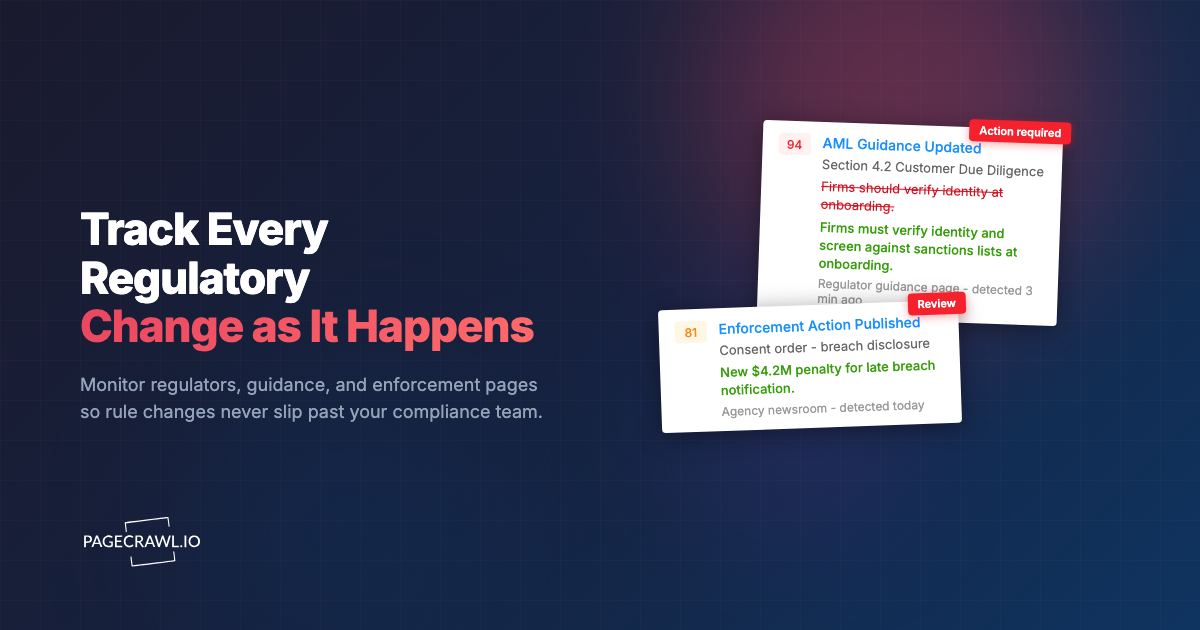
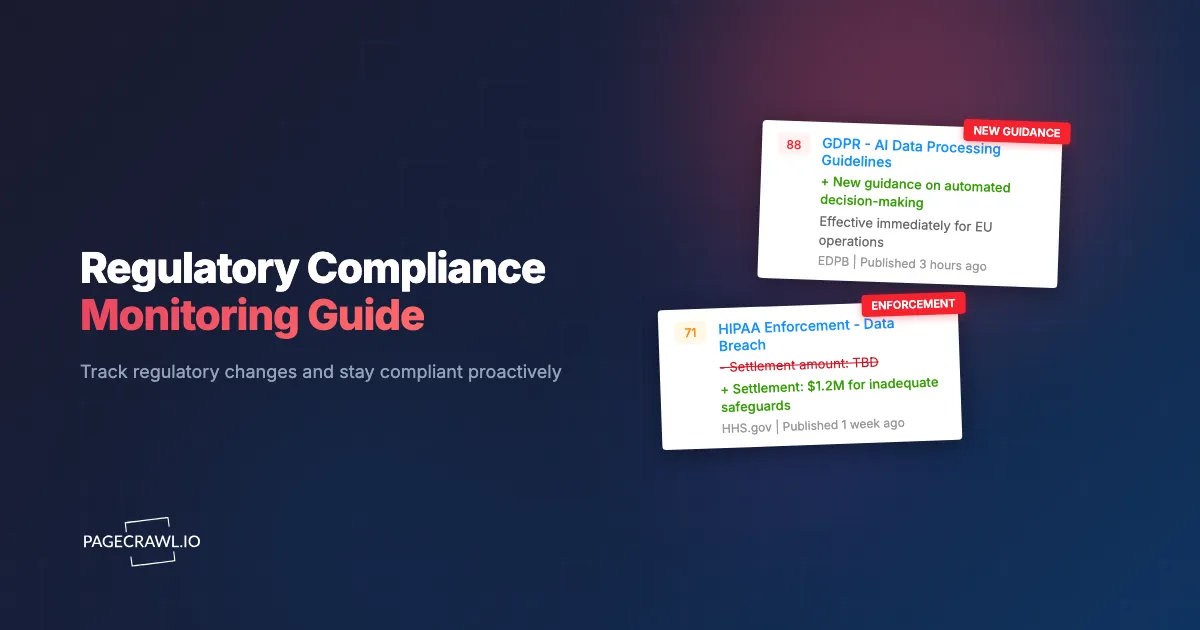
A new regulation gets published. Your compliance team finds out three weeks later when a client asks about it. The scramble begins: reading the full text, assessing the impact, updating internal policies, retraining staff, and modifying systems. All under time pressure that could have been avoided with earlier detection.
This scenario plays out constantly across regulated industries. Financial services, healthcare, pharmaceuticals, insurance, energy, and technology companies all face a growing volume of regulatory changes from multiple authorities. The FDA, SEC, FCA, GDPR supervisory authorities, state legislatures, and dozens of other bodies publish updates on their own schedules, in their own formats, on their own websites.
Manual monitoring of all these sources is not sustainable. Compliance teams that rely on periodic manual checks inevitably miss changes or discover them too late. Automated monitoring catches regulatory updates as they are published, giving your team the maximum time to assess and respond.
Why does regulatory change monitoring matter?
It matters because regulators do not tell you when they change something. Rules, guidance, and enforcement positions land on agency websites on the agency's schedule, and the cost of finding out late (fines, rushed remediation, audit findings) is far higher than the cost of watching the page.
The Volume Problem
Regulatory output has increased dramatically. In the United States alone, the Federal Register publishes thousands of final rules, proposed rules, and notices each year. Add state-level regulations, international requirements, and industry-specific guidance, and a single company may need to track hundreds of regulatory sources.
No compliance team can manually check all these sources daily. Even weekly checks create gaps where important changes go unnoticed for days.
The Cost of Missing Changes
Late discovery of regulatory changes leads to measurable costs:
- Compliance violations and fines: Regulators expect organizations to be aware of new requirements. "We didn't know" is not an accepted defense
- Rushed implementation: Discovering a change late compresses the timeline for achieving compliance
- Audit findings: External auditors flag gaps in regulatory change management processes
- Competitive disadvantage: Competitors who track changes early can adapt faster and potentially gain market advantages
- Reputational damage: Compliance failures become public record and erode trust with clients and partners
Regulatory Requirements for Change Monitoring
Some regulatory frameworks explicitly require organizations to have systematic processes for tracking regulatory changes:
- ISO 27001: Requires monitoring changes to laws, regulations, and contractual obligations related to information security
- SOX (Sarbanes-Oxley): Requires companies to maintain effective internal controls, which includes staying current with regulatory requirements
- Basel III/IV: Banks must demonstrate they track and implement regulatory changes across their operations
- PCI DSS: Requires awareness of changes to security standards and timely implementation. See our detailed guide on PCI DSS 11.6.1 website change detection for payment page monitoring specifics
- GDPR: Data protection officers must monitor changes to data protection law and guidance

What should you monitor for regulatory changes?
Monitor three layers: the government and regulator websites that publish the rules themselves, the industry standards bodies whose requirements change independently of legislation, and the enforcement actions and guidance that reveal how existing rules are being interpreted in practice.
Government and Regulatory Body Websites
These are the primary sources of regulatory changes:
Federal level:
- The Federal Register for proposed and final rules
- Agency-specific pages (SEC.gov, FDA.gov, FTC.gov, CFPB, OSHA)
- Congressional legislation tracking pages
State level:
- State legislature websites for new bills and enacted laws
- State regulatory agency websites
- Attorney general guidance pages
International:
- The EU Official Journal on EUR-Lex
- UK statute on legislation.gov.uk and FCA regulatory updates
- Country-specific regulatory authority websites
Industry Standards Bodies
Many industries are governed by standards that change independently of government regulations:
- Financial services: SWIFT, ISDA, Basel Committee publications
- Healthcare: HL7, HIPAA guidance updates, CMS bulletins
- Technology: NIST publications, ISO standards updates
- Energy: NERC standards, EPA guidance documents
- Pharmaceuticals: ICH guidelines, WHO publications
Enforcement Actions and Guidance
Regulatory bodies publish enforcement actions and guidance documents that signal how they interpret existing rules, and court, docket, and enforcement monitoring covers the litigation side of the same picture. These are often as important as the rules themselves:
- Enforcement action announcements
- Guidance documents and FAQs
- Comment letters and no-action letters
- Staff bulletins and advisories
Method 1: Direct Website Monitoring
The most straightforward approach is to monitor the specific web pages where regulatory bodies publish updates.

Setting Up Regulatory Page Monitors
Step 1: Identify your regulatory sources
List every regulatory body and government agency that publishes rules affecting your business. Include both the main regulatory pages and any subsidiary pages for guidance, enforcement actions, and proposed rules.
Step 2: Create monitors for each source
For each regulatory source, create a PageCrawl monitor on the specific page where new content appears. This is typically a news page, updates page, or regulatory actions page rather than the homepage.
Step 3: Choose the right tracking mode
- Use "Content Only" mode for pages with navigation menus and sidebars. This filters out layout changes and only alerts you when the actual content changes
- Use "Full Page" mode for simple pages that are primarily text content
- Use element tracking for pages where regulatory updates appear in a specific section
Step 4: Set an appropriate check frequency
- Daily checks work for most regulatory sources. Regulations rarely change hourly
- Every 6 hours for high-priority sources during active rulemaking periods
- Weekly checks for stable sources that rarely publish updates
Step 5: Configure AI focus areas
Set the AI summary focus to something like: "Summarize any new regulatory actions, proposed rules, final rules, or guidance documents. Flag anything related to [your industry/topic]."
This helps you quickly assess whether a change is relevant to your organization without reading the full page diff. The guide to AI-powered change detection and smart filtering explains how focus areas shape the summary and how the importance score is presented.
Example: Monitoring the SEC
The SEC publishes regulatory actions across several pages:
- Final Rules: Monitor the SEC's final rules page to catch new regulations as they are adopted
- Proposed Rules: Monitor proposed rules to get early warning of upcoming changes
- Staff Guidance: Monitor interpretive releases and staff bulletins for guidance on how rules will be applied
- Enforcement Actions: Monitor the litigation releases page for enforcement trends
Create a separate PageCrawl monitor for each of these pages. Set daily checks with Slack notifications so your compliance team sees each update on the check that detects it.
Example: Monitoring GDPR Updates
For GDPR compliance, monitor multiple sources:
- The European Data Protection Board guidelines and opinions
- Your local Data Protection Authority (e.g., ICO for UK, CNIL for France)
- EUR-Lex for legislative changes to the GDPR text and related directives
- Court of Justice of the EU for relevant case law (Schrems decisions, etc.)
Method 2: Federal Register and Legislative Tracking
Government registers and legislative databases offer structured access to regulatory changes.
Federal Register Monitoring
The Federal Register is the official daily publication for US government rules, proposed rules, and notices. It covers all federal agencies.
What to monitor:
- The daily table of contents page for your relevant agencies
- Specific agency pages within the Federal Register
- Unified Agenda of Regulatory and Deregulatory Actions (published twice yearly)
Setting up monitoring: Create PageCrawl monitors on the Federal Register search results pages filtered by your relevant agencies. When a new rule or proposed rule appears, the monitor detects the change and sends an alert.
Using AI summaries effectively: Set the AI focus area to: "Summarize new rules and proposed rules. Include the agency name, rule title, effective date, and comment deadline if applicable."
This gives your compliance team a quick overview of each new entry without reading the full Federal Register notice.
State Legislature Monitoring
State legislatures publish bills, committee reports, and enacted laws on their websites. These pages change frequently during legislative sessions and less often during recesses.
Best approach:
- Monitor the "recently enacted" or "signed by governor" pages for each relevant state
- Monitor committee pages for bills in your industry area
- Adjust check frequency based on the legislative calendar (more frequent during sessions)
Method 3: Regulatory Newsletter and Announcement Pages
Many regulatory bodies maintain email newsletters and announcement pages. These are curated summaries of recent activity and are often easier to monitor than raw regulatory databases.
What Makes These Valuable
- Pre-filtered content: The regulatory body has already selected the most important updates
- Plain-language summaries: Newsletter content is typically more readable than raw regulatory text
- Timely publication: Newsletters are published on a regular schedule
- Archived online: Most newsletters are archived on the regulatory body's website
How to Set Up Monitoring
- Find the newsletter archive page on the regulatory body's website
- Create a PageCrawl monitor with "Content Only" tracking mode
- Set daily checks to catch new newsletter publications
- Enable AI summaries so each detected change arrives with a plain-language readout of what is new
This approach works well as a complement to direct regulatory page monitoring. The newsletters catch things you might miss, and the direct monitoring catches changes that don't make it into newsletters.
Method 4: Automated Compliance Feeds
Several specialized regulatory change management platforms aggregate regulatory content into feeds and databases. While these are valuable, they have limitations that web monitoring can address.
Limitations of Compliance Feed Services
- Coverage gaps: No single service covers every regulatory source relevant to every organization
- Delays: Feed services process and categorize content before publishing, introducing delays
- Cost: Enterprise compliance intelligence platforms are expensive
- Customization: Generic feeds include a lot of noise from irrelevant regulatory areas
Using Web Monitoring to Fill Gaps
Web monitoring complements compliance feed services by:
- Covering niche sources that feed services do not include (state-level agencies, foreign regulators, industry bodies). Domain monitoring can also help you track changes across an entire regulatory agency's web presence
- Catching changes faster since monitoring checks the source directly rather than waiting for a feed service to process it
- Monitoring the feed service itself to verify it is capturing all relevant changes
- Providing a safety net in case the feed service misses something
Building a Regulatory Monitoring Framework
Step 1: Create a Regulatory Source Inventory
Document every regulatory source relevant to your organization:
| Source | URL | Relevance | Priority | Check Frequency |
|---|---|---|---|---|
| SEC Final Rules | sec.gov/rules/final | Direct | High | Daily |
| FCA Handbook Updates | handbook.fca.org.uk | Direct | High | Daily |
| State AG Guidance | ag.state.xx.us | Indirect | Medium | Weekly |
This inventory becomes your monitoring setup checklist.
Step 2: Assign Ownership
Each regulatory source should have an assigned owner who:
- Reviews alerts when they come in
- Assesses relevance and impact
- Escalates to the appropriate team
- Tracks the change through to implementation
Step 3: Set Up Tiered Alerting
Not all regulatory changes need the same response time:
Per-change alerts (Slack/Teams), delivered on the check that detects the edit:
- Final rules from primary regulators
- Enforcement actions in your industry
- Compliance deadline changes
Routing these to a dedicated compliance channel takes a few minutes; see sending change notifications to a Slack channel for the incoming-webhook setup.
Daily digest (email):
- Proposed rules and comment periods
- Guidance document updates
- Standard body publications
Weekly summary:
- Legislative activity
- Industry body publications
- International regulatory trends
Step 4: Create a Change Assessment Process
When a regulatory change is detected:
- Triage: Is this change relevant to our operations? (Quick assessment within 24 hours)
- Impact analysis: What systems, processes, and policies are affected? (Within one week)
- Action plan: What changes do we need to make, and by when? (Within two weeks)
- Implementation: Execute the required changes
- Validation: Confirm changes are complete and effective
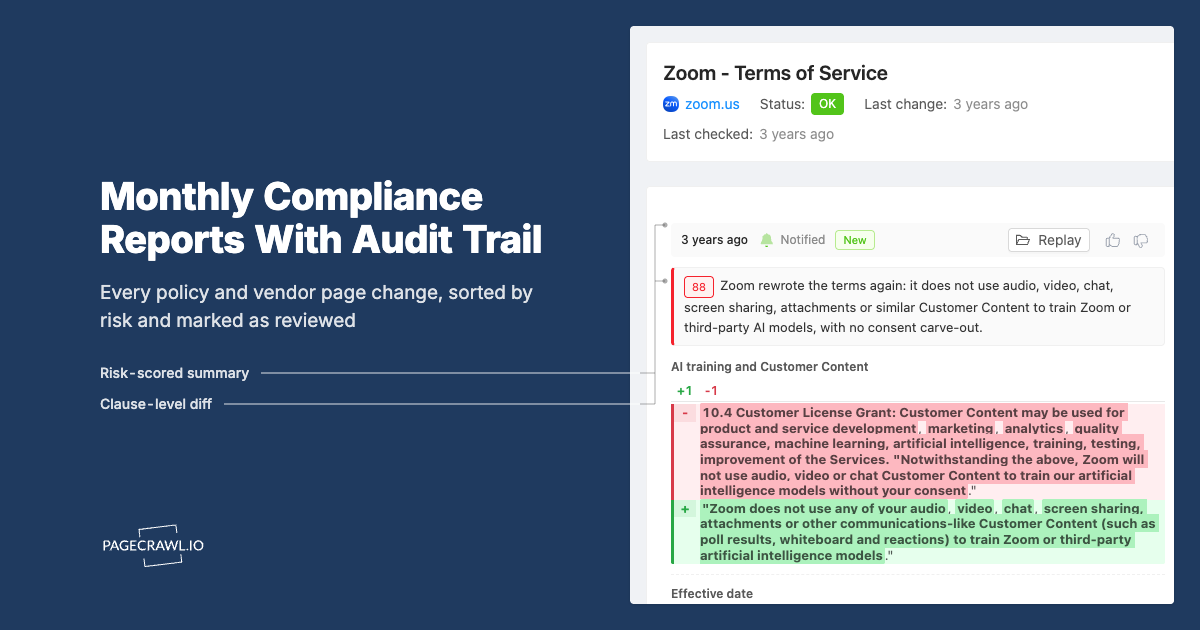
- Documentation: Record the change and response for audit purposes
Monitoring surfaces the edit and preserves the evidence. Always confirm the authoritative wording on the regulator's own page and involve qualified counsel before changing a policy or control; this article is informational, not legal advice.
Industry-Specific Monitoring Strategies
Financial Services
Financial institutions face regulation from multiple bodies simultaneously, which is the whole premise of banking and supervisory intelligence monitoring. A US bank might need to monitor:
- Federal Reserve Board publications
- OCC bulletins and guidance
- FDIC financial institution letters
- CFPB rules and guidance
- SEC rules (for broker-dealer activities)
- FINRA regulatory notices
- State banking department updates
- FinCEN advisories (anti-money laundering)
- OFAC sanctions updates
Monitoring strategy: Create a PageCrawl monitor for each of these sources. Use AI focus areas tailored to your specific activities (e.g., "Focus on changes related to consumer lending, BSA/AML, and capital requirements"). Set daily checks on primary regulators, weekly on secondary sources.
Healthcare
Healthcare organizations monitor:
- CMS Medicare and Medicaid updates
- FDA drug and device approvals and safety alerts
- HHS guidance and enforcement
- State health department regulations
- Joint Commission standards updates
- HIPAA guidance and enforcement actions
Monitoring strategy: Prioritize FDA safety alerts and CMS billing updates for the fastest check frequency. Use AI summaries to filter for your specific service lines.
Technology and Data Privacy
Technology companies face a growing web of privacy and data protection regulations:
- GDPR guidance and enforcement (EDPB, national DPAs)
- CCPA/CPRA updates (California AG)
- State privacy law developments (Virginia, Colorado, Connecticut, etc.)
- FTC enforcement actions and guidance
- NIST cybersecurity framework updates
- International privacy frameworks (APPI in Japan, LGPD in Brazil, PIPL in China)
Monitoring strategy: Privacy regulations are changing rapidly. Monitor the primary DPAs daily. Create monitors for each state that has enacted privacy legislation. Use AI focus areas to filter for data processing, consent, and cross-border transfer topics.
Pharmaceuticals
Pharmaceutical companies track:
- FDA drug approval and safety pages
- EMA regulatory decisions
- ICH guideline updates
- Clinical trial regulation changes
- Drug pricing and reimbursement policies
Monitoring strategy: FDA and EMA pages change frequently. Use element tracking to monitor specific sections rather than full pages to reduce noise.
How do you handle high-volume regulatory sources?
Narrow what you watch rather than how often you watch it. Four techniques do most of the work: AI focus areas that filter for your topics, monitoring pre-filtered search views instead of full listing pages, content-only tracking that strips page chrome, and a summary monitor on a curated industry news page.
Use AI Focus Areas
Set specific focus areas that filter for relevant changes. Instead of getting every FDA update, set the focus to: "Alert me about changes related to medical device regulations, specifically software as a medical device (SaMD) and AI/ML-based devices."
Monitor Filtered Views
Many regulatory websites offer filtered views or search results pages. Instead of monitoring the full updates page, monitor a pre-filtered view that only shows your relevant categories.
Use "Content Only" Mode
This mode strips navigation, sidebars, and other page chrome, focusing only on the main content area. This reduces false positives from layout changes.
Create Summary Monitors
In addition to individual source monitors, create a monitor for any regulatory news aggregation pages that cover your industry. These provide a curated view that catches important changes across multiple sources.
Documenting Your Monitoring Process
Auditors and regulators expect to see documented evidence of your regulatory monitoring process. Your documentation should include:
Monitoring Inventory
A complete list of all regulatory sources you monitor, including:
- The source name and URL
- Why this source is relevant to your organization
- Who is responsible for reviewing alerts
- How frequently it is checked
- When the monitor was last reviewed for accuracy
Change Response Records
For each regulatory change detected:
- Date the change was published
- Date your team was alerted
- Assessment of relevance and impact
- Actions taken in response
- Completion date and verification
A reliable website archiving workflow ensures these records are preserved with timestamped snapshots you can reference during audits, and teams that need audit-grade proof can turn on sealed web archives with independent timestamps on the Ultimate plan.
Process Reviews
Schedule quarterly reviews of your monitoring setup:
- Are all relevant sources still being monitored?
- Have any new regulatory bodies or requirements emerged?
- Are check frequencies appropriate?
- Are AI focus areas still relevant?
- Are the right people receiving alerts?
What are the most common regulatory monitoring pitfalls?
Five failure modes account for most broken compliance monitoring programs: monitoring too broadly, monitoring too narrowly, having no triage process, letting monitors go stale after site redesigns, and ignoring proposed rules that would have given you months of lead time.
Monitoring Too Broadly
Tracking every page on every regulatory website creates alert fatigue. Your compliance team stops reading alerts because most are irrelevant. Focus on the specific pages where actionable changes appear.
Monitoring Too Narrowly
Only tracking your primary regulator and missing changes from secondary bodies, industry standards, or related legislation. Cast a wide net initially, then refine based on what actually generates relevant alerts.
No Triage Process
Setting up monitoring without defining who reviews alerts and what the escalation process is. Alerts that nobody reads are worse than no monitoring at all because they create a false sense of security.
Stale Monitors
Regulatory websites get redesigned. URLs change. New regulatory bodies are created. Review your monitoring setup quarterly to ensure all monitors are still functioning and capturing the right content.
Ignoring Proposed Rules
Many teams only track final rules and miss the opportunity to comment on proposed rules or prepare for upcoming changes. Monitoring proposed rules gives you months of additional preparation time.
Choosing your PageCrawl plan
PageCrawl's Free plan lets you monitor 6 pages with 220 checks per month, which is enough to validate the approach on your most critical pages. Most teams graduate to a paid plan once they see the value.
| Plan | Price | Pages | Checks / month | Frequency |
|---|---|---|---|---|
| Free | $0 | 6 | 220 | every 60 min |
| Standard | $8/mo or $80/yr | 100 | 15,000 | every 15 min |
| Enterprise | $30/mo or $300/yr | 500 | 100,000 | every 5 min |
| Ultimate | $99/mo or $999/yr | 1,000 | 100,000 | every 2 min |
Annual billing saves two months across every paid tier. Enterprise and Ultimate scale up to 100x if you need thousands of pages or multi-team access.
Compliance monitoring pays for itself the first time it catches a regulatory change before your team would have found it manually. A single missed requirement that results in a fine, a rushed remediation project, or an audit finding can cost more in one afternoon than years of monitoring. Standard at $80/year covers 100 pages, enough to track your primary regulators, key guidance pages, and enforcement action feeds across multiple bodies. Enterprise at $300/year scales to 500 pages with timestamped screenshots, full change history, 5-minute checks, and SSO, which is exactly the kind of documentation an assessor expects to see as evidence of a systematic monitoring process.
All plans include the PageCrawl MCP Server, so your compliance team can ask Claude to summarize every detected change to a specific regulation over the past quarter and pull the exact diff, turning your monitoring archive into a queryable audit trail rather than a pile of email notifications. AI assistants can create monitors through conversation on every plan, including Free.
Getting Started
Start with these steps:
- List your top 10 regulatory sources: The government agencies, standards bodies, and regulatory authorities most relevant to your business
- Create PageCrawl monitors for each: Use "Content Only" mode, daily checks, and AI summaries focused on your industry
- Set up Slack or email notifications: Route alerts to your compliance team's channel
- Assign owners: Make sure someone is responsible for reviewing and acting on each alert
- Review after 30 days: Check which monitors are generating useful alerts, adjust focus areas, and add any sources you missed
This initial setup takes about an hour and gives you visibility into regulatory changes across your most important sources from the first round of checks onward. From there, expand your coverage based on what your compliance team needs.