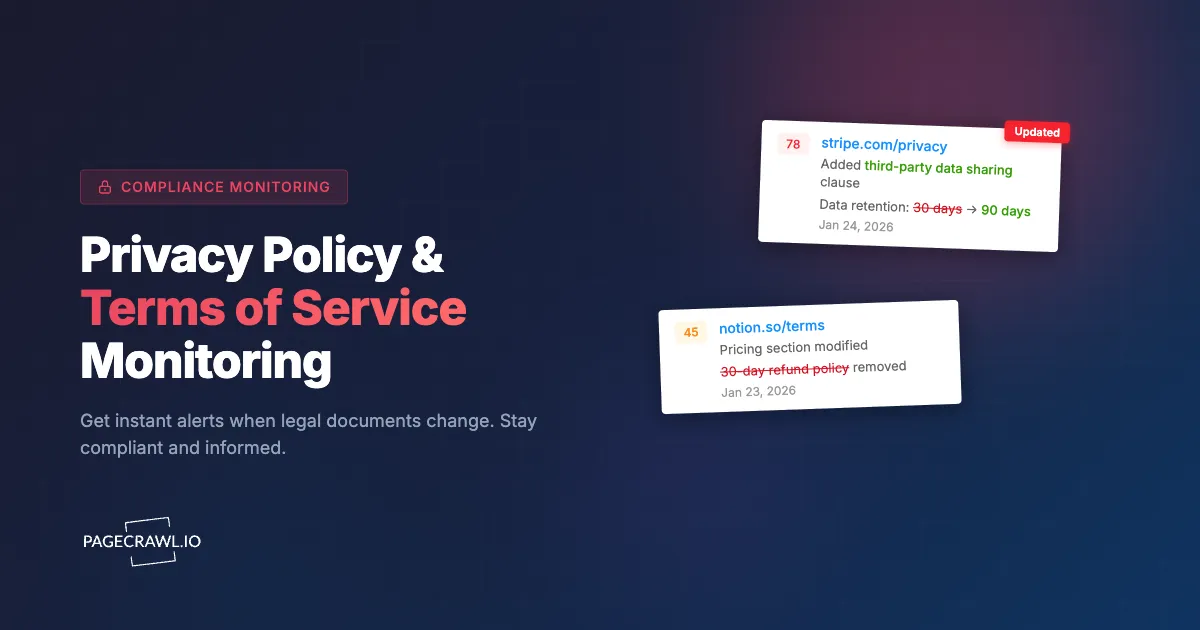
Stripe updated their privacy policy last month. Did you notice the new data sharing clause? Your cloud provider quietly changed their terms of service to limit liability. Did your legal team catch it? A vendor you rely on modified their acceptable use policy in ways that affect how you can use their API. Were you aware before your integration broke?
Most businesses miss these changes entirely. Legal documents update silently, buried in notification emails that get filtered or ignored. By the time someone notices, the grace period for objecting has passed, contracts have auto-renewed under new terms, or compliance gaps have emerged.
Privacy policies and terms of service aren't just legal boilerplate. They define what companies can do with your data, how disputes get resolved, what happens if services change, and your rights as a customer or user. When these documents change, the rules of your relationship change with them.
This guide explains why monitoring legal documents matters, who needs to do it, and how to automate the process with terms of service and privacy policy change tracking so you never miss a critical policy change again.
Why does monitoring legal documents matter?
Because a policy edit silently rewrites the rules of your relationship with a vendor. Legal documents change more often than most people realize, usually several times a year for an active SaaS provider, and terms of service update more frequently still. Each change potentially affects your rights, obligations, and risk exposure.
Compliance and Regulatory Risk
Regulations like GDPR, the California Consumer Privacy Act, EU cybersecurity directives, and industry-specific requirements create obligations that cascade through your vendor relationships. When a vendor changes how they handle data, your compliance posture may change too.
A marketing SaaS company discovered their email provider had updated terms to allow using customer data for AI training. This created a potential GDPR violation since their customers hadn't consented to that use. They only found out when a customer's legal team raised the issue during a security review.
With monitoring in place, the next scheduled check would have caught the change within hours, leaving time to negotiate an exception or switch providers before it became a compliance incident.
Contract and Vendor Management
Enterprise contracts often incorporate vendor terms by reference. When those terms change, your contract effectively changes too, sometimes in ways that conflict with your negotiated agreements.
Common changes that catch businesses off guard:
- Liability limitations: Caps on damages reduced or eliminated
- Indemnification clauses: Your obligations to defend the vendor expanded
- Service level changes: Uptime guarantees or support response times modified
- Pricing terms: How renewals are calculated or what triggers price increases
- Data handling: Where data is stored, who can access it, retention policies
A procurement team monitors key vendor terms of service pages. When their primary cloud provider updated terms to include automatic price increases tied to usage growth, they caught it during the 30-day notice period and negotiated a fixed-price amendment before the change took effect.
Competitive Intelligence
Competitor policy changes often signal strategic shifts before they're announced publicly.
A fintech company monitors competitor terms of service. When a competitor added clauses about cryptocurrency transactions, it signaled their upcoming crypto product launch weeks before the press release. The company used that lead time to prepare their own messaging and sales team responses.
Privacy policy changes can reveal:
- New data collection (what information they're gathering)
- Third-party partnerships (who they're sharing data with)
- Geographic expansion (new jurisdictions mentioned)
- Product changes (new features requiring new permissions)
Consumer and User Rights
For individuals and advocacy organizations, policy monitoring protects user rights. When platforms change terms in ways that affect users, early awareness enables:
- Public pressure before changes take effect
- Organized user responses during comment periods
- Documentation for regulatory complaints
- Informed decisions about continued platform use
Consumer advocacy groups monitor major platform terms. When a social media company added binding arbitration clauses, early detection allowed time to educate users about opting out before the deadline passed.
Who needs legal document monitoring?
Legal, compliance, procurement, product, security, and investment teams all benefit, but for different reasons: compliance cares about data handling, procurement about pricing and liability, product about API restrictions. Different roles therefore have different monitoring needs.
Legal and Compliance Teams
Primary responsibility for understanding how vendor and partner terms affect the organization. Need to:
- Track changes across dozens or hundreds of vendor relationships
- Assess whether changes require contract renegotiation
- Ensure ongoing compliance with regulations
- Document the change history for audits
Procurement and Vendor Management
Manage vendor relationships and need early warning when terms change. Focus on:
- Pricing and payment terms
- Service levels and support commitments
- Renewal and termination provisions
- Liability and indemnification
Product and Engineering
Integrate with third-party services where API terms and acceptable use policies affect what you can build. Watch for:
- API usage restrictions
- Data handling requirements
- Rate limits and fair use policies
- Prohibited use cases
Security and Privacy
Ensure data handling across the organization meets requirements. Monitor:
- Data processing locations and transfers
- Subprocessor lists and changes
- Breach notification commitments
- Data retention and deletion policies
Investors and Analysts
Track portfolio companies and potential investments, usually alongside SEC filings, IR pages, and earnings tracking. Policy changes can signal:
- Business model shifts
- Regulatory pressure
- Geographic expansion or contraction
- Risk exposure changes
Automating Legal Document Monitoring
Manual monitoring doesn't work at scale. Legal documents are long, changes are often subtle, and checking dozens of pages regularly is impractical. Automation makes comprehensive monitoring feasible.

AI-Powered Change Analysis
Raw change detection creates noise. Legal documents include timestamps, formatting changes, and minor wording tweaks that don't affect meaning. You need AI that understands context and highlights what actually matters.
PageCrawl's AI-powered change analysis reads each change and generates a plain-English summary of what actually matters. AI credits are included on every plan, and you can also connect your own AI provider account to use your own quota at no markup.
What the AI does for legal documents:
- Summarizes changes in plain English: Instead of a raw diff, you get "Added clause allowing data sharing with advertising partners" or "Changed dispute resolution from litigation to binding arbitration"
- Prioritizes by business impact: AI ranks changes so material modifications stand out from minor updates
- Filters formatting noise: Timestamp updates, copyright year changes, and reformatting get filtered automatically
- Custom instructions: Tell the AI what matters to your business so it focuses on relevant changes
A compliance officer monitoring subprocessor changes receives summaries like "Vendor X added new subprocessor located in Singapore" rather than wading through a 10,000-word document diff.
Visual Monitoring for PDF Documents
Many legal documents exist as PDFs or styled pages where text extraction misses important changes. Visual monitoring captures:
- Layout and formatting changes
- Added or removed sections
- Signature and effective date updates
- Embedded images or diagrams
Screenshot comparison with difference highlighting shows exactly what changed visually, even when the underlying text is the same.
Multi-Channel Notifications
Legal document changes need to reach the right people quickly. Different urgency levels warrant different channels.
PageCrawl includes seven notification channels on every plan:
- Email: Full change details with before/after comparison
- Slack: Route change alerts straight to legal and compliance channels
- Microsoft Teams: For Teams-based organizations
- Telegram: Fast mobile alerts for urgent changes
- Discord: Community and team notifications
- Web Push: Browser notifications across devices
- Webhooks: Feed data into contract management systems, ticketing tools, or custom workflows
No per-channel fees. Configure different channels for different document types: per-check Slack alerts for critical vendor terms, weekly email digests for lower-priority monitoring.
Smart Filtering
Legal documents contain dynamic elements that create false positives:
- "Last updated" timestamps
- Version numbers
- Cookie consent banners
- Session-specific content
PageCrawl provides six filter types to eliminate false positives:
- Date/time filters: Ignore timestamp changes
- Pattern filters: Exclude specific text patterns
- Element exclusion: Click to ignore specific page sections
- Cookie filters: Remove consent banner variations
- Number filters: Exclude view counts and dynamic statistics
- Overlay filters: Handle modal dialogs
Set up filters once per domain, and they apply across all monitored pages from that source.
Team Collaboration with Review Boards
Legal document changes often require multi-step review: initial triage, legal assessment, business impact analysis, and action decisions.
Review Boards bring Kanban-style organization to policy monitoring:
- Custom workflow stages: New, Under Review, Requires Action, Approved, Archived
- Assignment: Route changes to appropriate team members
- Notes and context: Add analysis and decisions to each change
- Filtering: View by vendor, document type, or status
Share workspaces with legal, compliance, and procurement teams. Role-based access ensures the right people see the right information.
History and Audit Trail
Compliance often requires demonstrating awareness of vendor terms over time. PageCrawl maintains:
- Complete change history: Every detected modification timestamped and archived
- Unlimited history on paid plans for long-term record keeping
- Full API access: Export data for compliance documentation
- Webhook integration: Feed history into contract management systems
When auditors ask "Were you aware of this vendor's data handling terms?", you have documentation showing exactly when changes occurred and when you were notified. For disputes where your own records are not enough, PageCrawl's sealed web archives preserve each captured version with an independent timestamp, available on higher plans.
Practical Use Cases
Here are real scenarios where automated legal document monitoring delivers value.
SaaS Compliance for Legal Teams
The need: "We use 50+ SaaS vendors. I can't manually check all their privacy policies and terms, but I need to know when something changes that affects our compliance."
The setup:
- Monitor privacy policy and terms of service pages for all major vendors
- AI summarizes changes with focus on data handling, liability, and compliance terms
- Slack notification to the legal channel as soon as a check detects a change
- Review Board for triage and tracking
The outcome: When a CRM vendor adds a new AI feature that processes customer data differently, legal hears about it on the next check rather than months later. They can assess implications, update data processing agreements, and notify affected customers if needed, all before the change takes effect.
Vendor Risk Management for Procurement
The need: "Our contracts reference vendor terms by URL. When those terms change, I need to know if it affects our negotiated agreements."
The setup:
- Monitor terms of service for top 20 strategic vendors
- AI flags changes to pricing, SLAs, liability caps, and termination provisions
- Weekly digest for routine changes
- Per-check alert for material modifications
The outcome: When a key vendor updates their limitation of liability clause, procurement catches it during the notice period. They negotiate a side letter preserving the original terms before automatic acceptance.
Competitive Intelligence for Product Teams
The need: "I want to know when competitors change their terms in ways that reveal product direction or create positioning opportunities."
The setup:
- Monitor competitor privacy policies and terms
- AI identifies data collection changes, new feature mentions, geographic updates
- Weekly summary of competitive policy changes
- Review Board shared with product and marketing
The outcome: A competitor adds HIPAA language to their privacy policy, signaling healthcare market expansion. Product team accelerates their own healthcare compliance roadmap to maintain competitive position.
Investor Due Diligence
The need: "I track 15 portfolio companies and 30 prospects. Policy changes can signal problems or opportunities before they show up in financials."
The setup:
- Monitor terms and privacy policies for all tracked companies
- AI flags unusual changes: liability increases, geographic restrictions, service limitations
- Monthly digest with significant changes highlighted
The outcome: A portfolio company quietly updates terms to limit service availability in certain countries. This signals potential regulatory issues that warrant a conversation with management before the next board meeting.
Consumer Advocacy
The need: "When major platforms change terms in ways that affect user rights, we need to know quickly enough to respond."
The setup:
- Monitor terms of service for major platforms
- AI flags changes to arbitration clauses, data usage, content rights, account termination
- Alerts on the next check for significant changes
- Public tracking dashboard for transparency
The outcome: A social platform adds mandatory arbitration with a 30-day opt-out window. Early detection allows time to educate users about opting out before the deadline passes.
Choosing your PageCrawl plan
PageCrawl's Free plan lets you monitor 6 pages with 220 checks per month, which is enough to validate the approach on your most critical pages. Most teams graduate to a paid plan once they see the value.
| Plan | Price | Pages | Checks / month | Frequency |
|---|---|---|---|---|
| Free | $0 | 6 | 220 | every 60 min |
| Standard | $8/mo or $80/yr | 100 | 15,000 | every 15 min |
| Enterprise | $30/mo or $300/yr | 500 | 100,000 | every 5 min |
| Ultimate | $99/mo or $999/yr | 1,000 | 100,000 | every 2 min |
Annual billing saves two months across every paid tier. Enterprise and Ultimate scale up to 100x if you need thousands of pages or multi-team access.
Compliance monitoring pays for itself the first time it helps you catch a vendor data-handling change before a customer's legal team raises it during a security review. Standard at $80/year covers 100 pages, which is enough to monitor the privacy policy and terms of service for every SaaS tool a typical team depends on, checked every 15 minutes. Enterprise at $300/year extends that to 500 pages with unlimited history and timestamped screenshots - exactly what an auditor wants to see when they ask whether you were aware of a vendor's terms at a specific point in time. All plans include the PageCrawl MCP Server, so your compliance team can ask Claude to pull every change detected on a vendor's privacy policy over the past quarter and get the exact diffs. AI assistants can create monitors through conversation on every plan, including Free, turning your monitoring archive into a queryable audit trail rather than a pile of alert emails.
Getting Started with Legal Document Monitoring
Building a legal document monitoring program is straightforward with the right tools.
Step 1: Identify Critical Documents
Start with the documents that matter most:
- Tier 1: Major vendors with significant data access or business dependency. Add these first.
- Tier 2: Secondary vendors and strategic partners. Add after Tier 1 is stable.
- Tier 3: Competitors and market participants. Valuable but lower priority.
Most organizations find 20-30 Tier 1 documents covering critical vendors, cloud providers, and payment processors.
Step 2: Set Up Monitoring
For each document:
- Add the URL to PageCrawl
- Set check frequency (daily for critical, weekly for others)
- Configure AI analysis with focus areas (compliance, liability, data handling)
- Set up notifications appropriate to document importance
Takes about 15 minutes to configure monitoring for 10-15 documents.
Step 3: Configure Team Workflow
Set up Review Boards for tracking changes through your review process:
- Create stages matching your workflow (Triage, Legal Review, Action Required, Complete)
- Assign team members to relevant document categories
- Configure notifications so the right people get alerted
Step 4: Establish Review Cadence
Even with automation, human review matters:
- Weekly: Triage new changes, assign for review
- Monthly: Review completed actions, identify patterns
- Quarterly: Assess vendor risk trends, update monitoring priorities
Is it legal to monitor a company's public policy pages?
Yes. Monitoring publicly available legal documents is entirely legitimate: these documents are published specifically for users and customers to read, and automated monitoring simply makes it practical to track changes across many of them at once. Always confirm the current wording on the vendor's own policy page before acting on it, and treat this article as informational, not legal advice.
Can you publish a changelog of your own policy edits?
Yes. If you monitor your own privacy policy or terms page, PageCrawl gives you a small embeddable changelog: a dated list of what changed, which you paste onto your legal page as a single snippet. Visitors see the revision history in place, expand any entry for the detail, and can follow the page themselves by email or Atom feed.
It publishes the dates and the summaries, and a new embed also adds a "Show diff" link under each summary that opens the exact wording removed and added; screenshots and the page address stay private. Whether the wording is published is a setting on the monitor rather than something in the embed code, and you can switch it to "Summary only" at any time. It is a separate switch from making the full monitoring history public, and it uses its own id, so the code you paste into your page exposes nothing beyond the changelog itself. Turn it off and the widget address stops serving your changelog.
This answers a question a lot of privacy-conscious readers ask and most companies cannot answer: when did these terms last change, and what changed? Publishing that history is a low-cost trust signal, and it is the same record your own compliance team is already keeping.
What should you look for in a legal document monitoring tool?
Prioritize AI summarization, team review workflows, long history retention, and strong filtering. Generic website monitoring tools can track legal documents but often lack the features that matter for this use case:
- AI summarization to extract meaning from dense legal text
- Team collaboration for multi-stakeholder review
- History retention for compliance documentation
- Filtering to eliminate false positives from legal document formatting
PageCrawl offers these capabilities at SMB-friendly pricing. The Enterprise plan starts at $30/month includes unlimited history, AI analysis, Review Boards, and all notification channels.
Start Monitoring Today
Start monitoring legal documents today. Set up your first policy monitors in 15 minutes for free and never miss a critical change again.