The FTC announces new enforcement guidelines for AI-generated content on a Tuesday afternoon. Your marketing team keeps running campaigns that now violate those guidelines for two weeks because nobody saw the announcement. By the time legal catches it during a routine review, you have published dozens of non-compliant ads and three competitors have already updated their practices.
Government agencies in the United States publish thousands of updates every month across hundreds of websites. Press releases, guidance documents, enforcement actions, proposed rules, final rules, advisory notices, grant announcements, and policy changes appear on agency websites with no universal notification system. The Federal Register publishes new content daily. Individual agencies post updates on their own schedules, in their own formats, on their own websites. Agencies offer their own email alert subscriptions, but there is no single feed that captures everything relevant to your business.
This guide covers which agencies to monitor and why, how to set up automated tracking for agency news pages, how to handle the structural differences between agency websites, how to filter signal from noise when monitoring dozens of sources, and how to build a government intelligence workflow that keeps your team informed without overwhelming them.
Why does government agency monitoring matter?
It matters because agencies publish the decisions that change how you operate, and almost none of them notify you directly. New guidance, enforcement actions, grant windows, and proposed rules all land on agency websites first, so the teams watching those pages learn about a change days or weeks before the teams waiting for a trade publication to write it up.
Policy Changes That Affect Operations
When an agency issues new guidance, it often changes how businesses must operate. The DOL updating overtime rules affects every company with hourly employees. The FDA issuing new labeling requirements affects every food and supplement manufacturer. The FCC changing broadband classification rules affects every internet service provider.
These changes are published on agency websites. If you are not monitoring those websites, you learn about changes secondhand, often days or weeks later, through industry publications, trade groups, or (worst case) an enforcement action.
Enforcement Actions as Early Warnings
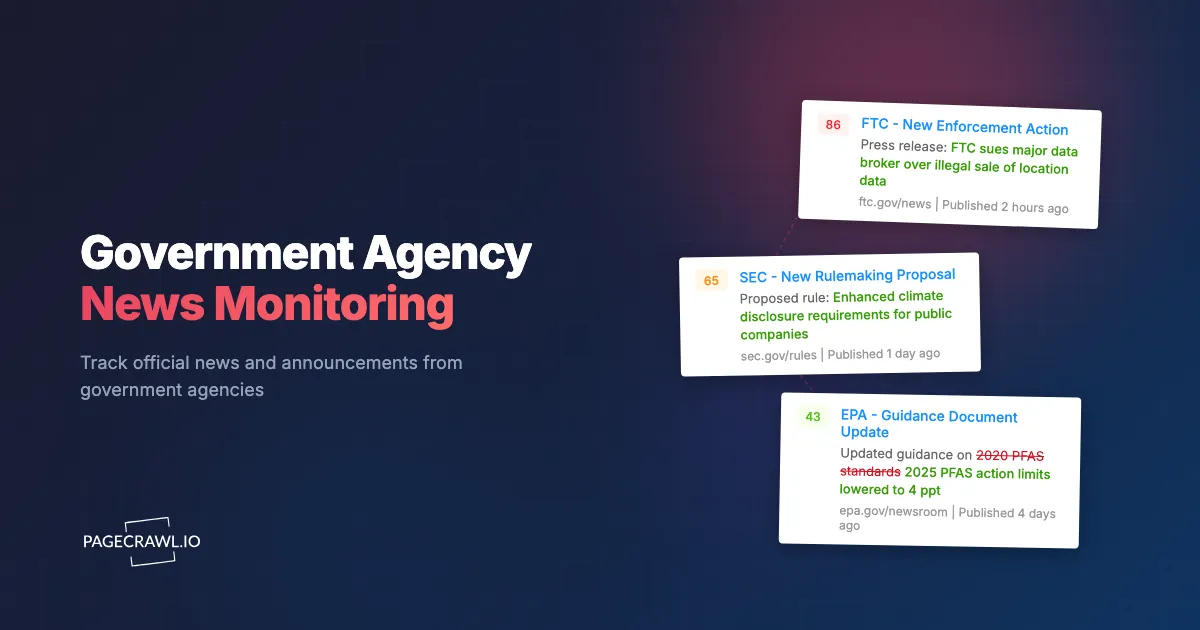
When the FTC files an enforcement action against a company for deceptive advertising practices, it signals how the agency interprets existing rules. These enforcement actions serve as case law for regulatory compliance. If a competitor gets fined for a practice your company also uses, you want to hear about it the same day.
Enforcement action pages on agency websites are some of the most valuable monitoring targets. Each action tells you what the agency considers a violation, how severely they penalize it, and what remedies they require.
Grant and Funding Announcements
Federal and state agencies announce billions in grants, subsidies, and incentive programs through their websites. Energy efficiency grants from the DOE, research funding from NSF, small business programs from SBA, and infrastructure funding from DOT all appear on agency websites before they appear anywhere else. Missing an announcement can mean missing an application deadline.
Proposed Rules and Comment Periods
Before most regulations become final, agencies publish proposed rules and open comment periods on their regulatory filing pages. These proposed rules give you months of advance notice about coming changes. They also give you the opportunity to submit comments that might influence the final rule. Organizations that monitor proposed rules can begin planning for changes while competitors are still unaware.
Which federal agencies should you monitor?
Start with the agencies whose rules touch every employer: the FTC, DOL, EEOC, IRS, and SBA. Then add the two or three regulators specific to your industry, such as the SEC for financial services, the FDA for food and medical products, or the EPA for manufacturing. Five to eight agencies covers most organizations.
Agencies That Affect Most Businesses
Federal Trade Commission (FTC): Advertising practices, consumer protection, data privacy, competition, and emerging technology guidance. The FTC's press releases and enforcement actions page should be on every business's monitoring list. Recent years have brought significant activity around AI disclosures, subscription cancellation practices, and data broker regulations.
Department of Labor (DOL): Wage and hour rules, overtime regulations, workplace safety through OSHA, employee classification, and benefits requirements. DOL updates affect any company with employees in the United States.
Equal Employment Opportunity Commission (EEOC): Employment discrimination guidance, enforcement priorities, and technical assistance documents. Important for HR departments and employment law compliance.
Internal Revenue Service (IRS): Tax guidance, revenue rulings, notices, and procedural changes. The IRS publishes guidance that affects tax planning and compliance throughout the year.
Small Business Administration (SBA): Loan programs, disaster assistance, contracting opportunities, and small business development resources. Critical for small businesses and their advisors.
Industry-Specific Agencies
Securities and Exchange Commission (SEC): Essential for financial services, publicly traded companies, and investment firms. Monitor the SEC's press releases, enforcement actions, proposed rules, and staff guidance. For detailed SEC monitoring setup, see our guide to SEC filings and EDGAR alerts.
Food and Drug Administration (FDA): Required monitoring for pharmaceutical companies, medical device manufacturers, food producers, and supplement companies. The FDA's safety alerts, guidance documents, and approval announcements are time-sensitive.
Environmental Protection Agency (EPA): Critical for manufacturing, energy, construction, agriculture, and waste management industries. EPA enforcement actions, new standards, and permit changes affect operations directly.
Federal Communications Commission (FCC): Important for telecommunications, broadcasting, technology companies, and any business that uses wireless spectrum. The FCC's rulemaking docket and public notices drive industry changes.
Consumer Financial Protection Bureau (CFPB): Essential for banks, credit unions, fintech companies, and any business offering consumer financial products. CFPB enforcement actions and guidance documents shape the consumer finance industry.
Department of Health and Human Services (HHS): Relevant for healthcare providers, insurers, and health technology companies. HIPAA guidance, Medicare/Medicaid changes, and public health announcements.
National Institute of Standards and Technology (NIST): Important for cybersecurity, manufacturing, and technology companies. NIST framework updates and standards publications influence industry practices and sometimes become regulatory requirements.
State Agency Monitoring
Federal agencies get the most attention, but state agencies often have more direct impact on daily operations.
State Attorneys General
State AG offices publish enforcement actions, consumer protection guidance, and data privacy rulings. With state-level privacy laws proliferating (California, Colorado, Connecticut, Virginia, and more), monitoring state AG websites is increasingly important for companies handling consumer data.
State Regulatory Boards
Industry-specific licensing boards, environmental agencies, labor departments, and health departments all publish updates on state websites. A contractor in Texas needs to monitor the Texas Department of Licensing and Regulation. A healthcare provider in New York needs to watch the New York State Department of Health.
State Legislatures
State bills become law faster than federal legislation. A bill introduced in January might be signed into law by March. Monitoring state legislature websites for bills relevant to your industry gives you advance notice of coming changes. Many states publish bill tracking pages that update as legislation moves through committees and votes.
What makes agency websites hard to monitor?
Three things: every agency structures its site differently, publishing rhythms range from hourly to monthly, and content arrives in wildly inconsistent formats, from clean press releases to bare PDF links. There is no shared standard, so each agency needs its own page target, its own check frequency, and its own tracking mode.
Every Agency Has a Different Structure
The SEC's website organizes content entirely differently from the FDA's, which is organized differently from the FTC's. Press releases might be on a "/news" page, a "/press-releases" page, a "/newsroom" page, or buried under several layers of navigation. There is no standard format.
This means you cannot use a one-size-fits-all approach. Each agency requires identifying the specific page where relevant updates appear and configuring monitoring for that page's particular structure.
Update Frequencies Vary Widely
The SEC might publish multiple updates per day. A state licensing board might publish updates once a month. Setting appropriate check frequencies for each source prevents both missed updates and wasted monitoring resources.
High-activity sources (SEC, FTC, FDA) benefit from checks every few hours. Lower-activity sources (state boards, smaller agencies) might only need daily checks.
Content Formatting Inconsistencies
Some agencies publish well-structured press releases with clear titles, dates, and categories. Others publish PDF documents with minimal metadata. Some post updates as blog entries. Others update static pages. Your monitoring approach needs to accommodate these variations.
PageCrawl's content-only mode handles most government websites well by focusing on the actual text content rather than navigation elements, sidebars, and footers. For pages that use complex layouts, you can use CSS selectors to target the specific content area. See our CSS selector guide for details on targeting specific page elements.
PDF and Document Publications
Many agencies publish guidance documents, reports, and rules as PDFs linked from their website. When the agency adds a new PDF to a page, the page itself changes (a new link appears), which PageCrawl detects. This effectively monitors for new document publications without needing to read the PDF content directly.
Setting Up Agency Monitoring with PageCrawl
Here is how to build an effective government monitoring system.

Step 1: Map Your Regulatory Landscape
Before adding monitors, identify every agency that publishes content relevant to your business. Consider:
- Federal agencies with jurisdiction over your industry
- State agencies in every state where you operate
- Industry standards bodies (which often publish on government-adjacent websites)
- Courts and judicial bodies that publish relevant opinions
Create a spreadsheet listing each agency, the specific page URL to monitor, the type of content published there (press releases, guidance, enforcement actions), and the expected update frequency.
Step 2: Find the Right Pages
For each agency, identify the specific page that publishes new content. This is rarely the homepage. Look for:
- Press release or news page: Usually the most comprehensive source of new announcements
- Enforcement actions page: Where the agency publishes cases, penalties, and consent orders
- Guidance documents page: Where interpretive guidance and FAQs appear
- Federal Register submissions: The agency's page listing proposed and final rules
- Grant announcements: Where funding opportunities are published
Some agencies consolidate all updates on a single page. Others separate press releases, enforcement actions, and guidance into different sections. Monitor each relevant section separately.
Step 3: Configure Monitors for Each Source
For each page, add a PageCrawl monitor with these settings:
Tracking mode: Use "Content Only" or "Reader" mode for most agency news pages. These modes focus on the actual content and ignore navigation, headers, and footers that change for unrelated reasons.
Check frequency: Set based on the agency's publishing activity. Every 4-6 hours for high-activity federal agencies (SEC, FTC, FDA). Daily for state agencies and lower-activity sources.
New content detection: Enable this to get alerts specifically when new content appears on the page, rather than when existing content changes. This is ideal for press release pages where you want to know about new announcements.
If you are setting up monitors for many agency pages at once, PageCrawl's templates let you save a pre-configured monitoring profile (tracking mode, check frequency, notification channels) and apply it to new monitors in one click. Create a "Federal Agency" template and a "State Agency" template to speed up onboarding and keep settings consistent across your entire regulatory monitoring setup.
For agencies that publish on multiple pages, use PageCrawl's automatic page discovery to find and monitor all relevant sections of an agency website automatically.
Step 4: Set Up Notification Routing
Different types of agency updates warrant different notification urgency:
Priority alerts (email + Slack/Teams): Enforcement actions in your industry, final rules that affect your operations, grant announcements with approaching deadlines. These fire as soon as a check detects the change.
Daily digest: Press releases, proposed rules, general news, and updates from lower-priority agencies.
Weekly summary: State legislature activity, standards body publications, and long-range planning items.
Configure PageCrawl notifications to route to the right channels. Compliance teams might get all regulatory alerts directly. Business units might get a filtered daily digest of relevant updates only.
Building a Government Intelligence Workflow
Monitoring is step one. Processing the information efficiently requires a workflow.
Triage and Classification
When an alert comes in, someone needs to assess its relevance and urgency quickly. Establish a classification system:
- Action required: A change that requires your organization to do something (update policies, modify practices, file comments)
- Monitor closely: A proposed change or trend that may require action later
- Informational: Useful context but no action needed
- Not relevant: False positive or content outside your scope
Assign Ownership
Each category of agency update should have a designated owner. SEC enforcement actions go to the compliance team lead. DOL guidance goes to the head of HR. EPA announcements go to the environmental compliance officer. Clear ownership prevents updates from falling through the cracks.
Track Response Timelines
When an agency update requires action, track the timeline. Comment periods have deadlines. Rule effective dates create compliance deadlines. Grant applications have submission windows. Build a calendar of regulatory deadlines driven by your monitoring alerts.
Document Your Response
For audit and compliance purposes, document how your organization learned about each relevant change and what action you took. Automated monitoring creates a timestamped record of when you were notified, which supports compliance documentation requirements.
Managing Alerts Across Dozens of Agencies
A comprehensive government monitoring setup might include 30-50 monitored pages across federal and state agencies. Managing this volume requires structure.
Use Folders for Organization
Organize monitors into folders by category, using labels, folders, and workspaces to keep a large watchlist navigable:
- Federal Regulatory: Core federal agencies (FTC, DOL, SEC, FDA)
- State Regulatory: State-level agencies grouped by state or by type
- Enforcement Actions: Enforcement pages across all agencies
- Grants and Funding: Grant announcement pages
- Legislative: State and federal legislative tracking pages
Use Tags for Cross-Cutting Categories
Tags let you slice your monitors differently from folders. Tag monitors by:
- Industry relevance: "healthcare," "fintech," "manufacturing"
- Priority level: "critical," "routine"
- Team ownership: "compliance," "legal," "HR," "operations"
This lets you create filtered views. The compliance team sees only their tagged monitors. The executive team sees only critical-priority items.
Archive and Review
Periodically review your monitoring setup. Are all the URLs still correct? Government websites redesign periodically and URLs change. Have new agencies or pages become relevant? Has your business expanded into new states that require additional state-level monitoring? A quarterly review keeps your monitoring current.
For long-term record-keeping, PageCrawl's website archiving feature preserves snapshots of agency pages over time, creating a historical record of published content.
Use Cases Across Industries
Financial Services
Banks, investment firms, and fintech companies run banking and supervisory regulator monitoring across the SEC, CFPB, OCC, FDIC, Federal Reserve, and state banking departments. Enforcement actions against competitors signal regulatory priorities. Proposed rules provide advance notice of compliance requirements. Guidance documents clarify how regulators interpret existing rules.
A mid-size bank might monitor 20-30 agency pages to cover federal banking regulators, the SEC (for investment activities), CFPB (for consumer products), and state regulators in every state where it operates.
Healthcare
Hospitals, insurers, pharmaceutical companies, and health technology firms monitor HHS, FDA, CMS, state health departments, and medical licensing boards. FDA safety alerts require immediate attention. CMS billing changes affect revenue. HIPAA guidance updates require policy adjustments.
Manufacturing
Manufacturing companies monitor EPA, OSHA, DOT, CPSC, relevant state environmental and workplace safety agencies, and trade pages for Section 232 tariff changes on steel, aluminum, and autos. EPA enforcement actions in your sector signal increased scrutiny. OSHA workplace safety updates require training and procedural changes.
Technology
Technology companies monitor the FTC (for consumer protection and data practices), FCC (for communications regulations), NIST (for cybersecurity standards), state privacy agencies, and international regulatory bodies. The pace of technology regulation has accelerated significantly, making automated monitoring essential.
Legal Professionals
Law firms and corporate legal departments monitor agencies relevant to their practice areas and clients, including immigration pages such as the green card lottery results. Monitoring enforcement actions and guidance documents supports client advisory services and helps anticipate legal risks.
Monitoring International Government Sources
For organizations operating globally, government monitoring extends beyond US borders.
European Union
EU institutions publish regulations, directives, and guidance through EUR-Lex and individual directorate general websites. The European Commission's press room, EDPB (for data protection), EMA (for medicines), and ESMA (for financial markets) are common monitoring targets.
United Kingdom
Post-Brexit, UK regulatory bodies publish independently from the EU. Monitor the FCA, ICO, CMA, and relevant sector regulators through their respective websites.
Other Jurisdictions
Each country has its own regulatory publication structure. PageCrawl monitors web pages regardless of the country, language, or website structure, making it suitable for international government monitoring.
Advanced Monitoring Strategies
Combining Multiple Detection Methods
For critical agencies, use multiple monitoring approaches simultaneously:
- Monitor the agency's press release page for announcements
- Monitor the agency's RSS feed (if available) for structured updates
- Monitor specific topic or industry pages within the agency website
- Monitor the Federal Register for the agency's proposed and final rules
This redundancy ensures you do not miss updates that appear on one page but not another.
Keyword-Focused Monitoring
Some agency pages publish content across many topics. If you only care about specific subjects, configure PageCrawl to alert you only when new content contains relevant keywords. This reduces noise from updates that do not affect your business.
Integration with Compliance Systems
Use PageCrawl's webhook notifications to feed agency updates into your existing compliance management system. When a relevant change is detected, the webhook can create a task in your project management tool, add an entry to your regulatory change log, or trigger a review workflow. See our guide on webhook automation for integration details.
How does agency monitoring fit into a compliance program?
It is the intake layer. Agency news monitoring catches new developments the day they are published, while compliance monitoring checks that your own policies and practices still match current requirements. Run both and you close the loop between what the regulator just changed and what your organization has to do about it.
Government agency monitoring is one component of a broader regulatory compliance monitoring strategy, and together they create a comprehensive approach to regulatory risk management.
For organizations in heavily regulated industries, see our compliance monitoring software guide for a broader view of compliance automation tools. Always confirm what a rule or enforcement action means for your business against the agency's own page and with counsel; this article is informational, not legal advice.
Choosing your PageCrawl plan
PageCrawl's Free plan lets you monitor 6 pages with 220 checks per month, which is enough to validate the approach on your most critical pages. Most teams graduate to a paid plan once they see the value.
| Plan | Price | Pages | Checks / month | Frequency |
|---|---|---|---|---|
| Free | $0 | 6 | 220 | every 60 min |
| Standard | $8/mo or $80/yr | 100 | 15,000 | every 15 min |
| Enterprise | $30/mo or $300/yr | 500 | 100,000 | every 5 min |
| Ultimate | $99/mo or $999/yr | 1,000 | 100,000 | every 2 min |
Annual billing saves two months across every paid tier. Enterprise and Ultimate scale up to 100x if you need thousands of pages or multi-team access.
Missing an FTC enforcement action that signals new scrutiny of a practice your company uses, or a grant announcement with a 30-day application window, can cost you far more than a year of monitoring. Standard at $80/year covers 100 agency pages, which is enough for comprehensive federal coverage across your core regulators plus state-level agencies in every state where you operate. Enterprise at $300/year scales to 500 pages for organizations monitoring dozens of agencies across federal, state, and international bodies.
All plans include the PageCrawl MCP Server, so your compliance or legal team can ask Claude to pull every enforcement action detected from a specific agency over the last quarter and summarize the trends, turning your monitoring history into an active intelligence briefing rather than a folder of saved alerts. AI assistants can create monitors through conversation on every plan, including Free.
Getting Started
Begin with the five agencies most relevant to your business. For most organizations, that includes the FTC and DOL at minimum, plus three industry-specific agencies. Find the press release or news page for each agency and add them to PageCrawl with "Content Only" tracking mode and daily check frequency.
Run this initial setup for two weeks. Review the alerts you receive. Are they relevant? Too frequent? Not frequent enough? Adjust tracking modes, check frequencies, and notification settings based on what you learn.
Then expand. Add enforcement action pages, guidance document pages, and state-level agencies. Organize into folders by category. Set up notification routing so the right team members get the right alerts.
PageCrawl's free tier includes 6 monitors, enough to cover the core federal agencies most relevant to your business and prove the value of automated government monitoring. The Standard plan at $80/year covers 100 pages, which handles a comprehensive federal monitoring setup plus state agencies. Enterprise at $300/year handles 500 pages for organizations monitoring across many states, agencies, and international bodies.
The organizations that respond fastest to regulatory changes are not the ones with the biggest compliance teams. They are the ones that learn about changes first, because they have automated monitoring running 24/7 on every agency website that matters.