
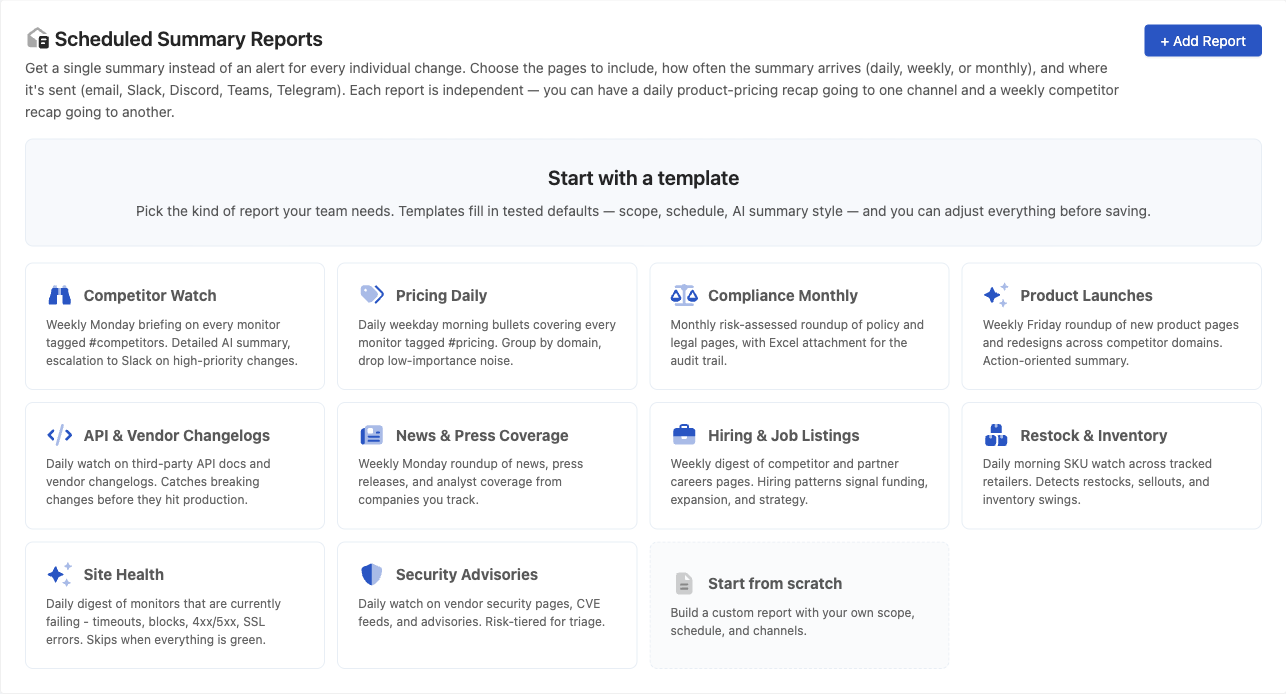
With pagecrawl.io, you can group your monitors into scheduled briefings that compile every detected change into a single digest, delivered automatically on the cadence each audience expects. Reports turn raw change notifications into something stakeholders actually open and read: a clean, AI-summarized email with the most important items at the top.
Instant alerts on every change flood inboxes until people mute the channel. Scheduled reports solve that without losing the safety net for genuinely urgent items, which still escalate immediately to your channel of choice.
Why Scheduled Reports
A single workspace often serves several audiences with very different appetites for detail:
- Marketing wants Monday morning competitor intel.
- Legal wants a monthly compliance roundup.
- Sales wants daily price movements across competitors.
- Product wants weekly competitor product launches.
- Your team wants to be paged the moment something critical lands.
Reports let you serve all of these from the same monitor set. Group monitors by tag, folder, or domain, then deliver a tailored briefing to each audience on their preferred schedule. High-priority changes still escalate instantly; everything else lands in the next digest.
When to Use Reports vs Instant Notifications
| Scenario | Recommended |
|---|---|
| Monitoring a handful of critical pages | Instant notifications |
| Tracking 50+ competitor pages for pricing | Scheduled report (daily or weekly) |
| Legal/compliance pages that rarely change | Scheduled report (weekly or monthly) |
| Stock availability that needs immediate action | Instant notifications with escalation |
| Executive stakeholder updates | Scheduled report with AI summary |
| Onboarding a non-PageCrawl recipient (CEO, board, client) | Scheduled report (public share link) |
You can mix both approaches. Monitors not assigned to any report continue to send instant notifications as usual. Monitors assigned to a report will only appear in digests, unless priority escalation is configured for urgent changes.
How Reports Work
Each report has four moving parts:
- Scope. Which monitors are included. Match by tag, folder, domain, specific monitors, or all monitors in the workspace.
- Schedule. When the digest is generated and sent. Daily, weekdays only, weekly, monthly, or on-demand.
- Recipients. Who gets the email or notification. Workspace members, additional Cc emails, and channel webhooks.
- Content. What goes in the digest: AI summary style, importance threshold, failing pages section, escalation rules, attachments.
Each generated digest is stored as a record in the workspace and gets a unique public share link, so anyone with the URL can view it in their browser without a PageCrawl account.
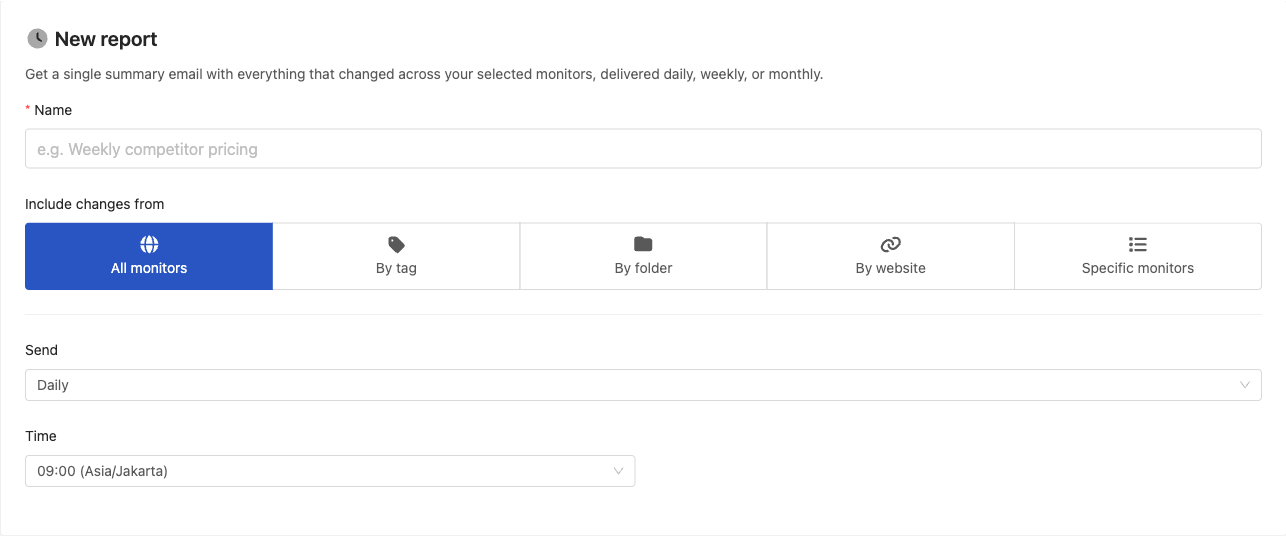
Setting Up Your First Report
- Go to Settings > Workspace > Alerts & Reports.
- Select the Scheduled Summary Reports tab.
- Click Add Report and give it a name, color, and (optionally) an icon.
- Pick the Scope: choose tag, folder, domain, specific monitors, or all monitors.
- Pick the Schedule and delivery hour.
- Add Recipients: workspace members and additional Cc emails. You can also wire in Slack, Teams, Discord, Telegram, or a custom webhook.
- Configure Content: AI summary style, importance threshold, failing pages, attachments.
- Save. Use Generate now to preview the next digest immediately.
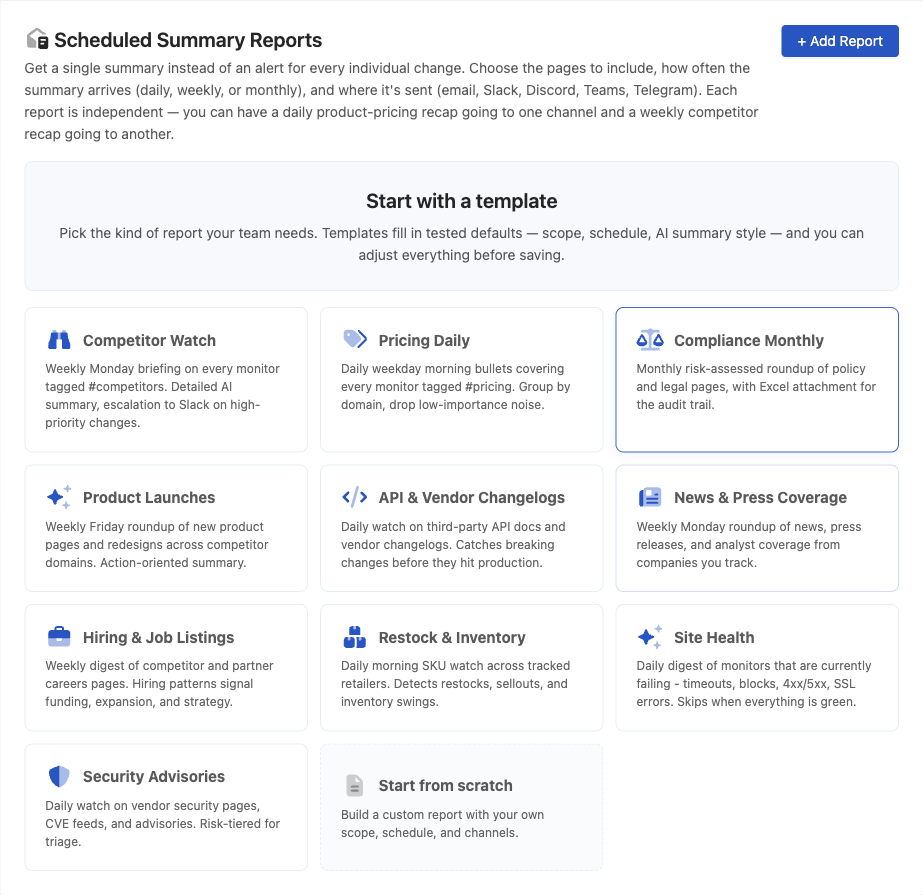
For step-by-step instructions on each option, see the Scheduled Reports setup guide.
Choosing What to Include (Scope)
The scope determines which monitors feed into the digest. Five options are available:
- All monitors: every monitor in the workspace. Useful for a single executive summary.
- By tag: monitors carrying a specific tag, e.g.
#competitors,#pricing,#legal. Easiest way to slice cross-cutting topics. - By folder: monitors inside a folder (and its sub-folders). Best when monitors are already organized hierarchically.
- By domain: monitors whose tracked URL matches one or more domains. Useful when you want a per-vendor view.
- Specific monitors: hand-picked list. For very small or very high-stakes reports.
Tag and folder scopes are dynamic: any monitor that picks up the tag or moves into the folder later will start appearing in the next digest, with no report change required.
Available Schedule Options
| Schedule | Description |
|---|---|
| Daily | Receive a digest every day at your chosen hour |
| Weekdays only | Monday through Friday |
| Weekly | On a specific day of the week |
| Monthly | On a specific day of the month |
| On-demand only | Only generated when you manually click "Generate now" |
All times are based on your workspace timezone.
Delivery Channels
A single report can ship to multiple channels at once. Each channel can override the workspace defaults if you want this report to use a different webhook or email list.
- Email: primary recipients, plus Cc and Bcc lists. Recipients do not need a PageCrawl account.
- Slack: posts a formatted message to a channel webhook.
- Microsoft Teams: posts to an incoming webhook URL.
- Discord: posts to a server webhook.
- Telegram: sends to a chat or group via bot token.
- Custom webhook: full JSON payload for your own automations or n8n / Zapier flows.
Channels can be enabled or disabled per report. If a channel is disabled or its webhook is missing, that channel is skipped without affecting the others.
AI Executive Summary
Every digest can include an AI-written summary at the top of the report. The summary is generated each time the digest is built, using the latest changes plus your workspace-level focus prompt for context. You choose the style that fits the audience.
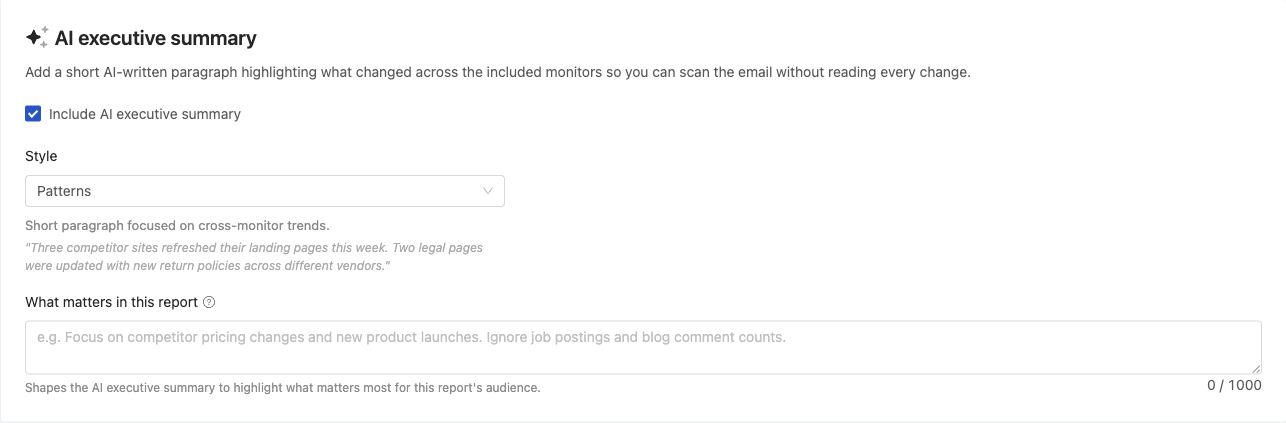
Eight summary styles are available:
- Headline: one short sentence (max 20 words) that captures the single most important takeaway. Best for chat notifications and SMS-style alerts.
- Patterns: a concise paragraph (2-4 sentences) focused on cross-monitor trends, e.g. "three competitors raised prices". The default. Good for general updates.
- Action briefing: leads with what the reader should DO (review, respond, monitor, ignore). Best for sales and ops teams.
- Detailed executive summary: a thorough multi-paragraph breakdown with section headings, notable individual changes, affected areas, and likely causes. Best for weekly and monthly executive briefings.
- Bullets: a markdown bullet list (5-10 bullets) with bolded category labels. Best when scanning matters more than narrative flow.
- Changelog: a chronological log, newest first, formatted like a release-notes file. Best for product and engineering audiences.
- Risk assessment: groups changes into High / Medium / Low risk with explanations of why each matters. Best for legal, compliance, and security teams.
- Brief: a plain-text summary under 280 characters. Designed for chat notifications where formatting is stripped.
You can change the style per report at any time. The next digest will reflect the new style.
AI-Generated Dynamic Title
In addition to the summary, every digest gets a short, content-aware title generated by AI. Examples:
- "5 price movements across tracked SKUs"
- "2 new pages, 1 redesign, 1 announcement"
- "4 policy updates this month"
- "3 high-priority competitor changes this week"
The title appears in three places:
- The email subject line, prefixed with the report name:
Competitor Intel: 3 high-priority competitor changes this week. - The digest header as a sub-heading on the public web view and PDF.
- The email body as a quick visual landmark above the AI summary.
Stakeholders can tell at a glance whether this digest is worth opening, without having to scroll.
Priority Escalation
Reports batch changes by design, but some changes are urgent enough that waiting for the next digest is unacceptable, like a competitor dropping prices 30% or a page being taken down. Priority escalation handles this.
When you enable escalation on a report:
- Each change is scored by AI for importance.
- If a change exceeds the threshold you set (e.g. score ≥ 90), it triggers an immediate notification through your chosen escalation channel: Slack, Teams, email, Discord, Telegram, or webhook.
- The change still appears in the next digest, with a label indicating it was already escalated.
This means stakeholders subscribed to the digest channel are not woken up at 3am, but the people who need to act on critical changes are paged the moment they happen.
Importance Threshold and Content Filters
Each report can filter what makes the cut:
- Minimum importance threshold: drop everything scored below a certain priority. Useful for executive reports where only important changes belong.
- Collapse to latest: if a monitor changed multiple times during the period, show only the most recent change. Avoids cluttering the digest with intermediate states.
- Group by domain: present changes grouped by website host, instead of priority. Best for digests that watch many vendors.
- Workspace AI focus prompt: a free-text prompt the AI uses to bias importance scoring and summary generation toward your team's specific concerns ("focus on enterprise pricing changes", "ignore design system updates").
Pages Currently Failing
Most digests focus on what changed. The "Pages Currently Failing" section flips that and shows what isn't being checked successfully right now: monitors stuck on timeouts, blocked by bot protection, returning server errors, or hitting SSL issues. 404s are not included, since broken pages have their own dedicated section with replacement suggestions.
The list shows the page name, the current status (timeout, blocked, server error, etc.), and how long ago the last attempt happened. It's a single block at the bottom of the digest, off by default for new reports but easy to enable per report.
This is the difference between thinking your monitor is healthy because no email arrived, and knowing it's silently broken.
Comments and Inline Feedback
Every change in the digest carries a thumbs-up / thumbs-down pair, plus a comment field. Recipients (whether they have a PageCrawl account or not) can:
- Mark a change as important (thumbs up). The AI uses this signal to bias future scoring on similar changes.
- Mark a change as noise (thumbs down). Future similar changes get a lower priority and may be filtered out automatically.
- Leave a comment on a specific change or on the digest as a whole. Other recipients see comments inline when they open the digest.
For teams that want a structured workflow, enable review board actions. Each change shows a board selector (To Review / Flagged / Reviewed) so the team can triage changes directly inside the digest without opening the dashboard.
Public Share Links
Every digest gets a unique URL that anyone can open in their browser without signing in. The URL is included in every email, and you can copy it from the digest header for pasting into Slack, a Notion doc, or a board deck.
Sharing options:
- Public: anyone with the link can view.
- Authenticated: only signed-in workspace members.
Links can be rotated (invalidates the old URL) or revoked at any time. Default expiry is 30 days.
Print, PDF, and Excel Export
Each digest is laid out for print. Open it in your browser, hit print, and you get a clean, paginated PDF for board decks, audit archives, or quarterly reviews.
Beyond print:
- Excel export: a spreadsheet with every change, score, monitor, URL, timestamp, and AI summary, plus an overview sheet. Available as an email attachment (toggle per report) or on-demand from the digest page.
- CSV: same data in a simpler format for analytics pipelines.
- PDF: a one-click download from the digest page.
The Excel attachment is automatically skipped if the file would be too large for SMTP delivery, so the email itself never bounces.
Managing Recipients
Recipients live on the report, not the workspace. You can mix:
- Workspace members: picked from a dropdown of users in the workspace.
- Additional Cc Emails: any email address, no PageCrawl account required. The address must be verified once before it can receive reports.
- Channel routes: Slack channels, Teams channels, Discord servers, Telegram chats, custom webhooks.
Each recipient slot can be set as To, Cc, or Bcc. Use Bcc when you want to send to a long list without exposing the recipient list (e.g., a board distribution).
If a report is misconfigured (no recipients, broken webhook), the workspace owner is notified after the first failure. Subsequent failures don't re-notify, so a broken report can't spam the owner.
Real-World Examples
Marketing, weekly competitor briefing. Scope: tag #competitors. Schedule: weekly, Monday 8am. Recipients: marketing team + CMO. Style: detailed executive summary. Escalation: enabled, threshold 90, channel Slack #competitor-intel.
Sales, daily pricing watch. Scope: tag #pricing. Schedule: daily, weekdays only, 7am. Recipients: VP Sales, RevOps lead. Style: bullets. Importance threshold: 50. Group by domain: on.
Legal, monthly compliance roundup. Scope: folder /vendor-legal. Schedule: monthly, 1st of the month, 9am. Recipients: General Counsel, compliance@. Style: risk assessment. Excel attachment: on.
Product, weekly launch radar. Scope: domains slack.com, notion.com, linear.app. Schedule: weekly, Friday 4pm. Recipients: product team + CEO. Style: action briefing. Priority escalation: on, threshold 80, Slack #product-radar.
Executive, monthly board pack. Scope: all monitors. Schedule: monthly, last Friday. Recipients: board distribution (Bcc). Style: detailed executive summary. Failing pages: on. Public share link: rotated each month.
Best Practices
- Start with one report per audience, not per monitor set. Reports are cheap to add. Adding more later is easier than collapsing too-granular ones.
- Use tags to slice across folders. Tags don't conflict with your folder hierarchy and can express cross-cutting concerns (
#enterprise-watch,#regulatory). - Match the AI summary style to the audience. Headlines for execs, bullets for ops, risk assessment for legal, action briefing for sales.
- Always enable priority escalation on the operational reports. Even daily digests miss things that need a same-hour response.
- Use Cc for accountability, Bcc for distribution. Cc keeps everyone visible; Bcc protects long lists.
- Test with "Generate now" before going live. A dry run catches misconfigured webhooks and unexpected scope before stakeholders see it.
- Rotate the public share link if you suspect leakage. Old links stop working immediately.
How Reports Interact with Instant Notifications
When a monitor is assigned to any scheduled report, its instant workspace-level notifications are bypassed. Changes are collected and delivered in the next digest instead.
Exceptions: escalation alerts still fire immediately, and public subscriber notifications are unaffected. If you delete or disable a report, the monitors it covered go back to receiving instant notifications automatically.
Plan Limits
Standard plans include up to 2 reports. Higher-tier plans include unlimited reports plus on-demand generation, the full eight summary styles, custom AI focus prompts per report, the failing-pages section, and Excel attachments.
For exact limits, see the pricing page.