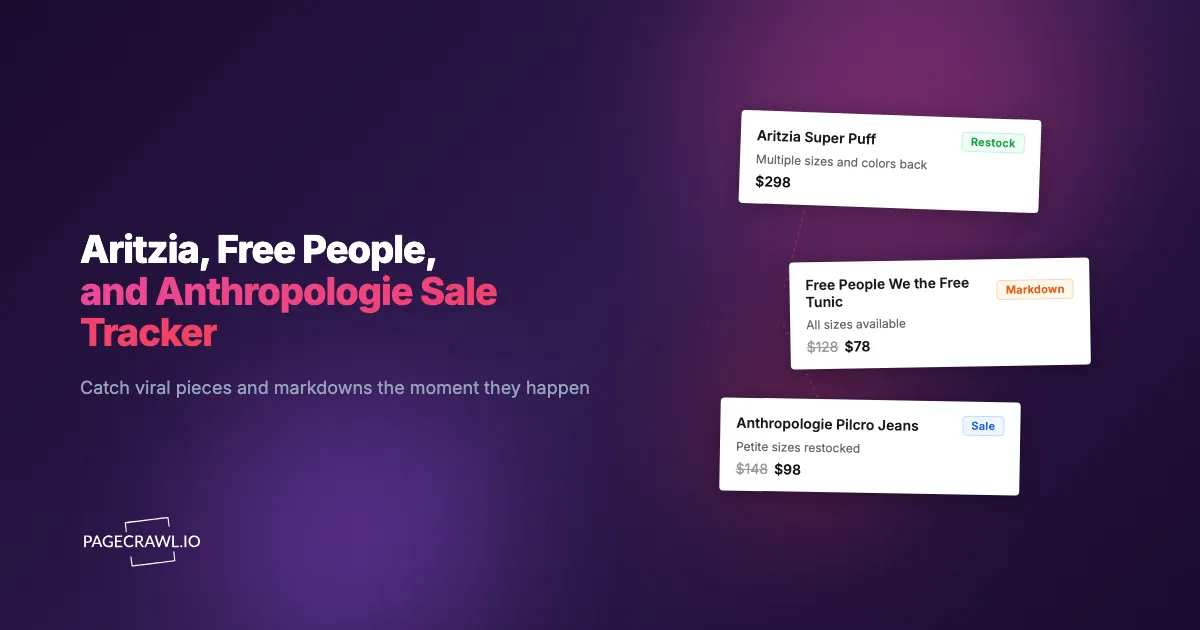
The Aritzia Super Puff in the most popular size-color combinations sells out every autumn and can stay gone for weeks, despite being one of Aritzia's flagship products. When a restock finally lands, often early in the morning with no announcement, the popular combinations are frequently gone again within hours. Threads on the r/Aritzia subreddit fill up with variations on "I missed it again." The buyers who had a monitor on the exact product page got an alert as soon as a check picked up the restock and bought before most shoppers were awake. Everyone else found out later that day from the subreddit.
Aritzia, Free People, and Anthropologie produce viral pieces that sell out within hours and restock on completely unpredictable schedules. Sale markdowns happen continuously rather than just at quarterly clearance windows. Specific colors and sizes are the operating bottleneck: a piece might be technically "in stock" but unavailable in the size or color you want. The retailers' native restock notification systems are inconsistent at best (Aritzia's notify-me works some of the time; Anthropologie's is hit-or-miss; Free People's exists). For loyal customers chasing specific items, a continuous monitor on the exact product page is the only reliable way to catch the restock.
This guide covers how these three retailers publish stock and sale data, what patterns make the difference between catching the restock and missing it, and how to set up monitors that surface restocks and markdowns within hours.
Why are Aritzia, Free People, and Anthropologie worth monitoring continuously?
These three retailers restock viral pieces without announcement, mark down individual items continuously, and run size-specific inventory that flips between sold out and available at unpredictable times. The fashion mid-market sits in a sweet spot for monitoring: products are aspirational enough to chase, but the inventory dynamics are messier than the luxury market and faster than mass market.

Viral Items Restock On Opaque Schedules
The Aritzia Super Puff, Free People We The Free Movement leggings, Anthropologie Faye Sweater, and dozens of similar pieces have cult followings. Restocks happen without announcement, often at unusual times (early morning Pacific, mid-afternoon, weekends). Native notify-me systems work inconsistently. Manual checking is impossible at any reasonable cadence.
Markdowns Happen Continuously, Not Just At Quarterly Sale
All three retailers run continuous markdowns on individual items rather than waiting for quarterly clearance windows. A piece you have been watching might suddenly drop sharply in price on a random Tuesday. Automatic price-drop and sale alerts catch the markdown on the next scheduled check.
Size And Color Restocks Drive Most Of The Signal
A piece restocking in unusable sizes is no good. The product page reflects the size availability state, and monitoring catches when specific size-color combinations come back in stock.
Promo Activations And Free Shipping Thresholds Move Site-Wide
Each retailer runs site-wide promotions periodically (Aritzia's friends-and-family, Free People's 15% off, Anthropologie's 30% off sale items). These activations land on the homepage and sale pages and can be the difference between paying full price and getting a meaningful discount on items already in your cart.
How are product and sale pages structured on these sites?
All three retailers expose stable product detail page URLs and category sale page URLs, which makes them straightforward to monitor.
https://www.aritzia.com/us/en/product/{slug}
https://www.freepeople.com/shop/{slug}
https://www.anthropologie.com/shop/{slug}
Product detail pages render per-size and per-color stock status. Sale category pages render a grid of marked-down products. New markdowns add rows to the sale grid. Restocks update the size selector on product pages from "sold out" to bookable.
For monitoring, the product detail page is the highest-signal monitor (catches restocks of specific size-color combinations), which is what product page monitoring is built for. The sale category page is the secondary monitor (catches new markdowns and promotional activations).
Which restock-tracking approach works best?
Direct monitoring of the product page is the most reliable approach, because it does not depend on the retailer's notify-me backend firing correctly. The table below compares the common options on cost, latency, and coverage.
| Approach | Cost | Latency | Coverage | Best For |
|---|---|---|---|---|
| Native notify-me email | Free | Hours to days, often missed | Per-product | Light users |
| Manual refresh | Free | Hours | Per session | Casual shoppers |
| Subreddits and Discord (r/Aritzia, r/FreePeople) | Free | Hours | Crowd-sourced | Community shoppers |
| Browser extensions | Free / Paid | Variable | Limited reliability | Tech shoppers |
| PageCrawl on product pages | Free tier to $80/year | 15 minutes to hours | Any URL | Active loyal customers |
The native notify-me systems exist on all three sites but their actual delivery rate is inconsistent. Many shoppers report signing up for notify-me and never receiving the email when the restock happens. Direct monitoring of the product page is the most reliable approach.
Setting Up Monitoring
Step 1: Build a focused product wishlist
Pick the 10-30 specific items you would actually buy at retail or markdown. Be specific about sizes and colors you would actually wear. Vague aspirational lists clutter alerts.
Step 2: Add product detail page URLs
For each item, add the product detail page URL with content monitoring. Screenshots are useful because stock state is visual on these pages.
Step 3: Add sale category pages
https://www.aritzia.com/us/en/sale
https://www.freepeople.com/sale
https://www.anthropologie.com/sale
Add each as a content monitor. Catches new markdowns and promotional activations.
Step 4: Set hourly checks during launch windows, daily otherwise
For known restock-imminent items (heading into winter for Super Puff, spring for Free People sundresses), hourly checks catch the restock within an hour. For routine sale watching, daily checks are enough.
Step 5: Route alerts to web push or email
Web push notifications deliver promptly after a check detects the change and are right for hot restocks. Email works for sale category monitoring where the signal is the markdown event, not minute-level inventory.
Step 6: Tag and group into a retailer or category folder
Create folders per retailer or per category (winter coats, dresses, denim), using labels, folders, and workspaces to organize monitored pages. The folder view rolls up the watchlist on a single page.
Worked Example: A Super Puff Hunter's Setup
A loyal Aritzia customer wants the Super Puff in a specific colorway and size for the upcoming winter. The setup:
- Add the Super Puff product page filtered to the specific colorway (1 monitor, hourly checks).
- Add 2-3 additional Aritzia wishlist items (3 monitors, daily checks).
- Add the Aritzia sale page (1 monitor, daily checks).
- Add the Free People and Anthropologie sale pages (2 monitors, daily checks).
- Tag everything
winter-wishlist. - Route Super Puff alerts to web push, route others to email.
Eight weeks in, the Super Puff alert fires at 6:13am on a Wednesday. The customer adds the right size and color to the cart and checks out by 6:18am. The same colorway sells through by 8:30am. Total cost: free, because the watchlist fits within the 6-monitor free tier.
Patterns Worth Watching
Restock badges on previously sold-out items. "Back in Stock" badges appear when stock returns. Monitoring catches the badge appearance within the check window.
Markdown price changes on watched items. Sale price changes are content changes on the product page, the core signal behind price monitoring and price-drop alerts. Monitoring catches them on the next check.
New arrivals on category pages. New SKUs appearing on category pages indicate seasonal drops or new collection launches.
Site-wide promo activations. Friends-and-family events, 15% off everything, free shipping thresholds. Activations land on the homepage and sale pages.
Final-sale extensions. Final-markdown tags moving deeper (50% off becomes 70% off) are the deepest markdown moments. Worth catching.
Limited-edition collab drops. Aritzia's collab capsules and Free People's seasonal collabs sell through fast. The collection page reveals the drop.
Combining Sale Alerts With Other Signals
Pair with cross-retailer comparison. Some Anthropologie items appear on Nordstrom or Free People. Monitoring multiple retailers, including peers like J.Crew, catches the rare cross-retailer price differences.
Pair with brand DTC sites. Brands like We The Free, Citizens of Humanity, and Maeve sometimes sell direct in addition to through these retailers. Monitoring the brand site catches direct-channel availability.
Pair with help center and policy monitoring. Return policy changes, sale-item return exceptions, and promotional terms shift periodically. See the help center diff monitoring guide.
Pair with the Aritzia, Free People, and Anthropologie subreddits. Community channels often surface restock alerts informally. PageCrawl provides the reliable trigger; community is supplemental.
Pair with Patagonia and Arc'teryx monitoring. For winter outerwear specifically, the Patagonia and Arc'teryx restock and sale alerts guide covers the technical-outerwear side.
Use Cases
Loyal customers. Same-day awareness of restocks for viral items turns "I missed it again" into a reliable buy. The Super Puff watcher who finally lands their size catches a piece that sat sold-out for two months.
Resellers. Limited drops and exclusive collaborations sometimes hold resale value. Catching a drop on a fast check cadence enables buy-and-flip on the hottest items.
Personal shoppers. Client-specific item monitoring. A personal shopper with five clients each wanting two items runs a 10-item watchlist routed to a per-client folder.
Content creators. Restock and sale awareness for affiliate content. The creator who covers the Super Puff restock at 6:15am earns the affiliate click before the rest of the audience even sees the subreddit post.
Gift shoppers. Specific items on a gift list often sit sold-out for weeks. Monitoring catches the restock in time for the gift occasion.
Wardrobe planners. Building a coordinated wardrobe around specific pieces benefits from continuous monitoring. The pieces you actually wear are the ones worth chasing.
Frequently Asked Questions
Why does the native notify-me system fail so often? Notify-me emails depend on the retailer's backend triggering the email when stock returns. Triggering logic is inconsistent and often misses small batches. Direct monitoring of the product page is consistent.
Can I monitor specific size-color combinations? Yes, as long as the product page renders the size and color selectors with per-variant stock status. All three retailers do.
How fast are restock alerts? On hourly checks, within an hour. On 15-minute checks (Standard plan), within 15 minutes. For viral items where restocks sell through in 2-3 hours, 15-minute checks are the minimum viable cadence.
Does this work for international sites (Aritzia Canada, Free People UK)? Yes. Any country site with stable product URLs works.
Will PageCrawl detect promo code applicability changes? Yes. Promotional banner content on the page changes when promos activate. PageCrawl catches the change.
Do I need a paid plan? For a small watchlist (5-6 items), the free tier is enough. For a serious 20+ item watchlist with hourly checks on hot items, Standard at $80/year is the right step.
Choosing your PageCrawl plan
PageCrawl's Free plan lets you monitor 6 pages with 220 checks per month, which is enough to validate the approach on your most critical pages. Most teams graduate to a paid plan once they see the value.
| Plan | Price | Pages | Checks / month | Frequency |
|---|---|---|---|---|
| Free | $0 | 6 | 220 | every 60 min |
| Standard | $8/mo or $80/yr | 100 | 15,000 | every 15 min |
| Enterprise | $30/mo or $300/yr | 500 | 100,000 | every 5 min |
| Ultimate | $99/mo or $999/yr | 1,000 | 100,000 | every 2 min |
Annual billing saves two months across every paid tier. Enterprise and Ultimate scale up to 100x if you need thousands of pages or multi-team access.
The math is straightforward. Standard at $80/year covers 100 product pages. If monitoring catches one $20 price drop, one mispriced competitor SKU, or one restock you would otherwise miss each month, the plan has paid for itself roughly four times over in the first year.
Getting Started
Add your watched product pages and sale category pages to PageCrawl on a daily check. Create a free account and the next restock or markdown will arrive in your inbox the day it lands.