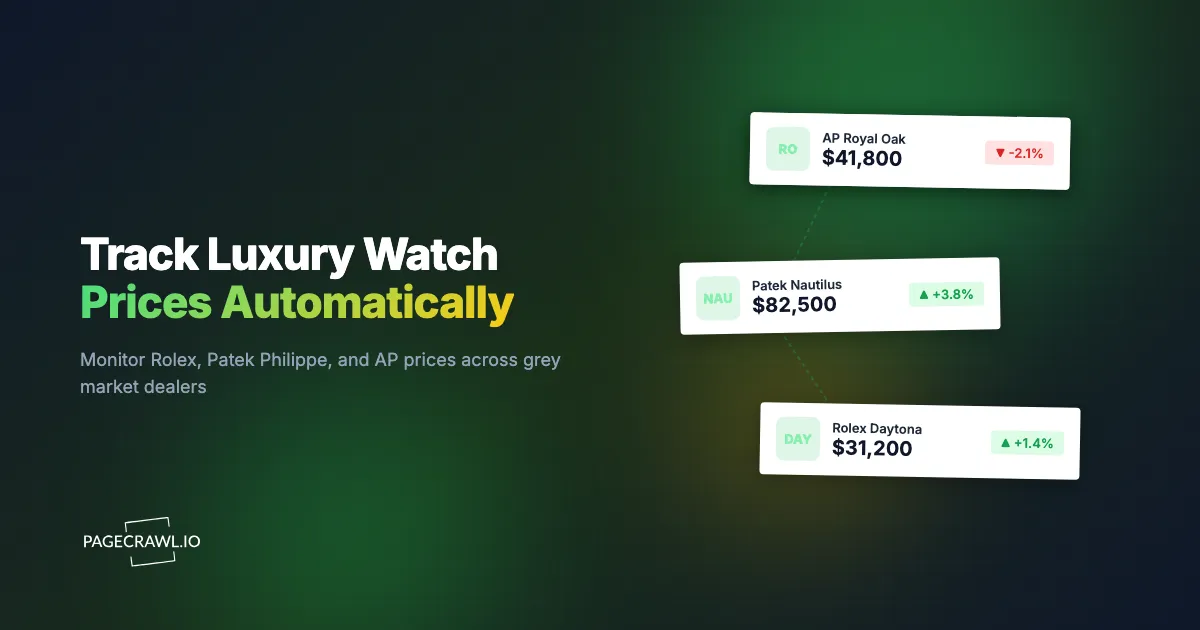
A Rolex Submariner drops $2,000 on Chrono24 overnight. By the time you check, the listing is gone. Or worse, you bought the same reference two weeks ago at the peak. In the secondary luxury watch market, double-digit percentage swings can happen in days rather than months. On a $30,000 watch, that is thousands of dollars you either saved or lost.
Whether you are a collector waiting for the right entry point, an investor tracking portfolio value, or a dealer managing margins across grey market platforms, manually checking prices on Chrono24, WatchBox, Bob's Watches, and dozens of authorized dealers every day is unsustainable. You will miss moves, you will lose context, and you will make worse decisions.
This guide covers how to set up automated price tracking for luxury watches, from basic platform alerts to monitoring any dealer page across the web for price changes, new listings, and availability shifts.
Why do luxury watch prices move, and why does speed matter?
Because the secondary market reprices around a handful of specific events: discontinuation announcements, annual retail price increases, macro sentiment shifts, and seasonal cycles. Each one moves grey market prices within days or hours, so understanding the drivers tells you what to monitor and how quickly you need to act.
Discontinuation Announcements
When Rolex discontinued the Milgauss in 2023, secondary prices jumped sharply within weeks. The same pattern repeats every time a popular reference gets cut from the catalog. Collectors who heard the news within hours bought at pre-spike prices. Those who found out a week later paid thousands more for the same watch.
Discontinuation news breaks on brand websites, press releases, and watch media sites like Hodinkee and Fratello. If you are not monitoring these sources, you are always reacting to price moves rather than anticipating them.
Manufacturer Price Increases
Rolex, Patek Philippe, and Audemars Piguet raise retail prices 3-8% annually, usually announced quietly on their websites or through authorized dealer communications, much the same way subscription price increases get slipped in by streaming and software services. Grey market prices adjust within days of these announcements, sometimes within hours.
If you know a retail price increase is coming, buying on the grey market before it ripples through becomes a straightforward arbitrage. But you need to catch the announcement early.
Market Sentiment Shifts
Macro events move watch prices. The crypto market crashes of 2022 knocked a large share off many grey market references as overleveraged buyers liquidated collections. Interest rate decisions, stock market corrections, and even celebrity associations can move demand for specific brands.
The Patek Philippe Nautilus 5711, famously trading at several times retail during the 2021 peak, lost much of its grey market premium when broader market sentiment turned. These are not slow drifts. Prices can move materially in a single week.
Seasonal Patterns
Watch prices follow predictable seasonal cycles. January through February typically sees price dips as post-holiday sellers list pieces they received as gifts. Prices often spike in March and April around Watches and Wonders (the industry's largest trade show) when new model announcements generate excitement.
Summer months tend to see softer demand, while prices firm up again in the fall as the holiday buying season approaches. Tracking these patterns over time gives you a clear picture of when to buy and when to wait.
Where should you track luxury watch prices?
Focus on four source types, in this order of signal quality: grey market platforms such as Chrono24 and WatchBox, auction houses, authorized dealer stock pages, and aggregated market data platforms. Not all sources are equally useful, so weight your monitoring toward the first three.
Grey Market Platforms
These are the primary marketplaces for secondary luxury watches:
- Chrono24 is the largest platform, and by its own account carries several hundred thousand watch listings at any time. Search results pages for specific references give you the broadest price snapshot. The "recently sold" section provides actual transaction data, not just asking prices.
- WatchBox offers curated pre-owned inventory with standardized pricing. Their prices tend to be competitive and reflect real market conditions.
- Bob's Watches specializes in Rolex and publishes transparent pricing with historical data. Good for Rolex-specific tracking.
- Crown and Caliber (Hodinkee partnership) has a smaller but well-curated selection with consistent grading standards.
- DavidSW, Takuya Watches, Lunar Oyster and other specialist dealers often have competitive pricing on specific references.
The key insight: the same reference can be priced 5-15% differently across platforms at any given time. Monitoring multiple sources simultaneously reveals the true market price and surfaces arbitrage opportunities.
Auction Houses
Christie's, Sotheby's, Phillips, and Antiquorum handle the highest-end pieces. Auction results set market benchmarks for rare references.
Monitor two things: upcoming lot listings (buying opportunities for rare pieces) and completed auction results (market data for pricing research). When a reference sells above or below estimate at Phillips, grey market prices for comparable pieces adjust within days.
Authorized Dealer Websites
For Rolex, Patek Philippe, and Audemars Piguet, retail prices are often significantly below grey market. A steel Rolex Submariner's list price sits well under what the same reference trades for pre-owned, a gap that regularly runs into thousands of dollars. If an authorized dealer shows a piece as available on their website, that is a buying opportunity worth thousands.
Most authorized dealers update their online inventory sporadically, but when they do, the window to purchase is short. Monitoring these pages for changes catches availability before it disappears.
Market Data Platforms
WatchCharts and WatchSignals aggregate pricing data and publish market indices. These are useful for understanding broad market trends but have significant limitations:
- They only index specific platforms, not all dealers
- Data can lag days behind live market moves
- They do not cover authorized dealer availability or auction lots
- You cannot customize what you track
These platforms are good for background research but insufficient as your primary price tracking tool.
Which watch price tracking method works best?
For more than a couple of references, automated web monitoring wins. Platform-native saved searches are free but locked to one marketplace with no price history. Manual spreadsheet tracking builds market intuition but costs 30 to 60 minutes a day and breaks down past three references. Automated monitoring works on any dealer page and keeps the history for you.
Platform-Native Alerts
Chrono24 offers "saved searches" that send email notifications when new listings match your criteria. This is the simplest option and costs nothing.
Pros: Free, zero setup, covers the largest marketplace.
Cons: Limited to Chrono24 only. No price history tracking. No cross-platform comparison. Basic email notifications with no customization. You have no visibility into price trends over time.
Manual Spreadsheet Tracking
Check 5-10 dealer websites daily and log prices in a spreadsheet. This builds good market intuition and gives you a historical record.
Pros: Full control over what you track. Forces you to learn the market deeply.
Cons: Takes 30-60 minutes daily. You will inevitably miss days. Does not scale beyond 2-3 references without becoming a part-time job. No alerts at all when prices move between your checks.
Automated Web Monitoring
Set up automated price monitoring on any dealer page, search results page, or listing across the web. Get notified when prices change, new listings appear, or stock becomes available.
Pros: Works on any website, not just specific platforms. Tracks price history automatically. Cross-platform comparison. Configurable alerts with thresholds. Scales to hundreds of pages without additional effort.
Cons: Requires initial setup time. Monthly subscription cost (though minimal compared to watch values).
| Feature | Platform Alerts | Manual Tracking | Automated Monitoring |
|---|---|---|---|
| Cross-platform | No | Yes (manual) | Yes (automated) |
| Price history | No | Yes (manual entry) | Yes (automatic) |
| Fast alerts on change | Limited | No | Yes |
| Any website | No | Yes | Yes |
| Setup effort | Low | Low | Medium |
| Ongoing effort | None | High (daily) | None |
| Scales beyond 5 references | No | Barely | Yes |
For anyone tracking more than a couple of references across multiple dealers, automated monitoring is the only approach that produces reliable data without consuming hours of your time.
Setting Up Automated Watch Price Monitoring
Here is a practical walkthrough for getting started with automated price tracking using PageCrawl.

Step 1: Identify Your Target References
Be specific. "Rolex Submariner" is not a target. "Rolex Submariner Date 126610LN" is a target. Different reference numbers within the same model line can have vastly different pricing dynamics. The Submariner Date 126610LN and the Submariner No-Date 124060 trade at different price points and follow different trends.
Start with 3-5 references you are actively considering buying, selling, or holding. Common starting points:
- Rolex Submariner Date 126610LN - the benchmark sports watch
- Rolex Daytona 116500LN - consistently high demand, volatile pricing
- Patek Philippe Nautilus 5711/1A - the blue chip of luxury watches
- Audemars Piguet Royal Oak 15500ST - strong secondary market
- Omega Speedmaster Professional 310.30.42.50.01.001 - more accessible entry point
Step 2: Choose Your Monitoring Approach
There are two core monitoring setups for watch price tracking, and most serious collectors use both.
Feed monitoring for listing pages (multiple watches on one page)
This is for search results pages and category pages where dozens of listings appear together. Monitor a Chrono24 search for "Rolex Submariner 126610LN" and you get a feed of every listing for that reference. PageCrawl detects when new listings appear, when existing listings change price, and when watches sell and disappear from the page. One monitor covers the entire market for a reference on that platform.
This approach is best for:
- Tracking overall market pricing for a reference across many sellers
- Catching new listings on the first check after they go live
- Spotting when multiple sellers drop prices simultaneously (a signal the market is softening)
- Monitoring "recently sold" pages to see actual transaction prices
Set up feed monitors on Chrono24, eBay, and WatchBox search pages for each of your target references. You will see the full picture of what is available and at what price, updated automatically.
Price and availability monitoring for individual listings (one watch per page)
This is for tracking a specific watch at a specific dealer. Monitor an individual listing page on Bob's Watches or Crown and Caliber and PageCrawl tracks both the price and whether the watch is still available. You get alerted if the dealer drops the price or if the watch sells before you act.
This approach is best for:
- Watching a specific piece you are considering buying, waiting for a price drop
- Tracking authorized dealer product pages where a single reference appears (or does not) based on stock
- Monitoring a dealer's "just arrived" or "new inventory" page for a specific reference
- Seeing that a listing has sold, on the next check, so you can gauge demand
Use price tracking mode for these monitors. It auto-detects prices and availability status on any page, so you do not need to configure CSS selectors or parse the page yourself. The walkthrough on monitoring numeric values for changes covers the price-history chart and percentage thresholds that come with tracking an asking price as a number.
Combining both approaches
The strongest setup uses both together. Feed monitors on Chrono24 and eBay give you the broad market view. Individual listing monitors on 2-3 trusted specialist dealers give you precise pricing on specific pieces. Together, you see both the forest and the trees.
Step 3: Configure Notifications
Set up alerts that match the urgency of each signal:
- Price drops below your target: Slack or Telegram for fast action. A watch at your buy price may sell within hours.
- New listings appearing: Email is fine for common references. Slack or Telegram for rare pieces where speed matters.
- Availability changes: Telegram or webhook for authorized dealer stock alerts, where the window to purchase can be very short.
- Price increases: Email digest is usually sufficient. This is portfolio tracking, not time-sensitive action.
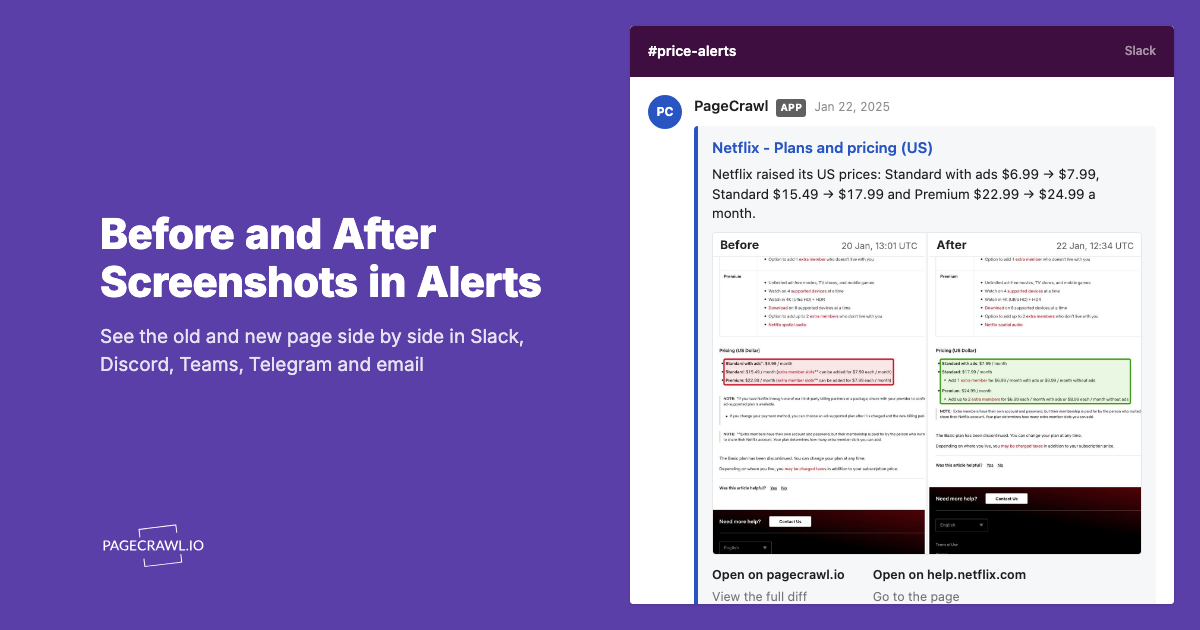
You can receive alerts via email, Slack, Discord, Telegram, Teams, or webhook. For time-sensitive deals, Slack or Telegram give you the fastest response time. If a reference is noisy, notification conditions and filters let you fire only when the price crosses a number you care about instead of on every listing edit.
Step 4: Set Up Cross-Platform Comparison
The real power comes from monitoring the same reference across multiple platforms. When a Rolex Daytona is listed at $31,000 on Chrono24 but $29,500 on WatchBox, that is immediately actionable information.
Set up both feed monitors and individual listing monitors for the same reference on 3-4 major platforms. Over time, you will see which platforms consistently price higher or lower, and you will spot outlier deals faster than anyone checking manually.
What else should you monitor besides price?
Four things: new listings for rare references, upcoming and completed auction lots, authorized dealer stock pages, and brand or media news that signals a discontinuation or retail price increase. Price is the most obvious signal, but these four are where collectors and dealers find their edge.
New Listing Alerts
For rare or vintage references, the challenge is not price, it is availability. A 1960s Omega Speedmaster with a specific dial variant might appear once or twice a year on the open market. If you are not monitoring search result pages for that reference across multiple platforms, you will miss it.
Set up monitors on Chrono24 search pages, eBay saved searches, and specialist vintage dealer sites. PageCrawl will alert you when new listings appear, giving you first-mover advantage on rare pieces.
Auction Lot Monitoring
Major auction houses publish their upcoming lots weeks before the sale. Monitor the watches category pages at Christie's, Sotheby's, and Phillips. When a reference you are interested in appears in an upcoming auction, you get early notice to research the lot, assess the estimate, and decide whether to bid.
Also monitor completed auction results pages. Hammer prices at major auctions set market benchmarks that grey market dealers reference when pricing their inventory.
Availability at Authorized Dealers
For references where retail price is significantly below grey market (most current Rolex, Patek Philippe, and AP sports models), monitoring authorized dealer websites for stock availability changes is potentially the highest-value monitoring you can do.
Some authorized dealers update their online product pages when new inventory arrives. The window between a piece appearing online and being sold can be hours. An automated alert gives you a realistic chance of purchasing at retail.
Note: many authorized dealers do not list live inventory online, so this approach works better with some dealers than others. Test a few and keep the monitors that produce useful signals.
Discontinuation and News Alerts
Monitor brand newsrooms, press release pages, and the editorial sections of major watch media:
- Brand websites: the newsrooms on Rolex.com, PatekPhilippe.com, and AudemarsPiguet.com
- Watch media: Hodinkee, Fratello Watches, Monochrome Watches, Revolution
- Industry events: Watches and Wonders official pages, Geneva Watch Days
Discontinuation news, new model announcements, and retail price changes all break on these pages first. Being among the first to know gives you time to act before prices adjust.
What are the most common watch price tracking mistakes?
Four recur constantly: tracking too many references at once, ignoring condition and completeness when comparing prices, watching only a single platform, and reacting to one unusually cheap listing as if it were the market. Each one turns good data into a bad decision.
Tracking Too Many References
Starting with 20 references sounds thorough but creates noise. You will get overwhelmed with alerts and lose focus on the references that actually matter to your buying, selling, or holding decisions. Start with 3-5 references. Add more once your system is running smoothly and you have a feel for the signal quality.
Ignoring Condition and Completeness
A "full set" (watch, box, papers, hang tags, warranty card) regularly commands a substantial premium over "watch only" for the same reference. When comparing prices across platforms, make sure you are comparing like-for-like. A $12,000 Submariner with no papers is not comparable to a $14,500 full set, even though both are the same reference number.
Service history matters too. A recently serviced watch from an authorized service center carries a premium over one with unknown service history. Factor these variables in when you evaluate the price data your monitors collect.
Only Monitoring One Platform
If you only watch Chrono24, you are seeing one slice of the market. Prices vary meaningfully across platforms because each has different seller demographics, fee structures, and buyer audiences. A reference that seems fairly priced on Chrono24 might be available for less on a specialist dealer site or eBay.
Cross-platform monitoring is not optional for serious price tracking. It is the difference between seeing the market and guessing at it.
Reacting to Single Data Points
One listing at an unusually low price does not mean the market has dropped. It could be a motivated seller, an incomplete set listed without clear disclosure, or even a scam listing. Track averages across multiple listings over weeks before making buying or selling decisions based on price movements.
The value of automated monitoring is precisely that it builds this historical context for you. After a few weeks of data, you will have a clear picture of the true market range for each reference, not just a snapshot from today's listings. Watch values are volatile and can fall as easily as they rise, so treat this article as informational rather than investment advice and confirm condition, papers, and current pricing with the seller before you buy.
Choosing your PageCrawl plan
PageCrawl's Free plan lets you monitor 6 pages with 220 checks per month, which is enough to validate the approach on your most critical pages. Most teams graduate to a paid plan once they see the value.
| Plan | Price | Pages | Checks / month | Frequency |
|---|---|---|---|---|
| Free | $0 | 6 | 220 | every 60 min |
| Standard | $8/mo or $80/yr | 100 | 15,000 | every 15 min |
| Enterprise | $30/mo or $300/yr | 500 | 100,000 | every 5 min |
| Ultimate | $99/mo or $999/yr | 1,000 | 100,000 | every 2 min |
Annual billing saves two months across every paid tier. Enterprise and Ultimate scale up to 100x if you need thousands of pages or multi-team access.
The math is straightforward. Standard at $80/year covers 100 product pages. If monitoring catches one $20 price drop, one mispriced competitor SKU, or one restock you would otherwise miss each month, the plan has paid for itself roughly four times over in the first year. For teams running real competitive pricing programs, Enterprise at $300/year tracks 500 SKUs, which is usually enough to cover a full category across every major competitor.
How do you get started tracking watch prices?
Start small and let the data accumulate before you expand. Three references, two platforms each, and one auction house page is enough to see whether the signal is worth scaling.
- Pick your top 3 watch references, the ones you are actively considering buying, selling, or holding. Use full reference numbers, not model names.
- Set up price tracking monitors on Chrono24 search pages and one specialist dealer for each reference. PageCrawl's free tier covers 6 pages, which is enough for 2-3 references across 2 platforms each.
- Add one auction house category page (Phillips or Christie's watches section) to catch rare lot announcements.
- Run it for two weeks. Review the price data that accumulates and look for patterns, consistent pricing gaps between platforms, time-of-week effects, and references that move more than others.
- Once you see the value, expand to more references, more dealers, and add authorized dealer pages for retail availability tracking. Standard at $8/month covers 100 pages, which is enough for a serious tracking program across every major platform.
The secondary luxury watch market rewards information speed and breadth. Automated monitoring gives you both without the daily time commitment of manual research.