In e-commerce, a 1% price difference can determine whether customers buy from you or your competitor. Yet most businesses check competitor prices manually, if they check at all. While you're sleeping, competitors adjust prices, launch promotions, and capture sales you could have won.
Manual price monitoring doesn't scale. Competitors change prices multiple times daily. Products have variants. New competitors enter the market. The only sustainable approach is automated monitoring that watches competitor prices 24/7 and alerts you when something changes.
This guide shows you how to build an effective competitor price monitoring system, from identifying what to track to setting up automated alerts to using price intelligence strategically.
Why does competitor price monitoring matter?
Price is often the deciding factor in purchase decisions. Research consistently shows that most online shoppers compare prices before buying, and will switch retailers for savings of just a few percentage points on expensive items.
The E-commerce Pricing Reality
E-commerce pricing is dynamic and competitive. Amazon adjusts prices across its catalog constantly, sometimes several times a day on a single listing. Smaller retailers adjust prices based on demand, inventory, competitor actions, and algorithms. A product that costs $149 at one retailer might be $142 at another, and both prices might change by tomorrow.
This creates both risk and opportunity. The risk: competitors undercut you and capture sales while you're unaware. The opportunity: catching competitor price increases lets you capture market share or improve margins.
First-Mover Advantage
In pricing, speed matters. When a competitor raises prices, you have a window to capture customers who notice the change. When they lower prices, responding quickly prevents customer defection.
Automated monitoring creates this advantage. Instead of discovering competitor price changes days or weeks later, you know as soon as the next check detects the move, within hours or even minutes depending on your check frequency. That speed difference translates directly to revenue and margin.
Beyond Individual Prices
Competitor monitoring reveals patterns beyond individual price points. You learn when competitors typically run sales, how they price new products, how aggressive they are on key items, and how they respond to market changes. This intelligence informs strategy beyond just matching prices.
What competitor prices should you monitor?
Monitor the competitors and products where price actually moves buying decisions: your direct rivals, your top-selling SKUs, and price-sensitive categories. Effective competitor price and stock monitoring requires strategic focus. You can't track everything, so prioritization matters.
Identifying Key Competitors
Start by categorizing competitors:
Direct competitors sell the same or very similar products to the same customer base, often through their own Shopify stores or standalone websites. These are your primary monitoring targets, their pricing directly affects your sales.
Marketplace competitors sell on platforms like Amazon, eBay, Walmart Marketplace, or TikTok Shop. Even if you don't sell on these platforms, customers compare their prices to yours.
Indirect competitors sell substitute products. A laptop retailer's indirect competitors include tablet sellers, different products but competing for the same budget.
Regional competitors may not be on your radar nationally but dominate in specific markets. Important if you serve geographic regions.
Most businesses should focus monitoring on 5-20 direct competitors initially, expanding as processes mature.
Selecting Products to Monitor
Not all products deserve equal monitoring attention. Prioritize based on:
Revenue impact: Your top-selling products deserve the most frequent monitoring. A price disadvantage on a best-seller costs more than on a slow-moving item.
Price sensitivity: Products where customers actively compare prices need closer monitoring. Commodity electronics, for example, see more price shopping than niche specialized products.
Margin importance: Products with healthy margins that could accommodate price matching matter more than low-margin items where you can't compete anyway, and tracking supplier and distributor price lists as part of wider supply chain monitoring tells you when those margins are about to move.
Competitive intensity: Products where multiple competitors actively compete on price require more frequent monitoring than products with less competition.
For most e-commerce businesses, starting with 50-100 key SKUs covers the products that matter most. Expand from there as you see results.
Beyond Base Prices
Effective monitoring goes beyond the listed price. Consider tracking:
- Sale and promotional prices: Competitors run promotions regularly. Knowing when and how deep they discount informs your own promotional calendar, and comparing those promotions against a 30-day lowest-price history shows whether their discount claims are genuine.
- Bundle pricing: Competitors may bundle products, changing effective per-unit prices.
- Shipping costs: "Free shipping over $50" changes competitive dynamics.
- Member/loyalty pricing: Some retailers offer better prices to members.
- Coupon availability: Publicly available coupons affect effective prices.
Setting Up Automated Monitoring
Manual competitor checking doesn't scale. Here's how to automate effectively using PageCrawl.
Adding Competitor Product URLs
For each competitor product you want to monitor:
- Navigate to the product page on the competitor's website
- Copy the URL from your browser
- Add the URL to PageCrawl
- The AI automatically detects the current price
Repeat for each product-competitor combination. If you monitor 50 products across 10 competitors, that's 500 monitors, too many to manage manually, but straightforward to set up systematically.
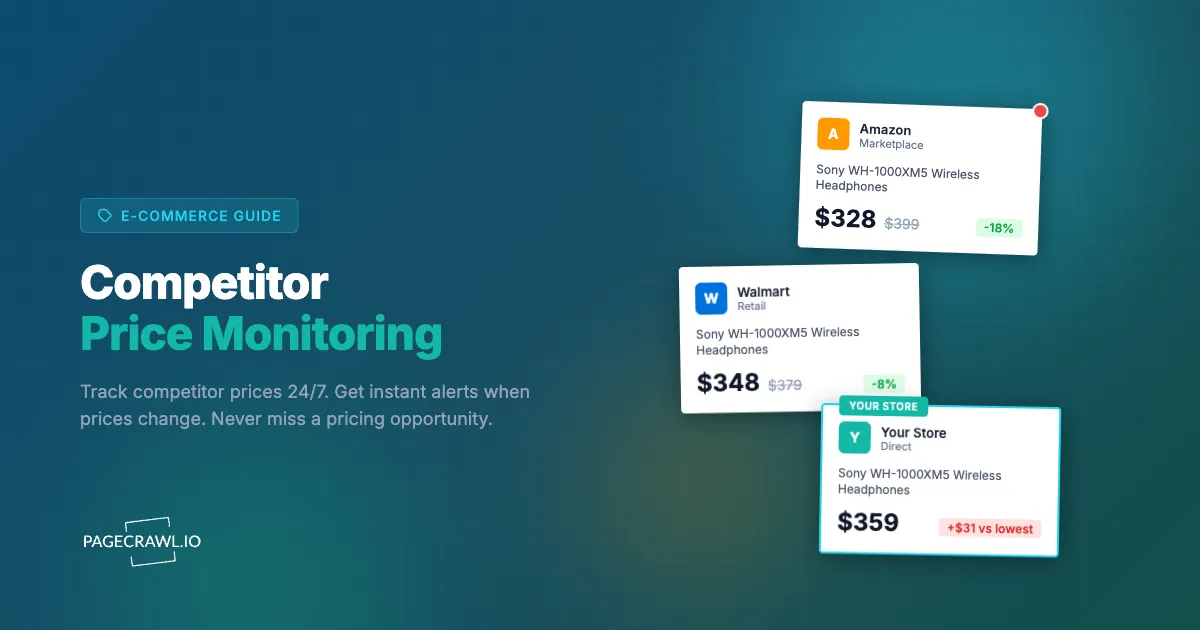
When you add the same product from multiple retailers, PageCrawl automatically groups them and shows a side-by-side price comparison so you can see at a glance who has the lowest price. With product comparison across multiple retailers, you can set alerts for when a specific competitor becomes the cheapest or when the price gap between retailers exceeds a threshold you define.
Handling Protected Websites
Many e-commerce sites use bot protection that blocks automated access to prevent scraping and competitive monitoring. Standard monitoring tools often fail on these sites.
PageCrawl handles pages behind bot protection reliably, maintaining access where other tools fail. This means you can monitor competitors who've specifically tried to prevent monitoring, often the competitors you most need to watch.
Setting Check Frequencies
Match monitoring frequency to how often prices actually change and how quickly you need to respond:
15-minute to hourly: Fast-moving categories where prices change multiple times daily and quick response matters. Consumer electronics, trending products, and high-competition items.
Daily: Standard monitoring for most products. Catches changes within a business day, sufficient for most pricing decisions.
Weekly: Stable categories with infrequent price changes. Books, specialty items, and products with less active competition.
More frequent checks consume more resources. Start conservatively and increase frequency for products where you notice frequent changes or where speed matters.
Configuring Alerts
Decide what triggers an alert:
Any price change: Alerts on any movement, useful for important products where you want full visibility.
Price decrease threshold: Alert when competitors drop prices by more than a percentage or absolute amount.
Price below yours: Alert when a competitor undercuts your price.
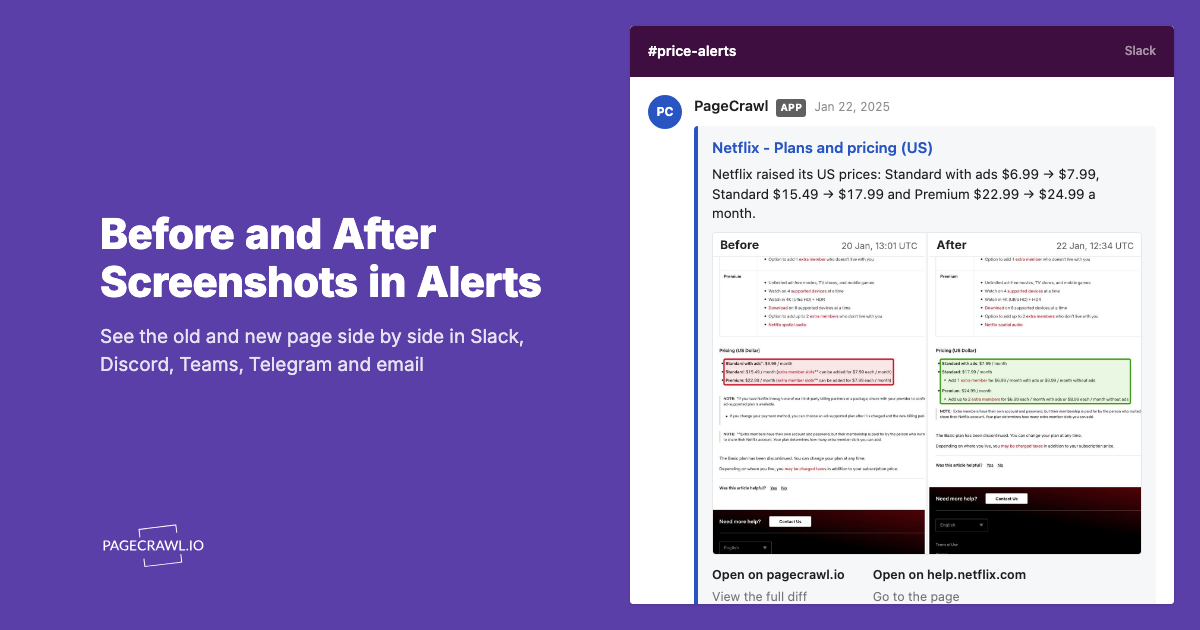
Route alerts to the appropriate people. Price changes might go to e-commerce managers, major competitive moves to category managers, and strategic pricing shifts to leadership. Use Slack channels, email distribution lists, or other tools to ensure the right people see relevant alerts quickly.
Analyzing Competitor Price Data
Collecting price data creates value only when you analyze and act on it.

Building Price Intelligence
Raw price alerts tell you what changed. Analysis tells you what it means. Look for:
Pricing patterns: Do competitors follow predictable cycles? Many retailers discount on specific days or run monthly sales. Recognizing patterns helps you anticipate moves.
Response behaviors: How do competitors react when you change prices? Some match quickly, others ignore changes, some undercut. Understanding response patterns informs your strategy.
Price positioning: Where do competitors position relative to market? Some consistently premium, others value-focused. Knowing positioning helps you find your space.
Promotional calendars: When do competitors run major sales? Holiday timing, seasonal patterns, and promotional rhythm all become visible through monitoring.
Creating Dashboards
For serious competitive pricing, raw alerts aren't enough. Build dashboards that show:
- Price trends over time for key products
- Your position relative to competition
- Price gap distribution
- Promotional activity calendar
- Response time metrics
Export data from PageCrawl via API or webhooks to feed business intelligence tools. Visualization helps identify patterns that individual alerts miss.
Pricing Strategy Responses
Monitoring data informs strategy, but strategy determines response. Different situations call for different approaches.
Price Matching
The simplest response to competitor price drops is matching. But matching isn't always right:
When to match: Products where customers actively compare, low switching costs, and where you can afford the margin impact.
When not to match: When it triggers a race to the bottom, when your value proposition justifies premium pricing, or when matching destroys margins on products competitors may be discounting as loss leaders.
Some retailers automate matching through rules-based repricing. "Match Amazon within $1" or "Stay within 5% of lowest competitor." Automation works for high-volume commodity products but risks unintended consequences without human oversight.
Strategic Positioning
Rather than reactive matching, use competitor intelligence strategically:
Value positioning: Price above competitors but emphasize service, quality, or experience. Monitoring ensures you're not too far above the market.
Value pricing: Position slightly below competitors on key traffic-driving items while maintaining margins elsewhere.
Cherry-picking: Beat competitors on high-visibility products while maintaining margins on less-compared items.
Promotional timing: Launch your promotions when competitors aren't running theirs to avoid head-to-head discounting.
Margin Protection
Not every competitor price drop deserves a response. Some considerations:
- Is this a permanent price change or a temporary promotion?
- Can you afford to match while maintaining acceptable margins?
- Will customers notice or care about this price difference?
- Is the competitor's pricing sustainable or a mistake?
Sometimes the right response is no response. A competitor selling below cost will eventually stop. A 2% price difference on a $15 item may not drive customer switching.
Handling Scale
As monitoring programs mature, scale becomes a challenge. Thousands of products across dozens of competitors generates massive data volumes.
Prioritization Frameworks
When you can't monitor everything equally, frameworks help prioritize:
ABC analysis: Categorize products by revenue contribution. Monitor "A" products (top 20% of revenue) intensively, "B" products regularly, "C" products periodically.
Competitive intensity scoring: Rate products by how actively competitors compete on price. High-intensity products need more frequent monitoring.
Margin impact analysis: Calculate the revenue impact of price changes by product. Focus monitoring on products where price disadvantages cost the most.
Automation and Rules
Scale requires automation. Consider:
Alert filtering: Don't alert on every change. Set thresholds so only significant changes trigger notifications.
Automated responses: For commodity products with clear rules, automated repricing can respond faster than humans.
Exception management: Flag anomalies for human review while automated systems handle routine changes.
Scheduled reviews: Rather than responding to every alert, schedule regular review sessions to analyze patterns and make strategic decisions.
Common Pitfalls
Competitor price monitoring programs often fail for predictable reasons.
Monitoring Without Action
Collecting data without acting on it wastes resources. Before building extensive monitoring, ensure:
- Clear ownership of price decisions
- Processes for reviewing and acting on alerts
- Authority to make pricing changes
- Systems to implement changes quickly
Racing to the Bottom
Matching every competitor price decrease starts a war nobody wins. If competitors respond by matching your matches, you've just destroyed margin for everyone.
Reserve aggressive matching for strategic products. Accept being underpriced on some items rather than starting destructive price wars.
Ignoring Context
A competitor's price drop might be a clearance (temporary), a mistake (will be corrected), a loss leader (not sustainable), or a strategic move (requires response). Responding to every drop the same way ignores context.
Build knowledge about competitor behavior. Some always correct mistakes within hours. Some use aggressive pricing to enter categories then raise prices. Context determines response.
Overcomplicating Analysis
You don't need perfect analysis to make better pricing decisions. Simple monitoring with consistent action beats sophisticated analysis that delays response.
Start with basic alerts and simple rules. Add complexity only when you've extracted value from the basics.
Is competitor price monitoring legal?
Yes. Monitoring publicly available competitor prices is legal and standard business practice. However, some boundaries exist, and they mostly concern how you gather data and what you do with it.
What's Clearly Allowed
- Monitoring publicly available prices on competitor websites
- Tracking promotional announcements
- Analyzing pricing patterns and trends
- Using insights to inform your own pricing
Gray Areas
- Excessive automated access that impacts competitor website performance
- Violating terms of service (though enforcement is rare)
- Circumventing access controls
- Scraping and republishing competitor data
What's Not Allowed
- Price fixing agreements with competitors
- Communicating pricing intentions to competitors
- Using non-public information from inside competitors
Monitoring and responding to public competitor prices is competitive business practice. Coordinating prices with competitors is illegal: price-fixing agreements violate antitrust law enforced by the Federal Trade Commission.
Choosing your PageCrawl plan
PageCrawl's Free plan lets you monitor 6 pages with 220 checks per month, which is enough to validate the approach on your most critical pages. Most teams graduate to a paid plan once they see the value.
| Plan | Price | Pages | Checks / month | Frequency |
|---|---|---|---|---|
| Free | $0 | 6 | 220 | every 60 min |
| Standard | $8/mo or $80/yr | 100 | 15,000 | every 15 min |
| Enterprise | $30/mo or $300/yr | 500 | 100,000 | every 5 min |
| Ultimate | $99/mo or $999/yr | 1,000 | 100,000 | every 2 min |
Annual billing saves two months across every paid tier. Enterprise and Ultimate scale up to 100x if you need thousands of pages or multi-team access.
The math is direct. Standard at $80/year covers 100 product pages - enough to monitor your top SKUs across several direct competitors at 15-minute intervals, so you catch price moves the same morning they happen rather than days later. A single recovered sale or one margin point preserved on a repricing decision typically covers the annual cost. For stores running a full category pricing program, Enterprise at $300/year tracks 500 product pages, which is usually enough to cover every meaningful competitor across an entire product line without needing to triage what gets monitored.
Getting Started
Competitor price monitoring transforms e-commerce from reactive to proactive. Instead of discovering you've been underpriced for weeks, you know within hours. Instead of guessing at competitor strategies, you see them unfold check by check.
The investment in monitoring pays for itself quickly through recovered sales, optimized margins, and strategic insight. One caught price gap often covers months of monitoring costs.
Start with your highest-volume products and most important competitors. Set up automated monitoring and establish basic response processes. Refine from there based on what you learn.
Try PageCrawl for competitor price monitoring and stop leaving revenue on the table.