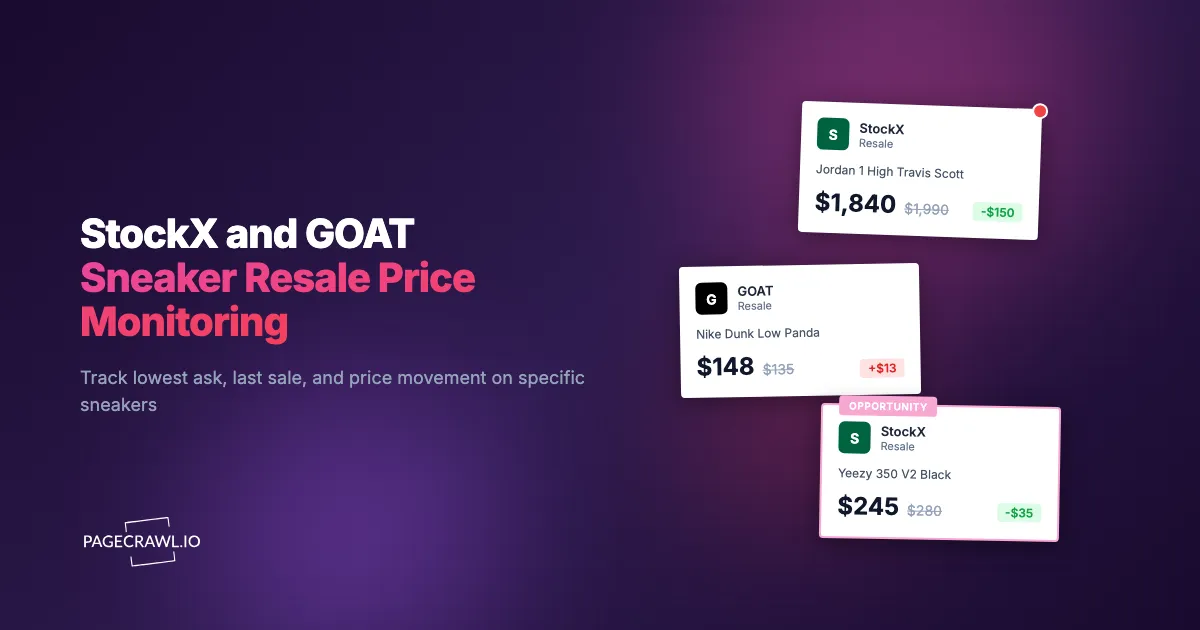
Picture a hyped Air Jordan collab in size 10 that has been trading in a tight band for months. One afternoon a seller relists and the lowest ask on StockX falls a couple of hundred dollars below that band. It sits there for a few hours, gets bought out, and the ask climbs back. Inside that window a flipper with a price alert on that exact size could have bought a pair, listed it back on GOAT at the cross-platform average, and cleared a real margin after fees. A collector could have taken the same pair at a market-low ask. Neither had any reason to refresh the page in the middle of a Tuesday afternoon, which is why the buyers in windows like that tend to be the same handful of resellers running continuous price monitors.
Sneaker resale on StockX and GOAT is liquid enough that lowest-ask and last-sale prices move on a daily and sometimes hourly cadence. Both platforms publish price history, sale volume, and the current ask publicly for every listed sneaker. A continuous monitor on the specific size-and-style combinations you actually flip or collect turns the platforms into a continuously updated arbitrage and buying tool. Manual checking is the standard pattern for casual collectors, but it does not catch the windows when the spread opens up for a few hours and closes again.
This guide covers how StockX and GOAT publish price data, what patterns drive the cheapest buys and the highest-margin flips, and how to set up monitors that surface price drops and cross-platform spreads in time to act.
Why are sneaker resale prices worth monitoring continuously?
Because the buy windows are short and unannounced: a lower ask can appear and be bought out in a few hours, and the price data that reveals it is public on every style page. The resale market is liquid, public, and seasonal in ways that create monitoring opportunities most flippers ignore.
Lowest Ask Drops Open Buy Windows
When a seller relists at a lower ask, the lowest displayed price on the page drops. If your buy target on a specific size is at or above the new ask, you want to know within minutes, not days. The cheapest pairs get bought out fast, especially on hyped silhouettes.
Last Sale Increases Signal Tightening Markets
When the last sale price ticks up, especially across multiple consecutive trades, the market is tightening. For flippers holding inventory, this is the signal to list. For collectors hoping to buy at a better price, this is the signal to act before further increases.
Cross-Platform Spreads Create Arbitrage
StockX and GOAT settle on slightly different equilibrium prices because of buyer composition, fee structure, and inventory dynamics. Sustained spreads on specific styles in specific sizes are common and persistent enough to trade against. Monitoring both platforms at once surfaces the spread, and PageCrawl can compare one product's price across multiple retailers in a single view rather than leaving you to diff two alerts by hand.
Volume Spikes Precede Price Moves
When trade volume on a specific style spikes, prices often move within days. A jump to several times the normal weekly volume on a quiet style usually telegraphs a collab announcement, an editorial moment, or a celebrity wear that drives demand.
Restocks And New Releases Reset The Market
Brand restocks (Air Jordan retro reissues, Yeezy restocks, Nike SB resurfaces) compress resale prices toward retail. A monitor on the resale page catches the compression so flippers can rebalance inventory before the market settles to a new baseline.
How do StockX and GOAT publish price data?
Both platforms expose stable per-style URLs that render lowest ask, last sale, sale volume, and price history publicly, with no account required to read them. That is what makes a monitor possible in the first place.
https://stockx.com/{slug}
https://www.goat.com/sneakers/{slug}
Each page renders for a specific style. The size selector changes the displayed lowest ask and last sale to that size's data. For flipping, the relevant URL is the style page with the size pre-selected (StockX includes the size as a URL parameter; GOAT in the path or query).
New asks at a lower price update the lowest ask. Completed sales update the last sale. Both fields are content that PageCrawl's product page monitoring tracks and flags on change.
Comparing Approaches
| Approach | Cost | Latency | Coverage | Best For |
|---|---|---|---|---|
| Manual refresh | Free | Hours to days | Per style/size | Casual collectors |
| StockX/GOAT native price alerts | Free | Hours | Limited per-account caps | Light users |
| Sole Retriever, SoleSavy, KicksOnFire alerts | $10-50/month | Hours | Curated drops only | Hype-cycle followers |
| Custom scraping | Engineering time | Minutes | Any URL | Technical flippers |
| PageCrawl on style URLs | Free tier to $80/year | 1-24 hours | Any style/size | Active flippers and collectors |
Native price alerts on both platforms exist but cap notifications, often miss small ask movements, and trail by hours. Curated drop alert services focus on new releases rather than secondary market price action. Direct monitoring of the style page is the most flexible and the highest signal for active flippers.
Setting Up StockX And GOAT Monitoring

Step 1: Build your style and size watchlist
Pick the 20-50 style/size combinations you actively flip or want to acquire. Be specific: a style with five sizes you flip is five monitors, not one. The size-specific data is the actionable data.
Step 2: Build URLs for each style/size combination
For StockX, the URL pattern includes the size as a parameter. For GOAT, it's structured similarly. Copy the URL with the size pre-selected so the monitor tracks size-specific lowest ask and last sale.
Step 3: Add as content monitors
Add each URL with content monitoring and screenshots enabled. Screenshots are useful because the lowest ask and last sale are the load-bearing numbers and visual diff is the fastest confirmation.
Step 4: Set daily checks (15-minute checks for hot styles)
For most of the watchlist, daily checks catch the meaningful moves. For the 5-10 highest-velocity styles (Travis Scott, Off-White, Yeezy, Dunk Low GR), bump to 15-minute checks (Standard plan) so you catch transient lowest-ask drops in time to buy out the inventory.
Step 5: Route to Telegram or Discord
Sneaker flipping is mobile and time-sensitive. A Telegram alert or Discord alert reaches your phone wherever you are, and the help centre covers connecting a Telegram bot to a chat, group, or channel. Email adds inbox delay on top of the check interval, which hurts most on the hot-style alerts.
Step 6: Tag by silhouette, brand, or hype level
Create folders for Jordan, Nike SB, Yeezy, New Balance, etc. The folder view rolls up the watchlist and helps you spot category-wide price moves (e.g., the entire SB 4 colorway run softening at once).
Worked Example: A 40-Pair Flipper Watchlist
A part-time flipper turning 15-20 pairs per month wants continuous awareness on a 40-style watchlist across StockX and GOAT. The setup:
- Build 40 StockX URLs with sizes pre-selected (40 monitors).
- Build 40 matching GOAT URLs (40 monitors).
- Tag everything by silhouette family (Travis, SB, Yeezy, Jordan retro, etc.).
- Set 15-minute checks on the top 20 hyped styles, daily on the rest.
- Route alerts to a Telegram channel so they reach the phone as soon as a check finds the move.
In a good month, that flipper catches a few cross-platform spread opportunities and a couple of lowest-ask drops on personal grails, bought out before the ask normalizes. A single caught spread comfortably covers the $80/year Standard plan for the year.
Which sneaker price patterns are worth watching?
Six signals carry most of the value: a lowest ask dropping under your buy target, a new all-time-high last sale, a cross-platform spread wider than your round-trip fee, a volume spike on a quiet style, restock-driven price compression, and pre-collab tightening across a silhouette family.
Sub-target lowest ask drops. When the lowest ask on a specific size drops below your buy target, alert fires. This is the basic flipping signal.
New all-time-high last sales. A new ATH on a style indicates tightening supply or rising demand. Worth listing into.
Cross-platform spreads. Lowest ask on StockX vs lowest ask on GOAT for the same size differing by more than your round-trip fee (which depends on the platform and your seller status, so check the current fee schedule on each) is arbitrage.
Volume spikes on quiet styles. A jump to several times the usual weekly volume on a style that normally trades a pair or two often telegraphs a coming hype moment.
Restock-driven compressions. Brand restocks of retro silhouettes compress resale prices toward retail. Monitor the resale page to catch the compression before the market settles.
Pre-collab divergence. Rumored collabs sometimes show up as price tightening on similar silhouettes weeks before the announcement. Watching the broader silhouette family surfaces the pattern.
Combining Sneaker Price Alerts With Other Signals
Pair with release calendars. Sole Retriever, Sneaker News, and the SNKRS app surface upcoming drops. Pairing release-calendar awareness with resale monitoring lets you plan flip strategy ahead of drops.
Pair with Goldin and PWCC for cards or other resale categories. Same monitoring approach works for sports cards, fashion resale on Poshmark, and other authenticated collectibles. The principle is identical: stable URL, public price data, continuous monitoring.
Pair with help center and policy monitoring. StockX and GOAT both change fee structures and seller policies periodically. The help center diff monitoring guide covers monitoring those.
Pair with social signal. Hypebeast, KicksOnFire, and key sneaker Twitter accounts often telegraph hype moments. A monitor on those plus resale price monitoring gives you the upstream and downstream signal together.
Use Cases
Active flippers. Daily and intra-day price awareness across a watchlist of 30-100 styles. Monitoring replaces what used to be hours of daily manual refresh.
Collectors with target prices. A watchlist of grails with target prices, alerts only firing when the ask hits target. Patience plus monitoring catches buys that manual checking misses.
Boutique buyers and consignment shops. Inventory planning informed by current resale prices. A monitor on incoming consignment styles informs accept/decline decisions.
Investors treating sneakers as an asset class. Sneaker indices and portfolio tracking benefit from continuous price data feeds. The monitoring archive becomes a personal price history database.
Sneaker content creators. Restock and price-move awareness fuels timely content. The creator who catches a sub-retail StockX moment can publish the alert before the buy-out happens.
Resale aggregator startups. Continuous price data across multiple platforms is the raw material for any aggregator or arbitrage tool. PageCrawl's API and webhook output feed downstream automation.
Frequently Asked Questions
How often do lowest-ask drops happen on hyped styles? Multiple times per day on the most-traded styles (Travis Scott Lows, SB Dunks GR colorways, popular Yeezy 350s). On quieter styles, weekly or less.
Will PageCrawl detect price changes inside a single check? PageCrawl captures the current state on each check. Transient drops that happen and reverse between two checks are missed. Tighter check frequency catches more of these.
Can I monitor specific sizes only? Yes. Build the URL with the size pre-selected and the monitor tracks size-specific data.
What about retail-channel restock alerts (SNKRS, Nike, etc.)? SNKRS is highly restricted but other retail surfaces work. Add the Nike or Adidas product page as a monitor for retail-channel stock changes.
Will alerts work for international platforms (Klekt, Restocks)? Yes. Any public sneaker resale page with a stable URL works.
Do I need a paid plan for sneaker monitoring? Casual collectors can fit 6 high-priority watches on the free plan. Active flippers usually move to Standard at $80/year for 100 monitors and 15-minute checks.
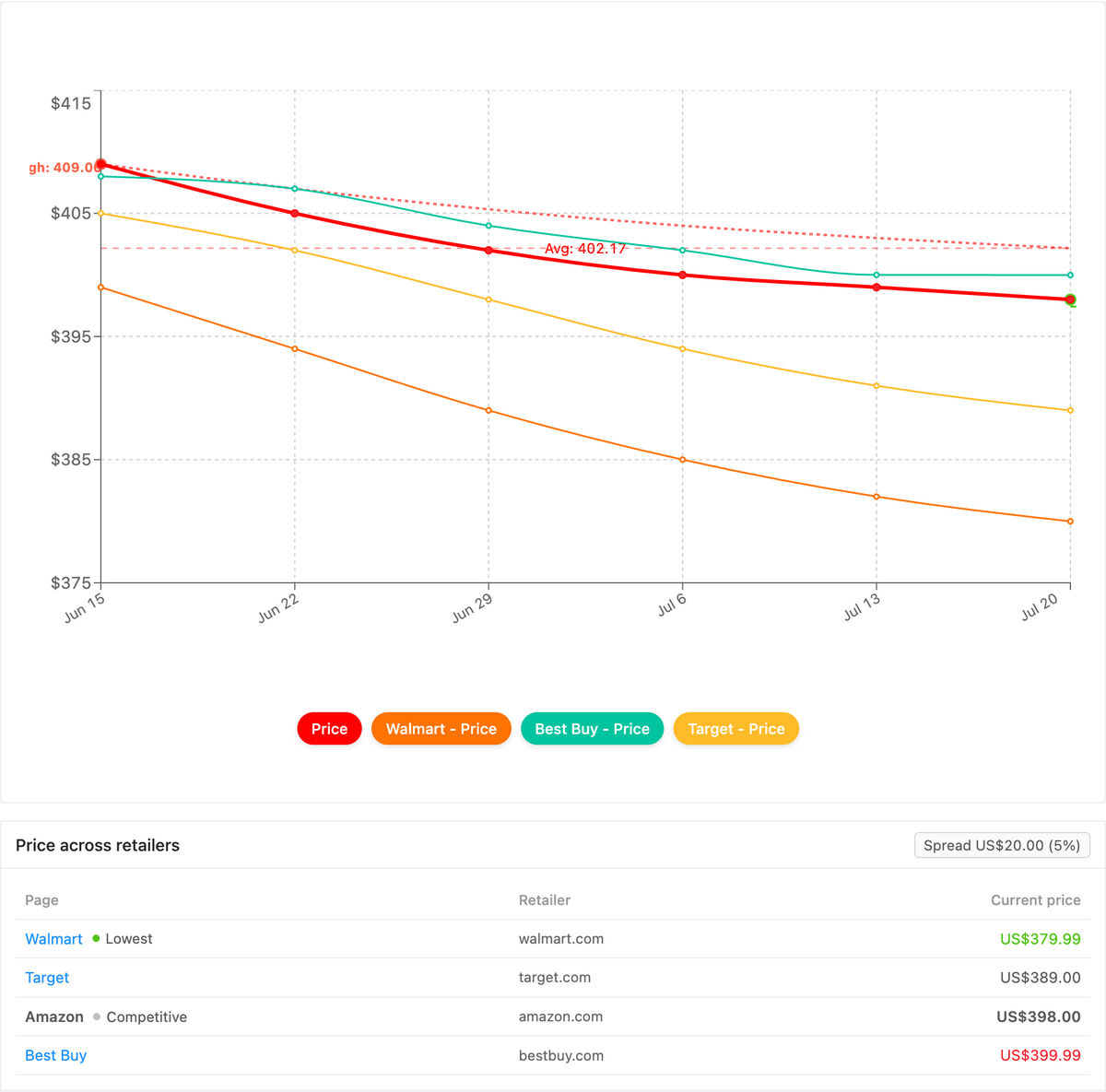
Can you line up one sneaker's price across StockX, GOAT, and every other marketplace at once?
Yes. PageCrawl's Product Comparison capability groups the monitors for one sneaker (a specific style and size) across every marketplace into a single view, highlights the cheapest advertised ask, and tracks the spread between the lowest and highest seller. That turns a cross-platform arbitrage gap from a number buried on one listing into an obvious, live figure you can act on.
Once your per-page ask and last-sale monitors are running, Product Comparison stitches together the ones that share a sneaker (by SKU, style code, or your own reference tag) into one grouped comparison. StockX, GOAT, and international boards like Klekt or Restocks line up side by side for the same size, the lowest ask is flagged, and the spread between cheapest and most expensive is a live number. When one platform drops below your buy target or a spread opens past your round-trip fee, a comparison-aware alert (cheapest, most-expensive, or spread-threshold) surfaces on the next check, routed to email, Slack, or a webhook. You can export the whole grid as a spreadsheet too. The full walkthrough lives in the cross-retailer price comparison guide, and Product Comparison is a custom capability we enable on request.
Choosing your PageCrawl plan
PageCrawl's Free plan lets you monitor 6 pages with 220 checks per month, which is enough to validate the approach on your most critical pages. Most teams graduate to a paid plan once they see the value.
| Plan | Price | Pages | Checks / month | Frequency |
|---|---|---|---|---|
| Free | $0 | 6 | 220 | every 60 min |
| Standard | $8/mo or $80/yr | 100 | 15,000 | every 15 min |
| Enterprise | $30/mo or $300/yr | 500 | 100,000 | every 5 min |
| Ultimate | $99/mo or $999/yr | 1,000 | 100,000 | every 2 min |
Annual billing saves two months across every paid tier. Enterprise and Ultimate scale up to 100x if you need thousands of pages or multi-team access.
The math is straightforward. Standard at $80/year covers 100 product pages. If monitoring catches one $20 price drop, one mispriced competitor SKU, or one restock you would otherwise miss each month, the plan has paid for itself roughly four times over in the first year.
How do you start monitoring sneaker resale prices?
Add product pages for the styles and sizes you watch to PageCrawl on a daily check, then tighten to 15-minute checks on the handful of styles that actually move. Create a free account and the next ask drop reaches you on the check that follows it, which on a daily schedule means the same day it lands.