A 1-star Trustpilot review posted at 11pm on a Friday described a payment refund that had taken three weeks to process. The brand's marketing team saw it the following Monday morning. By then it had collected a pile of helpful votes, been quoted on Reddit, and nudged the brand's overall rating down a notch. The team responded publicly within the hour, escalated the refund internally, and reached a resolution that the original reviewer updated to 4 stars three days later. The damage was real but bounded. If the same review had gone uncaught for another week, the bump in rating would have shown up in Google's organic snippet, the Reddit thread would have aged into category lore, and the brand would have spent the following quarter explaining the dip in conversion to leadership.
Trustpilot, G2, and Capterra sit at the top of most buyers' research funnels. Reviews on each platform update continuously, and the velocity of new reviews is itself a meaningful signal. A sharp spike in competitor review velocity over a fortnight usually points to a new acquisition campaign or product launch. A 1-star review on your own profile is a customer-success crisis that resolves better when caught in hours. Manual checking is not a workable strategy at any scale. A continuous monitor on the profile pages that matter is.
This guide covers how reviews appear on the three major B2B and consumer review platforms, what review-velocity patterns reveal about your competitors, and how to set up alerts that surface new reviews and rating shifts within hours of posting.
Why are review profiles worth monitoring continuously?
Because the three surfaces that drive buying decisions all move without warning: a negative review that recovers best when answered the same day, a competitor's review velocity that signals a campaign, and a rating that feeds search snippets and category leaderboards. Trustpilot, G2, and Capterra send no reliable push for any of it.
Negative Reviews Resolve Better When Caught Fast
Responding publicly within 24 hours of a 1-star or 2-star review tends to improve the outcome. Reviewers update or remove negative reviews more often when the brand engages quickly and resolves the underlying issue. The first 24 hours are the highest-leverage window for recovery.
Competitor Review Velocity Is A Category Signal
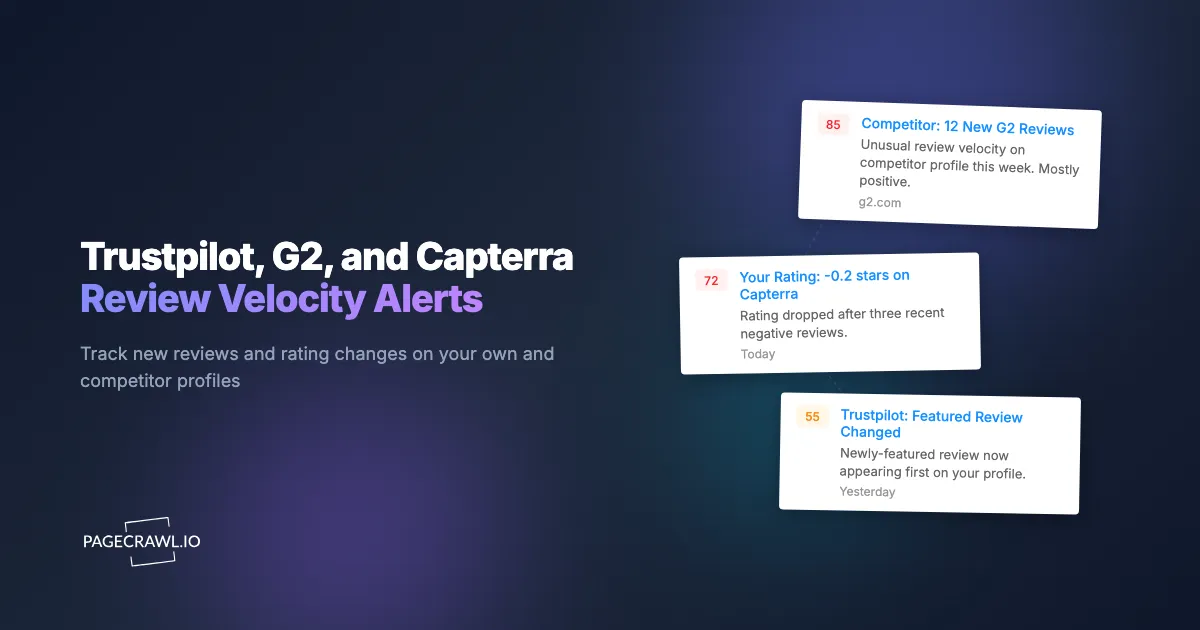
When a competitor's review velocity triples over two weeks, something is happening. New campaign. Product launch. Affiliate push. Whatever it is, you want to know about it. Sustained review velocity also affects ranking on category pages (G2 and Capterra both surface velocity in their algorithms), so a competitor moving up the leaderboard is a function of velocity, not just rating.
Rating Changes Affect Visibility And Conversion
Trustpilot's TrustScore and G2/Capterra's rating values feed into search engine results (rich snippets) and on-platform category placement. A drop from 4.4 to 4.2 affects organic CTR. A rise from 4.1 to 4.4 affects category leaderboard position. These transitions matter and monitoring catches them in time to respond.
Featured Review Changes Affect First-Impression For Prospects
Each platform features specific reviews at the top of the profile page. These are the reviews a buyer reads first. When the featured review changes from a 5-star case study to a 2-star complaint, conversion suffers straight away. Monitoring catches the featured-review rotation so customer-success or marketing can intervene.
How are review platforms structured?
Each of the three platforms publishes a single public profile page per product or brand, holding the aggregate rating, total review count, featured reviews, and the recent review feed. Each has its own URL pattern and rendering approach:
https://www.trustpilot.com/review/{domain}
https://www.g2.com/products/{slug}/reviews
https://www.capterra.com/p/{id}/{slug}/
Trustpilot profiles render the brand's TrustScore, total review count, and the recent review feed. G2 profiles render the star rating, total review count, and recent reviews with feature filters. Capterra profiles render the star rating, total review count, and review list with rating breakdown.
All three update review lists continuously as new reviews post. Rating values, total counts, and featured reviews update on the page render. PageCrawl monitors the page content and flags new reviews, rating changes, and featured-review rotations.
How do review monitoring approaches compare?
Native platform alerts cover only your own profile, full reputation suites cover everything at enterprise prices, and custom scraping costs engineering time. Monitoring the public profile pages directly sits in the middle: any profile on any platform, at a check frequency you choose.
| Approach | Cost | Latency | Coverage | Best For |
|---|---|---|---|---|
| Platform native email alerts | Free | Hours to days | Owned profile only | Light watchers |
| Reputation management tools (Birdeye, Podium, Reputation.com) | Enterprise pricing | Hours | Full reputation stack | Multi-location enterprises |
| Review management SaaS (Trustmary, Reviewflowz) | Mid-market subscription | Hours | Owned plus competitor | Mid-market with budget |
| Custom scraping | Engineering time | Minutes | Any profile | Technical teams |
| PageCrawl on review profiles | Free tier to $80/year | 1-24 hours | Any profile, any platform | Brand and CX teams of any size |
The full-stack reputation tools are powerful but priced for enterprises. For a focused watchlist of your own profile and the top 5-10 competitors, monitoring the public profile pages directly delivers the core signal at a small fraction of the cost.
Setting Up Review Monitoring
Step 1: Add your own profile on each platform
Your own Trustpilot, G2, and Capterra profiles are the highest-priority monitors. Add each as a content monitor with hourly checks.
Step 2: Add competitor profiles
Add the same three platforms for each of your top 5 competitors. Daily checks are usually enough for competitor profiles since you are watching for velocity patterns rather than single-review crises.
Step 3: Configure check frequency by priority
For your own profile, hourly checks support same-day response on negative reviews. For competitor profiles, daily checks catch velocity shifts and rating changes without burning checks. For owned profiles in high-volume categories with multiple reviews per day, every 30 minutes is worth the extra checks.
Step 4: Route own-profile alerts to a fast channel
For your own profile, route alerts to a #reviews Slack channel with CX and marketing both subscribed, following the Slack notification setup. The first respondent on a negative review wins time.
Step 5: Route competitor alerts to a weekly digest
For competitor profiles, a daily email digest or a weekly summary in the competitive-intelligence channel is the right cadence. The signal is the pattern, not any single review.
Step 6: Tag and group into folders
Create a "Reviews" folder with subfolders for "Own Profile" and "Competitors," using labels, folders, and workspaces. The folder view rolls up the watchlist on a single page and is the standard morning check for the CX lead.
Worked Example: A B2B SaaS Reputation Setup
A mid-market B2B SaaS company wants real-time awareness on its own G2 profile and category-aware monitoring of its top 5 competitors. The setup:

- Add own profile on Trustpilot, G2, and Capterra (hourly checks, route to
#reviewsSlack with CX lead and head of marketing tagged). - Add 5 competitor profiles on each of the 3 platforms (15 monitors total, daily checks, route to a weekly CI digest).
- Add the G2 category page for the company's primary category (daily checks, flagged when leaderboard order changes).
- Tag everything with
reputation.
Three weeks in, the CI digest surfaces a clear pattern: one specific competitor's G2 review velocity has 3x'd over the period and they have moved from #6 to #3 in the category leaderboard. The marketing lead investigates and finds the competitor running a "review for $50 Amazon gift card" campaign. The team designs a comparable, compliant program of their own. Total cost: $80/year for the Standard plan, which is dramatically less than any reputation-management SaaS would cost.
Patterns Worth Watching
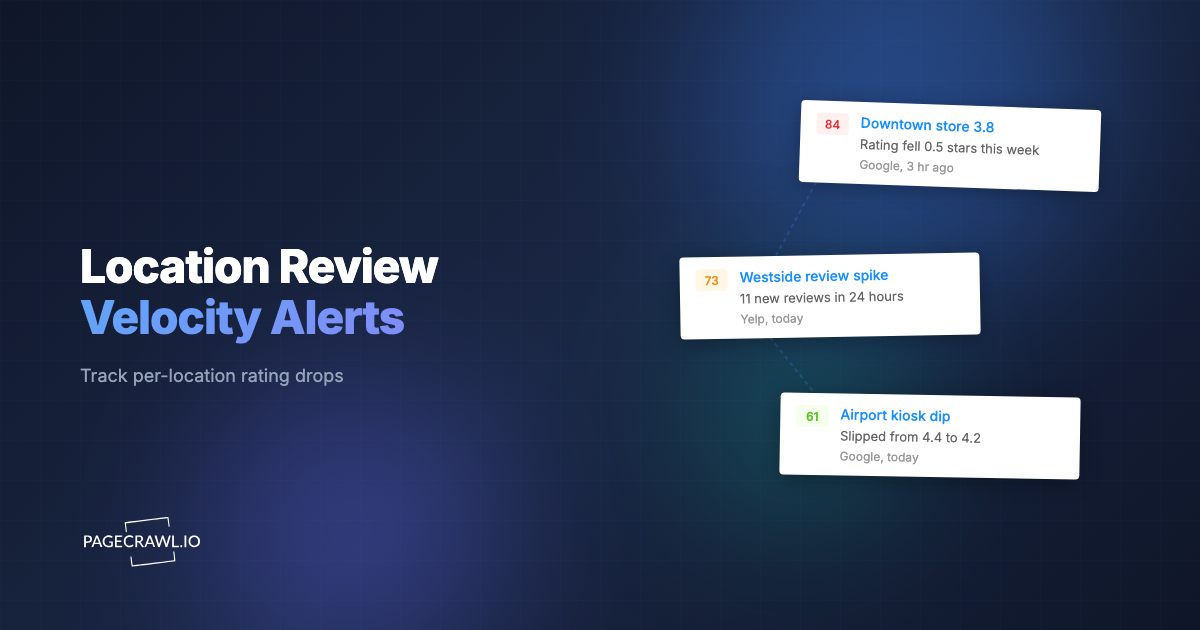
Sudden negative review clusters on your profile. Three or more 1-2 star reviews in a 48-hour window almost always points to a specific product or service incident. Investigate the underlying root cause, not just the individual reviews.
Velocity spikes on competitor profiles. 3x or higher acceleration over 14 days indicates a campaign, launch, or affiliate push. Worth investigating regardless of rating.
Rating drift over time. Slow drift (0.2 points over a quarter) is invisible day-to-day but visible in a quarterly review. The monitoring archive surfaces the drift.
Featured review rotations. Both G2 and Trustpilot rotate featured reviews on the profile page. When the featured review changes from positive to negative, conversion drops. Marketing should know within an hour.
Category leaderboard changes. G2 and Capterra both rank by a combination of rating and velocity. Movement in or out of the top 5 in a category is a meaningful event.
Cross-platform divergence. When a brand's G2 rating is rising while Trustpilot is falling, the divergence reveals different customer segments having different experiences. Worth investigating.
Combining Review Alerts With Other Signals
Pair with help center diffs. Negative reviews often correlate with help center policy edits. When refund or cancellation policy changes, reviews about refunds spike. See the help center diff monitoring guide.
Pair with social listening. A 1-star review that gets quoted on Twitter or Reddit creates an amplification cycle. Adding social monitoring on top of review monitoring catches the cycle early.
Pair with ad library monitoring. Competitor review velocity spikes after creative refreshes. The Meta and TikTok ad library monitoring guide captures the upstream signal.
Pair with Google Search updates. Algorithm changes affect rich-snippet display of review ratings. The Google algorithm update monitoring guide covers that surface.
Who uses review velocity monitoring?
CX and customer success teams use it to catch negative reviews the same day, marketing and sales use competitor rating and velocity shifts for positioning and battlecards, product teams mine new reviews for emerging issues, and brand teams watch featured-review rotations that shape first impressions.
Customer success and CX teams. Same-hour negative review awareness is operational. The first response on a 1-star Trustpilot review shapes the outcome, and the team that responds in hours instead of days recovers more of those reviewers.
Marketing. Competitor rating shifts and category leaderboard changes inform positioning and slot into the same competitive intelligence monitoring feed as rival pricing and product pages. A competitor moving up the leaderboard often telegraphs the next quarter's competitive pressure.
Product. New reviews surface emerging product issues before they show up in support tickets. Reading the last 30 days of competitor reviews is one of the cheapest product research methods available.
Brand and PR. Featured review changes affect first-impression conversion and brand perception, which is why review profiles belong in a wider brand and reputation monitoring watchlist. Same-day awareness lets the brand team intervene or amplify as appropriate.
Sales enablement. Competitor review themes (common complaints, common praise) are the raw material for battlecards. Quarterly review of competitor profiles produces objection-handling material no other source provides.
Investor relations. For public DTC and SaaS companies, review velocity and rating are public datapoints that feed into equity research. Monitoring catches the inflection points.
Frequently Asked Questions
Can PageCrawl alert on individual review content? PageCrawl's AI summary describes the change in human-readable form, including which review is new and the rough sentiment. For deeper content extraction, the webhook integration sends the full diff to a downstream service.
How fast will I be alerted to a new 1-star review? On hourly checks, within an hour. On 15-minute checks (Standard plan), within 15 minutes. For most CX response patterns, hourly is more than fast enough.
Will reviews trigger alerts even when the rating does not change? Yes. The review list itself is what PageCrawl monitors. New reviews trigger alerts regardless of whether they move the aggregate rating.
Can I monitor LinkedIn product reviews or App Store reviews? Yes. Any public review page with a stable URL works. App Store, Google Play, LinkedIn product pages, Software Advice, TrustRadius, and employer rating pages on Glassdoor and Indeed all monitor the same way.
What if a review platform requires login to see reviews? Most public review pages render fully without login. For platforms that require session, you may need a higher-tier setup with session capture.
Do I need a paid plan for review monitoring? No. Own profile across 3 platforms plus your top 3 competitor profiles fits within the 6-monitor free tier. Standard at $80/year is the right step up for a full Tier 1 and Tier 2 competitive watchlist.
Choosing your PageCrawl plan
PageCrawl's Free plan lets you monitor 6 pages with 220 checks per month, which is enough to validate the approach on your most critical pages. Most teams graduate to a paid plan once they see the value.
| Plan | Price | Pages | Checks / month | Frequency |
|---|---|---|---|---|
| Free | $0 | 6 | 220 | every 60 min |
| Standard | $8/mo or $80/yr | 100 | 15,000 | every 15 min |
| Enterprise | $30/mo or $300/yr | 500 | 100,000 | every 5 min |
| Ultimate | $99/mo or $999/yr | 1,000 | 100,000 | every 2 min |
Annual billing saves two months across every paid tier. Enterprise and Ultimate scale up to 100x if you need thousands of pages or multi-team access.
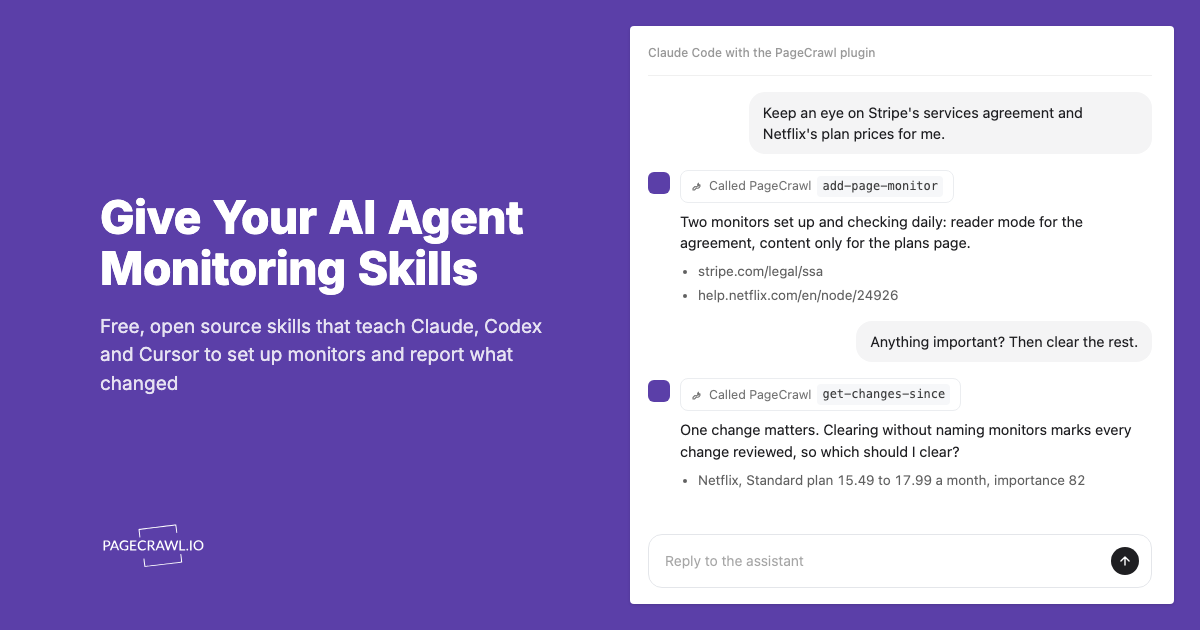
Catching a brand impersonation, a defamatory review, or a negative social post in hours instead of weeks is worth multiples of a Standard subscription. $80/year is enough to monitor 100 pages across your name, your products, and the top-volume places people talk about your brand. Enterprise at $300/year fits larger brand protection programs with dedicated ownership. All plans include the PageCrawl MCP Server, so you can ask Claude to summarize every sentiment shift and new mention across your brand footprint over the last week or month.
Getting Started
Add your own Trustpilot, G2, and Capterra pages plus the top three competitor pages on each to PageCrawl on hourly checks for your own and daily for competitors. Create a free account and the next review will arrive in your channel within an hour.