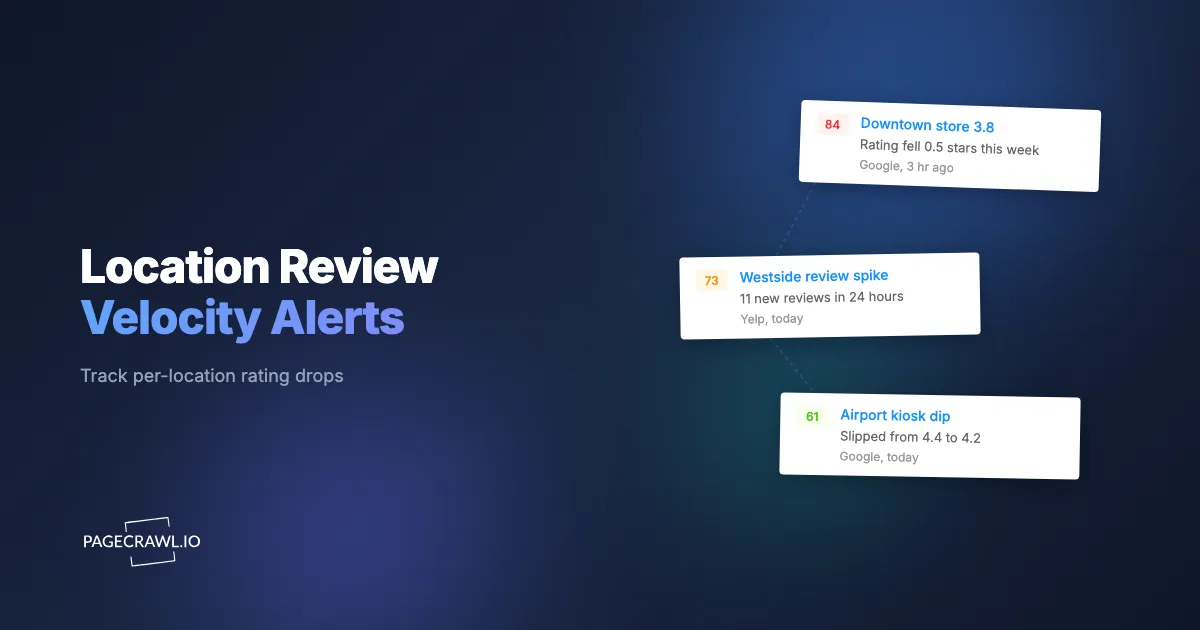
At 9:14 on a Monday morning, the area manager for a 38-location burger chain opened the quarterly reputation deck and found store #23 sitting at 3.9 stars on Google. Eleven weeks earlier the same listing had read 4.5. Somewhere inside that window a cluster of one-star reviews about a broken drive-through speaker and a rude closing shift had quietly dragged the average down, the location had slipped out of the Google local pack for its main search term, and nobody at corporate noticed until the numbers landed on a slide. By then the lost foot traffic was already baked into the month, and the operator was firefighting a reputation problem that was eleven weeks old.
The rating on a public listing is the single most visible number a local business carries. It sits in the search result, the map pin, and the booking widget, yet decays slowly enough that a single location can drift half a star before anyone reacts. When you run dozens or hundreds of locations, the problem compounds: each listing is buried inside a company-wide average that smooths over the one store that is quietly tanking. The aggregate looks fine while store #23 burns.
Velocity is the part most teams miss entirely. A static 4.5 tells you where a location has been. The rate of new reviews, and especially the rate of new one-star and two-star reviews, tells you what is happening right now. A sudden spike of negative reviews almost always traces back to a live operational failure: a bad hire, a health-code incident, a supply outage, or a viral social post. Catching that spike on the day it starts is the difference between a coaching conversation and a permanent dent in the average.
This guide explains what per-location review velocity monitoring is, why a 4.5 to 4.2 slide matters more than it looks, which signals to track on Google, Yelp, and Tripadvisor, and exactly how to set up automated, per-location alerts in PageCrawl that reach the right manager as soon as a check detects the move.
What is multi-location review velocity monitoring?
Multi-location review velocity monitoring is the practice of watching each individual location's public review listing for three things at once: the numeric star rating, the total review count, and the appearance of new low-star reviews. Instead of one company-wide average, every location gets its own tracked rating with its own threshold, so a single store's slide triggers an alert.
The "velocity" part matters because two locations can both sit at 4.3 stars while one is stable and the other is collecting a one-star review every two days. A static snapshot hides that. By tracking the review count over time alongside the rating, you separate a healthy, slowly-growing listing from one that is absorbing a burst of complaints. The first needs nothing. The second needs a manager on the floor today. This is the same velocity logic used for app store and Google Play review monitoring, applied to local consumer platforms instead of mobile stores.
Per-location granularity is the other half. Corporate reputation tools that report a brand average are useful for board decks and useless for operations, because the action always happens at one address. Monitoring the listing itself, location by location, keeps brand and reputation monitoring attached to the store that can actually fix the problem.
Why does a 4.5 to 4.2 rating drop matter so much?
A three-tenths slide looks trivial and is anything but. Public star ratings drive both ranking and conversion. Research by Michael Luca at Harvard Business School found that a one-star increase on Yelp lifts revenue 5 to 9 percent for independent restaurants. The same elasticity runs in reverse: small downward moves cost real bookings and foot traffic.
The mechanics are stacked against slow detection. Google's local pack, the three-listing map block that captures the majority of "near me" clicks, weighs rating and review signals heavily. A location that drifts from 4.5 to 4.2 can fall below a competitor and drop out of the pack for its primary keyword, which removes it from the most valuable real estate in local search. On the conversion side, BrightLocal's consumer surveys consistently show that most people read reviews before choosing a local business, and many set a minimum-rating filter (commonly 4.0) below which they will not consider a listing. Cross that line and you are invisible to a segment of buyers.
Thresholds are why the numeric value, not just the prose, has to be tracked. A 4.5 to 4.2 move is a 0.3 change that should fire an alert; a 4.5 to 4.49 wobble is noise. Treating the rating as a real number with a direction (down) and a threshold is what turns a vague "watch our reviews" goal into a precise, actionable trigger. Pairing that with conditional threshold rules means the alert only reaches a human when the move actually matters.
Which review signals should each location track?
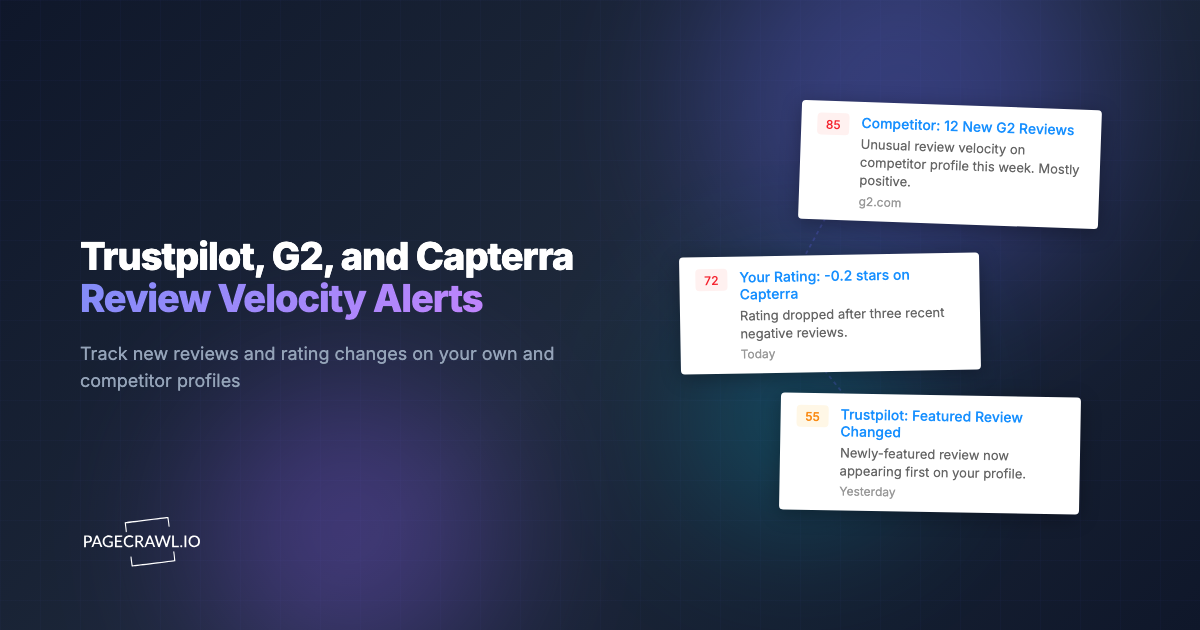
Each location should track four distinct signals: the star rating as a number, the total review count, the text of new low-star reviews, and the listing's live status. Track them separately so you can route a rating drop to one team and a review-count spike to another, and a single quiet wobble does not drown out a real operational fire.
The numeric star rating
The rating is the headline. Capture it as an extracted numeric value (for example 4.27) rather than as text, set a downward direction, and define a threshold such as "alert if it falls by 0.1 or more" or "alert if it drops below 4.0." This is the same numeric tracking used for price monitoring, applied to a rating field, and it is the most important single trigger you will configure.
Review count velocity
The total number of reviews, tracked over time, is your velocity gauge. A normal location adds a handful of reviews per week. A sudden jump of 15 new reviews in 48 hours, especially if the rating is sliding at the same time, almost always signals a complaint cluster or a coordinated incident. Track the count as a number with an upward direction and a spike threshold.
New one-star and two-star reviews
The most urgent signal is the appearance of fresh negative review text. Keyword and text tracking on the listing's most-recent-reviews block lets you catch the words of a new one-star review on the first check after it surfaces, so a manager reads "found a hair in my food, manager refused a refund" in an alert rather than discovering it three weeks later in a report.
Listing live status
Availability tracking confirms each listing is still live and not suspended, merged, duplicated, or hijacked. A listing that suddenly returns an error or a "permanently closed" flag is its own emergency, separate from any rating move, and it deserves a top-priority alert to corporate.
How do Google, Yelp, and Tripadvisor listings differ for monitoring?
The three platforms expose ratings differently, so each needs its own tracked element. Google shows a running average and review count in the Google Business Profile panel and local pack. Yelp publishes a recommended-review rating that filters some submissions. Tripadvisor reports a rating plus a "Popularity Index" rank within a city. Monitor each listing as its own page.
Google is the highest-traffic surface for most local businesses and the one most tied to map and "near me" discovery, so it is usually the primary listing to track per location. The visible rating and review count update continuously, which makes the numeric value and the count the two anchors for Google monitoring.
Yelp matters most for restaurants, bars, and service businesses, and its recommendation filter means the headline rating can move even when the raw submission pattern does not. Tracking the displayed recommended rating plus the count of recommended reviews keeps you aligned with what consumers actually see. For hospitality, Tripadvisor adds the ranking dimension: a hotel can hold a steady 4.0 while sliding from #3 to #11 in its city, which is a ranking signal worth capturing alongside the rating.
PageCrawl renders each of these pages fully, including the parts that load dynamically, and reliably reads listings on sites that resist simple scraping, so the extracted rating reflects what a real visitor sees. Because every location and every platform becomes its own monitored page, bulk URL monitoring is what makes a 200-location, three-platform footprint manageable instead of a spreadsheet nobody updates.
How do you set up multi-location review monitoring with PageCrawl?
Setting up per-location review monitoring takes six steps: build your listing URL list, choose the tracking mode for each signal, set check frequency, define thresholds and conditions, route notifications to the right team, and enable screenshots before going live. The whole process is repeatable across hundreds of locations once the first store is configured.

Step 1: Build your location URL list. Collect the public listing URL for each location on each platform you care about, one row per listing. A 50-location restaurant group tracking Google plus Yelp produces 100 monitored pages. Group them with tags like region:southwest or brand:flagship so alerts and reports can be filtered by territory. For large footprints, import the list in bulk rather than adding listings one at a time.
Step 2: Choose the tracking mode for each signal. On each listing, add a numeric/price tracking element pointed at the star rating so the value is extracted as a real number (4.27, not "4.27 stars based on 812 reviews"); the guide to monitoring numeric values with the number tracker covers the charting and trend view you get for free once a rating is stored as a number. Add a second number element for the review count. Add a keyword/text element on the recent-reviews block to catch new one-star and two-star wording. Use availability tracking to confirm the listing stays live. For listings behind a business dashboard (your Google Business Profile manager or Yelp for Business), login-gated monitoring lets PageCrawl read metrics that are not public.
Step 3: Set your check frequency. For most locations, every 15 minutes is the right cadence to catch a negative-review cluster while it is still small. High-risk or high-volume flagship locations can run as often as every 2 minutes on the higher plans. Quieter rural stores can check hourly. Frequency is set per monitor, so you can spend your check budget where reputation risk is highest.
Step 4: Define thresholds and conditions. Configure the rating element to alert on a downward move of 0.1 or more, or when it crosses a hard floor like 4.0. Set the review-count element to alert on a spike, for example more than 8 new reviews within a rolling 24 hours. Set the keyword element to alert whenever new one-star or two-star text appears. These threshold rules are what keep a 200-listing program from drowning you in routine wobble, so the alert only fires when a move actually matters.
Step 5: Route notifications to the right team. This is where multi-location monitoring earns its keep. Send each location's alert to its local manager through a per-store channel, and copy a corporate comms channel for anything that crosses a serious threshold. PageCrawl pushes to Slack, Telegram, Discord, email, browser web push notifications, and outbound webhooks, so a rating drop can ping the store's regional Slack channel and simultaneously open a ticket in your CX system.
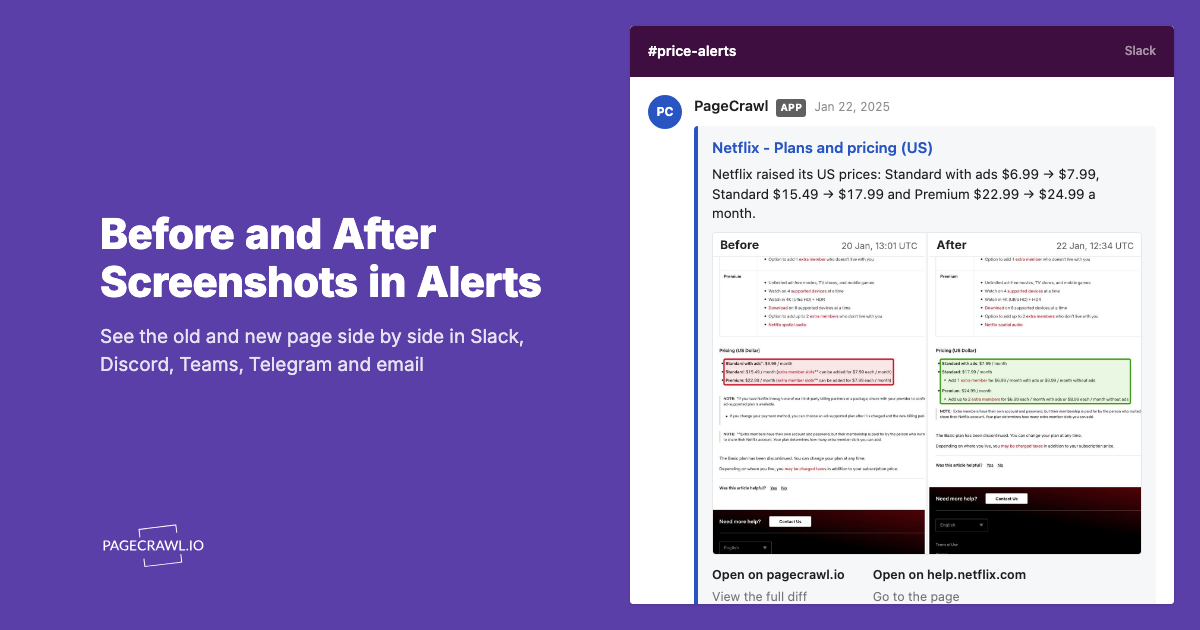
Step 6: Enable screenshots and review. New monitors default to screenshots on, which means every alert arrives with a visual capture of the listing exactly as it looked when the rating moved. That screenshot is your evidence: it shows the manager the new review, the changed star count, and the date, with no ambiguity. Run a few checks, confirm the extracted rating matches the listing, then let the monitor run.
How do you avoid false alarms across hundreds of listings?
You avoid alert fatigue by tracking the rating as a precise number with a meaningful threshold, isolating each signal into its own element, and tuning frequency per location. The goal is that every alert that reaches a human represents a real, actionable move, not a rounding wobble or a layout tweak on the platform.
The most common false-positive trap is treating the whole listing as one blob of text. Review pages change constantly: a new "helpful" vote, a reordered review, a rotating promotional banner. If you alert on any change to the page, you will get hundreds of meaningless pings a day. The fix is to track only the rating number, the count number, and the low-star review text as separate elements, so cosmetic churn on the rest of the page is ignored. Our guide on reducing monitoring false positives walks through this isolation approach in detail.
Thresholds do the rest. A 0.1 rating floor on the numeric element filters out sub-rounding noise. A spike condition on the count element means a single new review does not fire, but eight in a day does. Per-location frequency keeps low-risk stores from generating volume that buries the one location that genuinely needs attention. Tuned this way, a 300-listing program produces a handful of meaningful alerts a week instead of a firehose, which is the difference between a team that acts on alerts and one that mutes the channel.
Who should get the alert: local manager or corporate comms?
Both, but for different triggers. The local manager owns operational recovery and should get every new one-star review and every count spike for their store, as soon as a check picks it up, on a channel they actually watch. Corporate comms and the reputation team should get the serious threshold crossings: a location falling below 4.0, a multi-store negative pattern, or a listing going offline.
Routing by severity keeps each audience focused. If you send corporate every routine three-star review across 200 stores, they tune out, and the one genuine crisis gets lost. If you send the local manager only the company rollup, they never see their own store's problem in time to fix it. The split is operational alerts to the store, escalation alerts to the center.
Tagging by region and brand makes this scalable. With tags in place, a regional director can subscribe to just their territory, and corporate can pull a digest across everything. This per-location, per-channel routing is the same pattern that makes broader online reputation monitoring programs work: the right signal to the person who can act on it, and nothing more to everyone else.
How does per-location review monitoring fit franchises, hotels, healthcare, and retail?
It fits any business where a single physical location carries its own public rating and a single bad week can cost local revenue. Franchises, hotel groups, healthcare networks, restaurant chains, and multi-store retailers all run the same core problem: a brand-level average hides the one location that is sliding, and the operator who can fix it finds out too late.
Franchises have the sharpest version of this, because brand standards live at corporate but the reviews land on the individual operator. Per-location monitoring gives the franchisor an early-warning system and gives the franchisee accountability, without waiting for a quarterly audit. Hotels lean on Tripadvisor ranking as much as raw rating, so tracking the city-level Popularity Index per property catches slides that a steady star average would mask. Healthcare networks watch Google and specialist review sites per clinic, where a cluster of complaints about wait times or billing can move both rating and patient acquisition. Multi-location retailers tie store ratings directly to local pack visibility, so a 0.3 slide at one store is a measurable foot-traffic hit.
The thread across all of them, including adjacent use cases like Glassdoor and Indeed employer reputation monitoring, is the same mechanic: track the numeric rating with a threshold and a downward direction, track review velocity as a count, catch new low-star text with keyword tracking, and route the alert to the location that owns the fix. For teams comparing this against general-purpose tools, our brand monitoring tools roundup covers where dedicated reputation suites fit versus a configurable change monitor.
Choosing your PageCrawl plan
PageCrawl's Free plan lets you monitor 6 pages with 220 checks per month, which is enough to validate the approach on your most critical pages. Most teams graduate to a paid plan once they see the value.
| Plan | Price | Pages | Checks / month | Frequency |
|---|---|---|---|---|
| Free | $0 | 6 | 220 | every 60 min |
| Standard | $8/mo or $80/yr | 100 | 15,000 | every 15 min |
| Enterprise | $30/mo or $300/yr | 500 | 100,000 | every 5 min |
| Ultimate | $99/mo or $999/yr | 1,000 | 100,000 | every 2 min |
Annual billing saves two months on every paid tier. Enterprise and Ultimate add room for thousands of pages and multi-team access as you grow.
How do you get started with review velocity monitoring?
Pick your three highest-risk locations, add their Google listings as numeric rating monitors with a 0.1 downward threshold, point each alert at the channel its manager actually reads, and let it run for a week. You will catch the next slide on the day it starts, not in next quarter's deck.
From there, scaling to every location and every platform is just adding rows. Start free today and turn your review ratings into an early-warning system that protects revenue store by store.