Last reviewed: August 20, 2026. Prices and plan details reflect each vendor's public pages at the time of review and can change, so confirm on the vendor's site before buying.
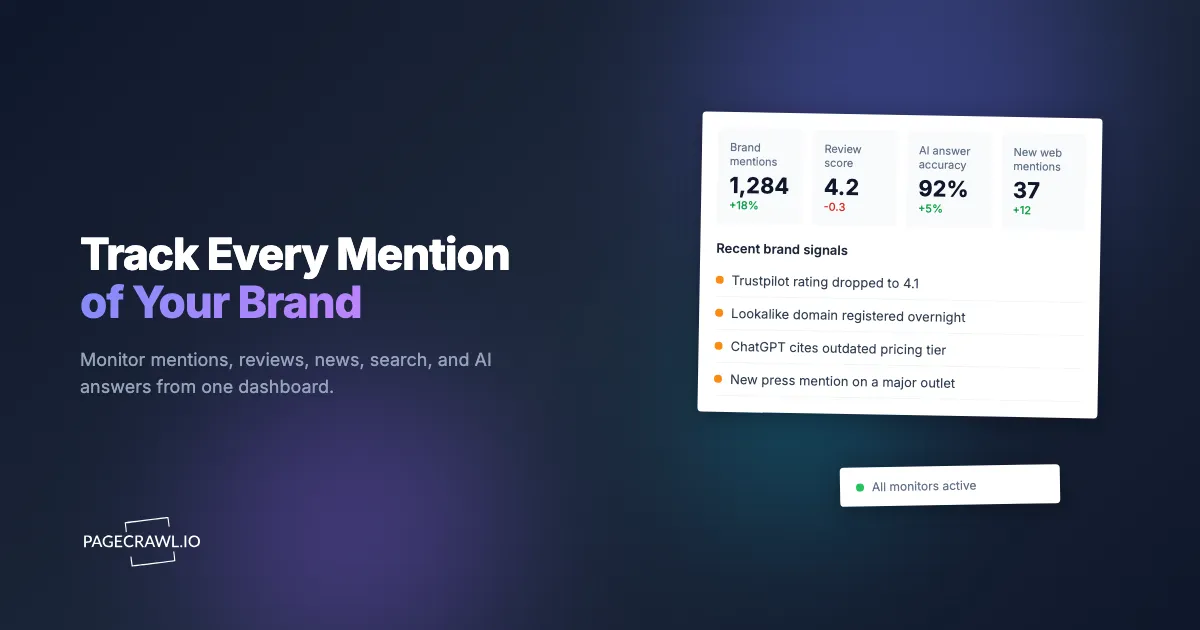
It is 7am and your phone lights up with a screenshot from a customer. A site using your logo is advertising a 70% off "official sale" that you never ran. While you are processing that, your support inbox fills with confused buyers, your Trustpilot rating quietly slips from 4.4 to 4.1 overnight, and a prospect emails to ask why ChatGPT told them your product was discontinued. None of these started this morning. They have all been spreading for days, and you are only finding out now.
Brand reputation no longer lives in one place. It is scattered across social mentions, review platforms, news coverage, search results, lookalike domains, your own web pages, and increasingly the answers AI assistants give when someone asks about you. A modern brand and reputation monitoring stack watches all of those surfaces and tells you when something shifts, instead of waiting for an angry customer to discover it first.
This guide compares the 10 best brand monitoring tools available in 2026. It covers dedicated social listening platforms, media monitoring suites, the free baseline everyone starts with, and the web page monitoring layer that most "mention" tools quietly ignore.
Our top picks at a glance:
- PageCrawl: teams that want certainty on the specific pages, domains, and AI answers that shape buying decisions.
- Brandwatch: large brands and agencies that need analytical depth and historical data.
- Meltwater: PR and communications teams that need media coverage tracking and journalist outreach.
- Awario: startups and small teams that want listening on a tight budget.
- Google Alerts: individuals and very early-stage brands who need a zero-cost first signal.
How does brand monitoring actually work?
Brand monitoring works by continuously scanning the places your brand appears and alerting you when something new or changed shows up. Most tools fall into two families: social and media listening that crawls public conversations for your name, and web page monitoring that watches specific URLs for changes. The strongest programs combine both.
Social and media listening
Listening tools index huge volumes of public content (social posts, news articles, forums, blogs, podcasts, review feeds) and surface every item that mentions your brand keywords. They are excellent for volume, sentiment trends, and catching a viral moment as it builds. Their weakness is that they only see what they can crawl and tag, so private review dashboards, gated comparison pages, and AI chat answers usually slip past them.
Web page monitoring
Web page monitoring watches specific URLs and tells you exactly what changed on them. Instead of asking "who mentioned us today?", it answers "what changed on the 40 pages I care about?". That includes a competitor editing their comparison page, a review site changing your average rating, your own landing page being defaced, or a registrar parking a lookalike domain. It is precise, deterministic, and works on pages listening tools cannot reach.
What should you look for in a brand monitoring tool?
Look for coverage across every surface that shapes your reputation, alerts fast enough to act on, and signal quality high enough that your team does not learn to ignore notifications. The best tool is the one your team actually checks, so coverage and noise control matter more than a long feature list.
Coverage across surfaces
Strong coverage means mentions (social, news, blogs, forums), reviews (Trustpilot, G2, Capterra, app stores), search results, owned web pages, competitor pages, domains, and AI answers. A tool that nails social but ignores review velocity or AI drift leaves a blind spot exactly where buyers make decisions.
Alert speed and channels
A mention you see three days late is a post-mortem, not a response window. Look for near-real-time alerting and routing to where your team already works: Slack, Teams, Discord, email, and webhooks. Catching a viral complaint in an hour rather than a day is often the difference between a quiet fix and a public crisis.
Signal quality and noise control
Brand keywords are noisy. Generic terms, unrelated namesakes, and bot chatter flood most listening feeds. Good tools let you filter by sentiment, source authority, language, and threshold rules so the alerts that reach a human are worth a human. On the page monitoring side, you want change detection that ignores cosmetic churn (rotating testimonials, visitor counters) and flags meaningful edits.
Sentiment, history, and reporting
Intelligence is the trend line, not the raw mention: sentiment over time, share of voice against competitors, review score history, and readable summaries for a weekly report. Historical context turns "we got mentioned" into "negative sentiment is up 30% since the pricing change."
How did we review these tools?
We compared each tool on the criteria this guide sets out for brand monitoring: coverage across surfaces, alert speed and channels, signal quality and noise control, and sentiment, history, and reporting. Pricing and plan details come from each vendor's public pages, and every profile notes the kind of team the tool fits best.
- Coverage across surfaces (mentions, reviews, search, web pages, AI answers)
- Alert speed and channels
- Signal quality and noise control
- Sentiment, history, and reporting
What are the 10 best brand monitoring tools in 2026?
The best brand monitoring tools in 2026 are PageCrawl, Brand24, Mention, Brandwatch, Meltwater, Talkwalker, Awario, Google Alerts, Determ, and Sprout Social. They split into web page monitoring, affordable social listening, enterprise consumer intelligence, and media/PR suites. Below is an honest look at each.
PageCrawl
Type: Web page and AI answer monitoring with change detection Starting price: Free (6 monitors), $8/month (100 monitors), $30/month (500 monitors)
PageCrawl monitors specific URLs and alerts you as soon as a check detects a change, which is the layer most mention-based tools skip. It covers the deterministic side: your own pages, competitor comparison pages, review pages, domains, and the answers AI assistants give about you. You add a page, choose what to watch, and get an alert with a visual diff and an AI summary when it changes.
Brand monitoring features:
- Watch competitor "vs you" pages and comparison content for misleading edits
- Detect website defacement and unexpected changes on your own pages
- Track lookalike and fraud domains as they appear
- Monitor what ChatGPT and AI search say about your brand and catch AI hallucinations before prospects do
- Watch review pages and software comparison listings for rating and content changes
- AI summaries that translate raw diffs into "what changed and why it matters"
- Alerts to Slack, Discord, Telegram, Teams, email, and webhooks
Strengths:
- Works on any URL, including gated, JavaScript-heavy, and login-protected pages
- Precise change detection with screenshot history, so you see exactly what changed at each check
- Combines reputation surfaces (owned pages, competitor pages, reviews, AI answers, domains) in one tool
- Generous free tier with full features on 6 monitors
Limitations:
- Not a broad social listening firehose. It watches pages you choose, so pair it with a listening tool for open-web mention volume.
Best for: Teams that want certainty on the specific pages, domains, and AI answers that shape buying decisions, rather than a wall of unfiltered mentions.
Brand24
Type: Social listening and mention tracking Starting price: From around $149/month (lower individual tiers available)
Brand24 is a popular mid-market social listening tool that tracks mentions across social media, news, blogs, forums, and reviews with sentiment analysis and an influence score for each source.
Strengths: Easy setup, solid sentiment analysis, influencer scoring, and a readable dashboard. Good Slack and email alerting.
Limitations: Historical data depth is limited on lower tiers, some platforms have crawl gaps, and it does not monitor specific page changes or AI answers.
Best for: Small to mid-size brands that want affordable, real-time social and news mention tracking.
Mention
Type: Real-time mention monitoring and social management Starting price: From around $49/month (Solo), higher for teams
Mention pairs real-time alerting with lightweight social media publishing, so you can monitor and respond from the same place. It crawls social, news, blogs, and forums with fast notifications when your brand keywords spike.
Strengths: Quick alerts, combined monitoring and publishing, competitive analysis views, and a clean mobile experience.
Limitations: Mention quotas can be restrictive on lower plans, deep analytics require higher tiers, and there is no page-level change detection or AI answer tracking.
Best for: Social-first teams that want monitoring and posting in one tool.
Brandwatch
Type: Enterprise consumer and social intelligence Starting price: Custom (enterprise)
Brandwatch is an enterprise-grade consumer intelligence platform with a massive historical data archive, advanced query building, and AI-assisted analysis, built for research teams that need deep, segmented insight rather than a simple alert feed.
Strengths: Enormous historical coverage, powerful boolean querying, image and logo detection, and rich segmentation and reporting.
Limitations: Expensive, with a real learning curve. Overkill for small teams, and it focuses on social and web conversation rather than page changes or AI answer accuracy.
Best for: Large brands and agencies that need serious analytical depth and historical data.
Meltwater
Type: Media monitoring and PR intelligence Starting price: Custom (enterprise)
Meltwater is a media monitoring and PR suite that spans news, broadcast, print, and social, with journalist databases and campaign reporting baked in.
Strengths: Broad media coverage, PR and outreach tooling, and strong reporting for proving campaign impact. Pairs well with press release and PR tracking workflows.
Limitations: Enterprise pricing and contracts, a dense interface, and a PR focus that leaves gaps on owned-page changes and AI answer monitoring.
Best for: PR and communications teams that need media coverage tracking and journalist outreach in one platform.
Talkwalker
Type: Enterprise social and media analytics Starting price: Custom (enterprise)
Talkwalker combines social listening with media analytics and strong visual recognition, including logo detection in images and video. It is positioned for global brands tracking many markets and languages.
Strengths: Visual and logo recognition, broad language coverage, predictive analytics, and polished executive dashboards.
Limitations: Enterprise budget required, and like other listening suites it does not handle precise page-level change detection or AI answer drift.
Best for: Global brands that need image-aware listening and multi-market analytics.
Awario
Type: Affordable social listening Starting price: From around $29/month
Awario is a budget-friendly listening tool that tracks mentions across social, news, blogs, and the wider web, with a useful boolean search mode and lead-finding features built in.
Strengths: Low entry price, decent web coverage, boolean queries, and lead-finding features that go beyond pure monitoring.
Limitations: Smaller data archive than enterprise tools, occasional crawl delays, and no page change or AI answer monitoring.
Best for: Startups and small teams that want listening on a tight budget.
Google Alerts
Type: Free web mention alerts Starting price: Free
Google Alerts is the baseline almost every brand starts with. You enter keywords and Google emails you when new pages matching them appear in its index. It costs nothing, which is exactly why it is worth knowing its limits.
Strengths: Free, quick setup, and a reasonable catch-all for new indexed web pages mentioning your brand.
Limitations: No sentiment, no social coverage, unpredictable timing, frequent misses, no review or AI answer tracking, and no real filtering. It is a starting point, not a system, which is why most brands end up looking for a Google Alerts alternative that watches actual pages instead of search results.
Best for: Individuals and very early-stage brands who need a zero-cost first signal. For forum and community spikes it misses, pair it with Hacker News and Product Hunt mention alerts.
Determ
Type: Media monitoring and social listening Starting price: Custom (from the mid hundreds per month)
Determ (formerly Mediatoolkit) is a media intelligence platform that emphasizes fast alerting and spike detection across online news and social, useful for catching sudden surges in mentions early during a crisis.
Strengths: Quick spike alerts, clean interface, good language coverage, and solid reporting for the price tier.
Limitations: Less brand recognition than the enterprise leaders, smaller historical archive, and no page-level or AI answer monitoring.
Best for: Mid-market communications teams that prioritize early crisis detection.
Sprout Social
Type: Social media management with listening Starting price: From around $199/seat/month, listening as a premium add-on
Sprout Social is primarily a social media management suite (publishing, engagement, inbox) with a premium social listening module bolted on, so listening lives in the same workflow your team already uses.
Strengths: Polished all-in-one social workflow, strong engagement and inbox tools, and good reporting.
Limitations: Listening sits behind a premium add-on, per-seat pricing climbs quickly, and coverage is social-centric with no page change or AI answer tracking.
Best for: Teams already standardized on Sprout for social management who want listening in the same tool.
How do the top brand monitoring tools compare?
The right tool depends on whether you need broad mention volume, deep analytics, media coverage, or precise page and AI answer monitoring. Note that "web page monitoring" and "AI answer tracking" are where most listening tools leave a gap that page monitoring fills.
| Tool | Type | Web page monitoring | AI answer tracking | Starting price | Free tier |
|---|---|---|---|---|---|
| PageCrawl | Page + AI answer monitoring | Yes | Yes | Free, then $8/mo | 6 monitors |
| Brand24 | Social listening | No | No | ~$149/mo | Trial only |
| Mention | Mentions + publishing | No | No | ~$49/mo | Limited free |
| Brandwatch | Enterprise intelligence | No | No | Custom | No |
| Meltwater | Media / PR | No | No | Custom | No |
| Talkwalker | Social + media analytics | No | No | Custom | No |
| Awario | Affordable listening | No | No | ~$29/mo | Trial only |
| Google Alerts | Free web alerts | No | No | Free | Free |
| Determ | Media monitoring | No | No | Custom | Trial only |
| Sprout Social | Social management | No | No | ~$199/seat | Trial only |
How do you build a brand monitoring workflow?
Build your workflow in layers: pick the surfaces that matter, monitor each with the right tool, route alerts by urgency, and review on a regular cadence. The goal is a system where the signal that needs a human reaches a human fast. Here is a concrete setup using PageCrawl for the page-level layer.

Step 1: Map your brand surfaces
List every place your reputation lives: your own key pages (homepage, pricing, login), the top competitor comparison pages that name you, your review profiles (Trustpilot, G2, Capterra, app stores), brand-name search results, your primary domain plus likely lookalikes, and the AI answers prospects see when they ask about you. Most brands land on 15 to 40 URLs that genuinely move the needle.
Step 2: Set up your monitors
Create a monitor for each URL. PageCrawl's free tier covers 6 monitors with 220 checks per month, enough to validate the approach on your six most critical pages before expanding. For each monitor:
- Choose a check frequency that fits the surface (hourly for reviews and competitor pages, daily for slower-moving owned pages)
- Set the AI summary focus to the angle you care about, for example "rating changes, new negative reviews, and pricing claims"
- Add filters that reduce false positives so rotating testimonials, dates, and visitor counters do not trigger false alerts
Step 3: Add the AI answer and domain layers
Add a monitor for a brand query in AI search to catch hallucinations and answer drift before they cost you a deal, and a domain monitor to flag lookalike or fraudulent domains soon after they register. These are the surfaces traditional listening tools miss entirely, so they often deliver your highest-value alerts.
Step 4: Route alerts by urgency
Send high-severity alerts (defacement, a rating drop, a fraud domain, a competitor claim) to a dedicated Slack channel that tags the right owner. Route lower-severity changes (minor copy edits, routine review additions) into a daily or weekly digest. Feed everything into a webhook for a central log.
Step 5: Review and respond on a cadence
Data without a response loop is noise. Establish a rhythm: daily triage of overnight alerts, a weekly review of sentiment and review trends, and a monthly look at the full surface map. Assign a clear owner for each surface so no alert dies unread.
What are the hardest parts of brand monitoring?
The hardest parts are noise, coverage gaps, and proving impact. Brand keywords generate enormous unrelated chatter, no single tool sees every surface, and reputation work is hard to tie to revenue. Knowing these up front lets you design around them rather than abandon the program after a flood of useless alerts.
Cutting through mention noise
Generic brand terms and namesakes drown real signal. Combat this with stricter boolean queries, sentiment and source-authority filters, and threshold rules so only meaningful spikes alert a human. On the page side, change-detection filters that ignore cosmetic churn keep your alerts trustworthy enough that your team keeps reading them.
Closing coverage gaps
No listening tool sees review dashboards, gated comparison pages, AI chat answers, and new domains all at once, which is exactly where page monitoring earns its place. Pair a listening tool for breadth with page monitoring for the specific URLs, defacement risks, and AI answers it cannot reach.
Preserving evidence and proving impact
When a defamatory claim or fake site appears, you need a timestamped record, not a screenshot someone took later. Page monitoring keeps a dated history of every version, which matters for takedowns and disputes. See how to preserve internet evidence and connect it to a broader online reputation monitoring program so leadership sees the value.
Choosing your PageCrawl plan
PageCrawl's Free plan lets you monitor 6 pages with 220 checks per month, enough to validate brand monitoring on your most critical surfaces. Most teams upgrade once they see what they were missing.
| Plan | Price | Pages | Checks / month | Frequency |
|---|---|---|---|---|
| Free | $0 | 6 | 220 | every 60 min |
| Standard | $8/mo or $80/yr | 100 | 15,000 | every 15 min |
| Enterprise | $30/mo or $300/yr | 500 | 100,000 | every 5 min |
| Ultimate | $99/mo or $999/yr | 1,000 | 100,000 | every 2 min |
Annual billing saves two months across every paid tier. Enterprise and Ultimate scale up to 100x if you need thousands of pages or multi-team access.
Standard at $80/year covers 100 pages at 15-minute checks, enough for your owned pages, competitor comparison pages, top review profiles, and a set of AI answer queries. Catching a single defacement, fraud domain, or misleading competitor edit before it spreads usually pays for the plan many times over. Enterprise at $300/year extends that to 500 pages at 5-minute checks for a full multi-brand or multi-market footprint.
Getting Started
Pick the five surfaces that would hurt most if they changed without you knowing: your pricing page, one competitor comparison page, your main review profile, an AI answer query about your brand, and your primary domain. Set up a monitor on each, route alerts to Slack, and run it for two weeks. You will be surprised how much was already moving without you.
Your brand reputation is changing on a dozen pages right now. The only question is whether you find out today or after a customer does.