A small developer-tools startup launched on a Tuesday morning. Someone (not the founder) submitted their product to Hacker News at 2:47 PM Eastern. The post climbed to position 12 by 4 PM. The founder didn't find out until 7:30 PM when a friend texted them a screenshot. By that point, the post had 84 comments and was trending toward the front page, but the founder had missed the critical 4-hour window where engineering questions were going unanswered and a few skeptical comments had set the tone. By the next morning, the post was off the front page and the conversation had moved on. The launch got coverage, but a fraction of what it could have produced with a present founder responding in real time.
This is the Hacker News problem from the inside. Hacker News is one of the most consequential discovery channels for developer-facing products, and the comments thread is often more valuable than the upvotes. Founders who respond in the thread within the first hour materially improve the perception of their product. Founders who arrive late find the conversation already shaped. Product Hunt operates on a similar but slightly slower cadence (Pacific time, daily reset). Both platforms expose their submission feeds publicly, which means monitoring is trivial in principle but rarely done well in practice.
This guide covers how Hacker News and Product Hunt work as discovery channels, what's worth monitoring beyond your own mentions in a wider brand and reputation monitoring program, and how to set up alerts that surface relevant submissions on the first check after they're posted.
Quick Setup
Pick a platform and keyword, and we'll alert you on the next check that finds a new submission or comment.
Why does monitoring Hacker News and Product Hunt matter?
Because both platforms reward presence in the first hour and neither tells you when you are being discussed. A third party can submit your product, a competitor can launch, or a category thread can take off, all without any notification to you. Monitoring turns those public feeds into alerts you actually see while the thread is live.
Brand Mentions Drive Owned Threads
When your product, company name, or related project is submitted to HN by a third party, the thread will exist whether you're present or not. Being present in the first hour, answering technical questions, and responding to criticism converts a passive thread into a brand asset. Missing the window cedes the conversation to whoever's loudest.
Competitor Launches Inform Positioning
When a direct or adjacent competitor launches on HN or PH, the comments thread reveals exactly what the developer community thinks of the positioning, the pricing, the technical choices, and the perceived differentiators. This is high-quality competitive intelligence on rival products, available as the thread unfolds.
Category Submissions Reveal Emerging Themes
Watching the broader category (e.g., "developer tools", "AI infrastructure", "database") on PH and the relevant search terms on HN surfaces emerging themes, new entrants, and shifting positioning that you'd otherwise have to chase through Twitter or press releases.
Front-Page Promotions Drive Sustained Traffic
A post that reaches the HN front page sustains attention for 12-36 hours. Same-hour awareness of a front-page promotion lets you tune support readiness, marketing follow-up, and content amplification while the attention is live, not in the post-mortem.
Which Hacker News and Product Hunt pages can you monitor?
Monitor three kinds of URL: the Hacker News front page, a term-filtered HN Algolia search results URL, and Product Hunt topic or search pages. All three are public, stable, and render their results as page content, which is exactly what a change monitor needs.
Hacker News (HN). The main site (news.ycombinator.com) is the front-page view. The search interface at hn.algolia.com allows date-range and term-filtered searches. The search results page is monitorable as a URL with query parameters.
Product Hunt (PH). The site (producthunt.com) lists today's launches on the home page. Topic pages (producthunt.com/topics/[slug]) list launches in specific categories. The daily reset happens at midnight Pacific.
HN search URL pattern. A search for new HN submissions matching a term in the last 24 hours looks like this:
https://hn.algolia.com/?dateRange=last24h&query=YourBrandName&sort=byDate&type=storyWhen a new submission lands matching the term, it appears at the top of the search results.
PH topic URL pattern. A topic page for a specific category looks like this:
https://www.producthunt.com/topics/developer-toolsNew launches in that category appear on the topic page.
Comparing Monitoring Approaches
| Approach | Cost | Latency | Coverage | Best For |
|---|---|---|---|---|
| HN Algolia search (manual) | Free | None for the search itself | Per-term | Founders who actually remember to check |
| HN email digests (third-party services) | Free / Paid | Daily | Curated | Casual readers willing to miss real-time |
| PH email digests | Free with account | Daily | Curated | Casual readers |
| Google Alerts for HN URLs | Free | Hours to days | Variable | Low-volume backstop |
| PageCrawl on search/topic URLs | Free tier to $80/yr | 15-60 minutes | Any URL you choose | Founders, marketers, and CI teams who want first-look access |
The HN Algolia search is genuinely free and excellent, but the workflow requires manual checking. PageCrawl turns the search into a push channel, alerting you when new submissions appear without requiring you to remember to check.
Setting Up HN and PH Monitoring in PageCrawl

Step 1: Build your search term list
Brand name, product names, founder names, and 2-4 category-relevant terms. Don't add too many terms initially; start narrow and expand based on what produces signal.
Step 2: Add HN search URLs by term
For each term, construct the Algolia search URL with date range and sort parameters:
https://hn.algolia.com/?dateRange=last24h&query=YourBrandName&sort=byDate&type=storyAdd each as a content monitor. Repeat for each term.
Step 3: Add Product Hunt topic and brand URLs
For PH category monitoring:
https://www.producthunt.com/topics/developer-tools
https://www.producthunt.com/topics/artificial-intelligence
For brand-name PH search, the search URL pattern works similarly.
Step 4: Pick the right check frequency
HN and PH submissions can land at any time. A reasonable layering:
- HN brand-name search URLs: 15-30 minutes. The first hour after submission is the most valuable response window.
- HN competitor and category search URLs: Hourly. The 60-minute window catches submissions before they reach front-page momentum.
- PH topic pages: Hourly during business hours, daily otherwise. PH launches concentrate during Pacific business hours.
- PH category-specific brand search: Hourly.
Step 5: Route alerts to a community channel
For founder and CI use cases, route alerts to a shared Slack channel or Discord where the team can discuss and assign responses. Setting this up takes one incoming webhook, as the guide to sending change notifications to a Slack channel shows. For solo founders, a personal Telegram channel works.
Step 6: Use AI summaries to filter the noise
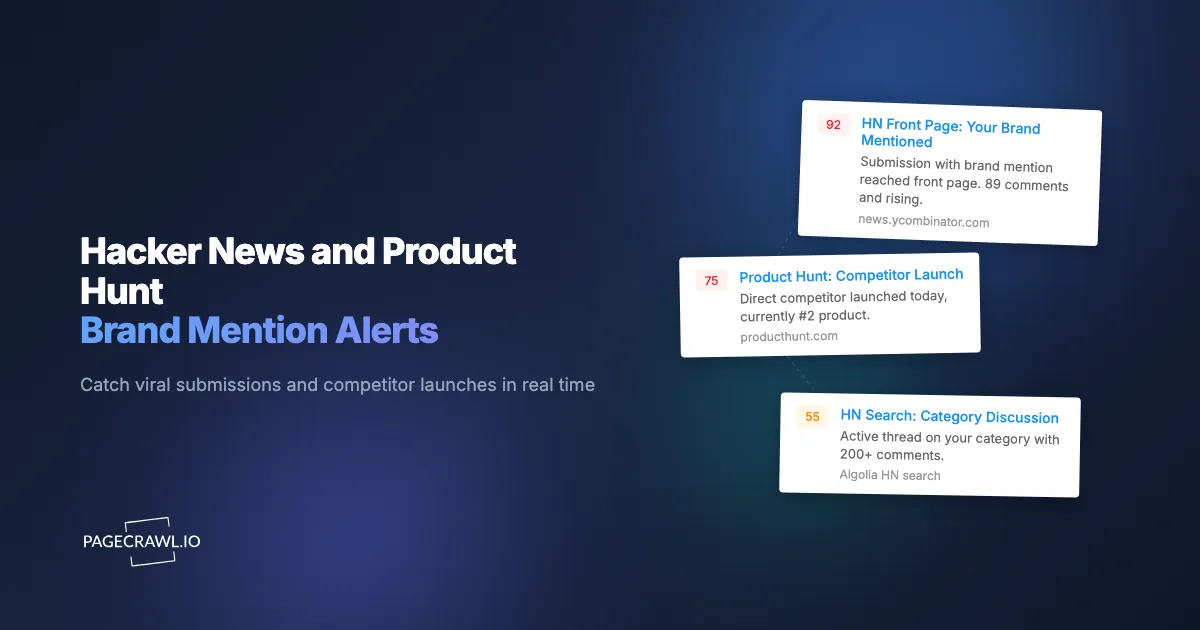
HN and PH search result pages contain dozens of items. PageCrawl's AI-powered change detection and smart filtering describes which specific submission was added (title, submitter, current score), so you can decide whether to engage based on the alert alone. The brand mention monitoring guide covers complementary patterns.
Worked Example: A Developer-Tools Founder's Setup
A solo founder running a small developer-tools company set up the following:
- HN search URL for the brand name on 15-minute checks
- HN search URLs for two product names on 30-minute checks
- HN search URLs for three competitor names on hourly checks
- PH topic page for "developer-tools" on hourly checks
- PH topic page for the related sub-category on hourly checks
- All alerts routed to a personal Telegram channel with AI summaries
Over a 6-month period, the founder caught two third-party HN submissions of the brand (responded in both within 30 minutes, both reached front page), four competitor HN launches (informed positioning changes), and ongoing PH category coverage that surfaced two acquisition candidates and three integration partnerships. Time spent on the system: roughly 5 minutes per day. Standard plan cost: $80.
Patterns Worth Watching
Tuesday and Wednesday HN front-page peaks. Mid-week mornings (Pacific) tend to produce the highest front-page volume on HN. Submissions during this window have better odds of reaching the front page.
Product Hunt's weekend community launches. Product Hunt's weekend community-launch events surface a high volume of independent maker launches, useful for adjacent and partnership discovery.
Competitor launch threads. When a direct competitor launches on HN, the comments thread typically reveals 5-10 specific criticisms or feature requests within the first hour. These are direct competitive intelligence.
Threads about your category, not your product. "Ask HN: best X tool?" threads with significant comment volume reveal current sentiment about category leaders and emerging entrants. Worth monitoring even when you're not the topic.
Recovery from negative thread tone. Threads that start negative often shift if the founder shows up and engages constructively. Same-hour presence is the variable that matters most.
Advanced Patterns: Beyond HN and PH
A complete community-mention monitoring workflow extends past these two platforms to other places people discuss your brand, including activist campaign pages and petitions.
Combine with Reddit subreddit monitoring. Specific subreddits (/r/programming, /r/devops, /r/SaaS) carry community conversations adjacent to HN. The same search-URL pattern applies.
Combine with Bluesky and Mastodon search. Federated and decentralized platforms increasingly carry developer community conversation. The Bluesky and Mastodon monitoring pattern applies.
Combine with GitHub issue and discussion monitoring. Open-source projects in your space often have GitHub Discussions or Issues that surface integration requests and competitive comparisons.
Combine with conference talk and meetup monitoring. Conference CFPs and meetup talk titles often reveal what's being discussed in the community before the discussion hits public forums.
Who should monitor Hacker News and Product Hunt?
Founders of developer-facing products get the most from it, followed by launch teams, competitive intelligence and PR functions, investors watching a portfolio category, and open source maintainers. All of them share the same need: knowing a thread exists while there is still time to take part in it.
Developer-facing startup founders. Same-hour awareness of HN submissions is the single highest-leverage marketing tool for developer-focused products. The monitoring pays for itself the first time you catch and engage a brand thread.
Product Hunt launch teams. Pre-launch and launch-week monitoring of category and competitor activity informs launch-day positioning and post-launch engagement strategy.
Competitive intelligence teams. Tracking competitor HN and PH launches as they post surfaces the highest-signal community feedback available on competitor products.
PR and communications teams. HN front-page coverage often precedes press coverage by 12-48 hours. Same-hour awareness lets PR teams coordinate response and amplification.
Investors and VCs. Portfolio company launches and competitor launches in portfolio categories become visible through HN and PH monitoring within a check cycle of going live.
Open source maintainers. Project mentions on HN drive sustained traffic and contribution interest. Same-hour awareness lets maintainers respond to questions and amplify positive coverage.
Frequently Asked Questions
How do I avoid noise from common brand names? Use precise search terms (quoted exact matches in Algolia, specific URL paths) rather than broad terms. The Algolia URL parameters support query="exact phrase" for tighter matching.
Can I monitor specific HN users? Yes. HN user profile pages list recent submissions and comments. Adding a specific user's submission page as a monitor catches their new activity.
What about HN comment-only mentions vs full submissions? Algolia search supports both. The type=story filter in the URL restricts to submissions; removing it includes comments. Comment mentions are higher-volume and require more filtering.
Does PH expose an upcoming launches view? Yes. The PH "Upcoming" view lists products that have set a launch date. Monitoring catches new entries.
Do I need a paid plan? For a 5-6 search-URL setup at hourly frequency, the free plan works. For a complete brand + competitor + category program with 15-30 monitors, Standard at $80/year is the right tier.
Will I miss submissions if I check only every hour? A 60-minute window is acceptable for most response use cases. HN threads typically peak between 2-6 hours after submission, so a 60-minute detection window leaves substantial response time.
Choosing your PageCrawl plan
PageCrawl's Free plan lets you monitor 6 pages with 220 checks per month, which is enough to validate the approach on your most critical pages. Most teams graduate to a paid plan once they see the value.
| Plan | Price | Pages | Checks / month | Frequency |
|---|---|---|---|---|
| Free | $0 | 6 | 220 | every 60 min |
| Standard | $8/mo or $80/yr | 100 | 15,000 | every 15 min |
| Enterprise | $30/mo or $300/yr | 500 | 100,000 | every 5 min |
| Ultimate | $99/mo or $999/yr | 1,000 | 100,000 | every 2 min |
Annual billing saves two months across every paid tier. Enterprise and Ultimate scale up to 100x if you need thousands of pages or multi-team access.
Catching a brand impersonation, a defamatory review, or a negative social post in hours instead of weeks is worth multiples of a Standard subscription. $80/year is enough to monitor 100 pages across your name, your products, and the top-volume places people talk about your brand. Enterprise at $300/year fits larger brand protection programs with dedicated ownership. All plans include the PageCrawl MCP Server, so you can ask Claude to summarize every sentiment shift and new mention across your brand footprint over the last week or month.
Getting Started
Add HN Algolia search URLs for your brand name and top product name on 15-minute checks. Add the relevant Product Hunt topic page on hourly checks. Create a free account and route alerts to a Slack or Telegram channel where you can respond quickly.
Over the first month, you'll see how often your brand and category are mentioned and develop a feel for which terms produce signal and which produce noise. Once you see the value, expand to cover competitor terms, additional topic pages, and adjacent platforms like Reddit and Bluesky. The Standard plan at $80/year handles a complete community-mention program with room for full competitive coverage.