A competitor's CEO posted a pricing strategy thread on Bluesky at 8:17 AM Pacific on a Thursday. The thread laid out a tiered restructure that, if executed, would directly affect a competing product's mid-market positioning. By 10:30 AM the thread had been quoted in two industry Discords. By lunch it was the topic of a Slack thread at the competing company. The product marketer at the competing company didn't see it until that evening because their Bluesky feed prioritized algorithmic suggestions over chronological posts from specific accounts. By the time they were drafting a response strategy on Friday morning, the discussion had shifted and the moment for proactive positioning had passed.
This is the modern fragmented-social problem. The fragmentation of public discourse from a single dominant platform (Twitter, pre-2023) into a half-dozen meaningful venues (Bluesky, Mastodon, Threads, plus the algorithmic remnants of X and LinkedIn) means competitive intelligence teams now need to track the same set of stakeholders across multiple platforms with different algorithms, different surfacing logic, and different chronological reliability. Following someone is not the same as seeing their posts. Daily algorithmic feeds miss accounts that don't post often enough to compete for slot space.
This guide covers what's monitorable on Bluesky, Mastodon, and Threads, why direct profile monitoring beats algorithmic feed scrolling for competitive intelligence, and how to set up a system that surfaces posts from specific accounts within the day they're published.
Quick Setup
Pick a platform and profile handle to monitor, and preview your new-post and bio-change alerts.
Why Does Monitoring Specific Accounts Matter?
Algorithmic feeds are not a reliable substitute for following specific accounts: platforms suppress infrequent posters, and pinned or bio changes never surface in feeds at all. Direct profile monitoring gives you a deterministic view of every post and profile change from the accounts you care about.
Algorithm-Suppressed Posts From Important Accounts
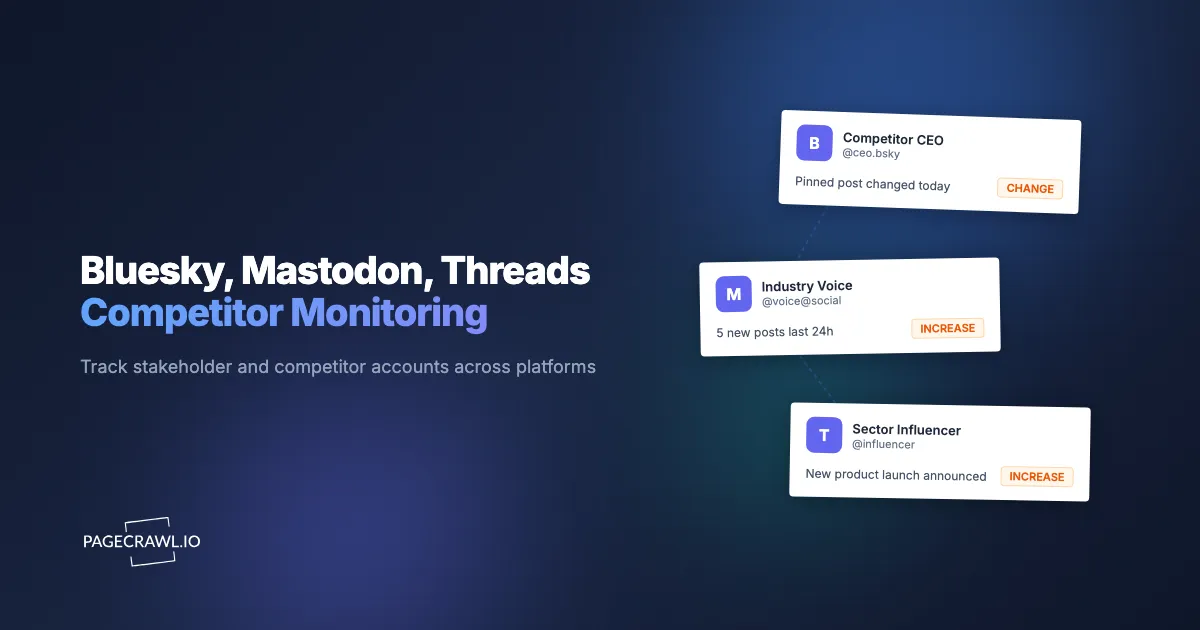
On every algorithmic platform, accounts you follow can be suppressed from your feed if engagement metrics or behavior signals don't match the algorithm's preferences. Important competitors and stakeholders often post infrequently, which is exactly the pattern algorithms deprioritize. Direct profile monitoring catches every post.
Pinned Post Changes Signal Strategic Shifts
When a competitor company or executive changes their pinned post, it typically signals a new positioning, launch, or strategic focus. Pinned changes are invisible in normal feed scrolling but show up as profile-page changes on the next monitoring check.
Bio and Link Updates Telegraph Career and Company Moves
When a competitor executive updates their bio to add a new role, removes an old company affiliation, or changes their linked website, the signal is often available days before press coverage. The same applies to founder career announcements.
Account Creation From New Competitor Entrants
Monitoring category-relevant search terms on each platform surfaces new competitor accounts as they're created. Early visibility into new entrants is a competitive intelligence advantage.
How Do Bluesky, Mastodon, and Threads Profile Pages Work?
Each platform exposes public profile pages with stable URL structures, which is what makes direct monitoring reliable.
Bluesky. Profile URLs on Bluesky follow bsky.app/profile/[handle]. The page lists recent posts in chronological order. The bio, banner, and pinned post are all on the profile.
Mastodon. Mastodon is federated across thousands of instances. A profile URL looks like mastodon.social/@username or [instance]/@username for non-default instances. Posts list chronologically.
Threads. Profile URLs on Threads follow threads.net/@handle. Posts list chronologically with a similar visual structure to Threads' Instagram parent.
Search and tag pages. Each platform supports search and hashtag URLs that can be monitored for broader category awareness, the same way TikTok creator and hashtag pages surface emerging trend signals.
A typical Bluesky profile URL looks like this:
https://bsky.app/profile/handle.example.comWhen a new post is published, it appears at the top of the profile page, which is detectable as a page change.
Comparing Monitoring Approaches
| Approach | Cost | Latency | Coverage | Best For |
|---|---|---|---|---|
| Native platform notifications | Free | Real-time | Per-account, often suppressed | Casual following |
| RSS feeds (Mastodon, Bluesky have public RSS) | Free | Minutes | Per-account | Power users with RSS workflows |
| Hootsuite, Sprout Social, Brandwatch | $$$ | Real-time | Multi-platform | Enterprise social listening |
| Manual scrolling | Free | Daily-ish | Whatever algorithm shows | Casual reading |
| PageCrawl on profile URLs | Free tier to $80/yr | 1-24 hours | Any profile URL | Competitive intelligence, PR, journalism |
The enterprise social-listening tools work but cost orders of magnitude more than PageCrawl and target large-scale brand listening. For specific-account monitoring at small to mid scale, PageCrawl is the practical option.
Setting Up Social Account Monitoring in PageCrawl

Step 1: Build your account tracking list
List the accounts that actually matter to your work: direct competitor company accounts, competitor executive accounts, key journalists, key analysts, industry-relevant founders, target customer accounts. A typical CI tracking list runs 20-80 accounts.
Step 2: Find the profile URL for each account on each platform
For each tracked account, identify which platforms they actively post on (Bluesky, Mastodon, Threads, X, LinkedIn) and construct the profile URL for each.
Step 3: Add each profile URL as a monitor
Use the canonical profile URL on each platform. Add each as a content monitor, picking from the available tracked element types.
Step 4: Pick the right check frequency
Social accounts post on variable cadences. A reasonable layering:
- Tier 1 accounts (CEO, key competitors): 4-6 hour checks. Surfaces new posts within hours.
- Tier 2 accounts (executives, analysts, journalists): Daily checks. Acceptable latency for most strategic monitoring.
- Tier 3 accounts (broader stakeholders): Daily checks.
- Profile structural changes (bio, pinned): Daily checks. Infrequent but high-signal.
Step 5: Use AI summaries to filter noise
Profile pages contain dynamic elements (post counts, follower-suggestion sidebars) that change without new posts. PageCrawl's AI-powered change detection and smart filtering distinguishes between new posts, profile-text changes, and trivial UI shifts.
Step 6: Route alerts to a competitive-intelligence channel
For CI and PR use cases, route alerts to a shared Slack channel where the team can discuss and assign responses. For journalism use cases, per-beat channels work.
Worked Example: A PR Team's Stakeholder Tracking Setup
A PR team at a B2B SaaS company tracking competitive announcements, analyst commentary, and journalist coverage set up the following:
- Eight competitor company and executive Bluesky and Threads profiles on 4-hour checks
- Twelve industry analyst and journalist profiles on daily checks
- Five Mastodon profiles for federated-tech-community analysts on daily checks
- Six hashtag and search URLs on daily checks for category-level awareness
- All alerts routed to a shared #pr-intel Slack channel with AI summaries
- Folders organized by stakeholder type
Over a 90-day period, the team surfaced 287 new posts across the tracking list. 22 were materially relevant to PR strategy. 7 of those triggered same-day media outreach that secured coverage. Time spent on triage: roughly 30 minutes per day.
Patterns Worth Watching
Pinned post rotations. When a competitor executive rotates their pinned post (every 2-4 weeks for active accounts), the new pin typically reflects current strategic priority. The signal is high-quality and easy to miss without monitoring.
Bio role changes. Executive bio changes (adding a new role, removing a prior affiliation, updating to "Founder of [new]") often precede public announcement by days.
Coordinated thread launches. Multi-executive threads launched simultaneously across accounts (one executive posts; others quote-amplify within minutes) signal a coordinated campaign. Detecting the pattern requires multi-account monitoring.
Quiet periods that break. When a typically-active account goes quiet for 2-4 weeks and then resumes, the resumption post often reveals significant context (new launch, departure, strategic shift).
Cross-platform divergence. When an executive posts on one platform but not others, the platform choice itself signals audience targeting (developer-only on Bluesky, broader business audience on Threads).
Advanced Patterns: Beyond Social Profiles
A complete stakeholder monitoring workflow extends past social platforms to product feedback like App Store and Google Play review velocity.
Combine with newsletter monitoring. Many tracked accounts also operate newsletters. The Substack and Beehiiv monitoring pattern covers this.
Combine with LinkedIn employee tracking. Career moves often appear on LinkedIn before they appear in bio updates on other platforms. The LinkedIn monitoring pattern applies.
Combine with podcast feed monitoring. Many tracked accounts appear on podcasts. Monitoring the podcasts for guest announcements catches signal.
Combine with conference and event monitoring. Speaker pages on conference sites often announce executive participation before the executive themselves posts about it.
Who Benefits From Social Account Monitoring?
Competitive intelligence, PR, sales, journalism, investing, and crisis teams all rely on knowing what specific accounts said, without depending on an algorithmic feed to surface it.
Competitive intelligence teams. Direct profile monitoring of competitor executives adds social signal to a broader competitive intelligence monitoring program, surfacing strategy shifts that algorithmic feeds reliably miss.
PR and communications teams. Journalist and analyst account monitoring, the social-platform half of media monitoring across journalists, publications, and press pages, informs pitch timing, relationship building, and rapid response to industry commentary.
Sales teams. Account-specific monitoring of target buyer profiles surfaces context for outreach and renewal conversations.
Journalists and beat reporters. Source account monitoring is the modern equivalent of working a beat. Same-day awareness of source posts informs story development.
Investors. Portfolio company executive accounts and competitor accounts in portfolio categories provide ongoing situational awareness.
Crisis management teams. Early awareness of stakeholder posts during emerging crises is the difference between proactive response and damage control.
Frequently Asked Questions
Will I miss private or follower-only posts? Yes. PageCrawl monitors publicly-visible pages. Follower-only posts on Threads, private accounts on Bluesky, and instance-restricted Mastodon posts are not visible to public monitoring.
Can I monitor X (Twitter) the same way? X has restricted public profile access in recent years. Some profile pages render publicly enough to monitor; others require authentication that breaks public access. The X situation is unstable; monitoring is hit-or-miss compared to Bluesky and Threads where public profile access is reliable.
What about Mastodon's federated structure? Each Mastodon instance hosts its own profiles. The profile URL on the user's home instance is the canonical one. Federated copies on other instances may have different views.
Can I monitor hashtag and search pages? Yes. Each platform exposes hashtag URLs (bsky.app/hashtag/[tag], threads.net/search?q=[term]) that can be monitored as broader category coverage.
Do I need a paid plan? For a 6-profile setup at daily frequency, the free plan works. For a 30-80 account program with multi-tier monitoring, Standard at $80/year or Enterprise at $300/year is the right tier.
Will I get noise alerts on profile UI changes? With AI summaries enabled, no. PageCrawl distinguishes between new posts, profile structural changes, and trivial UI shifts.
Choosing your PageCrawl plan
PageCrawl's Free plan lets you monitor 6 pages with 220 checks per month, which is enough to validate the approach on your most critical pages. Most teams graduate to a paid plan once they see the value.
| Plan | Price | Pages | Checks / month | Frequency |
|---|---|---|---|---|
| Free | $0 | 6 | 220 | every 60 min |
| Standard | $8/mo or $80/yr | 100 | 15,000 | every 15 min |
| Enterprise | $30/mo or $300/yr | 500 | 100,000 | every 5 min |
| Ultimate | $99/mo or $999/yr | 1,000 | 100,000 | every 2 min |
Annual billing saves two months across every paid tier. Enterprise and Ultimate scale up to 100x if you need thousands of pages or multi-team access.
Catching a brand impersonation, a defamatory review, or a negative social post in hours instead of weeks is worth multiples of a Standard subscription. $80/year is enough to monitor 100 pages across your name, your products, and the top-volume places people talk about your brand. Enterprise at $300/year fits larger brand protection programs with dedicated ownership. All plans include the PageCrawl MCP Server, so you can ask Claude to summarize every sentiment shift and new mention across your brand footprint over the last week or month.
Getting Started
List the 10-20 accounts that matter most to your role. Identify which platforms each actively posts on, and construct profile URLs. Add each as a monitor with daily checks, route alerts to a shared Slack or Telegram channel. Create a free account.
Over the first month, you'll see which accounts produce material signal and which produce noise. Once you see the value, expand to cover Tier 2 accounts at daily frequency and Tier 1 competitors at 4-6 hour frequency. The Standard plan at $80/year handles a serious stakeholder-tracking program, and Enterprise at $300/year covers full multi-team PR and CI programs with hundreds of monitored profiles.