Your competitor just announced a major partnership. The news hit PR Newswire at 6:00am Eastern. By 9:00am, industry journalists had written three articles. Your CEO found out at lunch when a board member forwarded the coverage. By then, your sales team had already fielded questions from confused prospects, and your PR team was scrambling to draft a response.
In business, timing is everything. Press releases signal product launches, executive changes, funding rounds, acquisitions, partnerships, regulatory actions, and strategic pivots. Companies that learn about these announcements first have hours or even days to respond before competitors who rely on secondhand coverage. Yet most organizations still discover critical announcements through social media feeds, industry newsletters, or word of mouth, long after the information became public.
This guide covers where press releases live, why traditional monitoring methods miss critical announcements, and how to build an automated press release monitoring system that alerts you on the next check after publication.
Why does press release monitoring matter?
Because press releases are the official record of corporate activity, and the companies that read them first get hours of lead time on everyone relying on secondhand coverage. Unlike social media posts or news articles, press releases come directly from the source. They contain specific claims, exact figures, and carefully worded positioning that reveals strategic intent.
Competitive Intelligence
Every press release from a competitor is a data point. Product launches reveal roadmap priorities. Partnership announcements show go-to-market strategy. Hiring announcements signal expansion areas. Pricing changes indicate market positioning shifts.
Collecting these signals as they are published, rather than discovering them days later, lets you respond proactively. Your sales team can address customer questions immediately. Your product team can assess competitive threats. Your marketing team can adjust messaging before the news cycle moves on.
For a deeper framework on building competitive intelligence programs, see our competitive intelligence guide.
Investor Relations
Public companies are required to disclose material events through press releases and SEC filings. For investors, these disclosures are trading signals. Earnings announcements, guidance changes, executive departures, and acquisition agreements all move stock prices.
Private company press releases matter too. Funding announcements signal growth trajectory. Partnership announcements suggest revenue streams. Customer win announcements indicate market traction. Angel investors and venture capitalists monitor press releases from portfolio companies, competitors, and potential investments.
Media and Journalism
Journalists covering a beat need to know about announcements in their space immediately. Being first to report on a press release, with additional context and analysis, drives traffic and establishes authority. A journalist who learns about a major announcement from another publication's coverage has already lost the story.
Sales Intelligence
When a target company announces expansion, a new round of funding, or a leadership change, that is a sales trigger. The company has money to spend, new priorities, and decision-makers who may be open to new vendors. Monitoring press releases from target accounts provides timely sales signals that most CRM enrichment tools miss.
Partnership and Business Development
Press releases reveal partnership patterns. If a company announces partnerships with three companies in your category but not you, that is competitive intelligence. If a potential partner announces expansion into your market, that is an opportunity signal. Monitoring press releases across your industry surfaces these patterns.
Where do press releases actually get published?
In four places: the company's own newsroom, the paid wire services (PR Newswire, Business Wire, GlobeNewswire), regulatory filing systems such as SEC EDGAR, and industry-specific channels. Press releases are distributed through multiple channels, so comprehensive monitoring requires covering all of them.
Corporate Newsrooms
Most companies maintain a press or news section on their corporate website. This is often the first place press releases appear, sometimes hours before they hit wire services. URLs typically follow patterns like:
company.com/presscompany.com/newsroomcompany.com/newscompany.com/about/press-releasesinvestor.company.com/news-releases
Corporate newsrooms are the most reliable source because companies control publication timing. Wire services can have distribution delays, but the company website is immediate.
PR Newswire
PR Newswire is one of the largest press release distribution services. Companies pay to distribute releases through PR Newswire, which pushes them to media outlets, financial terminals, and news databases simultaneously.
PR Newswire's website organizes releases by company, industry, and topic. You can monitor specific company pages or industry category feeds.
Business Wire
Business Wire, a Berkshire Hathaway company, is the other major wire service. Many large public companies prefer Business Wire for major announcements. Like PR Newswire, it provides company-specific and industry-specific pages.
GlobeNewswire
GlobeNewswire serves a broad range of companies, particularly mid-cap and international firms. It is often used for earnings announcements, regulatory filings, and routine corporate disclosures.
SEC EDGAR
For US public companies, filings on the SEC's EDGAR system are a form of press release. 8-K filings contain current reports on material events. 10-K and 10-Q filings contain earnings data. These filings often precede or supplement traditional press releases.
Monitoring SEC filings alongside press releases provides complete coverage of public company activity. See our SEC filings monitoring guide for detailed setup instructions.
Industry-Specific Sources
Some industries have specialized press release distribution channels:
- Healthcare: FDA announcements, clinical trial registries, medical journals
- Technology: Product Hunt launches, GitHub release pages, developer blogs
- Finance: Central bank announcements, regulatory body publications
- Legal: Court filing services, regulatory dockets
- Government: Government press offices, agency newsrooms
Which press release monitoring method works best?
It depends on how fast you need the news and how much you can spend. Google Alerts is free but slow and lossy, enterprise PR suites are thorough but priced for dedicated PR departments, RSS is quick where it exists but many newsrooms do not publish a feed, and page monitoring works on any URL you choose at a frequency you control.
Google Alerts
Google Alerts is the most commonly used free monitoring tool, and also the most limited.
How it works: Set up an alert for a company name or topic. Google sends you an email when it indexes new content matching your query.
Limitations: Google Alerts is delayed (often hours or days after publication), inconsistent (misses many press releases entirely), and noisy (includes irrelevant mentions from blogs, forums, and aggregators). There is no way to monitor a specific page or URL. You are at the mercy of Google's indexing schedule and relevance algorithms.
For time-sensitive competitive intelligence, Google Alerts is inadequate. It is fine for general awareness over days and weeks, but not for same-day monitoring, which is the gap our Google Alerts alternative comparison walks through in detail.
Dedicated PR Monitoring Services
Enterprise PR monitoring services (Cision, Meltwater, Mention, Brandwatch) provide comprehensive press release tracking with analytics, sentiment analysis, and media databases.
Strengths: Professional-grade coverage, historical archives, analytics dashboards, journalist databases, report generation.
Limitations: Expensive (enterprise contracts are typically quoted in the hundreds to thousands of dollars per month), complex to configure, focused on PR professionals rather than general business users, limited webhook/API output for automation.
These services make sense for dedicated PR teams at large organizations. For competitive intelligence, investor monitoring, or sales intelligence use cases, they are often overkill.
RSS Feeds
Some corporate newsrooms and wire services offer RSS feeds. RSS readers (Feedly, Inoreader) aggregate these feeds and can send notifications for new items, though a Feedly alternative built on page monitoring also covers the newsrooms that publish no feed at all.
Strengths: Free or low cost, real-time updates, organized by source.
Limitations: Not all newsrooms offer RSS. Feed quality varies. RSS readers provide limited notification options (mostly email). No extraction of specific content elements. No change detection for pages that update without RSS. Integration options are basic.
Web Monitoring with PageCrawl
Web monitoring fills the gap between free tools that miss content and enterprise services that cost thousands per month.
How it works: Monitor corporate newsroom pages and wire service company pages directly. PageCrawl detects when new content appears on these pages and alerts you through your preferred channel on the check that finds it.
Strengths: Monitor any web page (not limited to RSS-enabled sources), multiple notification channels (email, Slack, Discord, Telegram, webhook), AI-powered summaries of new content, automatic page discovery for finding newsroom pages, works on JavaScript-heavy sites that RSS cannot reach.
Setting Up Press Release Monitoring with PageCrawl
Here is a step-by-step approach to building a comprehensive press release monitoring system.

Step 1: Identify Pages to Monitor
For each company you want to track, find their newsroom or press release page. Visit the company website and look for links labeled "Press," "News," "Newsroom," or "Media." Add the URL to your monitoring list.
For wire services, find the company-specific page:
- PR Newswire:
prnewswire.com/news-releases/COMPANY-NAME - Business Wire:
businesswire.com/portal/site/home/COMPANY - GlobeNewsWire:
globenewswire.com/news-releases/COMPANY
PageCrawl's automatic page discovery feature can help locate newsroom pages when the URL is not immediately obvious. Point automatic page discovery at a company's root domain, and it crawls the site to find press release pages, newsroom sections, and investor relations pages automatically. This is especially useful when onboarding a batch of new competitors, since you can add a dozen company domains and let discovery surface the exact pages worth monitoring rather than hunting through each site manually.
Step 2: Configure Content-Only Monitoring
For press release pages, use "Content Only" or "Reader" tracking mode. These modes focus on the actual text content of the page, ignoring navigation, ads, and other page elements that change independently of the press releases.
Content-only mode is ideal because press release listing pages typically add new entries at the top while the rest of the page structure stays the same. PageCrawl detects the new content and includes it in the alert.
Step 3: Set Check Frequency
Check frequency depends on how time-sensitive the information is:
- Critical competitors: Every 1-2 hours during business hours
- Important industry players: Every 4-6 hours
- General awareness: Once or twice daily
For SEC filings that may precede press releases, more frequent checks catch announcements faster.
Step 4: Configure Notifications
Choose notification channels based on your workflow:
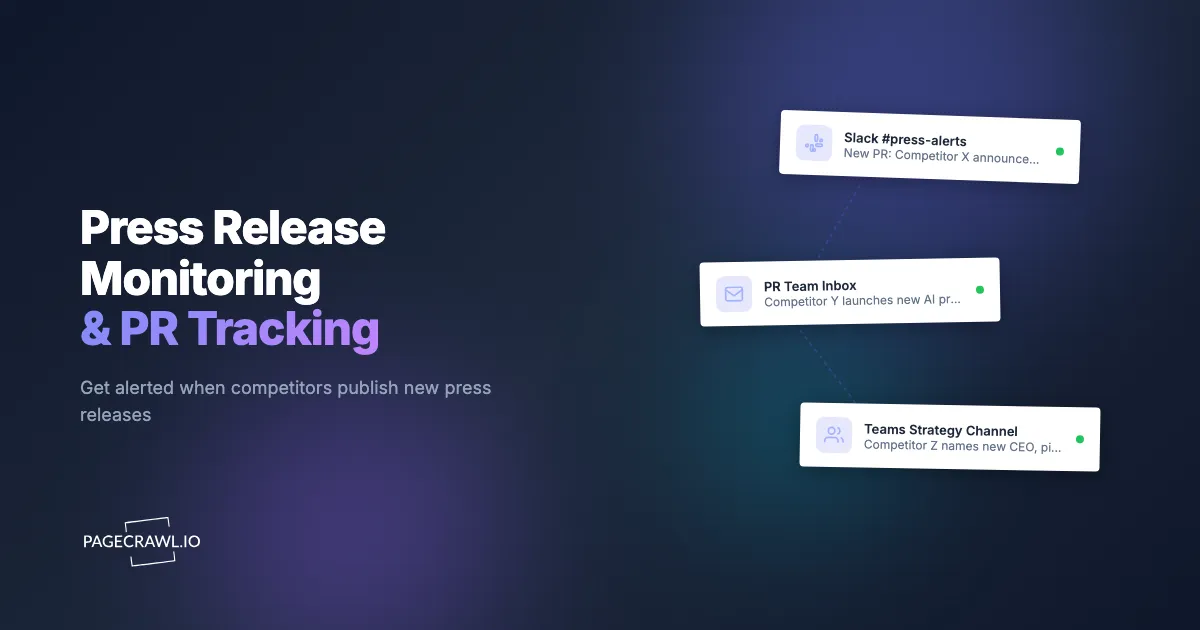
- Slack/Discord: Best for teams that need shared awareness. Create a #competitor-news or #press-releases channel and route all alerts there. The entire team sees announcements simultaneously.
- Email: Good for individual monitoring or digest-style awareness.
- Telegram: Fast mobile push notifications for time-sensitive monitoring.
- Webhook: Essential for feeding press release data into CRM systems, databases, or automation workflows.
For Slack integration setup, see our guide on website change alerts in Slack.
Step 5: Use AI Summaries
PageCrawl's AI-powered change summaries are particularly valuable for press release monitoring. Instead of receiving raw HTML diff data, you get a natural language summary: "New press release: Company X announced partnership with Company Y for enterprise AI solutions in the healthcare sector."
This saves significant time when monitoring many companies. You can scan AI summaries in seconds and decide which announcements deserve deeper attention.
Monitoring Multiple Companies Simultaneously
Real-world press release monitoring involves tracking dozens or hundreds of companies. Here is how to scale effectively.
Organize by Priority
Create folders in PageCrawl to categorize monitored companies, following the guide to organising monitors with labels, folders, and workspaces:
- Tier 1 (Direct Competitors): Check every 1-2 hours, alerts routed straight to the team channel
- Tier 2 (Adjacent Competitors): Check every 4-6 hours, alerts to a dedicated channel
- Tier 3 (Industry Players): Check daily, email digest
- Tier 4 (Watchlist): Check daily, logged for review
Different tiers get different check frequencies and notification channels. This prevents alert fatigue while ensuring critical announcements get immediate attention.
Monitor Wire Services by Industry
Instead of monitoring individual company pages on wire services, monitor industry category pages. PR Newswire and Business Wire both offer industry-filtered views (Technology, Healthcare, Financial Services, etc.), and keyword alerts on the major newswires narrow that firehose to releases naming a specific rival, exec, or product. One monitor on an industry page captures announcements from many companies.
This approach catches announcements from companies you were not specifically tracking, surfacing unexpected competitive moves, new entrants, and industry trends.
Use Webhooks for Central Collection
For organizations monitoring at scale, webhook integration feeds all press release alerts into a central system. This could be a database, a CRM, a Slack channel with automated tagging, or a custom dashboard.
The webhook payload includes the monitored URL, detected changes, and AI summary. Your automation can parse company names, categorize by topic, score by relevance, and route to the appropriate team.
Building a Press Monitoring Workflow
Automated monitoring is step one. Turning raw alerts into actionable intelligence requires a workflow.
Alert Triage
When a press release alert arrives, someone (or an automation) needs to categorize it:
- Immediate action: Competitor pricing change, major partnership, executive departure
- Same-day review: Product launch, funding announcement, customer case study
- Weekly digest: Minor updates, routine disclosures, event announcements
- Archive: No action needed, logged for reference
Intelligence Distribution
Different teams need different information:
- Sales: Funding announcements, leadership changes, expansion news for target accounts
- Product: Competitor feature launches, technology partnerships, acquisition of complementary products
- Marketing: Competitor positioning changes, thought leadership topics, event participation
- Executive: Major strategic moves, market-defining announcements, regulatory changes
Webhook automation can tag and route announcements to the right team channel automatically.
Trend Analysis
Individual press releases are data points. Patterns across press releases tell a story. If a competitor announces three AI partnerships in two months, they are building an AI strategy. If an industry segment sees a wave of funding announcements, growth is accelerating.
Review collected press releases monthly to identify trends. PageCrawl's monitoring history provides the timeline data needed for this analysis.
Use Cases by Role
PR and Communications Teams
PR teams monitor competitor announcements to inform their own media strategy. When a competitor makes news, the PR team needs to know immediately to prepare spokesperson responses, adjust upcoming announcement timing, and brief executives.
Monitoring also tracks earned media. Set up monitors on industry publications and news sites to see when your company (or competitors) are mentioned in editorial coverage.
Investors and Analysts
Investors monitor press releases for trading signals and due diligence. Earnings announcements, guidance changes, executive departures, and strategic pivots all affect valuation.
For public companies, combining press release monitoring with SEC filing alerts provides comprehensive coverage of material disclosures.
Sales and Business Development
Sales teams use press release monitoring for account intelligence. A target account announcing expansion funding is a buying signal. A prospect announcing a new CTO means a potential champion or blocker has changed.
Configure webhook automation to push relevant press releases into your CRM as activities on the corresponding account record. Sales reps see the news alongside deal notes and contact history.
Journalists and Media
Journalists monitor beats by tracking press releases from key companies and industry wire service categories, a core use of website monitoring for journalists. Being first to cover a story requires learning about it as soon as possible.
Set up Telegram notifications for fast mobile alerts on critical sources. For broader industry coverage, use a dedicated Slack channel that aggregates wire service category feeds.
Procurement and Supply Chain
Monitor supplier press releases for risk signals. A key supplier announcing financial difficulties, executive departures, or acquisition by a competitor could affect your supply chain. Early awareness allows contingency planning.
Advanced Monitoring Strategies
Monitor Company Career Pages
Press releases announce big moves, but career pages reveal strategy in advance. A company posting 15 machine learning engineer positions is signaling an AI initiative months before the press release. Career page monitoring complements press release monitoring by providing leading indicators.
Track Regulatory Body Announcements
For regulated industries, monitor the announcement pages of relevant regulatory bodies (FDA, FCC, SEC, EPA). Regulatory decisions affect entire industries and individual companies. Getting these alerts the same day is critical for compliance and investment decisions.
Monitor Conference and Event Pages
Industry conferences often serve as platforms for major announcements. Monitor conference schedule pages and speaker announcement pages ahead of events to anticipate what companies will be presenting and which announcements to expect.
What goes wrong with press release monitors?
Four things, mostly: newsroom redesigns that move the content, listings that load after the page renders, alert volume that buries the important releases, and multilingual regional newsrooms that publish the same announcement separately. Each is manageable with the right tracking mode and a little organisation.
Page Structure Changes
Corporate newsrooms occasionally redesign their pages. When this happens, the monitored page structure changes and monitoring may need to be reconfigured. PageCrawl handles most structural changes gracefully through content-focused monitoring modes, but significant redesigns may require updating the monitor.
Dynamic Content Loading
Many modern newsrooms use JavaScript to load press release listings dynamically. Simple HTTP-based monitoring tools miss this content entirely. PageCrawl renders pages in a full browser, so JavaScript-loaded content is captured correctly.
Alert Volume Management
Monitoring 50+ companies generates a significant volume of alerts. Without organization, important announcements get lost in the noise. Use the folder and priority system described above, and consider webhook automation that scores and filters alerts based on keywords, company tier, and announcement type.
International and Multilingual Sources
Global companies publish press releases in multiple languages across regional newsrooms. Monitor all relevant regional pages if your competitive intelligence needs are international. PageCrawl handles pages in any language, though AI summaries work best with widely spoken languages.
Choosing your PageCrawl plan
PageCrawl's Free plan lets you monitor 6 pages with 220 checks per month, which is enough to validate the approach on your most critical pages. Most teams graduate to a paid plan once they see the value.
| Plan | Price | Pages | Checks / month | Frequency |
|---|---|---|---|---|
| Free | $0 | 6 | 220 | every 60 min |
| Standard | $8/mo or $80/yr | 100 | 15,000 | every 15 min |
| Enterprise | $30/mo or $300/yr | 500 | 100,000 | every 5 min |
| Ultimate | $99/mo or $999/yr | 1,000 | 100,000 | every 2 min |
Annual billing saves two months across every paid tier. Enterprise and Ultimate scale up to 100x if you need thousands of pages or multi-team access.
Catching one competitor funding announcement before your sales team walks into a prospect meeting, or knowing about a rival product launch before your customers ask you about it, pays for years of monitoring. Standard at $80/year covers 100 pages, enough for a full Tier 1 and Tier 2 competitor program across corporate newsrooms and wire service category feeds. Enterprise at $300/year scales to 500 pages with 5-minute check intervals and up to 100,000 checks per month.
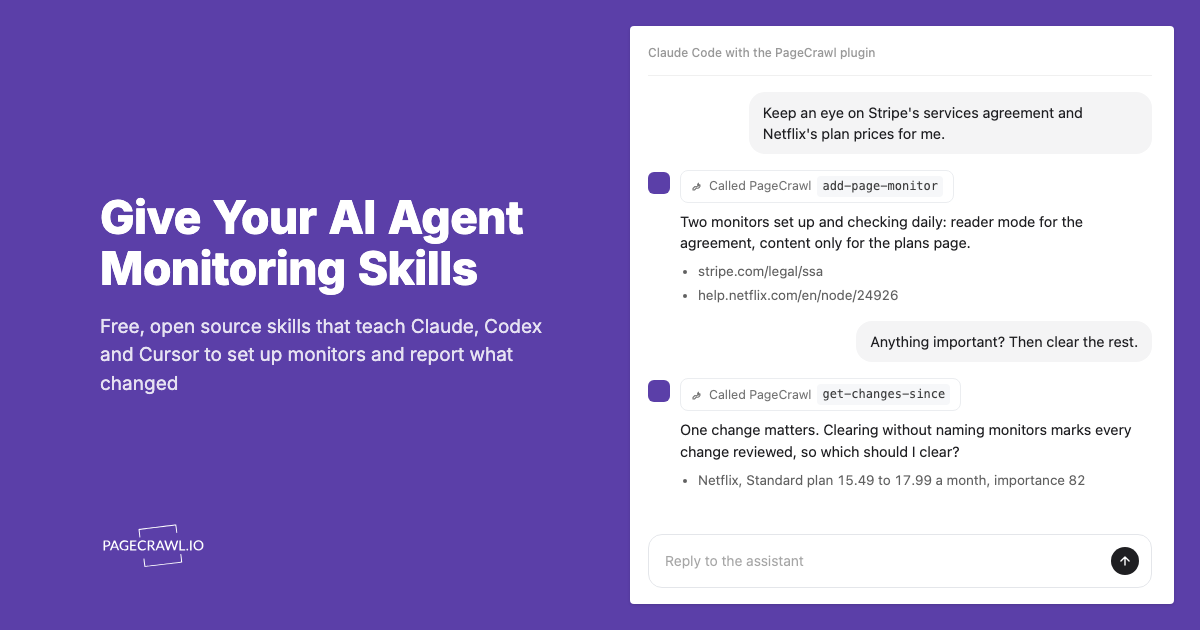
All plans include the PageCrawl MCP Server, so your team can ask an MCP-compatible AI tool to summarize every announcement from a specific competitor over the last six months and get an answer drawn directly from your own monitoring archive. AI assistants can create monitors through conversation on every plan, including Free. Press release history becomes a queryable intelligence database rather than a folder of old emails.
Getting Started
Start with your top 5 competitors. Find their corporate newsroom pages, create monitors in PageCrawl, and set up Slack or email notifications. Run the monitoring for two weeks to see the volume and type of announcements these companies publish.
Once you see the value, expand to wire service industry pages, additional competitors, and target accounts for sales intelligence. Add webhook automation to route alerts to the right teams and build a searchable archive of competitive announcements.
PageCrawl's free tier includes 6 monitors, enough to track your most important competitors and prove the concept. Paid plans start at $80/year for 100 monitors (Standard) and $300/year for 500 monitors (Enterprise), giving you room to build comprehensive press release coverage across your entire competitive landscape.