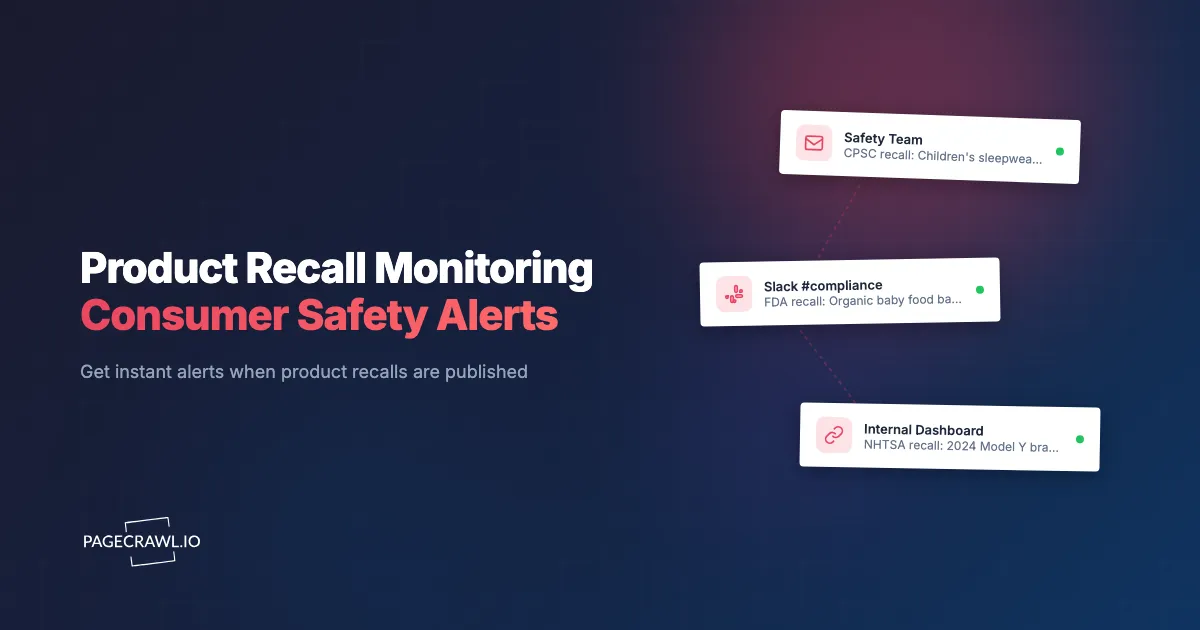
A children's toy recalled for a choking hazard sits on retail shelves for weeks after the recall is issued. The retailer did not know about the recall because nobody was monitoring the CPSC announcements. A daycare center continued using a recalled crib because the recall notice was buried in an email newsletter that went unread.
Product recalls happen constantly. The Consumer Product Safety Commission (CPSC) issues hundreds of recalls per year. The FDA manages recalls across food, drugs, medical devices, and cosmetics. NHTSA handles vehicle and equipment recalls. The USDA Food Safety and Inspection Service (FSIS) covers meat, poultry, and egg products.
For businesses that sell products, care for children, manage fleets, or handle food, missing a recall is not just inconvenient. It creates legal liability, safety risks, and reputational damage. Manually checking recall databases every day is not realistic. Automated monitoring that watches these pages and alerts you when new recalls appear is the practical solution.
This guide covers why recall monitoring matters, which sources to monitor, how to set up automated recall alerts with PageCrawl, and how to build a recall response workflow for your organization.
Why does recall monitoring matter?
Because a recall you learn about late is a safety risk, a liability exposure, and an inventory write-off at the same time. Product recalls affect more people and organizations than most realize, and the impact extends beyond the manufacturer to every business and institution in the supply chain.
Consumer Safety
The primary purpose of recalls is protecting people from harm. Defective products cause injuries and deaths every year. The faster you learn about a recall, the faster you can remove the product from use or sale. For parents, daycare operators, schools, and healthcare facilities, rapid recall awareness is a safety obligation.
Children's products are among the most frequently recalled categories. Toys, clothing, nursery furniture, and feeding products face recalls for choking hazards, lead content, flammability, and structural failures. The window between recall announcement and product removal from shelves directly affects child safety.
Legal Liability
Retailers and distributors who continue selling recalled products face legal liability. "We did not know about the recall" is not a strong defense when the information was publicly available on government agency and public records pages. Demonstrating that you have a systematic recall monitoring process shows due diligence.
Product liability attorneys actively monitor recalls to identify potential claims. If your business sells a product that was recalled and someone is harmed, having no monitoring process in place makes the legal situation significantly worse.
Inventory and Financial Impact
Recalled products represent financial exposure. Inventory that cannot be sold must be returned, destroyed, or held pending manufacturer instructions. The sooner you identify a recall affecting your inventory, the sooner you can stop ordering more of the affected product and begin the return process.
For retailers with large inventories, even a single day of continued sales of a recalled product creates returns, customer complaints, and potential regulatory attention.
Brand and Reputation
Businesses that respond quickly to recalls demonstrate responsibility. Customers notice when a retailer proactively contacts them about a recalled product versus when they learn about it from the news weeks later. Recall response speed directly affects customer trust.
For brands and manufacturers, monitoring recall pages also means tracking competitor recalls. A competitor's recall creates both a market opportunity and a chance to review whether your own products have similar issues.
Which recall sources should you monitor?
Four federal agencies cover almost everything sold in the United States: CPSC for consumer products, FDA for food, drugs, devices and cosmetics, NHTSA for vehicles and vehicle equipment, and USDA FSIS for meat, poultry, and egg products. Each covers different product categories and operates its own announcement system.
CPSC (Consumer Product Safety Commission)
The CPSC handles recalls for consumer products excluding food, drugs, vehicles, and items under other agencies' jurisdiction. This covers:
- Children's products (toys, cribs, car seats, clothing)
- Household appliances and electronics
- Furniture and home furnishings
- Sporting goods and outdoor equipment
- Tools and hardware
- Seasonal products (heaters, holiday decorations)
CPSC publishes recalls at cpsc.gov/Recalls. The page lists recent recalls with product descriptions, hazard information, remedy instructions, and photos.
FDA (Food and Drug Administration)
The FDA manages recalls across several product categories:
- Food products (contamination, allergens, mislabeling)
- Pharmaceutical drugs
- Medical devices
- Cosmetics and personal care products
- Animal food and veterinary products
- Tobacco products
FDA recalls appear at multiple locations including their recall page, enforcement reports, and safety alerts, so regulatory filing monitoring for the agency has to cover more than one URL. The FDA also issues safety communications for medical devices that may not be formal recalls but still require attention.
NHTSA (National Highway Traffic Safety Administration)
NHTSA handles vehicle and vehicle equipment recalls:
- Passenger vehicles (cars, trucks, SUVs)
- Motorcycles
- Commercial vehicles
- Child car seats
- Tires
- Vehicle equipment and accessories
NHTSA publishes recalls at nhtsa.gov/recalls. For fleet managers and automotive businesses, NHTSA monitoring is essential.
USDA FSIS (Food Safety and Inspection Service)
FSIS handles recalls for products under USDA jurisdiction:
- Meat products
- Poultry products
- Processed egg products
FSIS recall announcements appear at fsis.usda.gov. Grocery stores, restaurants, food distributors, and institutional kitchens need to monitor these announcements.
Other Sources
Depending on your industry, additional recall sources may be relevant:
- EPA: Environmental recalls (pesticides, toxic substances)
- FCC: Electronic device recalls
- State-level agencies: Some states issue their own recall notices
- International agencies: Health Canada, EU RAPEX for businesses operating internationally
Setting Up Automated Recall Monitoring
Here is how to configure PageCrawl to monitor recall pages and alert you when new recalls are posted.

Monitoring the CPSC Recall Page
Step 1: Navigate to the CPSC recalls page at https://www.cpsc.gov/Recalls. This page lists the most recent recalls in reverse chronological order.
Step 2: Add this URL to PageCrawl. Use the default "Full Page" tracking mode to capture all content on the page, including new recall entries as they appear.
Step 3: Set check frequency to every 2-4 hours. CPSC typically posts new recalls during business hours, but the exact timing is unpredictable. Frequent checking ensures you learn about recalls within hours of publication.
Step 4: Configure notifications. For safety-critical monitoring, use multiple notification channels: email for documentation, plus Slack or another fast channel for team awareness.
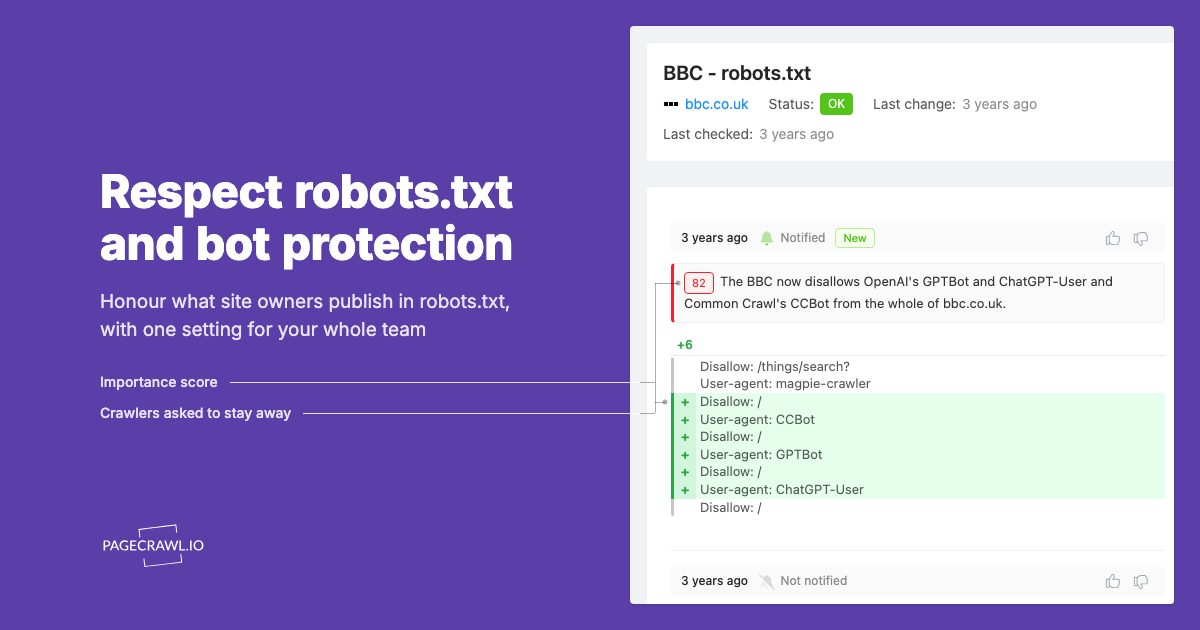
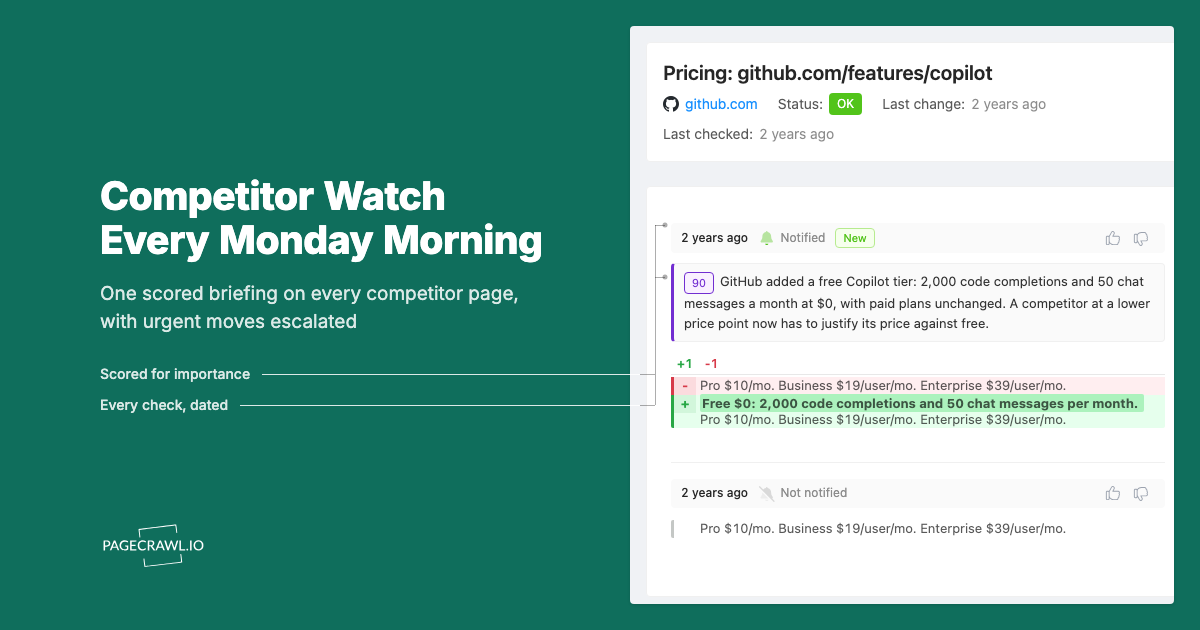
When a new recall appears on the CPSC page, PageCrawl detects the changed content and sends you an alert showing what was added. You see the new recall information directly in the notification.
Monitoring FDA Recall Pages
The FDA publishes recall information across several pages. Monitor these key URLs:
- FDA Recalls: The main recall listing page
- FDA Safety Alerts: Urgent safety communications
- FDA Enforcement Reports: Weekly enforcement action reports
Add each URL as a separate monitor. The FDA updates these pages on different schedules, so monitoring all three provides comprehensive coverage.
Keyword Filtering for Relevant Recalls
Not every recall on a government page is relevant to your business. A daycare center needs to know about children's product recalls but not power tool recalls. A restaurant needs food recalls but not automotive recalls.
PageCrawl's AI analysis helps here. When a recall page updates with new content, the change notification includes the text of the new recall. Using notification conditions and filters, you can require a keyword match before an alert fires, so only recalls containing terms relevant to your business reach the team.
For example, a children's clothing retailer might focus on notifications containing words like "children," "infant," "clothing," "pajamas," or "sleepwear." A grocery store might filter for their specific suppliers or product categories.
For more advanced filtering, webhook integrations let you route recall notifications through automation platforms that can parse the content and make routing decisions.
Monitoring Specific Product Categories
Some recall sources offer category-specific pages or search results. Instead of monitoring the entire recall feed, you can monitor a filtered view:
- CPSC allows filtering by product type
- FDA separates recalls by category (food, drugs, devices)
- NHTSA allows searching by make, model, and year
Monitor the filtered URL rather than the main page to reduce noise. You will only receive alerts when new recalls appear in your specific category.
Using Page Discovery for Comprehensive Coverage
For thorough recall monitoring, PageCrawl's automatic page discovery can identify new pages on recall websites. When a government agency adds a new recall detail page, page discovery detects it even if the main listing page has not yet been updated. Automatic page discovery works by scanning a domain for newly added URLs, so you do not need to guess which pages a regulatory agency will create next. Just point it at the recall section of a site and let it find new pages as they appear.
This provides an additional layer of coverage beyond monitoring the main recall listing pages.
Use Cases for Recall Monitoring
Different organizations need recall monitoring for different reasons. Here are the most common use cases and how to configure monitoring for each.
Retailers and E-Commerce Sellers
Retailers need to know as early as possible when a product they sell is recalled. The monitoring strategy:
- Monitor CPSC and relevant agency recall pages
- Set up keyword filters for product categories you sell
- When a recall alert arrives, cross-reference against your current inventory
- Pull affected products from shelves and online listings
- Contact the manufacturer for remedy instructions
- Notify customers who purchased the affected product
For large retailers with diverse inventories, monitoring all major recall sources is necessary. Smaller specialty retailers can focus on the agency most relevant to their products.
Amazon and marketplace sellers face additional urgency. Platforms may suspend listings for recalled products, and continued sales after a recall creates both legal liability and account risk.
Daycare Providers and Schools
Childcare facilities have a heightened responsibility for product safety. Children interact with toys, furniture, art supplies, and equipment daily. A recalled item in a daycare causes not just safety risk but regulatory and licensing consequences.
Daycare operators should monitor:
- CPSC recalls (filtered for children's products)
- FDA recalls (filtered for food products served to children)
- State childcare licensing announcements
Set notifications to go to both the facility director and a backup contact. Recall information should not depend on a single person checking their email.
Fleet Managers
Organizations that operate vehicle fleets need NHTSA monitoring to track recalls affecting their vehicles and equipment.
Monitor NHTSA recall pages filtered by the makes and models in your fleet. When a recall appears, cross-reference against your vehicle inventory by VIN. Schedule recall repairs promptly and document completion for compliance records.
Fleet recalls sometimes involve safety-critical components (brakes, airbags, steering). Fast awareness of these recalls directly protects drivers and the public.
Food Service and Restaurants
Restaurants, cafeterias, and food service operations need FDA and USDA FSIS monitoring for food safety recalls. A contaminated ingredient in your kitchen creates both health risk and business risk.
Monitor food recall pages with filters for your ingredient categories and suppliers. When a food recall alert arrives, immediately check your inventory for the affected products (matching lot numbers and dates), remove them from use, and document your response.
Product Liability Attorneys
Attorneys who handle product liability cases monitor recalls to identify potential claims, track manufacturer responses, and gather evidence. Comprehensive recall monitoring across all agencies provides early awareness of safety issues before they become major news stories.
For legal monitoring, full page tracking with historical snapshots preserves a record of when recalls were published and how recall information changed over time.
Manufacturers and Brands
Manufacturers monitor recall pages for several reasons:
- Track competitor recalls for products similar to yours
- Verify that your own recall notices are published correctly
- Monitor for unauthorized or counterfeit versions of your products appearing in recalls
- Stay informed about regulatory trends in your product category
Building a Recall Response Workflow
Monitoring is only the first step. Having a defined response process ensures that recall alerts lead to action.
Immediate Response (Within Hours)
When a recall alert arrives:
- Read the full recall notice. Identify the specific product, hazard, remedy, and affected units.
- Check your inventory. Do you have this product in stock, on shelves, or in use?
- Stop sales or use immediately if you have the affected product.
- Notify key personnel. Safety managers, store managers, and purchasing staff need to know.
Short-Term Response (Within 24-48 Hours)
After the immediate response:
- Contact the manufacturer for remedy instructions (refund, replacement, repair).
- Notify affected customers if you sold the product and have customer records.
- Document everything. Record when you learned about the recall, what actions you took, and when.
- Update your systems. Remove the product from your website, point of sale, and ordering systems.
Ongoing Response
Some recalls involve ongoing actions:
- Track remedy completion. For fleet recalls, ensure all affected vehicles are repaired.
- Monitor for updates. Recall notices sometimes expand to include additional products or lot numbers.
- Review your sourcing. If a supplier's product was recalled, evaluate whether to continue the relationship.
Automating Response Steps
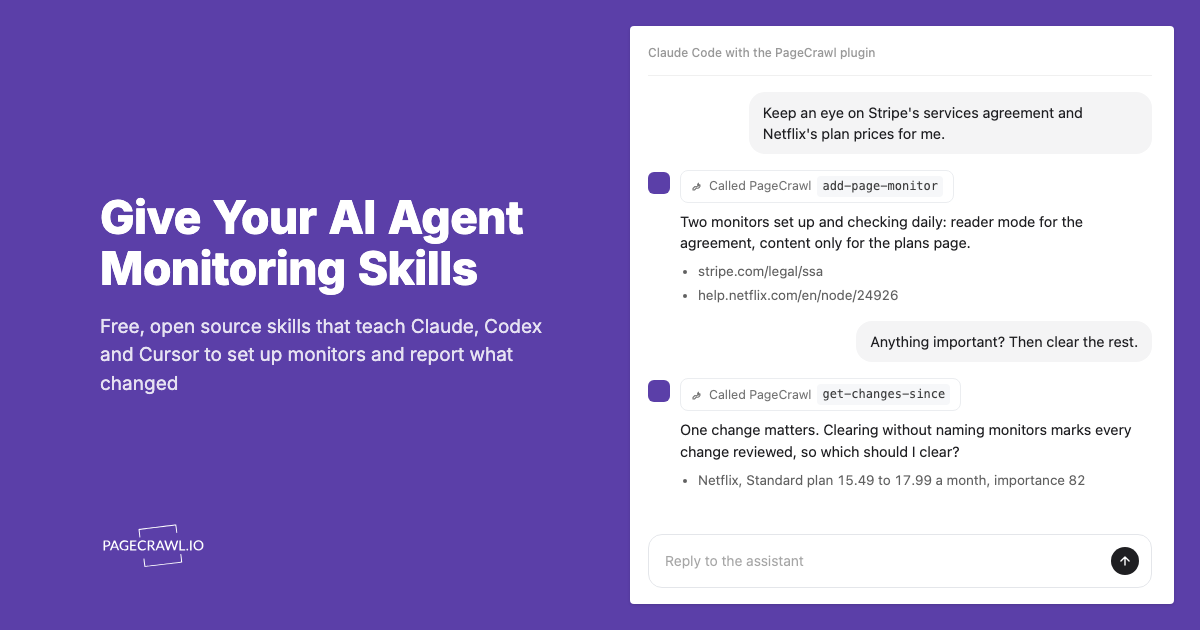
Webhook integrations allow you to automate parts of the recall response workflow:
- Automatically create a ticket in your project management system when a recall is detected
- Send formatted alerts to specific Slack channels based on recall category
- Log recall information to a database for compliance documentation
- Trigger inventory review checklists
Is recall monitoring legally required?
Not as a specific tool, but the obligations behind it are real. Retailers and distributors have reporting duties under the Consumer Product Safety Improvement Act, food businesses have participation duties under FDA regulations, and several states add requirements for childcare, food service, and automotive dealers. A documented monitoring process is how you show due diligence against all of them.
Consumer Product Safety Improvement Act (CPSIA)
Retailers and distributors have reporting obligations when they learn about product defects. The CPSIA requires businesses to report potentially hazardous products to the CPSC. Having a monitoring system demonstrates proactive compliance.
FDA Requirements for Food Businesses
Food manufacturers, distributors, and retailers have obligations under FDA regulations to participate in recall processes. While the FDA does not mandate specific monitoring tools, demonstrating awareness of recalls affecting your products is part of regulatory compliance.
For businesses subject to regulatory compliance requirements, automated recall monitoring creates an auditable record of your monitoring activities and response actions.
State-Level Requirements
Some states have additional requirements for recall compliance, particularly for childcare facilities, food service operations, and automotive dealers. Check your state's requirements to determine whether recall monitoring is legally required or merely best practice for your industry. Always confirm the details of any recall on the issuing agency's official page; this article is informational, not legal advice.
Configuring Effective Recall Alerts
Getting the most value from recall monitoring requires thoughtful configuration.
Check Frequency
Government recall pages update during business hours on weekdays, with occasional weekend updates for urgent safety issues. A 2-4 hour check frequency provides timely awareness without excessive monitoring.
For food safety recalls where contaminated products pose immediate health risks, consider hourly monitoring. The faster you learn about a contaminated food product in your inventory, the faster you can pull it.
Notification Channels
Recall alerts should reach the right people quickly. Configure multiple notification channels:
- Email: Creates a documentation trail and reaches people who check email regularly
- Slack or Teams: Reaches the whole team quickly during work hours
- Webhook to ticketing system: Automatically creates action items
- SMS or push notification: For urgent safety recalls outside business hours
Using PageCrawl, you can configure different notification destinations for different monitors. CPSC monitors might alert your safety team, while FDA monitors alert your kitchen manager.
Reducing False Positives
Government recall pages sometimes update with minor formatting changes, date updates, or page redesigns that do not represent new recalls. The complete guide to reducing false positive notifications covers the full toolkit, but the essentials are:
- Use content-specific monitoring rather than full-page monitoring when possible
- Configure change sensitivity thresholds to ignore minor text changes
- Use keyword filtering in your notification workflow to surface relevant recalls
Archiving Recall Data
Recall monitoring generates data that may be valuable for compliance audits, legal proceedings, or business analysis. PageCrawl maintains a history of all detected changes, providing a timestamped record of when recalls were published and when you were notified.
For organizations with strict compliance requirements, export this data regularly to your own records management system.
Scaling Recall Monitoring
For larger organizations, recall monitoring needs to cover more sources and serve more stakeholders.
Multi-Agency Monitoring
A comprehensive recall monitoring setup might include:
- CPSC main recall page
- CPSC category-specific pages (3-5 monitors)
- FDA recall page
- FDA safety alerts
- NHTSA recalls (filtered by your fleet's makes)
- USDA FSIS recalls
- State-level recall pages
- International recall sources
This might require 10-20 monitors total. PageCrawl's Standard plan ($80/year, 100 monitors) handles this easily with room for growth. Enterprise organizations monitoring across multiple countries or tracking many product categories can use the Enterprise plan ($300/year, 500 monitors).
Team Notifications
Different recall categories should alert different teams:
- Children's product recalls to the product safety team
- Food recalls to the food safety and procurement teams
- Vehicle recalls to the fleet management team
- Competitor product recalls to the product development team
Configure separate monitors with different notification destinations for each team.
Integration with Existing Systems
For organizations with established compliance or safety management systems, recall monitoring should feed into existing workflows. Webhook integrations connect PageCrawl to virtually any system:
- Compliance management platforms
- Quality management systems (QMS)
- Enterprise resource planning (ERP) systems
- Customer notification systems
Choosing your PageCrawl plan
PageCrawl's Free plan lets you monitor 6 pages with 220 checks per month, which is enough to validate the approach on your most critical pages. Most teams graduate to a paid plan once they see the value.
| Plan | Price | Pages | Checks / month | Frequency |
|---|---|---|---|---|
| Free | $0 | 6 | 220 | every 60 min |
| Standard | $8/mo or $80/yr | 100 | 15,000 | every 15 min |
| Enterprise | $30/mo or $300/yr | 500 | 100,000 | every 5 min |
| Ultimate | $99/mo or $999/yr | 1,000 | 100,000 | every 2 min |
Annual billing saves two months across every paid tier. Enterprise and Ultimate scale up to 100x if you need thousands of pages or multi-team access.
A single recalled product that stays on your shelves or in use for an extra week creates liability exposure that dwarfs any monitoring cost. Standard at $80/year covers 100 pages, which is more than enough to monitor every relevant government recall agency plus category-filtered views for a small or mid-sized operation. Enterprise at $300/year handles 500 pages for organizations tracking recalls across multiple agencies, multiple product categories, and international sources, with 5-minute checks, SSO, and full change history.
All plans include the PageCrawl MCP Server, so your compliance team can query monitoring history directly through an MCP-compatible AI tool, pulling a timestamped record of every recall detected and when your system was notified. AI assistants can create monitors through conversation on every plan, including Free. That kind of audit trail is exactly what regulators and insurers ask for.
Getting Started
Begin with the recall sources most relevant to your business or household. If you sell consumer products, start with the CPSC recall page. If you manage food operations, start with FDA and USDA FSIS pages. Parents and caregivers should monitor CPSC's children's product recalls.
Add 2-3 recall source URLs to PageCrawl using the "Full Page" tracking mode. Set check frequency to every 4 hours and configure email notifications. Run this for two weeks to understand the volume of recalls in your categories and fine-tune your monitoring.
Once you see the pattern of recall announcements, expand monitoring to additional sources, add keyword filtering, and connect webhook integrations to automate your response workflow.
PageCrawl's free tier (6 monitors) covers monitoring the most important recall sources for a small business or household. For organizations needing broader coverage, the Standard plan provides enough monitors to track every relevant government recall page with room to spare.
Product recalls will continue happening. The question is not whether a product you sell, use, or serve will be recalled. The question is whether you will find out in time to act. Automated monitoring ensures the answer is yes.