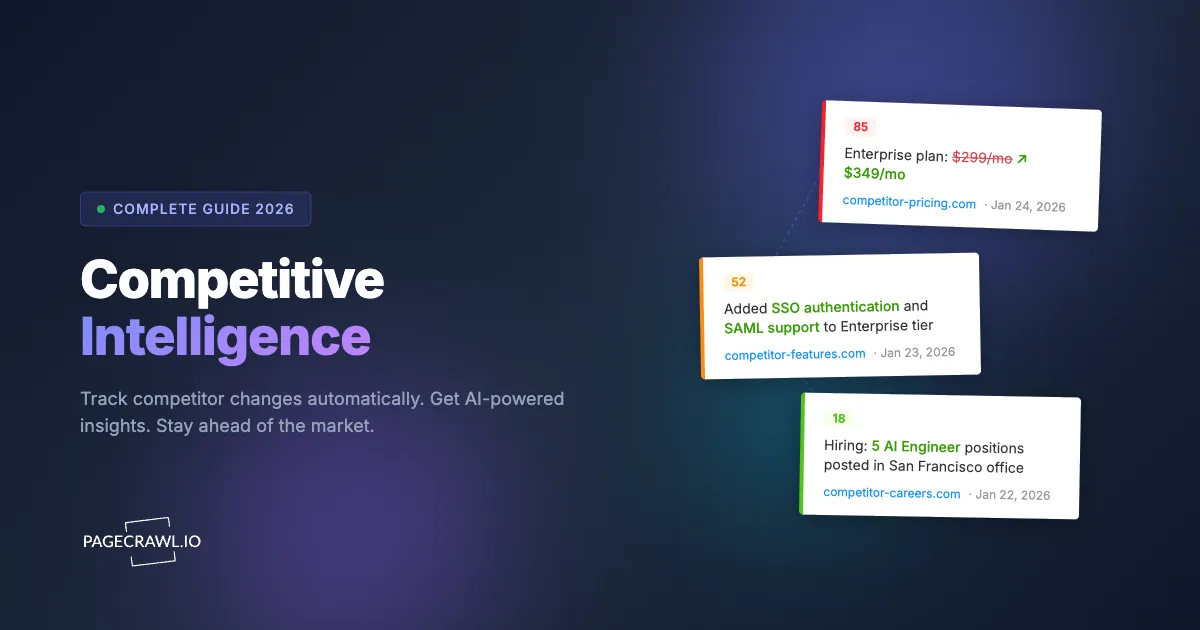
Your competitor changed their pricing last week. Did you know? A new feature appeared on their product page three days ago. Did you catch it? Their careers page now lists five AI engineer positions, a signal of their next strategic move. Did you notice?
Most businesses miss these signals entirely. They find out about competitor changes weeks or months later, often from a customer asking "Did you see what Company X is doing?" By then, the opportunity to respond quickly has passed.
Every business has direct and indirect competitors. The businesses that consistently win understand their competition better. They anticipate moves, spot weaknesses, identify opportunities, and make informed decisions while competitors operate on assumptions.
Competitive intelligence (CI) is how organizations systematically understand their competitive environment. It's not corporate espionage or illegal snooping. It's the disciplined practice of collecting, analyzing, and acting on publicly available information about competitors and markets.
This guide explains what competitive intelligence is, how to build a CI program without enterprise budgets or dedicated analysts, and how automation transforms CI from a time-consuming project into a continuous advantage.
What is competitive intelligence?
Competitive intelligence is the systematic collection, analysis, and application of information about competitors, markets, and the external business environment to support decision-making. It relies on public sources, runs continuously rather than as a one-off project, and exists to change decisions rather than to fill a slide deck.
What CI Actually Is
Legal and ethical: CI uses publicly available information. Competitor websites, press releases, job postings, financial filings, industry reports, customer feedback: all legitimate sources. The information is out there; CI organizes it into actionable insight.
Systematic: Effective CI isn't occasional Google searches when someone asks a question. It's structured processes that continuously monitor, collect, analyze, and distribute relevant intelligence.
Action-oriented: Intelligence without action is trivia. CI programs exist to inform decisions: strategic planning, product development, marketing positioning, sales enablement, and operational improvements.
Continuous: Markets change constantly. Competitors evolve. CI isn't a one-time project but an ongoing function that keeps organizations current.
Why does competitive intelligence matter?
It matters because organizations that understand their competitive environment make better decisions than those operating blind. CI lets you anticipate competitor moves, spot unserved market gaps, de-risk pricing and launch decisions, and position your messaging against what rivals actually claim rather than what you assume they claim.
Anticipate Competitive Moves
With systematic monitoring, patterns emerge. You see competitors ramping up hiring in a new area. Their job postings reveal technology investments. Their content strategy shifts toward new markets. These signals often precede major moves by months.
One technology company noticed a competitor suddenly posting multiple positions for machine learning engineers despite having no AI products. Six months later, that competitor launched an AI product line. The company had months of warning to prepare their response rather than being caught off guard.
Identify Market Opportunities
Monitoring competitors reveals gaps they're not serving. Customer complaints on review sites highlight unmet needs. Products competitors discontinue may signal underserved markets. Weaknesses in competitor offerings suggest differentiation opportunities.
A B2B software company monitored competitor support forums and discovered recurring complaints about integration difficulties. They prioritized integration features and won multiple deals from frustrated competitor customers specifically because of superior integration.
Reduce Strategic Risks
Major business decisions carry risk. CI reduces that risk by grounding decisions in competitive reality rather than internal assumptions.
Launching into a market? CI reveals how competitors have fared there. Considering a pricing change? CI shows how competitors have responded to similar moves. Planning a product feature? CI indicates whether competitors are investing in the same direction.
Optimize Positioning and Messaging
Understanding how competitors position themselves helps you differentiate effectively. You find the positioning space they're not occupying. You discover messages that resonate with customers they're not reaching. You identify claims you can credibly make that they can't.
Sales teams with CI win more deals. They can address how they differ from specific competitors, counter competitor claims, and position against competitor weaknesses.
Sources of Competitive Intelligence
Understanding where to find intelligence helps build comprehensive monitoring.
Competitor Websites
The most direct source. Competitors publish extensive information about products, pricing, positioning, and capabilities. Monitor:
- Product pages (features, specifications, versions)
- Pricing pages (price points, models, changes) - for products sold across multiple retailers, monitor each retailer's page with price tracking and view them together in your dashboard; cross-retailer comparison that automatically groups the same product and compares prices across stores is a custom capability you can ask us to enable
- About/company pages (leadership, locations, growth claims)
- Blog/content (topics of focus, market positioning)
- Case studies (customer types, use cases, results claimed)
- Jobs pages (hiring priorities, growth areas)
Websites change constantly. Manual checking misses changes; automated competitive intelligence monitoring catches them.
Press and News
Competitor announcements, media coverage, and industry news provide official narratives and external perspectives.
- Press releases (launches, partnerships, milestones)
- News coverage (analysis, context, criticism)
- Industry publications (trends, comparisons)
- Analyst reports (assessments, predictions)
Financial Sources
Public companies disclose extensive information in regulatory filings, and in the US those filings are free to read on the SEC's EDGAR database:
- Annual reports (strategy, risks, segment performance)
- Quarterly filings (recent developments, outlook)
- Earnings calls (management commentary, Q&A)
- Investor presentations (strategy, positioning)
Even for private competitors and new market entrants, funding announcements, estimated valuations, and investor commentary provide insights into strategy and priorities.
Job Postings
What companies hire for reveals where they're investing. Job postings often describe upcoming products, technologies, or market focuses months before public announcement.
- Sudden hiring in a new area signals investment
- Job descriptions reveal technology choices
- Volume of hiring indicates growth rates
- Location patterns show expansion plans
Social Media and Community
Less formal but often revealing:
- LinkedIn (employee movements, company updates, executive posts)
- Twitter/X (customer sentiment, company voice, industry commentary)
- Community forums (customer feedback, support issues)
- Review sites (customer satisfaction, complaints, competitive comparisons)
Automating Competitive Intelligence
Manual CI doesn't scale. Competitors update websites daily. News breaks constantly. Job postings appear and disappear. Humans can't monitor everything continuously, and most SMBs don't have dedicated CI analysts on staff anyway.

The choice isn't between comprehensive CI and no CI. It's between automated monitoring that works while you focus on your business versus ad-hoc checking that misses critical changes.
Automation transforms CI from periodic research into continuous awareness. Here's how modern CI automation works.
AI-Powered Change Analysis
Raw change detection isn't enough. Getting alerts that say "Page changed" without context creates noise, not intelligence. You need to know what changed and why it matters.
PageCrawl's AI analysis solves this automatically. Each change is analyzed and converted into a human-readable summary, so you get intelligence instead of raw diffs, as explained in the guide to AI-powered change detection and smart filtering. AI credits are included on every plan, and you can connect your own AI provider account to use your own quota at no markup.
What the AI does:
- Generates plain-English summaries: Instead of raw diffs, you get "Competitor X increased their Enterprise plan price by 15% and added a new Growth tier"
- Prioritizes by business impact: AI ranks changes by importance so you focus on what matters
- Filters noise automatically: Timestamps, view counts, and dynamic content get filtered out
- Custom AI instructions: Add context about your business so the AI understands what's relevant to you
- Reduces false positives: AI learns from patterns you mark as noise
This means the marketing manager gets actionable intelligence, not a technical diff they need to interpret.
Visual Monitoring
Some changes aren't visible in text. A competitor redesigning their pricing page layout, adding new trust badges, or changing their call-to-action buttons: these visual changes signal strategic shifts.
Visual monitoring captures:
- Screenshot comparisons with pixel-level difference highlighting
- Before/after visual archives
- Threshold-based detection (ignore minor rendering differences, catch significant changes)
When a competitor completely redesigns their homepage, you'll see exactly what changed side-by-side.
Multi-Channel Notifications
Intelligence is worthless if it doesn't reach you when you need it. Different changes deserve different urgency levels, and different people prefer different channels.
PageCrawl includes seven notification channels, all on every plan:
- Slack: Team channels for collaborative review
- Microsoft Teams: For Teams-based organizations
- Discord: Community and team servers
- Telegram: Fast mobile alerts (free, no additional apps)
- Email: Traditional notifications with full change details
- Web Push: Browser notifications that work across devices
- Webhooks: Feed data into any system (Zapier, n8n, custom workflows)
No per-channel fees. No premium tiers for Slack access. Every notification channel available on every plan.
Smart Alert Management
Not every change deserves the same attention. AI helps by ranking changes by business impact, so you can quickly identify what matters most.
Alert options include:
- Per-change notifications: Get alerted as soon as a check detects the change
- Digest summaries: Batch updates into daily or weekly emails
- Priority filtering: AI ranks changes so critical updates stand out
Web Push notifications work alongside other channels, ensuring you catch important changes even when you're away from email. Combine channels strategically: Telegram for fast mobile alerts, Slack for team visibility, email digests for comprehensive weekly reviews.
Advanced Filtering
Websites contain dynamic content that creates noise: timestamps, session IDs, view counters, rotating testimonials, cookie consent banners. Without filtering, you'd get flooded with irrelevant change notifications.
PageCrawl provides six filter types:
- Date/time filters: Ignore timestamp and "last updated" changes
- Number filters: Exclude view counts, stock numbers, dynamic statistics
- Cookie/consent filters: Remove consent banner variations
- Overlay filters: Handle modal dialogs and popups
- Pattern filters: Regex-based filtering for complex cases
- Element exclusion: Click to ignore specific page sections
The timeline history includes click-to-ignore. See a false positive, click to ignore that pattern in future. AI also suggests filters based on detected patterns, reducing setup time.
Global domain filters apply rules across all pages from a domain, so you set up filtering once and it applies everywhere.
Team Collaboration
Competitive intelligence isn't a solo activity. Product teams need feature updates. Sales needs pricing changes. Marketing needs messaging shifts.
Review Boards bring Kanban-style organization to detected changes:
- Drag changes through custom workflow stages (New, Reviewing, Actionable, Archived)
- Assign changes to team members for follow-up
- Add notes and context to changes
- Filter by competitor, change type, or status
Shared workspaces and folders organize monitoring by team, project, or competitor. Role-based access controls who sees what: full admin for CI leads, viewer access for stakeholders who just need updates.
History and API Access
Competitive intelligence builds over time. A pricing change today might need comparison against six months of history.
PageCrawl provides:
- Unlimited history on paid plans for long-term competitive analysis
- Full API access for custom integrations and automated workflows
- Webhook data for feeding CI into your existing tools
- Priority support for enterprise customers
Custom proxies and geo-specific monitoring capture what competitors show in different regions. This is essential for companies with international competitors.
Practical CI Use Cases for SMBs
Enterprise CI platforms cost thousands per month and require dedicated teams. SMBs need practical approaches that work with limited time and budget. Here are real scenarios where automated CI delivers immediate value.
Pricing Intelligence for Marketing Managers
The need: "I need to know when our 3 main competitors change prices, but I can't check their sites every day."
The setup:
- Monitor 5-10 competitor pricing pages
- AI summarizes changes in plain English
- Weekly digest keeps you informed without alert fatigue
- Per-change Telegram alert for major changes (>10% price shift)
The outcome: When Competitor X drops their starter price by 20%, you know within hours. You can adjust messaging, alert sales, or prepare a response before customers start asking questions.
Product Launch Detection for Product Managers
The need: "I want early warning when competitors launch new features so we're not caught off guard in sales calls."
The setup:
- Track competitor product and features pages daily
- Monitor changelog and release notes pages
- AI summarizes what changed: "Competitor X added SSO support and raised their Enterprise minimum seats from 10 to 25"
- Review Board to share findings with engineering and sales
The outcome: Your product roadmap stays informed by competitive reality. When sales asks "Does Competitor Y have feature Z now?" you have the answer, and the date they added it.
Sales Battlecard Updates for Sales Leaders
The need: "Our sales team needs current competitor info, but nobody has time to keep battlecards updated."
The setup:
- Monitor competitor pricing, features, and case study pages
- AI categorizes changes by relevance to sales conversations
- Changes flow to a Sales Slack channel automatically
- Weekly summary email with all competitive updates
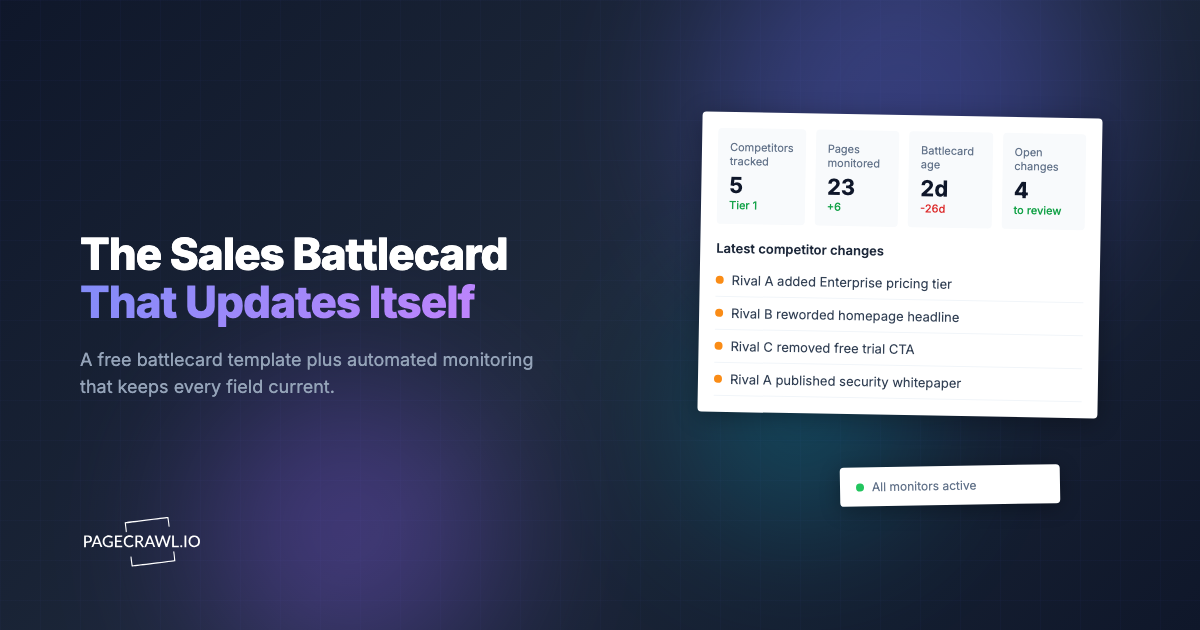
The outcome: Your sales battlecard template stays current because updates arrive automatically. When a competitor removes a feature or changes their enterprise pricing model, sales knows before their next call.
Hiring Intent Signals for Founders
The need: "I want early warning when competitors are expanding into new areas, before the press release."
The setup:
- Monitor 3-5 competitor careers pages
- Weekly summary of job posting changes
- AI flags new job categories (AI, international markets, new product lines)
The outcome: When your main competitor starts hiring product managers with payments experience, you know they're building fintech features months before launch. That's strategic intelligence without any effort.
Content Strategy Tracking for Marketing Teams
The need: "What topics are competitors writing about? Are they shifting their positioning?"
The setup:
- Monitor competitor blog and resources pages
- AI identifies topic patterns and messaging shifts
- Monthly content strategy summary
The outcome: You see competitors pivoting their content toward "enterprise" messaging or doubling down on specific use cases. Ongoing competitor content monitoring keeps your own content strategy differentiated.
Choosing CI Tools
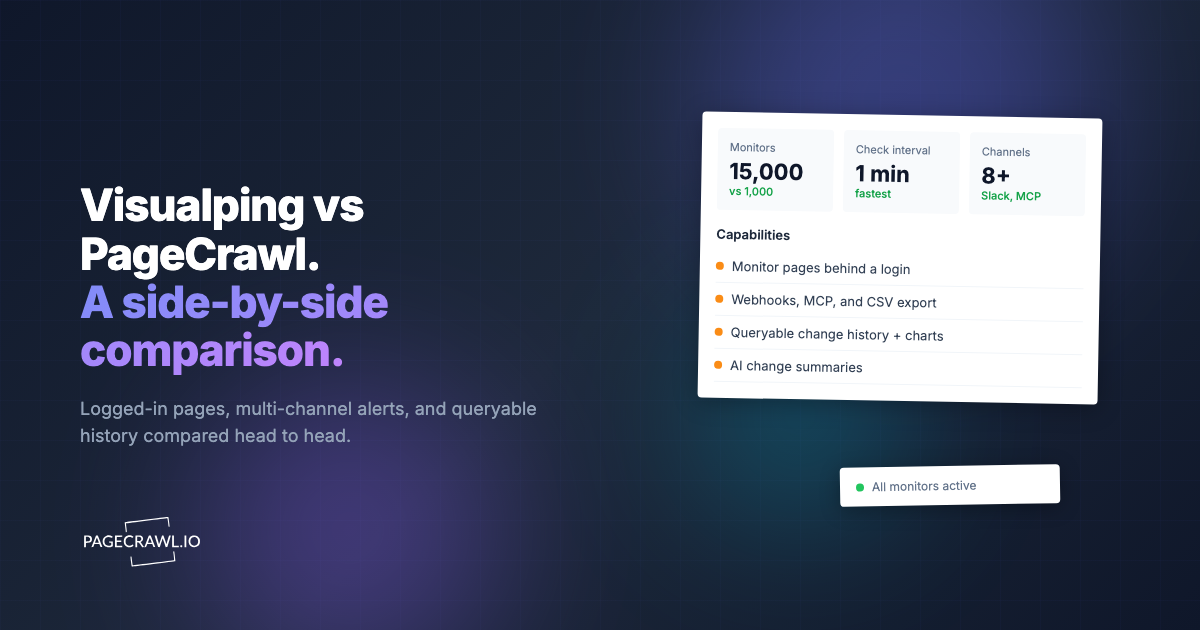
Enterprise platforms like Crayon and Klue offer comprehensive CI suites, but require significant investment and lengthy implementation, a trade-off laid out in our Crayon alternative comparison. Basic website monitors like Visualping and Distill provide change tracking but lack AI-powered analysis and team collaboration features.
PageCrawl bridges this gap, offering enterprise-grade features like BYOK AI analysis, Review Boards, and advanced filtering at SMB-friendly pricing. At $30/month for the Enterprise plan, you get unlimited history, team collaboration, and all notification channels included.
Building a CI Program
The right CI program depends on organization size, competitive intensity, and available resources.
For Small Businesses
Start simple:
- Identify top 3-5 competitors
- Monitor their websites (products, pricing)
- Set up Google Alerts for names and key terms
- Review win/loss feedback from sales
- Monthly review of competitive landscape
Tools: PageCrawl for website monitoring, Google Alerts for news, spreadsheet for tracking insights.
Time investment: 2-4 hours weekly.
For Mid-Market Companies
More structured:
- Dedicated CI responsibility (part-time or full-time)
- Comprehensive competitor list with priority tiers
- Automated monitoring of websites, news, jobs
- Regular CI deliverables (weekly updates, quarterly reports)
- Integration with planning and decision processes
- Review Boards for team collaboration
Tools: PageCrawl for web monitoring with AI analysis, news monitoring platform, CRM integration for sales intelligence.
Time investment: Part-time to full-time role.
Is competitive intelligence legal?
Yes, when it stays on public information. Monitoring public websites, reading public filings, analyzing publicly available information, and tracking public job postings are all legal and ethical, and the professional body SCIP publishes a code of ethics that draws the same line.
Avoid: accessing password-protected content without authorization, misrepresenting yourself to gain information, or anything you wouldn't want published. The simple test: if your CI methods appeared in a news article, would you be comfortable? Stick to public information and you're on solid ground.
Choosing your PageCrawl plan
PageCrawl's Free plan lets you monitor 6 pages with 220 checks per month, which is enough to validate the approach on your most critical pages. Most teams graduate to a paid plan once they see the value.
| Plan | Price | Pages | Checks / month | Frequency |
|---|---|---|---|---|
| Free | $0 | 6 | 220 | every 60 min |
| Standard | $8/mo or $80/yr | 100 | 15,000 | every 15 min |
| Enterprise | $30/mo or $300/yr | 500 | 100,000 | every 5 min |
| Ultimate | $99/mo or $999/yr | 1,000 | 100,000 | every 2 min |
Annual billing saves two months across every paid tier. Enterprise and Ultimate scale up to 100x if you need thousands of pages or multi-team access.
Starting a CI program does not require a big budget, which makes $80/year for Standard a practical entry point. 100 monitored pages is enough to cover your Tier 1 and Tier 2 competitors across pricing, product, messaging, and job listings, all the signals a new program needs to get traction. All plans include the PageCrawl MCP Server, which connects your monitoring data to Claude, Cursor, and other MCP-compatible tools, so your sales and product teams can ask Claude to summarize every change to a competitor's pricing page over the past quarter and get the answer pulled from your own monitoring archive. AI assistants can create monitors through conversation on every plan, including Free. That turns the alert feed into a searchable competitor database your whole team can use. Once CI is embedded in your team's workflow, Enterprise at $300/year adds 500 pages, 5-minute check frequency, and team collaboration features.
Getting Started with CI Today
Building competitive intelligence capability doesn't require massive investment or dedicated analysts. Start with what matters most:
Identify your top competitors: The 3-5 companies you compete with most directly.
Set up automated monitoring: Use PageCrawl to monitor competitor websites (pricing, products, messaging). The Enterprise plan at $30/month includes unlimited history, AI analysis, and team collaboration features. Takes 15 minutes to configure.
Configure smart alerts: Per-change notifications for pricing pages, weekly digests for blogs. Match urgency to importance.
Establish a review cadence: Weekly or biweekly review of competitive updates. What changed? What does it mean? Use Review Boards to track follow-up.
Connect to decisions: When making strategic decisions, ask "What do competitors do here?" Make CI part of the decision process.
Automate CI Workflows with n8n
For teams that want to build custom CI workflows, PageCrawl integrates directly with n8n, the popular workflow automation platform. The PageCrawl n8n node lets you trigger automated actions when competitors make changes.
Example workflows CI teams build with n8n:
- Auto-update sales battlecards: When a competitor changes pricing, automatically update a Google Doc or Notion page with the new information
- Enrich with additional data: When a change is detected, fetch related data from LinkedIn, Crunchbase, or other sources
- Create tickets: Automatically create Jira or Linear tickets for product team review when competitors launch new features
- Build custom dashboards: Push change data to Airtable, Google Sheets, or a custom database for trend analysis
- Notify specific people: Route different types of changes to different team members based on their responsibilities
The n8n integration means PageCrawl fits into your existing tech stack rather than requiring you to change how your team works.
The hardest part of CI isn't the collection or analysis. It's starting. Organizations that establish CI capability early build competitive understanding that compounds over time. Those that wait operate on assumptions while competitors operate on intelligence.
Start monitoring competitors today. You'll see what you've been missing within the first week.