Picture a DTC mattress brand quietly switching its primary Meta ad creative from a 30-second product testimonial to a 6-second "back pain in the morning?" hook. Competitors take weeks to notice. By the time the second-fastest mover runs a similar hook in their own ads, the original brand has already cycled to a new variant and is testing a third format. The lag between a competitor's creative shift and your own team's response is one of the most under-managed risks in performance marketing, and it exists almost entirely because nobody has set up a continuous monitor on the public ad-library page that shows exactly what every advertiser is running.
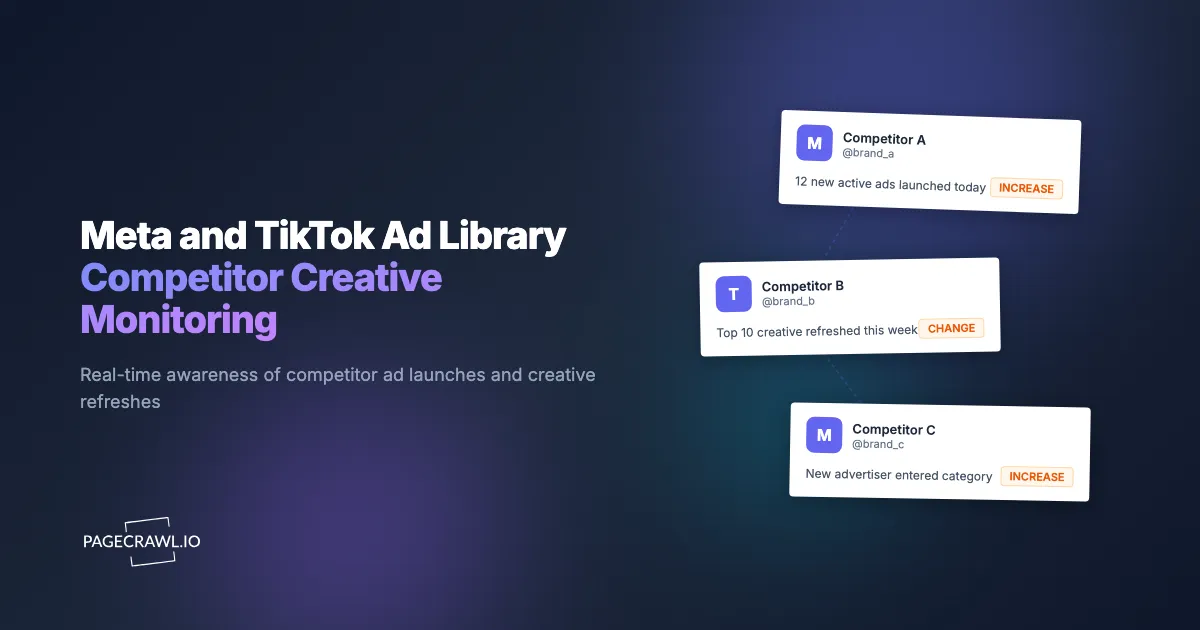
Meta Ad Library exposes every active ad on Facebook, Instagram, Messenger, and Audience Network for every advertiser, searchable by page name. TikTok for Business publishes top-performing ad creative in its Creative Center by region, industry, and format. Together they form the most under-utilized public dataset in competitive advertising. The data is free, the URLs are stable, and a continuous monitor on the advertiser pages you care about will surface every new creative launch and every meaningful refresh inside a day of the change.
This guide covers how Meta Ad Library and TikTok Creative Center expose competitor creative, what patterns are worth alerting on, and how to set up a monitoring workflow that gives your team same-week awareness of every meaningful creative move your competitors make.
Quick Setup
Pick a competitor and platform, and we'll watch their ad creative for new launches and refreshes.
Why are ad library pages worth monitoring?
Because they are the only public, advertiser-level record of what your competitors are actually running right now. The competitive advantage in performance marketing increasingly lives in creative iteration speed, and knowing what rivals are testing, what they are killing, and what they are scaling is the foundation of that speed.
New Creative Launches Signal Active Campaigns
When a brand publishes a batch of new ads, they are spending. The format, hook, and offer in a fresh creative tell you what they currently believe is working. Catching launches the day they go live, rather than weeks later in an industry trend report, gives your team the longest possible runway to respond.
Creative Refresh Patterns Reveal What Competitors Are Iterating On
A creative that runs for weeks unchanged signals it is winning. A creative that gets pulled within days signals it failed testing. A creative with five small variations launched together signals an A/B program. Reading the refresh cadence on a competitor's library tells you their pace of iteration and where their attention is focused.
Promotion And Offer Copy Appears First In Ads
Discount levels, free shipping thresholds, BOGO mechanics, and bundle offers usually show up in ads days or weeks before they appear on the site or in email. If a competitor starts running "$50 off your first order" ads, that is the leading indicator they are dropping the offer in market.
New Advertiser Entrants Signal Category Activity
When a brand that has not been advertising suddenly launches a Meta campaign, that is a signal. New entrants in your category, dormant competitors that go active, and adjacent-category brands that move into your space are all worth flagging.
How do Meta Ad Library and TikTok Creative Center work?
Both are free public archives of live ad creative: Meta indexes every active ad by advertiser, and TikTok's Creative Center surfaces top performers by region and industry. Meta Ad Library is a public website at facebook.com/ads/library. The default page lets you search by advertiser name, page ID, keyword, or political-ad filter. The most useful URL pattern for competitive monitoring is the per-advertiser active-ads view:

https://www.facebook.com/ads/library/?active_status=active&ad_type=all&country=US&search_type=page&q={advertiser}Replace {advertiser} with the Page name or ID of the competitor you want to monitor. The page returns every active ad that advertiser is currently running, with format (image, video, carousel), placement, and copy. New ads add cards. Removed ads disappear. PageCrawl monitors the page contents and flags every change.
TikTok Creative Center's Top Ads view (ads.tiktok.com/business/creativecenter/topads) is filterable by region, industry, objective, and time window. The filtered URL is stable and can be monitored the same way, as can individual TikTok creator profiles and hashtag pages. New top-performing creatives add cards to the result set as they qualify.
How does this compare with paid ad-spy tools?
Paid ad-spy platforms index creative across every advertiser and add tagging and search, which is worth the subscription if you need discovery. If you already know which competitors matter, monitoring their public ad-library pages directly gives you the same launch-and-refresh signal for a fraction of the cost.
| Approach | Cost | Latency | Coverage | Best For |
|---|---|---|---|---|
| Manual ad library refresh | Free | Days to weeks | One advertiser at a time | Casual research |
| AdSpy, Anstrex, BigSpy | Paid subscription | Hours | Cross-platform | Agencies and large advertisers |
| Foreplay, Motion | Paid subscription | Hours | Curated + AI tagging | Performance creative teams |
| Industry trend reports | Free / Paid | Weeks to months | Aggregated only | General awareness |
| PageCrawl on ad-library pages | Free tier to $80/year | 1-24 hours | Any advertiser you specify | Specific competitor watchlists |
The dedicated ad-spy tools are excellent for cross-platform creative search but they are priced for agencies. For a team that knows exactly which competitors matter, monitoring the public ad-library pages directly is dramatically cheaper and surfaces the same signal for the advertisers on your list.
Setting Up Ad Library Monitoring
Step 1: Build your competitor list
Pick the 10-20 competitors who matter most. Be honest about which brands actually pull deals away from you. Vanity inclusion of every adjacent brand dilutes the watchlist.
Step 2: Build Meta Ad Library URLs for each
Use the URL pattern above with the competitor's Facebook Page name. Test each URL by opening in a browser first; sometimes the advertiser uses a different page name than their brand name.
Step 3: Add TikTok Creative Center filtered URLs
On Creative Center, build Top Ads searches filtered to your industry and region. Copy the URL after applying filters. One or two filtered views per industry is usually enough.
Step 4: Add monitors with content tracking
Add each URL as a content monitor. Screenshots are useful here because creative is visual; a screenshot diff confirms a new image or video card has appeared without needing to read the page text. The help centre rundown of available tracked element types explains which mode suits a card-grid page like this.
Step 5: Set a daily check frequency
Creative refreshes happen on a multi-day cadence. Daily checks catch every meaningful change while keeping check usage low. For a creative team running active competitive analysis during a launch window, bump to every 6 hours.
Step 6: Tag by competitor and group into folders
Create a "Competitive Creative" folder with subfolders per competitor, following the help centre guide to organizing monitored pages with labels, folders, and workspaces. The folder view rolls up all recent creative activity across the competitor set on one page, which is how patterns surface (a coordinated push by three competitors, a category-wide format shift, an offer ladder spreading across the industry).
Worked Example: A DTC Brand Watching Five Direct Competitors
A DTC supplements brand wants same-week awareness of five named competitors plus the top-of-category TikTok creative. The setup:
- Build five Meta Ad Library URLs for the five competitors.
- Build one TikTok Creative Center search filtered to health & wellness, US, 30-day top performers.
- Add all six as content monitors with daily checks and screenshots.
- Tag all six
creative-watchand route alerts to a#performance-marketingSlack channel.
Two weeks in, the alerts surface a clear pattern: three of the five competitors have shifted to UGC-style 6-second hooks featuring real customer faces. The team's creative briefs for the next sprint pivot to match the format, and the head of growth credits the monitoring setup for the read. Total cost: $0, because the six monitors fit inside the free tier.
Patterns Worth Watching
New ads launching in batches of 5-15. Indicates a fresh creative test cycle. The hook and format in the batch tells you what the brand believes is currently winning.
A single ad running unchanged for 30+ days. That ad is winning. Worth dissecting in depth: hook, length, format, music, copy, offer.
Variants of the same ad with one element changed. A/B testing in production. The elements they are testing tell you what they are unsure about.
Format shifts (carousel to video, image to UGC). Category-wide format trends. If three competitors all shift to vertical video in the same month, the format is the trend.
Offer escalation. $20 off becomes $30 off becomes free shipping plus $30 off. The escalation pattern is the offer war.
Dormant advertisers going active. A brand that has not run ads in 60 days suddenly publishing fresh creative is launching something. Worth flagging.
Combining Ad Library Alerts With Other Competitive Signals
Pair with help center and pricing page diffs. Creative often telegraphs offers that show up in the help center pricing FAQ a week later. See the help center diff monitoring guide for the parallel setup.
Pair with G2 and Trustpilot review velocity. New campaigns drive new reviews, so brand and review site monitoring is a natural companion to creative tracking. A spike in competitor review velocity 2-3 weeks after a creative refresh confirms the campaign is converting. See the review velocity alerts guide.
Pair with Google Trends and SEO monitoring. Creative campaigns drive search demand. The Google algorithm update monitoring guide covers a parallel SEO surface worth monitoring.
Pair with the LinkedIn jobs page. Performance marketing hires precede campaign launches. A competitor posting growth roles is often gearing up for a push.
Use Cases
Performance marketing teams. Same-week competitor creative awareness is the foundation of fast iteration. Teams that catch creative shifts the week they happen iterate ahead of the category.
Brand and content teams. Promotion and copy patterns inform messaging strategy. When three competitors all start using the same hook, the hook is either commodity (avoid) or proven (test variants).
Agency creative teams. Industry-wide creative monitoring fuels concepting. A weekly review of the watchlist surfaces format trends in time for the next pitch.
Competitive intelligence functions. Ad activity is a leading indicator of competitor strategy, and ad-library pages sit alongside pricing and product pages in a competitive intelligence monitoring program. The team that integrates ad library monitoring into the weekly CI brief is two weeks ahead of teams relying on trend reports.
Investor and analyst teams. Tracking ad activity for publicly traded DTC brands provides a private-data signal layered onto earnings analysis. Heavy creative refresh often precedes campaign quarters with elevated marketing spend.
Product marketing. Competitor creative is the cleanest signal of how a competitor is positioning a product right now. Reading their library is faster and more accurate than reading their website.
Frequently Asked Questions
Can I see how much a competitor is spending on each ad? No. Meta Ad Library shows the creative and metadata but does not expose spend by ad. The political-ads section shows spend ranges; commercial ads do not.
How long does a new ad take to appear in the library? Ads appear in Ad Library within hours of being approved and going live. PageCrawl's daily check catches every new ad within a day of launch.
Will PageCrawl detect creative changes inside a single ad? Major changes (different image, different video) trigger alerts because the page contents change. Minor changes like edits to copy in an existing ad may or may not depending on how the change renders.
What about LinkedIn ads or Google ads? LinkedIn has its own ad library at linkedin.com/ad-library and the same monitoring approach works. Google has the Ads Transparency Center with per-advertiser URLs that can also be monitored.
Does this work for international competitors? Yes. Meta Ad Library covers every country; change the country=US parameter to the relevant country code. TikTok Creative Center is also region-filterable.
What is the right check frequency for active launch windows? Every 6 hours during a known launch window, daily otherwise. For sustained competitive analysis during a 30-90 day window, daily catches almost everything that matters.
Choosing your PageCrawl plan
PageCrawl's Free plan lets you monitor 6 pages with 220 checks per month, which is enough to validate the approach on your most critical pages. Most teams graduate to a paid plan once they see the value.
| Plan | Price | Pages | Checks / month | Frequency |
|---|---|---|---|---|
| Free | $0 | 6 | 220 | every 60 min |
| Standard | $8/mo or $80/yr | 100 | 15,000 | every 15 min |
| Enterprise | $30/mo or $300/yr | 500 | 100,000 | every 5 min |
| Ultimate | $99/mo or $999/yr | 1,000 | 100,000 | every 2 min |
Annual billing saves two months across every paid tier. Enterprise and Ultimate scale up to 100x if you need thousands of pages or multi-team access.
One competitive signal caught early can swing a deal worth more than a decade of Enterprise. If you win one additional deal per year because you spotted a pricing change, a product launch, or a messaging shift before your competitors did, $300/year is a rounding error. Standard at $80/year handles 100 monitored pages, enough for a Tier 1 and Tier 2 competitor program. Enterprise adds 500 pages and SSO. All plans include the PageCrawl MCP Server for AI assistants like Claude and Cursor.
Getting Started
Add Meta Ad Library URLs for your top 10 competitors plus your industry's TikTok Top Ads page to PageCrawl on a daily check. Create a free account and the next creative launch will arrive in your marketing channel the day it goes live.