In 2023, a mid-sized fintech company noticed their largest competitor quietly posting three "Head of AI" roles across different departments within the same month. Six months later, the competitor launched an AI-powered product that captured significant market share. The signals were public the entire time. Nobody was watching.
Job postings are one of the most underused sources of competitive intelligence. They are public, detailed, and remarkably honest about a company's strategic direction. A company hiring for "Senior Blockchain Engineer" is telling you about their technology roadmap. A sudden burst of sales roles in Southeast Asia reveals geographic expansion plans. A shift from hiring junior developers to senior architects signals a maturing product line. Every job posting is a data point, and patterns across postings tell a strategic story.
This guide covers how to systematically monitor competitor job postings, interpret the signals they contain, and build an ongoing intelligence system that turns public hiring data into competitive advantage.
Why do job postings reveal strategy before press releases?
Companies announce products, partnerships, and market moves through press releases and marketing campaigns. But before any announcement, they need to hire the people who will build and execute those plans. Hiring is the leading indicator. Announcements are lagging.
The Hiring Timeline
The typical sequence runs: strategic decision, budget approval, headcount approval, job posting, recruiting, hiring, onboarding, execution, announcement. By the time a competitor announces a new product, they typically started hiring for it many months, sometimes more than a year, earlier. Monitoring job postings lets you see the signal at the "job posting" stage rather than the "announcement" stage.
Forced Transparency
Marketing materials are carefully crafted to reveal only what a company wants you to know. Job postings, by contrast, need to attract qualified candidates. This requires specificity about what the role involves, what technologies are used, what products are being built, and what the team structure looks like. Recruiters optimize for attracting talent, not for keeping secrets.
A job description saying "Join our team building the next generation of real-time payment processing using event-driven architecture on AWS" tells you the technology stack, the product direction, and the infrastructure choices, all in a single sentence.
Volume as Signal
The number of open positions is itself intelligence. A company that goes from 5 open engineering roles to 40 in a quarter is either preparing for a major product push, has experienced significant attrition (which is its own signal), or has secured new funding. Each interpretation carries different strategic implications for competitors.
What hiring signals should you look for?
Not every job posting matters. The intelligence value lies in patterns, changes, and anomalies rather than individual listings: role types that map to strategy, seniority mixes, technology requirements, locations, and shifts in posting volume.
Role Types That Signal Strategy
Product and engineering roles reveal what is being built. Job titles and descriptions mentioning specific technologies, product features, or technical challenges indicate active development areas.
- Machine learning and AI roles signal automation or intelligence features
- Mobile development hiring suggests app-first or mobile expansion strategies
- Infrastructure and DevOps roles indicate scaling challenges or platform migrations
- Security engineering roles may precede compliance certifications or enterprise market entry
Go-to-market roles reveal commercialization plans. Sales, marketing, and business development postings indicate how and where a competitor plans to sell.
- Enterprise sales hiring signals upmarket movement
- Channel and partner roles indicate indirect sales strategy shifts
- Product marketing hires suggest upcoming launches that need positioning
- Customer success team expansion signals subscription or retention focus
Executive and leadership roles reveal organizational priorities. C-suite and VP-level postings indicate strategic shifts at the highest level.
- A new Chief Data Officer role signals data-driven transformation
- VP of International expansion plans are exactly what the title suggests
- Head of M&A roles indicate acquisition-driven growth strategy
- Chief Compliance Officer hiring suggests regulatory preparation
Seniority Patterns
The seniority distribution of open roles tells a story about organizational maturity and growth stage.
Heavy junior hiring (associates, analysts, coordinators) typically means execution scaling. The strategy is set, and the company needs hands to execute it. This often follows a period of senior hiring where leadership was established.
Heavy senior hiring (directors, VPs, principals) suggests strategic repositioning. The company is bringing in experienced leaders to define new directions. This often precedes major strategic shifts.
Mixed-level hiring across a function indicates building a new team from scratch. When a company posts a VP, two senior managers, and four individual contributors in the same function within weeks, they are likely creating an entirely new department or capability.
Technology Requirements as Intelligence
The specific technologies mentioned in job descriptions reveal infrastructure decisions and technical direction.
If a competitor's engineering postings shift from requiring Java and Oracle experience to requiring Python, Kubernetes, and cloud-native technologies, they are likely undergoing a platform modernization. This has implications for their product roadmap (new features may be delayed during migration), their talent pool (they are competing for different candidates), and their cost structure.
Watch for emerging technology mentions. When a competitor starts requiring experience with vector databases, LLM fine-tuning, or real-time streaming, they are investing in capabilities that will eventually appear in their products.
Location Signals
Where a company hires reveals geographic strategy.
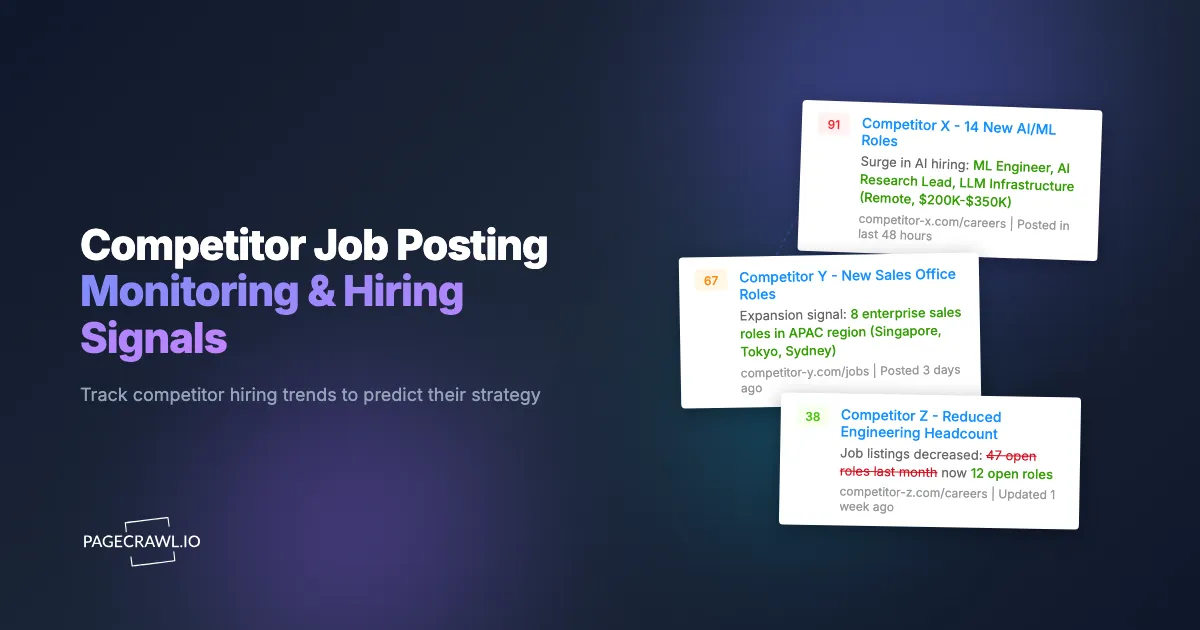
New office locations indicated by job postings with unfamiliar city names are clear expansion signals. If a US-based competitor starts posting roles in London, Singapore, and Sao Paulo simultaneously, international expansion is underway.
Remote-first shifts signaled by location-agnostic postings indicate talent strategy changes that affect recruiting competition and operational structure.
Concentration changes matter too. If a competitor that historically hired only in San Francisco starts posting engineering roles in Austin and Denver, they may be responding to cost pressures or talent availability challenges.
Volume and Velocity Changes
Track the total number of open positions over time, not just individual postings.
Sudden increases in posting volume suggest funding events, new contracts, or strategic pivots requiring rapid team building.
Sudden decreases or mass removal of postings may indicate budget cuts, hiring freezes, or strategic retreat. A company that goes from 200 open positions to 40 within a month is experiencing significant organizational change.
Department-specific spikes are the most strategically interesting. If overall hiring is flat but security engineering roles triple, something specific is driving that need.
Where should you monitor competitor job postings?
Job postings appear across multiple channels, and monitoring all of them gives the most complete picture.
Company Careers Pages
The primary source. Most companies maintain a careers section on their website that lists all open positions. This is the most complete and up-to-date source because it is directly controlled by the hiring company.
Careers pages use various technologies. Some use embedded job boards (Greenhouse, Lever, Workday, iCIMS, BambooHR), while others use custom-built pages. The URL structure varies:
company.com/careerscompany.com/jobsjobs.company.comboards.greenhouse.io/companynamecompany.lever.co
Monitor the main job listing page with job board and career page monitoring to catch new postings and removals. For more targeted monitoring, many companies allow filtering by department (engineering, sales, marketing), which lets you focus on the areas most relevant to your competitive analysis.
LinkedIn Company Pages
LinkedIn job postings often mirror the company careers page but sometimes include additional roles or different descriptions. LinkedIn also shows hiring trends and employee growth metrics on company pages.
For monitoring LinkedIn company pages, see our LinkedIn monitoring guide. LinkedIn's dynamic content requires a monitoring tool that renders JavaScript, since the job listings load dynamically.
Job Board Aggregators
Indeed, Glassdoor, and ZipRecruiter aggregate postings from multiple sources. These can surface positions that are not yet on the company's own careers page, particularly if the company uses recruitment agencies.
However, aggregators also carry stale listings and duplicates. Use them as supplementary sources, not primary ones.
Applicant Tracking System (ATS) Pages
Many companies use hosted ATS platforms with public-facing job boards:
- Greenhouse:
boards.greenhouse.io/companyorcompany.greenhouse.io - Lever:
jobs.lever.co/company - Workday: Varies by implementation
- BambooHR:
company.bamboohr.com/careers
These ATS pages often show more detail than the company's own careers page, including team names, hiring manager information, and posting dates. They also tend to update faster because they connect directly to the internal ATS.
Setting Up Competitor Careers Page Monitoring with PageCrawl
Automated monitoring transforms sporadic careers page checking into systematic competitive intelligence.

Step 1: Identify Target Pages
For each competitor you want to track, find their primary careers page URL. Check both the company website careers section and any ATS board they use. If the company has separate listings by department, note those URLs as well.
Start with 3-5 key competitors. You can expand later.
Step 2: Create Content Monitors
Add each careers page URL in PageCrawl. Select "Content Only" mode, which strips navigation elements, footers, and repeated page chrome, focusing on the actual job listing content. This reduces noise from unrelated page changes.
"Content Only" mode is particularly valuable for careers pages because the surrounding site template may change frequently (new blog posts in the footer, updated navigation items) without any change to the actual job listings.
Step 3: Configure New Content Detection
For careers page monitoring, the most valuable alert is when new content appears (a new job posting) or existing content disappears (a position was filled or removed). PageCrawl's change detection captures both additions and removals.
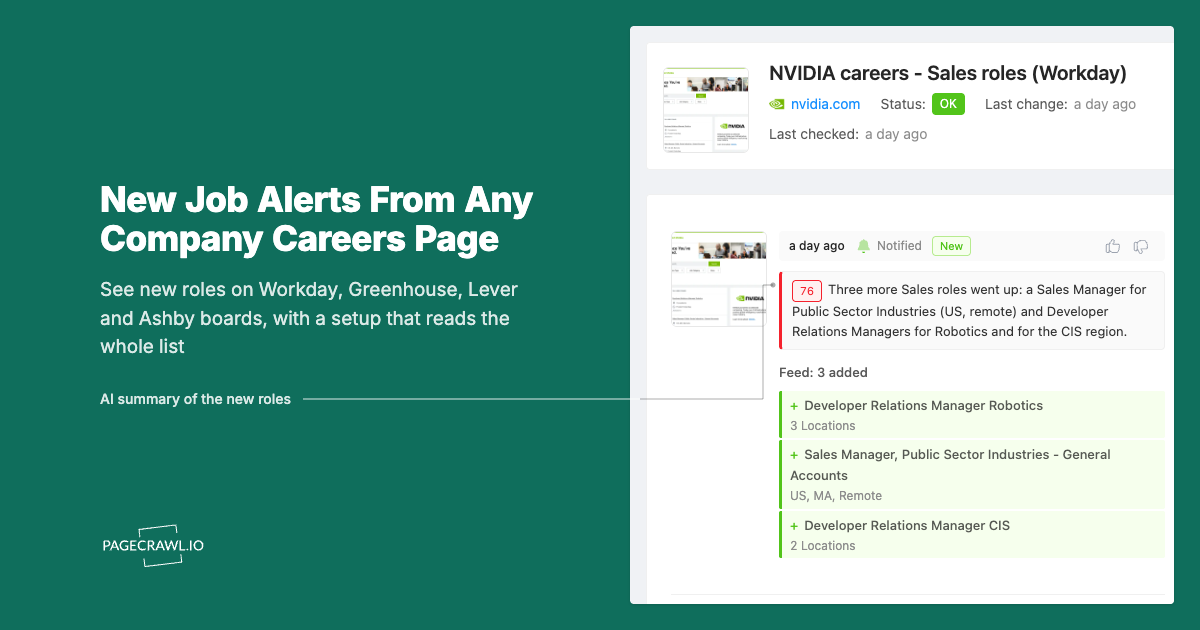
Enable AI summaries so that when changes are detected, you receive a plain-language description: "Two new engineering positions were added: Senior Machine Learning Engineer and Data Platform Lead. One position was removed: Junior Frontend Developer." This is far more actionable than a raw text diff.
For teams monitoring many competitors, PageCrawl's Kanban-style Review Board for organizing detected changes provides a centralized view where you can see all recent hiring changes across every monitored careers page in one place, mark changes as reviewed, and leave internal notes. Instead of chasing individual alerts across email and Slack, the review board gives your competitive intelligence team a shared workspace to triage and discuss hiring signals together.
Step 4: Set Check Frequency
Daily checks are sufficient for most competitor monitoring. Job postings typically stay live for weeks, so checking every 24 hours catches new postings within a day of publication. For high-priority competitors or during periods of intense competitive activity, increase to every 12 hours.
Weekly checks work for lower-priority competitors or when you are monitoring a large number of companies and want to conserve monitor capacity.
Step 5: Route Alerts Appropriately
For individual analysis, email notifications with AI summaries work well. You receive a daily or weekly digest of hiring changes across competitors.
For team-based competitive intelligence, route alerts to a dedicated Slack channel or use webhooks to feed data into your competitive intelligence tools.
Interpreting Hiring Signals: A Framework
Raw job posting data needs interpretation. Here is a structured framework for turning observations into intelligence.
The STAR Framework for Job Posting Analysis
S - Scale: How many positions? Is this a single hire or a team buildout? Volume indicates investment level.
T - Timing: When did these postings appear? Is there a cluster of related postings within a short window? Timing reveals urgency and planning cycles.
A - Alignment: Do the postings align with known strategic initiatives, recent funding, or announced plans? Alignment confirms direction. Misalignment suggests unannounced plans.
R - Recurrence: Is this a replacement hire for an existing role, or is it a net-new position? Replacement hires tell you about retention. Net-new roles tell you about growth.
Building Pattern Recognition
Individual job postings are data points. Patterns across postings over time are intelligence.
Track competitor hiring in a simple spreadsheet or database with columns for: date posted, company, role title, department, seniority level, location, key technologies mentioned, and notable requirements. Over weeks and months, patterns emerge that are invisible when looking at individual postings.
For example, tracking might reveal that Competitor A posted 3 AI/ML roles in January, 5 in February, and 8 in March, all at senior levels. That is a clear acceleration signal for an AI initiative.
Signal Strength Assessment
Not all signals are equally reliable. Assess signal strength based on:
High confidence signals: Multiple related postings across departments (engineering + product + marketing for the same product area), executive-level hires with specific domain expertise, and postings that explicitly describe new products or markets.
Medium confidence signals: Individual senior hires that could indicate either growth or replacement, technology stack changes in job requirements, and new location postings.
Low confidence signals: Individual junior or mid-level postings (could be replacement), generic role descriptions without specific technology or product mentions, and intern or contractor postings.
Case Studies: Hiring Signals That Predicted Major Moves
These composited examples illustrate how job posting monitoring revealed strategic shifts before public announcements.
The Enterprise Pivot
A B2C software company began posting roles for "Enterprise Account Executive," "Solutions Architect," and "Enterprise Customer Success Manager" across a three-month period. Previously, their careers page showed only inside sales and SMB-focused roles. The shift in role types signaled a move upmarket into enterprise sales, which was confirmed six months later when the company announced an enterprise product tier.
Competitors who spotted the hiring signal had six months to prepare their enterprise positioning and competitive response.
The Geographic Expansion
A European SaaS company posted its first US-based roles (initially remote, then specifying New York and San Francisco). The postings included sales, marketing, and legal roles, indicating a full market entry rather than just engineering talent acquisition. Nine months later, the company announced a US headquarters and launched localized pricing.
Monitoring the careers page using automatic page discovery would have caught the addition of new location filters on the careers page itself.
The Technology Migration
A competitor's engineering postings gradually shifted technology requirements over eight months. Early postings required Ruby on Rails and PostgreSQL. Newer postings required Go, Kubernetes, and event-driven architecture experience. This signaled a major platform rewrite, which meant the competitor's product development would slow during the migration period, creating a competitive window.
Building a Hiring Signal Dashboard
For organizations that take competitive intelligence seriously, systematize the monitoring process.
Data Collection Layer
Use PageCrawl monitors on each competitor's careers page. Route all change alerts via webhooks to a central collection point (a database, spreadsheet, or business intelligence tool).
Structure the incoming data to capture: timestamp, competitor name, change type (addition/removal), role details (extracted from the AI summary or parsed from the webhook payload).
Analysis Layer
Aggregate the collected data to surface patterns:
- Hiring velocity by competitor: Total open roles over time, charted weekly or monthly
- Department breakdown: Engineering vs. sales vs. operations hiring ratios
- Seniority distribution: Junior vs. senior vs. leadership hiring ratios
- Technology trends: Emerging technology mentions across competitors
- Geographic patterns: New locations or concentration changes
Reporting Layer
Produce regular competitive intelligence reports (weekly or monthly) that summarize:
- Notable new postings across monitored competitors
- Significant changes in hiring volume or composition
- Emerging patterns and their strategic implications
- Recommended competitive responses or further investigation areas
This transforms ad-hoc careers page checking into a structured intelligence capability that the entire organization can benefit from.
Monitoring at Scale
When monitoring many competitors, efficiency matters.
Prioritize Your Monitoring Tiers
Tier 1 (daily monitoring): Direct competitors who compete for the same customers in the same market. Monitor their main careers page and department-specific pages for your most relevant functions.
Tier 2 (weekly monitoring): Adjacent competitors, potential market entrants, and companies in related spaces. Monitor their main careers page only.
Tier 3 (monthly check): Companies on your watchlist that might become competitors based on their trajectory. A quick manual check supplemented by automated monitoring of their main page.
Use Folders for Organization
Create folders in PageCrawl by competitor or by monitoring tier. Structuring monitors with labels, folders, and workspaces keeps your dashboard organized and lets you manage notification preferences by group.
Combine with Broader Competitive Monitoring
Job posting monitoring is most powerful when combined with other competitive intelligence sources. Monitor competitor websites for product changes, pricing updates, content strategy shifts, and customer win and churn signals on their logo walls and case-study pages. Our guide on tracking competitor websites covers the broader picture.
For a comprehensive approach to competitive intelligence that includes job monitoring as one component of a larger system, see the competitive intelligence guide.
Is monitoring competitor job postings legal and ethical?
Yes, when done through public channels. Job posting monitoring uses only publicly available information. Companies publish job postings with the explicit intent of reaching the widest possible audience. Monitoring publicly accessible careers pages and job boards is standard competitive intelligence practice.
A few guidelines to keep the practice ethical:
- Monitor only publicly accessible pages. Do not attempt to access internal job boards or password-protected ATS pages.
- Use the information for strategic planning, not for poaching employees or disrupting hiring processes.
- Combine job posting signals with other data sources before drawing conclusions. A single posting can be misleading. Patterns are more reliable.
- Respect rate limits and reasonable monitoring frequencies. Daily checks are sufficient and avoid placing unnecessary load on careers pages.
Common Challenges
ATS Platform Complexity
Greenhouse, Lever, and Workday pages render content dynamically with JavaScript. PageCrawl handles this because it renders pages in a full browser, but some ATS platforms use pagination or infinite scroll for job listings. If a company has hundreds of open positions, the initial page load may show only the first 20-50. Monitor the full careers page URL, and if the company uses department filters, create separate monitors for the departments you care about most.
Stale Listings
Some companies are slow to remove filled positions from their careers pages. A role that has been posted for six months might be filled, on hold, or genuinely still open. Weight recent postings (last 1-2 months) more heavily than older ones when interpreting signals.
Duplicate Listings Across Platforms
The same role posted on the company careers page, LinkedIn, Indeed, and Glassdoor can create noise if you are monitoring all platforms. Focus your automated monitoring on the company's primary careers page or ATS board, and use aggregators as supplementary manual checks.
Mergers, Acquisitions, and Rebrands
Company websites change URLs during acquisitions and rebrands. If a competitor is acquired, their careers page URL may change entirely. Monitor for these organizational changes and update your monitors accordingly.
Choosing your PageCrawl plan
PageCrawl's Free plan lets you monitor 6 pages with 220 checks per month, which is enough to validate the approach on your most critical pages. Most teams graduate to a paid plan once they see the value.
| Plan | Price | Pages | Checks / month | Frequency |
|---|---|---|---|---|
| Free | $0 | 6 | 220 | every 60 min |
| Standard | $8/mo or $80/yr | 100 | 15,000 | every 15 min |
| Enterprise | $30/mo or $300/yr | 500 | 100,000 | every 5 min |
| Ultimate | $99/mo or $999/yr | 1,000 | 100,000 | every 2 min |
Annual billing saves two months across every paid tier. Enterprise and Ultimate scale up to 100x if you need thousands of pages or multi-team access.
Spotting a competitor's AI initiative six months before they announce it - because you caught the hiring cluster in January - is the kind of advantage that changes product roadmap decisions, not just weekly tactics. Standard at $80/year covers 100 monitored pages, enough to track careers pages, department-filtered job boards, and ATS listings for a full competitive set. Checking daily means you catch new postings within 24 hours of publication, well inside the window where the signal is still actionable. Enterprise at $300/year adds 500 pages and 5-minute check frequency for teams that need near-real-time visibility into hiring shifts.
All plans include the PageCrawl MCP Server, so tools like Claude can query your hiring history directly - your strategy team can ask "what roles has Competitor X posted in the last quarter and what do they suggest?" and get an answer built from your own monitoring archive. AI assistants can create monitors through conversation on every plan, including Free.
Getting Started
Choose your three most important competitors. Find their careers page URLs and any ATS board URLs they use. Create PageCrawl monitors in "Content Only" mode with daily check frequency and AI summaries enabled. Route alerts to a dedicated Slack channel or email folder.
Run the monitors for one month to establish a baseline of each competitor's typical hiring activity. After that baseline period, new postings and removals stand out as meaningful signals against the established pattern. Expand to additional competitors and add webhook automation as your competitive intelligence practice matures.
PageCrawl's free tier includes 6 monitors, enough to cover careers pages for 3-5 key competitors. Paid plans start at $80/year for 100 monitors (Standard) and $300/year for 500 monitors (Enterprise), providing capacity for comprehensive multi-competitor, multi-source hiring intelligence.