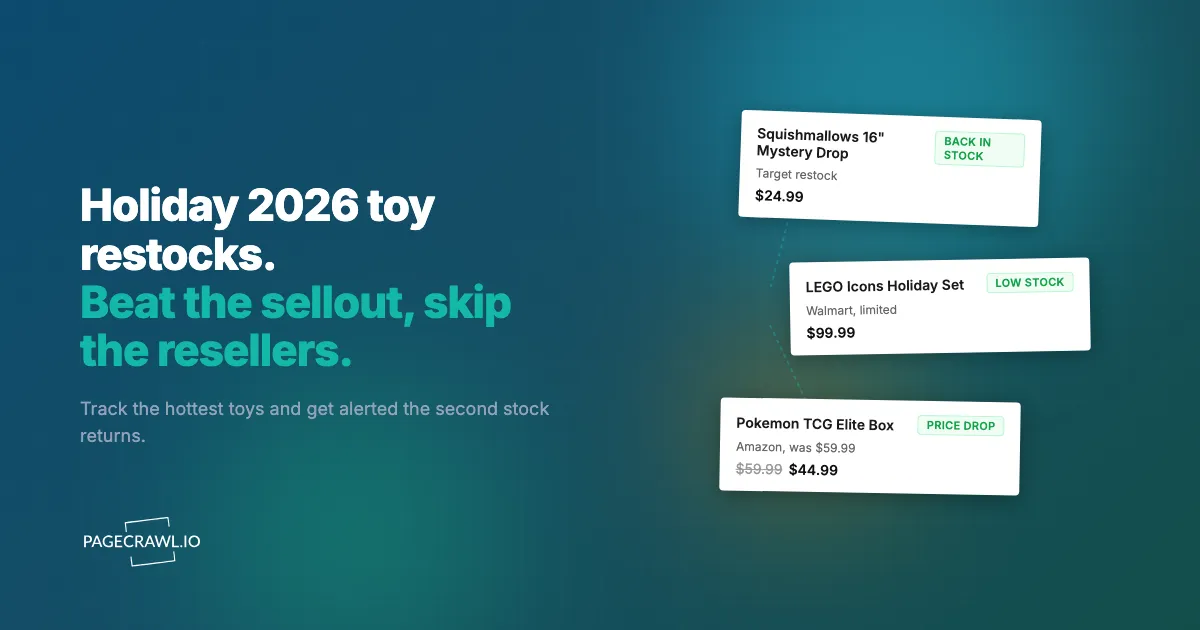
Last December, the toy your kid actually asked for went out of stock at every major retailer within a week of Thanksgiving. You set up an account alert that never fired, paid scalper prices on a marketplace, or settled for a substitute and hoped nobody noticed. The retailers had stock the whole time. It just came back in unannounced batches at odd hours, sold through in minutes, and disappeared again before any official notification reached you.
Hot holiday toys follow a predictable cruelty. A handful of items each year become the must-have gift, demand outruns supply by October, and the items that were $30 at retail trade for $80 to $150 on the secondary market by mid-December. Squishmallows have been on the hot list for several years running, with specific characters and sizes selling out faster than the line as a whole. The same pattern hits whatever the year's breakout doll, plush, collectible, or electronic gets crowned. The parents and resellers who get these at retail are not refreshing pages at midnight. They have automated stock availability monitoring watching the exact product pages and alerting them as soon as a check detects that stock has returned.
This guide covers how the 2026 holiday toy cycle works, which products and retailer lists to watch, and how to set up automated restock and price monitoring so you get notified before an item sells out again, ideally well before the December panic.
Why is holiday toy stock different from normal retail?
Holiday toy demand is seasonal, concentrated, and driven by a small set of items the entire market decides are essential within a few weeks. Supply arrives in unannounced waves, scarcity is variant-specific rather than brand-wide, and prices move in both directions during the season. That concentration is exactly what makes monitoring worthwhile.
The hot-toy list effect
Every fall, major retailers and media outlets publish "top toys" and "hot holiday toys" lists. Amazon, Walmart, Target, and outlets like Good Housekeeping and The Toy Insider all release their picks between September and early November. The moment an item lands on one of these lists, demand spikes and available inventory drains. The list is both a buying guide and a sellout predictor. If you are watching, the list tells you exactly which product pages to start monitoring before the rush.
Squishmallows and character scarcity
Squishmallows are a useful example because the scarcity is granular. The brand is widely stocked, but specific squad members, sizes (the 16-inch and 20-inch sizes especially), and seasonal or licensed editions sell out independently. A store can be "in stock on Squishmallows" while the one character your kid wants has been gone for three weeks. Monitoring the brand category page is close to useless. Monitoring the specific product page for the specific character and size is what actually works.
Restocks arrive in unannounced batches
Retailers receive shipments throughout the season and push inventory online in waves. These restocks are rarely announced ahead of time. They appear, the page flips from "Out of Stock" to "Add to Cart," and high-demand items clear within minutes. Official "email me when available" features exist at most retailers, but they are slow, frequently batched, and sometimes never fire at all. By the time the email lands, the wave is gone.
Prices move during the season too
Hot toys do not only go out of stock. They get marked up by third-party sellers when official stock dries up, and they get discounted during Black Friday and Cyber Monday windows. Tracking Black Friday and Cyber Monday deal alerts alongside availability means you catch both the restock and the best price, rather than panic-buying the first listing you find at any price.
The 2026 Holiday Toy Categories to Watch
You will not know the full hot list until the fall, but the categories are predictable, and you can pre-build monitors against the product pages as soon as they exist.
Plush and collectible characters
Squishmallows remain the anchor of this category, alongside other plush lines and blind-box style collectibles. Demand here is character-specific and size-specific. Seasonal exclusives (holiday-themed releases) and licensed crossovers sell out fastest. If you collect blind-box style items, the same monitoring approach applies to lines covered in our Pop Mart and Labubu blind box restock guide.
Trading cards and TCG products
Pokemon and other trading card products are perennial holiday sellouts, especially special-edition tins, elite trainer boxes, and collection bundles released for Q4. These often sell out within minutes of a restock. See our dedicated guides on Pokemon TCG restock and new set drops and trading card restock alerts for TCG and sports cards for product-specific tactics.
Collectible figures
Funko Pops and similar collectible figures spike during the holidays, with exclusives and chase variants driving the scarcity. Our Funko Pop exclusive drop alerts guide covers the convention and retailer-exclusive patterns that matter here.
Electronics and gaming
The crossover between "toy" and "electronics" is where the most expensive sellouts happen. Game consoles, handhelds, and popular game titles are holiday staples. If a console or handheld is on your list, our guides on Nintendo Switch 2 stock alerts and Steam Deck stock tracking cover those specifically.
Dolls, building sets, and the annual breakout
Every year produces a breakout item nobody fully predicted, a doll line, an interactive plush, a building set, or a novelty electronic. You cannot pre-build a monitor for something with no product page yet, but you can watch the hot-toy lists and add a monitor within minutes of the item being named.
What are the best methods for catching toy restocks?
Automated page monitoring is the only method that covers many items at once and catches the overnight waves. Manual refreshing cannot scale past one item, retailer "notify me" emails are frequently batched hours behind the actual restock, and deal communities usually surface an item after it has already sold through. Here is how the four compare.
Manual refreshing
Opening retailer pages and refreshing during the season.
Pros
- Free, no setup
- You see the page exactly as it is
Cons
- You cannot watch multiple items or stores at once
- Restocks happen at unpredictable hours
- You will miss the overnight and early-morning waves
Best for: A single item you are casually watching, nothing high-demand.
Retailer "notify me" buttons
Most retailers offer an email alert when an item is back.
Pros
- Built into the retailer, zero cost
- Tied to your account for fast checkout
Cons
- Notoriously slow and sometimes batched hours behind the actual restock
- Sometimes never fires for high-demand items
- One alert per item per retailer, no central view
Best for: A backup layer, not your primary system.
Stock alert communities and deal channels
Reddit threads, Discord servers, and deal-tracking sites that post restocks. Good for general awareness across many items, but you often learn about a restock after it has sold out, the feeds are noisy, and they rarely cover the specific niche item on your list. Use them as a supplement, not your primary system.
Automated page monitoring
A tool that checks the exact product pages on a schedule and alerts you as soon as a check detects the availability status changing.
Pros
- Watches many items across many retailers at once
- Catches overnight and early-morning waves automatically
- Pushes to your phone as soon as the next check detects the change
- Tracks price changes alongside availability
Cons
- Requires a few minutes of setup per item
- You still need to complete checkout quickly
Best for: Anyone with a specific must-have item, or anyone tracking several gifts across multiple stores.
Here is how the approaches compare:
| Method | Multi-item | Catches overnight waves | Speed | Tracks price too | Cost |
|---|---|---|---|---|---|
| Manual refresh | No | No | Slow | Manual | Free |
| Retailer "notify me" | One at a time | Sometimes | Slow / batched | No | Free |
| Deal communities | Yes | Partial | Variable | Sometimes | Free |
| Automated monitoring | Yes | Yes | Next check | Yes | Free tier, then paid |
Where to Monitor
Different retailers restock on different schedules and sometimes carry exclusive editions. Spreading monitors across stores raises your odds.
Amazon
The broadest selection and the most dynamic pricing. Amazon carries first-party and third-party listings for nearly every hot toy, and prices swing widely as official stock fluctuates. Amazon in-stock alerts catch restocks, and Amazon price tracking catches both the deals and the third-party markups that signal a sellout.
Walmart
Walmart is a primary source for holiday toys and publishes its own influential hot-toy list each year. Online availability updates independently from other retailers, and Walmart often carries exclusive editions. See Walmart in-stock alerts and Walmart price tracking.
Target
Target carries a heavy toy assortment, runs frequent exclusives, and is a common source for Squishmallows seasonal editions specifically. Online stock can differ sharply from in-store. Use Target inventory and stock alerts and Target price tracking.
Specialty and brand stores
Brand-direct stores and specialty toy retailers sometimes carry editions the big-box stores do not, and they sometimes restock when everyone else is empty. For hard-to-find characters and exclusives, a brand-direct product page is worth a monitor of its own.
Watching the same product across multiple retailers is the single highest-leverage tactic. This mirrors the approach in our cross-retailer price comparison and product monitoring guide: one item, several store pages, whichever flips to in-stock first wins.
Setting Up Holiday Toy Monitoring with PageCrawl
PageCrawl checks retailer product pages directly on a schedule and alerts you as soon as a check detects an availability or price change. New monitors come with screenshots enabled by default, so every alert includes a visual snapshot of the page state, which is useful for confirming a restock is real before you rush to checkout. Here is the setup.

Basic restock alert
Step 1: Add the product URL
Copy the URL of the exact product page from the retailer, the specific Squishmallows character and size, the specific TCG tin, the specific console bundle. Not the brand category page. Create a new monitor in PageCrawl and paste the URL.
Step 2: Choose the tracking mode
For availability, "Full Page" mode captures the whole page state including the add-to-cart button and stock status text. For tighter, lower-noise monitoring, use element tracking with a CSS selector targeting just the availability button or stock message. For items where price matters as much as stock, use price/number tracking mode so you can alert on a threshold (for example, only notify if the price is at or below retail).
Step 3: Set the check frequency
For a high-demand item during the peak season (late November through mid-December), check as often as your plan allows. The free tier checks every 60 minutes, which catches most waves; paid plans check every 5 to 15 minutes for the fastest items. For items you are watching casually or for a price drop rather than a sellout, every 6 to 12 hours is plenty. Increase frequency as the season ramps up.
Step 4: Configure fast notifications
Speed wins holiday restocks. PageCrawl supports multiple notification channels, so pick the fastest ones. The help centre covers enabling web push notifications for change alerts on desktop and mobile:
- Push and Telegram: the fastest channels once a check detects the change; see web push notifications for restock alerts
- Slack or Discord: good for a shared family or group channel
- Email: reliable but slower, use it as a backup layer
- Webhook: for automated workflows if you are technical
For items that sell out in minutes, push notifications give you the best shot at completing checkout in time.
Organize monitors by urgency
For a full gift list, group your monitors by priority so your check budget goes where it matters most. PageCrawl supports labels, folders, and workspaces for organising monitored pages, which makes this easy to keep tidy across a season:
Folder: Must-Have (High Priority)
- The exact items your kids asked for, the ones that will cause real disappointment
- Mirror each item across Amazon, Walmart, and Target
- Highest check frequency your plan allows during peak season
Folder: Nice-to-Have (Normal Priority)
- Backup gift ideas and lower-stakes items
- One or two retailers each
- Check every 6 to 12 hours
Folder: Watching the Lists
- Retailer hot-toy list pages and editorial roundups
- Monitor these so you learn what the breakout items are the day they are named
- Daily checks, increasing in October
Monitoring the Hot-Toy Lists Themselves
One overlooked tactic: monitor the list pages, not just the products. When Amazon, Walmart, or Target updates its "top holiday toys" page, that change is itself a signal. The newly added item is about to spike in demand, and you want a monitor on its product page before everyone else does.
Set up a Full Page monitor on each retailer's hot-toy list URL and on a couple of editorial roundups. When PageCrawl detects the page changed and a new item appears, you get an alert with a screenshot showing exactly what was added. Add a product monitor for the new item within minutes. This is the same "watch the source, react to the change" pattern used for out-of-stock monitoring more broadly, applied to demand signals instead of inventory.
Combining Availability with Price Tracking
Availability and price are two different problems, and the best setups track both.
Catch the deal, not just the stock
During Black Friday and Cyber Monday, hot toys get genuine discounts, then bounce back. A price monitor with a threshold lets you buy at the low and skip the markup. Pair availability monitoring with price-drop alerts so you are not forced to buy the first available listing at any price.
Read the markup as a scarcity signal
When third-party prices for a toy start climbing above retail, that is a reliable sign that official stock is drying up. It is your cue to buy at retail immediately wherever you can find it, before the only option left is the inflated secondary market. Watching price trends gives you a few days of warning that pure stock monitoring does not.
What are the common challenges with toy restock alerts?
Four things trip people up: checkout speed once an alert fires, retailer wording that hides whether an item will ever return, monitoring at the wrong product granularity, and pages that reshuffle their layout during promotions. Each has a straightforward fix.
You still have to check out fast
Monitoring gets you to the page as soon as a check detects stock returning, but the highest-demand items can still sell out during checkout. Stay logged into your retailer accounts, save payment and shipping details ahead of time, and keep the product page bookmarked. Every second counts. Bots compete for the same inventory; for context on that, see what a bot is and how sneaker bots work.
"Out of stock" versus "sold out" versus "coming soon"
Retailers use different phrasing for "will restock" versus "gone for good" versus "not released yet." Pay attention to which state your monitor is catching. An item flipping from "coming soon" to "available" is a launch; an item flipping from "out of stock" back to "add to cart" is a restock. Both are worth alerts, but they call for different urgency.
The right product, the right size
This is the Squishmallows trap and it applies to most toy lines. Brand pages and category pages tell you almost nothing. Always monitor the specific variant page (character, size, color, edition), which is exactly what product page monitoring is built for. A monitor on the wrong granularity will either never fire or fire constantly for changes you do not care about.
Page layout changes during promotions
Retailer pages shift layout during holiday sales and promotional events. PageCrawl handles most of this automatically through full-page rendering, and the screenshot attached to each alert lets you confirm what actually changed at a glance.
Choosing your PageCrawl plan
PageCrawl's Free plan lets you monitor 6 pages with 220 checks per month, which is enough to validate the approach on your most critical pages. Most teams graduate to a paid plan once they see the value.
| Plan | Price | Pages | Checks / month | Frequency |
|---|---|---|---|---|
| Free | $0 | 6 | 220 | every 60 min |
| Standard | $8/mo or $80/yr | 100 | 15,000 | every 15 min |
| Enterprise | $30/mo or $300/yr | 500 | 100,000 | every 5 min |
| Ultimate | $99/mo or $999/yr | 1,000 | 100,000 | every 2 min |
Annual billing saves two months across every paid tier. Enterprise and Ultimate scale up to 100x if you need thousands of pages or multi-team access.
The math is straightforward. Standard at $80/year covers 100 product pages. If monitoring catches one $20 price drop, one mispriced competitor SKU, or one restock you would otherwise miss each month, the plan has paid for itself roughly four times over in the first year. For teams running real competitive pricing programs, Enterprise at $300/year tracks 500 SKUs, which is usually enough to cover a full category across every major competitor.
Getting Started
Start before the season heats up, not during it. Pick the 3 to 5 items most likely to be on the hot list this year, or that your family has already named. Find the exact product page URLs (the right character, the right size, the right edition) on Amazon, Walmart, and Target. Create a monitor for each, and mirror the must-have items across two or three retailers so you catch whichever restocks first.
Set the fastest notification channel you can, push or Telegram, and set your check frequency higher as November approaches. Add a couple of monitors on the retailer hot-toy list pages so you learn about breakout items the day they are named. Save your payment and shipping details on each retailer site so you can check out in seconds when an alert fires.
Run it for a couple of weeks in early fall to learn each item's restock rhythm, then expand as the season builds. PageCrawl's free tier includes 6 monitors, enough to watch 3 priority toys across 2 retailers each and prove the concept well before December. If your gift list grows, the Standard plan at $80/year covers 100 pages, comfortably enough to track a full holiday wishlist across every major store.