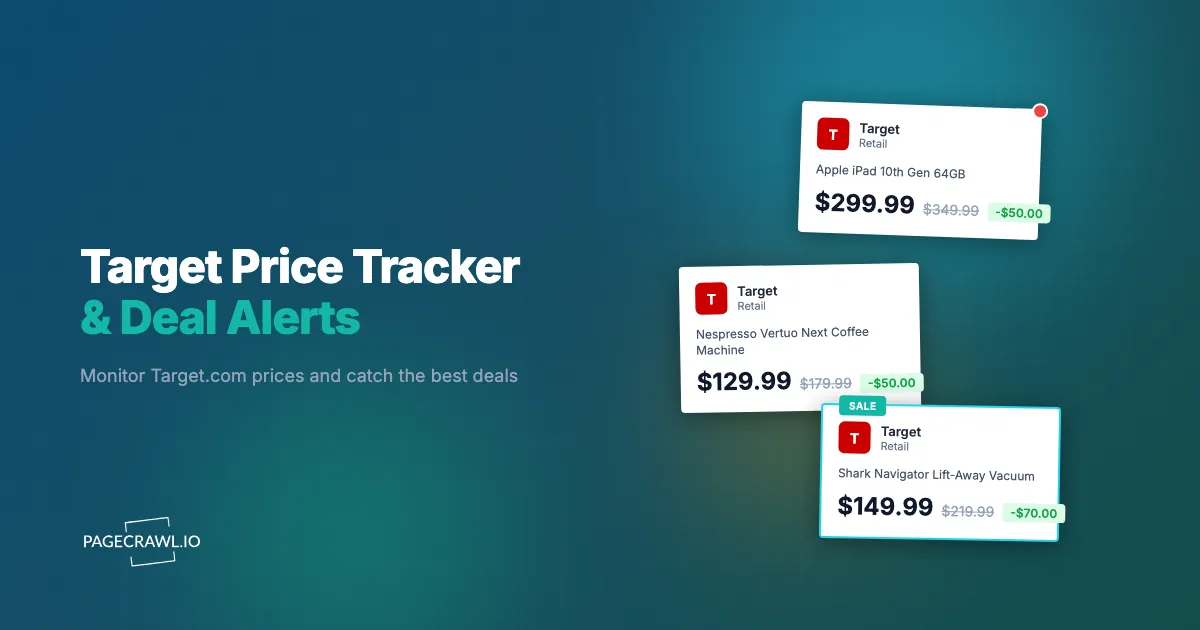
Target marks down a KitchenAid mixer from $349 to $219 on a random Wednesday morning. By Thursday afternoon, the price is back to $299. You never saw the deal because Target sent no alert and posted no announcement.
Target operates one of the most complex pricing systems in retail. Between Target Circle offers, weekly ad promotions, clearance cycles, and price matching policies, the price of any given product can shift multiple times in a single month, which makes manual price checking unreliable.
This guide covers how Target pricing works, what products benefit most from automated tracking, every method for monitoring Target prices in 2026, and how to set up deal alerts that catch markdowns while there is still time to act.
How does Target pricing work?
Target prices move through four main mechanisms: personalized Target Circle offers, weekly ad promotions that refresh every Sunday, staged clearance markdowns that step from 15% to 70% off, and a 14-day price match policy. Unlike Amazon's constant algorithmic repricing, Target makes deliberate moves on a promotional calendar, so the patterns are learnable even when the timing is not.
Target Circle and Personalized Offers
Target Circle is Target's free loyalty program, and it fundamentally changes how prices work on Target.com. Circle members receive personalized offers based on their shopping history and location, so two shoppers looking at the same product page might see different Circle offers. Some offers are universal, others are targeted to specific accounts.
Automated monitoring tracks the public (non-logged-in) page price, which is the most consistent baseline. Circle-specific offers require logging into your account to verify, but knowing when the base price drops still gives you the signal to check for stacking Circle deals.
Weekly Ad Cycles
Target's weekly ad runs Sunday through Saturday, with new deals launching each Sunday in stores and online. It covers a curated set of products with temporary price reductions, buy-one-get-one offers, and gift card promotions.
Not everything in the weekly ad appears on product pages as a visible price change. Some deals require adding to cart to see the promotional price, and gift card promotions do not change the displayed price at all. The most trackable weekly ad deals are direct price reductions on the product page; category-level and gift card offers are better caught by monitoring the weekly ad page itself.
Clearance and Markdown Cycles
Target follows a predictable markdown cadence for clearance items. Products typically move through 15%, 30%, 50%, and 70% off stages before final clearance, and toys see aggressive clearance in January after holiday overstock and again in late summer before back-to-school inventory arrives.
Knowing where a product sits in the cycle helps you decide whether to buy now or wait. If something just hit 30% off, a deeper cut is likely coming in two to four weeks, unless inventory is running low. Seasonal goods follow the same cadence: a patio set that costs $800 in May might clear at $200 in September, and Christmas decorations hit 70% off by January 2nd.
Price Match Guarantee
Target price matches select competitors (Amazon, Walmart, Best Buy, and others) within 14 days of purchase, and matches their own price if it drops within 14 days. Buy when a deal looks good, and if the price drops further within two weeks, request an adjustment.
This also means tracking Amazon prices and Walmart prices alongside Target creates a comprehensive deal-finding system.
What products should you track at Target?
Focus your tracking on categories where prices move meaningfully and timing matters: electronics, kitchen appliances and vacuums, furniture, baby gear, and toys ahead of the holidays. These categories cycle through promotional pricing every few weeks, and the gap between regular and sale price can be substantial.
Electronics
TVs, headphones, tablets, and gaming accessories see the most dramatic price swings. A TCL TV might sit at $399 for weeks, drop to $279 during a promotion, and return to $349 afterward. Target prices electronics aggressively to compete with Amazon and Best Buy, so track the specific models you are considering.
Home and Kitchen
KitchenAid mixers, Dyson vacuums, Instant Pots, bedding sets, and furniture are popular Target purchases where price tracking pays off. The Threshold and Hearth & Hand home brands are Target exclusives that only go on sale at Target, making direct monitoring the only way to catch deals.
Toys (Pre-Holiday)
October through December, toy prices change weekly as promotions cycle through. Start monitoring in September if you plan holiday shopping: the best deals often appear in early November before Black Friday, and some items sell out at their lowest price.
Baby and Kids
Car seats, strollers, diapers, and kids clothing are high-frequency Target purchases where even small discounts add up. Target Circle frequently offers baby and kids deals, seasonal clearance on kids clothing can reach 70% off, and rotating diaper promotions change the per-unit cost significantly from week to week.
What is the best way to track Target prices?
Automated price monitoring is the most reliable way to track Target prices. The Target app requires manual checking, and deal sites only surface popular products. A monitoring service watches the exact product pages you care about and alerts you when a scheduled check detects a price change. Here is how the three main approaches compare.
Method 1: Target App and Target Circle
The Target app shows current prices, Circle offers, and personalized deals in the "My Deals" section, and lets you scan items in-store for the latest price.
Pros: Free, shows personalized Circle offers, integrates with in-store shopping. Cons: No automated alerts for specific products, requires manual checking, Circle offers change without notice.
Method 2: Browser Extensions and Deal Sites
Price tracking browser extensions and deal aggregator sites (like Slickdeals) can catch some Target deals by tracking the main displayed price.
Pros: Simple setup, some historical price data, community deal sharing. Cons: Limited to the main price element, no tracking of Circle offers or cart-specific pricing, email-only alerts on most platforms, no webhook or API output. Niche products get little attention from deal hunters.
Method 3: Web Monitoring with PageCrawl
Instead of relying on deal communities or manual app checking, you monitor the specific product pages you care about and get alerted when the next check detects a price change.
How it works:
- Copy the Target.com product URL for the item you want to track.
- Add it to PageCrawl using "Price" tracking mode, which identifies the price element automatically.
- Set your check frequency. Every 6 hours catches most deals; every 2 hours gives tighter coverage during sales events.
- Configure notifications. Email for general awareness, Telegram or Slack for time-sensitive deals where you want a push notification on your phone.
PageCrawl renders the full Target product page, handling any JavaScript-loaded pricing. PageCrawl identifies the primary price element and tracks it across layout changes, so you do not need to manually specify CSS selectors (though the CSS selector guide covers targeting specific elements if you want more control). Price changes, clearance markdowns, and weekly ad pricing all reflect on the product page, and base price changes always appear even when Circle-specific offers do not.
The resulting price history makes Target's promo rhythm obvious. This is a cordless vacuum over three months: the $469.99 regular price, a week-long Circle promotion at $389.99, the return to regular, and the current $399.99 markdown.

How do you set up Target price monitoring?
Setting up Target price monitoring takes about five minutes: gather product URLs, add them to PageCrawl in Price tracking mode, choose a check frequency that matches how fast deals move in that category, and pick your notification channels. The five steps below walk through each decision.

Step 1: Choose Your Products
Start with high-value items you are actively considering purchasing (electronics, appliances, furniture), where price differences matter most. Gather the Target.com URL for each product in the canonical format https://www.target.com/p/product-name/-/A-XXXXXXXX, avoiding URLs from search results or category pages.
PageCrawl's browser extension makes this step faster: click the extension icon on any product page to add a monitor without leaving Target.com, convenient when adding several items from the weekly ad or clearance sections in one session.
Step 2: Create Monitors
Add each URL to PageCrawl with "Price" tracking mode and verify that the detected price matches what you see on the website. For popular items that go in and out of stock, the price mode captures both price and availability status. The help centre guide to monitoring numeric values like prices and stock levels explains the charts and statistics you get once a few checks have run.
Step 3: Set Check Frequency
For general price tracking: Check every 12 hours. Target prices change less often than Amazon, and most deals last at least a full day.
For sales events (Target Circle Week, Black Friday): Increase to every 2-4 hours, since event prices can sell out or change within hours.
For clearance tracking: Daily checks are sufficient. Markdowns happen on a weekly cycle, and clearance prices tend to stay available for days.
Step 4: Configure Notifications
- Email: Good for general deal awareness where you will act within hours.
- Telegram: Mobile push notifications for time-sensitive deals like electronics and limited-stock items (how to connect a Telegram chat, group, or channel).
- Slack or Discord: Useful if you share deals with family or friends.
- Webhooks: Feed price data into spreadsheets or automation tools (see the webhook automation guide).
Step 5: Enable Actions
Enable "Remove cookie banners" and "Remove overlays" on your Target monitors. Target occasionally displays location selectors, sign-in prompts, or promotional overlays, and these actions clean up the page before monitoring.
Which PageCrawl plan do you need?
PageCrawl's Free plan is enough to validate the approach on your most important products, with checks running hourly. Paid plans add more pages and faster checks, which matters during Target Circle Week or Black Friday, when deals can expire within a few hours.
| Plan | Price | Pages | Checks / month | Frequency |
|---|---|---|---|---|
| Standard | $8/mo or $80/yr | 100 | 15,000 | every 15 min |
| Enterprise | $30/mo or $300/yr | 500 | 100,000 | every 5 min |
| Ultimate | $99/mo or $999/yr | 1,000 | 100,000 | every 2 min |
Annual billing saves two months on every paid tier. Standard covers every item on a typical shopping list across Target's electronics, home, and seasonal categories, and pays for itself the first time it catches a markdown you would have missed.
Can you monitor Target Circle offers and weekly ads?
Yes. Beyond individual product pages, you can monitor Target's weekly ad page, category deal pages, and the Circle bonus offers page in content-only mode. When a promotional page updates, your next check picks up the change and sends an alert, often before most shoppers notice the new deals.
Weekly Ad Page Monitoring
Target's weekly ad page (target.com/weekly-ad) updates each Sunday with new deals. Monitor it in content-only mode with a daily check; the page changes once per week, so daily checks are more than sufficient.
Category Deal and Circle Offer Pages
Target maintains category-specific deal pages (electronics deals, home deals, clothing deals) and a Circle bonus offers page that changes weekly. Monitoring these in content-only mode alerts you when new deals land in categories you care about, catching products you had not considered tracking specifically but would buy at the right price. Circle offers are personalized, so your specific offers may differ from what the monitor sees.
What advanced strategies improve Target price tracking?
Once basic monitoring runs, three strategies add the most value: cross-retailer comparison that feeds Target's price match policy, clearance cycle tracking that predicts the next markdown stage, and bulk monitoring for large wishlists.
Cross-Retailer Comparison
Set up monitors for the same product across multiple retailers and view their prices together in your dashboard. When Amazon drops below Target's price, buy from Amazon directly or take the Amazon price to Target for a price match. PageCrawl's grouped cross-retailer comparison, with automatic product matching and cheapest-price alerts, is a custom capability you can ask us to enable.
Clearance Cycle Tracking
When a product first appears on clearance at 15% off, create a monitor and track the price through the 30%, 50%, and 70% stages. Historical data shows exactly when each markdown happened, helping you predict the next cut. The risk with waiting is sellout, so pair price tracking with stock availability tracking: if a product hits 50% off and stock is running thin, buy rather than holding out for 70%.
Bulk Monitoring for Large Wishlists
If you are tracking 20 or more Target products, use PageCrawl's bulk import feature or the API to create monitors programmatically. Organize monitors into folders by category and set different notification rules per folder. This scales well for holiday shopping, where you might track 30 to 50 gift ideas while waiting for the best prices.
How do you maximize savings at Target?
The biggest savings come from stacking: Target allows combining a base price reduction, a Circle offer, the Target Circle Card (formerly RedCard) 5% discount, and gift card promotions on the same purchase, which together can exceed 30% off. Use monitoring to catch the base price drop, then check the Target app for stackable offers before checking out.
Monitor RedCard/Circle Card Exclusive Deals
Target Circle Card holders get exclusive deals beyond the standard 5% discount. Card-specific pricing does not appear on the public product page, but a base price drop is often accompanied by an even better cardholder price.
Use Price History for Negotiation
If a product was cheaper within the past 14 days and you missed it, show Target customer service the lower price from your monitoring history and they should adjust your purchase price under the price match policy.
What are the common challenges with Target price tracking?
The main challenges are personalized Circle offers that never appear on the public page, regional availability differences, promotions that only show their price in the cart, and occasional site layout changes. Each has a workaround.
Personalized Pricing and Circle Offers
Your monitoring sees the public page price, not your specific Circle offers. Use monitoring as a signal: when the base price drops, check your Target app for additional stacking offers.
Regional Availability
Target shows different availability, and sometimes different pricing, based on your location, particularly for store pickup items. Monitoring provides a consistent baseline, but your local store may differ.
Cart-Specific Pricing
Some promotions only show their discounted price after adding to cart ("Save 25% in cart"), so they cannot be detected on the product page alone. Weekly ad monitoring helps catch these by alerting you to the promotion even when the product page price appears unchanged.
Page Layout Changes
Target periodically updates their website layout. PageCrawl's price detection adapts to layout changes automatically in most cases; if detection breaks after a major site update, recreating the monitor typically resolves it within minutes.
When does Target Circle Week happen?
Target Circle Week typically runs in early July, positioned as Target's answer to Amazon Prime Day, with additional Circle Week events appearing in spring and fall in recent years. Target announces the dates on its corporate newsroom before the event goes live. Electronics, home goods, and apparel see some of the year's steepest markdowns. Increase your check frequency to every 2-4 hours during the event, because deal prices can sell out within hours.
Does Target adjust prices if an item drops after purchase?
Yes. Target matches its own prices within 14 days of purchase, alongside matching select competitors like Amazon and Walmart. If an item you bought drops within that window, show the lower price to customer service or request an adjustment online, and they should refund the difference. Price history from your monitors makes proving the drop easy.
How fast are Target price drop alerts?
Alerts arrive when the next scheduled check detects the change, so speed depends on your check frequency. Paid PageCrawl plans can check as often as every 2 minutes, while the Free plan checks hourly. Most Target deals last hours or days, so checks every few hours catch the markdown with plenty of time to act.
Getting Started
Stop guessing when Target will drop prices on items you want. Start with three to five high-value items you are actively shopping for, set up PageCrawl monitors with price tracking, and configure Telegram or email notifications. Within a few weeks, you will have enough price history to spot genuine deals versus cosmetic discounts.
Combine Target monitoring with Amazon and Walmart trackers to build a complete deal-finding system that covers the biggest retailers. The free plan is enough to track your most-wanted items across multiple stores and prove the concept before scaling up.