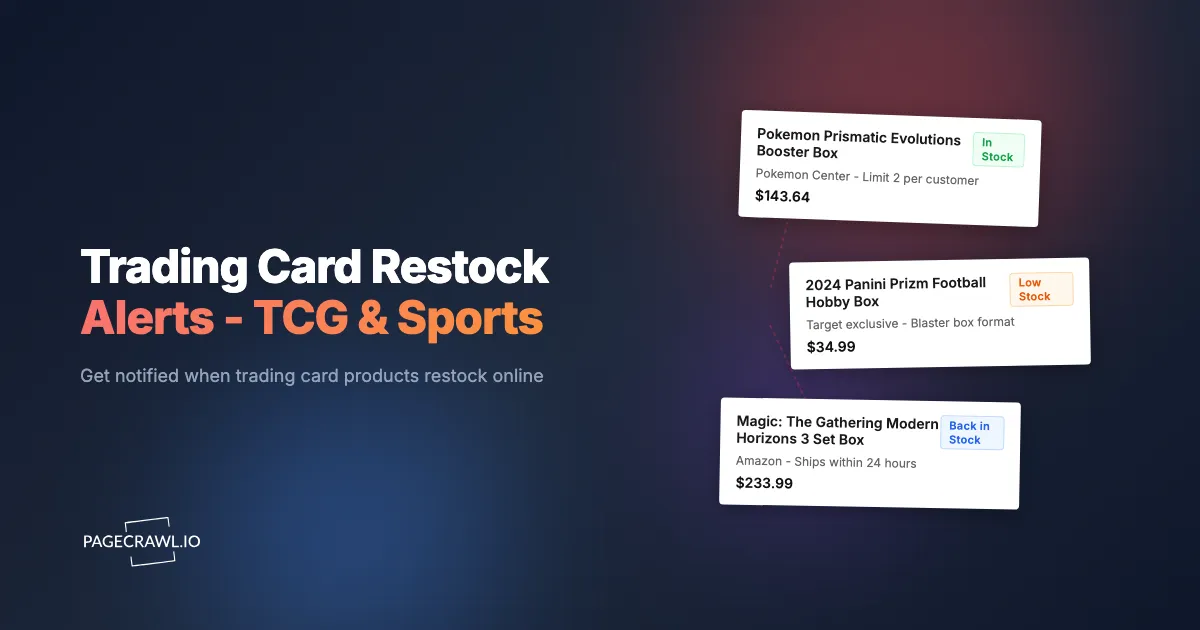
The Prismatic Evolutions Elite Trainer Box lasted minutes on Pokemon Center. The Panini Prizm Football Hobby Box disappeared from Target's website about as quickly. A Magic: The Gathering collector edition sat in stock for less than a coffee break before every unit was claimed. You heard about all of them hours later, after the resale listings had already doubled the retail price.
Trading card collecting across every major game has the same core problem: the products people want most are the products that disappear fastest. Whether you collect Pokemon TCG, sports cards from Panini and Topps, Magic: The Gathering, One Piece TCG, or Yu-Gi-Oh, the pattern is identical. Limited production meets massive demand, and the window between "in stock" and "sold out" is measured in minutes rather than hours.
The collectors and players who consistently buy at retail are not faster at clicking. They have systems watching retailer inventory around the clock that alert them as soon as a check finds a product available. This guide covers how to set up automated restock monitoring across every major trading card game, the retailers worth tracking, and the strategies that turn alerts into successful purchases.
Why are trading card restocks so competitive?
Restocks are competitive because manufacturers deliberately cap print runs while demand keeps climbing, and professional resellers watch retailer inventory around the clock. What was once a casual hobby is now a marketplace where limited supply meets organised buyers long before most collectors notice the product is back.
The Production Problem
Card manufacturers deliberately limit production runs. Pokemon's The Pokemon Company International prints special sets in controlled quantities. Panini and Topps produce sports card hobby products in limited runs. Wizards of the Coast creates Magic: The Gathering collector editions with fixed print numbers.
This is intentional. Limited supply protects product value, creates collector excitement, and keeps the secondary market healthy. But it also means that retail availability windows are extremely short for popular products.
The Reseller Factor
Professional resellers have transformed the trading card landscape. They monitor inventory across dozens of retailers simultaneously, often using automated purchasing tools that can complete checkout faster than any human. When a desirable product restocks, resellers may claim a significant portion of available units before casual collectors even know the product is available.
This creates an information asymmetry. Resellers hear about restocks almost as they happen. Regular collectors find out when they happen to check a website or see a social media post, often long after inventory has sold. Closing that information gap is the single most effective thing a collector can do to improve their chances of buying at retail.
Unpredictable Timing
Restocks follow no public schedule. Pokemon Center might restock a popular ETB at 2pm on a Wednesday. Target's online inventory refreshes could happen at midnight. TCGPlayer seller listings appear around the clock as individual sellers add inventory. Sports card hobby boxes at Walmart might appear early Tuesday morning.
Without monitoring, buying at retail requires either extraordinary luck or constantly refreshing product pages, which is neither practical nor sustainable.
Which trading card products actually sell out?
The products worth monitoring are the scarce ones: Pokemon Center exclusives and special-set Elite Trainer Boxes, sports card hobby boxes from Panini and Topps, Magic collector boosters and Secret Lair drops, and One Piece TCG sealed product. Everything else usually stays available long enough to buy without an alert.
Pokemon TCG Products
Pokemon TCG has the broadest demand and some of the most intense competition for limited products.
High Priority Monitoring:
- Elite Trainer Boxes for special sets (Prismatic Evolutions, special illustration sets)
- Pokemon Center exclusive products
- Special collections and gift sets
- Ultra Premium Collections
- Holiday and anniversary releases
Medium Priority:
- Standard set booster boxes during the first few weeks of release
- Build and Battle Stadium kits
- Trainer Gallery products
Pokemon Center exclusives deserve the most aggressive monitoring because they are sold through a single retailer and often produced in smaller quantities than products distributed through mass retail.
Sports Cards
The sports card market spans multiple manufacturers and sports, each with their own scarcity dynamics.
High Priority Monitoring:
- Panini Prizm Football and Basketball Hobby Boxes
- Topps Chrome Baseball Hobby Boxes
- Panini National Treasures products (all sports)
- Topps Sapphire Edition releases
- Bowman Draft and Bowman Chrome Hobby Boxes
Medium Priority:
- Retail blaster boxes for popular releases
- Select and Mosaic hobby products
- Panini Donruss Optic products
Sports card hobby products often have the shortest availability windows because the price difference between retail and resale is enormous. A $250 hobby box might resell for $400 or more immediately after selling out.
Magic: The Gathering
MTG has collector products that sell out and standard products that remain available. Focus monitoring on scarcity.
High Priority Monitoring:
- Collector Booster Boxes for popular sets
- Secret Lair drops (limited time availability)
- Special edition products (30th Anniversary, etc.)
- Commander Masters and premium commander products
Medium Priority:
- Draft booster boxes for popular sets during the first week
- Bundle products for new releases
- Universes Beyond crossover products
Secret Lair drops are particularly time-sensitive because they are only available during a defined window and do not restock in the traditional sense.
One Piece TCG and Other Growing Games
The One Piece TCG has seen explosive growth with extremely limited supply in English-language markets.
High Priority Monitoring:
- One Piece TCG Booster Boxes (any set, while supply remains constrained)
- Starter Decks (frequently out of stock)
- Special booster sets
Medium Priority:
- Lorcana products during initial release windows
- Dragon Ball Super Card Game premium products
- Yu-Gi-Oh collector sets and anniversary products
For newer TCGs, the scarcity problem may be temporary as manufacturers adjust production. But during periods of undersupply, monitoring is essential.
Where should you monitor for trading card restocks?
Cover four groups of sellers: the manufacturer store (Pokemon Center), the marketplace (TCGPlayer), the big-box retailers (Target, Walmart, Best Buy, GameStop, Amazon), and specialty card shops. Each restocks on a different rhythm, so spreading monitors across all four dramatically improves your chances.
Pokemon Center
The official Pokemon retail store carries exclusive products unavailable elsewhere and also sells standard Pokemon TCG releases. Restocks are unpredictable but tend to happen during business hours Pacific time.
Key Pages to Monitor:
- Individual product pages for items you want
- New arrivals and featured products sections
- Pre-order pages for upcoming releases
Pokemon Center limits quantities per customer, which helps against bulk resellers but makes speed even more important for individual collectors.
TCGPlayer
TCGPlayer's marketplace model means inventory fluctuates constantly as individual sellers list and sell products. This creates more frequent availability windows than single-retailer stores.
Key Pages to Monitor:
- Product listings filtered by price (to avoid scalper-priced listings)
- Specific reputable seller storefronts
- Sealed product category pages for new releases
- Condition-filtered searches for singles collectors
TCGPlayer often has inventory when major retailers are sold out because individual sellers and small shops list their allocations independently.
Major Retailers
Big-box retailers receive trading card inventory in waves and restock online sporadically.
Target: Carries Pokemon, sports cards, and some MTG products. Online restocks are unpredictable. Target has been a battleground for trading card availability since the hobby boom.
Walmart: Similar product range to Target. Walmart's online inventory system sometimes shows availability briefly before selling out. Monitoring catches these windows.
Best Buy: Carries Pokemon and some collector card products. Less competitive than Target and Walmart for cards, which sometimes means longer availability windows.
GameStop: Reliable carrier of Pokemon TCG products and some sports card releases. GameStop's loyalty program sometimes gives early access to pre-orders.
Amazon: Carries all major TCGs but pricing varies wildly between Amazon-sold inventory at retail prices and third-party sellers at markups. Monitor specifically for Amazon-sold listings at or near MSRP.
Specialty Retailers
Card-specific retailers often receive allocations directly from distributors.
Card shops with online stores: Many local game stores sell online. Their inventory may be smaller but competition is lower. Monitor store websites for restock announcements.
Steel City Collectibles, Dave and Adam's, Blowout Cards: Dedicated card retailers that sell sealed products. They often have different inventory timing than mass retailers.
Sports card-specific retailers: For Panini and Topps products, specialty sports card shops and online retailers sometimes hold inventory longer than general retailers.
Setting Up Trading Card Restock Monitoring with PageCrawl
Effective card monitoring requires covering multiple products across multiple retailers with fast alerts. Here is how to configure it.

Step 1: Identify Your Target Products
Start with a focused list. Rather than monitoring everything, pick the 3-5 products you most want to buy at retail. For each product, identify every retailer that carries it.
For example, if you want the latest Pokemon ETB:
- Pokemon Center product page
- Target product page
- Walmart product page
- GameStop product page
- Amazon product page (sold by Amazon)
- 1-2 card shop product pages
That is 6-8 URLs for a single product across all retailers.
Step 2: Add Product Pages to PageCrawl
For each retailer product page, add it to PageCrawl as a product page monitor. The key configuration for trading card monitoring:
Tracking mode: Use stock availability tracking to detect when products go from "Out of Stock" to "Add to Cart" or "In Stock." This captures the exact transition you care about.
Monitoring frequency: For hot products during restock periods, check every 15 minutes. For products with lower urgency, hourly checks work well. For general category monitoring, daily checks catch trends.
Step 3: Configure Fast Notifications
Speed matters enormously for trading card restocks. Alerts go out as soon as a check detects the change, so choose the channels that reach you fastest once that happens:
Telegram: The quickest channel for most collectors. You can route change alerts into a Telegram group dedicated to card drops and share it with collecting friends.
Push notifications: Web push notifications deliver directly to your phone or computer without needing to check email.
Email: Works as a backup notification channel but may be too slow for products that sell out in minutes.
Discord webhooks: If your collecting group uses Discord, send alerts directly to a shared channel. Everyone gets notified simultaneously.
Step 4: Organize Monitors by Game
Create folders or tags in PageCrawl to organize monitors by game:
- Pokemon TCG
- Sports Cards (Football, Basketball, Baseball)
- Magic: The Gathering
- One Piece TCG
This organization makes it easy to manage monitoring frequency, pause monitors for products you have purchased, and add new products for upcoming releases.
Multi-Product, Multi-Retailer Strategy
Serious collectors need a systematic approach to monitoring across dozens of product and retailer combinations.
The Coverage Matrix
Build a matrix of products versus retailers. Each cell represents a monitor. For example:
Pokemon ETB: Pokemon Center, Target, Walmart, GameStop, Amazon, Card Shop A
Panini Prizm Hobby: Target, Walmart, Amazon, Steel City, Blowout Cards, Card Shop B
MTG Collector Booster: Amazon, GameStop, Card Kingdom, Channel Fireball, Card Shop C
Each row in your matrix is a product. Each column is a retailer. The goal is coverage, so that no matter where a restock happens, you catch it.
Prioritization
With PageCrawl's free tier covering 6 monitors, focus on your highest-priority product across the most likely retailers. The Standard plan at $80 per year covers 100 monitors, which is enough for comprehensive multi-product, multi-retailer monitoring. Enterprise plans at $300 per year offer 500 monitors for collectors tracking large numbers of products across extensive retailer networks.
Pre-Order Windows
Pre-orders require a different approach than restock monitoring. For upcoming releases:
- Monitor retailer category pages and new arrivals sections before pre-orders open
- Add specific product page monitors as soon as product pages are created (even if they say "Coming Soon")
- Increase monitoring frequency in the days before expected pre-order opening
- Configure all notification channels to maximize the chance of seeing the alert quickly
Pre-order windows for popular products can be just as brief as restock windows. The advantage of monitoring is hearing about a live pre-order button on the next check rather than the next day.
Game-Specific Strategies
Different card games have different market dynamics that affect monitoring approaches.
Pokemon TCG Strategy
Pokemon has the largest number of retailers and the most unpredictable restock timing.
Focus on exclusives. Pokemon Center exclusives have no alternative source. These deserve the most monitors and highest frequency.
Track release waves. New Pokemon sets typically have an initial sell-out followed by restock waves over the next few weeks. Set up monitoring before release day and maintain it for 3-4 weeks after.
Watch for surprise drops. Pokemon Company occasionally releases products with minimal advance notice. Monitoring their announcements page catches these early.
For more Pokemon-specific strategies, see our dedicated Pokemon card restock monitoring guide.
Sports Card Strategy
Sports card products are heavily seasonal and event-driven.
Draft and season timing. Major sports card releases align with draft picks, season starts, and playoff periods. Panini Prizm Football arrives in fall. Topps Chrome Baseball comes in summer, and the Topps online store lists its upcoming releases. Plan monitoring around those calendars.
Rookie class impact. Products featuring strong rookie classes sell out faster and restock less frequently. A generational quarterback prospect or a dominant NBA draft class will make corresponding products extremely competitive.
Hobby vs retail. Hobby boxes (sold by specialty retailers) and retail boxes (sold by Target, Walmart) are different products with different availability. Monitor both channels because hobby products have better card quality but retail products are more accessible.
Magic: The Gathering Strategy
MTG has the most predictable release calendar but the most varied product types.
Set releases. Standard set releases are well-announced and widely available. Collector Booster Boxes are the scarcity point. Focus monitoring on collector products.
Secret Lair drops. These limited-time products have defined sale windows. Monitor the official Secret Lair store for drop announcements and set up monitoring for the product pages once they appear. Secret Lair products have fixed availability windows rather than traditional restocking.
Commander products. Premium commander products, especially limited editions, sell out quickly. Standard Commander preconstructed decks remain available longer.
One Piece and Emerging TCG Strategy
For newer games experiencing supply constraints, a broader monitoring approach works better.
Monitor everything initially. When an entire game's product line is undersupplied, monitoring category pages at major retailers catches any restock. As supply stabilizes, narrow monitoring to specific high-demand products.
Track distribution announcements. Bandai (One Piece TCG) and other publishers sometimes announce reprint waves. Monitor their official channels for supply updates.
Local shops may be best. For supply-constrained TCGs, local card shops with online ordering may have inventory that sells more slowly than major retailers because fewer people know about it.
Combining Monitoring with Purchase Preparation
Getting an alert is only valuable if you can act on it quickly. Prepare in advance so that converting an alert into a purchase takes seconds, not minutes.
Retailer Account Setup
For every retailer you monitor, have an account created with:
- Current shipping address saved
- Payment method saved and current
- Two-factor authentication configured (prevents account lockout)
- Mobile app installed with saved login
When a restock alert arrives, you should be able to open the retailer's website or app, add the product to cart, and check out in under 60 seconds.
Bookmark Organization
Create a browser bookmark folder for each product you are monitoring. Include direct links to the product page on each retailer. When you receive an alert, you can open the correct page in one click rather than searching.
Mobile Readiness
Most restock alerts will arrive when you are not sitting at a computer. Configure notifications on your phone. Have retailer apps installed. Practice the mobile checkout flow so you can complete purchases quickly on a small screen.
Tracking Price Alongside Availability
Restocks are not always at retail price. Some retailers adjust pricing, and third-party sellers on Amazon and TCGPlayer may list products at markups.
Price Threshold Monitoring
Use PageCrawl to monitor not just availability but price. With cross-retailer price comparison, you can track when products drop to acceptable price levels across multiple sellers.
This is particularly valuable for TCGPlayer where the same product might be listed at $50 by one seller and $120 by another. Monitoring for listings at or near MSRP saves you from overpaying.
Tracking Market Trends
Over time, your monitoring data reveals patterns. You might discover that Target restocks Pokemon products most frequently on Tuesdays. Or that Amazon's MSRP inventory appears early in the morning. These patterns help you prioritize monitoring and prepare for likely restock windows.
Building a Collecting Community Alert System
Monitoring does not have to be a solo activity. Many collectors share alerts with friends and collecting groups.
Shared Alert Channels
Configure PageCrawl to send alerts to a shared Discord server or Telegram group. When any member's monitor detects a restock, everyone in the group gets notified. This multiplies the monitoring coverage because each person can focus on different products or retailers.
Using Webhooks for Custom Workflows
PageCrawl's webhook integrations let you build custom alert workflows. Send restock data to a shared spreadsheet, trigger a group notification, or log availability patterns over time. Collectors with technical skills can build surprisingly sophisticated monitoring dashboards for their groups.
Staying Alert Without Alert Fatigue
Monitoring dozens of products across multiple retailers can generate a lot of notifications. Managing this volume is important for long-term effectiveness.
Filter Out the Noise
PageCrawl's noise filtering lets you click on any detected change to ignore it in future checks. Trading card product pages frequently update seller counts, shipping estimates, and "customers also bought" sections. Noise filtering ensures you only get alerted to actual availability changes. Once you dismiss a type of change once, it stays ignored, so your alerts stay focused on what matters: the product going back in stock.
Categorize by Urgency
Not all alerts need the same response time. Create tiers:
Drop everything: Pokemon Center exclusives, limited hobby products, Secret Lair drops. These alerts need action within minutes because inventory will be gone shortly after.
Act soon: Standard restocks at major retailers. You have a window of 30 minutes to a few hours before these sell out.
Check when convenient: General availability changes, price movements, pre-order page updates. These are informational and do not require immediate action.
Route different urgency levels to different notification channels. Telegram for "drop everything" alerts. Email for informational updates.
Seasonal Adjustments
Card releases are seasonal. Increase monitoring frequency and notification urgency around major release dates. Reduce it during quiet periods. This prevents fatigue during low-activity months and ensures maximum alertness during release windows.
Pause Completed Monitors
Once you have successfully purchased a product, pause or remove those monitors. This reduces notification volume and frees up monitor slots for new targets.
Beyond Restocks: Monitoring the Trading Card Market
Restock monitoring is the most immediate use case, but automated monitoring supports broader collecting goals.
New Product Announcements
Monitor official channels (Pokemon Company, Wizards of the Coast, Panini, Bandai) for new product announcements. Early awareness of upcoming releases gives you time to set up monitoring before products become available.
Secondary Market Pricing
Monitor secondary market platforms for price trends on products you own or want to buy. Understanding market values helps you decide whether to buy at current prices or wait for potential restocks.
In-Stock Alerts as Buying Signals
For general in-stock monitoring strategies and out-of-stock monitoring approaches, our dedicated guides cover techniques applicable to any product category, from networking gear restocks to trading cards.
Choosing your PageCrawl plan
PageCrawl's Free plan lets you monitor 6 pages with 220 checks per month, which is enough to validate the approach on your most critical pages. Most teams graduate to a paid plan once they see the value.
| Plan | Price | Pages | Checks / month | Frequency |
|---|---|---|---|---|
| Free | $0 | 6 | 220 | every 60 min |
| Standard | $8/mo or $80/yr | 100 | 15,000 | every 15 min |
| Enterprise | $30/mo or $300/yr | 500 | 100,000 | every 5 min |
| Ultimate | $99/mo or $999/yr | 1,000 | 100,000 | every 2 min |
Annual billing saves two months across every paid tier. Enterprise and Ultimate scale up to 100x if you need thousands of pages or multi-team access.
Standard at $80/year pays for itself the first time you buy a hobby box at retail instead of paying a $50-100 resale markup. 100 monitored pages is enough to cover several target products across every major retailer simultaneously, and the 15-minute check frequency gives you a genuine window before popular restocks sell through. For serious collectors tracking entire product lines across Pokemon, sports cards, and MTG, Enterprise at $300/year covers 500 monitors with 5-minute checks.
Getting Started
Pick the one product you most want to buy at retail right now. Identify 3-5 retailers that carry it. Add each retailer's product page to PageCrawl and configure Telegram or push notification alerts. Set monitoring frequency to every 15 minutes for high-demand products.
PageCrawl's free tier includes 6 monitors, enough to track one product across multiple retailers or a few products at your most likely retailers. Standard plans at $80 per year cover 100 monitors, which supports a comprehensive multi-game, multi-retailer monitoring setup. Enterprise plans at $300 per year handle 500 monitors for serious collectors tracking entire product lines.
The difference between collectors who buy at retail and those who pay resale premiums is not luck or speed. It is information. Automated monitoring tells you about a restock as soon as the next check detects it, across every retailer, for every product you care about. That information advantage is how you build a collection without paying markup prices.