A project management startup spent two years obsessed with the one rival their sales team kept losing deals to. They tracked that company's pricing page weekly, rebuilt their feature comparison page every quarter, and trained every rep to counter its objections. Then their churn spiked, and the exit surveys told a story nobody on the team had been watching for: customers were not switching to the rival at all. They were canceling because a general-purpose spreadsheet-plus-AI tool had become good enough to run their projects for free. The threat that killed those accounts was never on the competitor list.
This is the classic failure of treating "competitors" as a single flat list. The company you fight in head-to-head deals is only one kind of competitor. There are at least two others, each capable of taking your customers in ways a direct rival never could. Misclassify them and you over-invest in watching the obvious threat while the real one walks off with your market.
This guide defines direct, indirect, and replacement competitors, gives you 8 concrete examples across industries, and shows you how to map your full competitive set and monitor each tier with the right intensity. By the end you will know exactly which rivals deserve daily attention and which need only a light touch.
What is the difference between direct and indirect competitors?
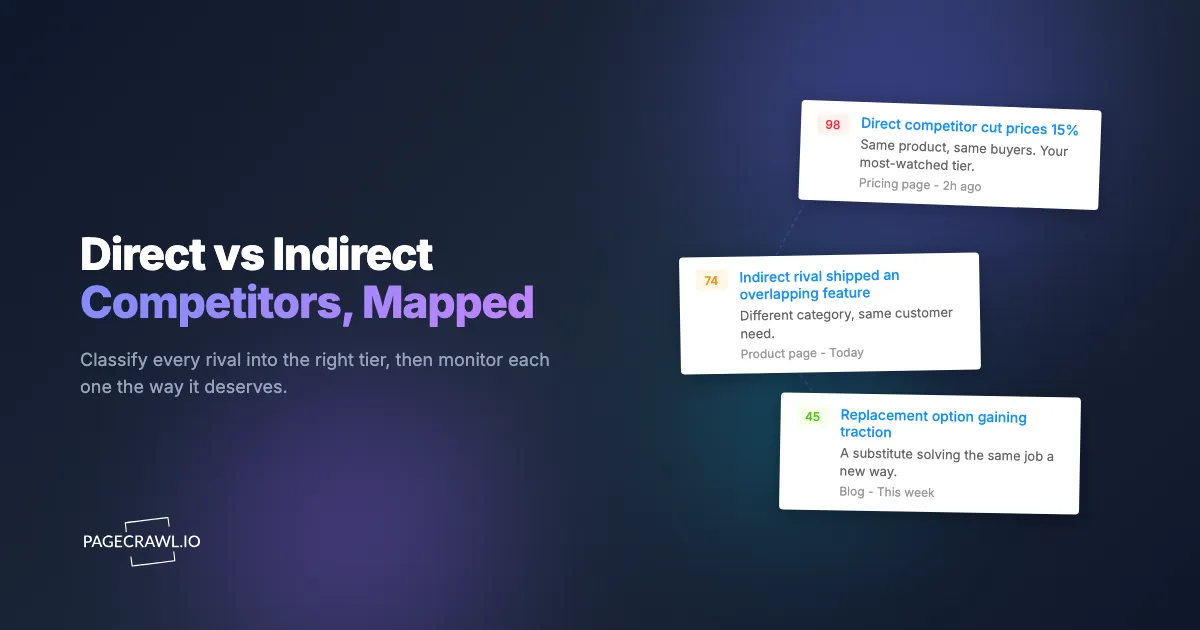
Direct competitors sell the same product to the same customers to solve the same problem. Indirect competitors solve the same problem with a different type of product, targeting an overlapping audience. A third group, replacement competitors, removes the need for your category entirely. The distinction is about what job the customer is hiring a product to do, the framing Clayton Christensen popularized in Know Your Customers' Jobs to Be Done.
The cleanest way to separate the three is to ask one question about any rival: how similar is what they sell, and how similar is the need they meet?
Direct competitors
Direct competitors offer a near-identical product or service to the same target market. When a buyer is choosing between you and a direct competitor, they are comparing apples to apples: similar features, similar pricing models, similar use cases. These are the names your sales team hears in deals, the logos prospects put side by side on a comparison spreadsheet. Coca-Cola and Pepsi are direct competitors. So are Uber and Lyft. If your product disappeared tomorrow, a direct competitor is the most obvious place your customers would go.
Indirect competitors
Indirect competitors satisfy the same underlying need with a different category of product. They are not on the same shelf as you, but they compete for the same budget, the same time, or the same outcome. A customer who chooses an indirect competitor solved the same problem a different way. A fast-casual burrito chain competes indirectly with a sushi place next door: different food, same "I need lunch" job. Indirect competitors are easy to overlook precisely because they do not look like you.
Replacement competitors
Replacement competitors (sometimes called substitutes, the threat Michael Porter formalized in The Five Competitive Forces That Shape Strategy) eliminate the need for your product category altogether. Instead of choosing a different version of what you sell, the customer chooses to not buy your category at all. Video conferencing replaces business air travel. A do-it-yourself spreadsheet replaces a paid software tool. Staying home replaces a night out. Replacement competition is the most dangerous kind because it is the hardest to see coming and the hardest to counter with feature parity, since the substitute is not playing your game at all.
Why does competitor classification matter?
Classification matters because it tells you where to spend finite attention and how to respond. You cannot monitor every company in your market with equal intensity, and you should not. Tiering competitors by type lets you watch direct rivals closely, track indirect ones for shifts into your lane, and stay alert to replacement threats that could erode your whole category.
Treating all competitors the same produces two predictable mistakes. The first is tunnel vision: pouring resources into out-featuring one direct rival while an indirect competitor quietly repositions into your segment. The second is paralysis: trying to track dozens of companies at once, drowning in noise, and missing the few signals that actually matter.
A clear competitive map fixes both. It turns "watch the competition" into a specific, prioritized monitoring plan. Direct competitors get the heaviest coverage because their moves affect your deals immediately. Indirect competitors get moderate coverage focused on the signals that would indicate they are moving toward you, like a pricing change, a new product line, or a hiring surge in roles that overlap with yours. Replacement competitors get lighter, trend-level monitoring focused on adoption and capability shifts. This is the same tiering logic at the heart of a structured competitive intelligence program, applied specifically to who counts as a competitor in the first place.
What are 8 examples of direct, indirect, and replacement competitors?
Here are 8 real-world examples across industries, each showing how a single company faces all three types of competition at once. The pattern repeats everywhere: a head-to-head rival you cannot miss, an adjacent category you might, and a substitute that removes the need entirely.
1. Streaming video (Netflix)
Netflix competes directly with other subscription streaming services like Disney+, Max, and Amazon Prime Video, which sell the same product (on-demand video for a monthly fee) to the same audience. Indirectly, it competes with YouTube and TikTok, which fill the same "entertain me right now" need with free, ad-supported video. The replacement competitor is everything that fills leisure time without a screen: video games, books, sleep, going outside.
2. Ridesharing (Uber)
Uber's direct competitor is Lyft, a near-identical app-based ride service. Indirectly, Uber competes with public transit, taxis, and car-rental services, which all move you from A to B with a different model. The replacement competitor is car ownership, walking, cycling, or simply not making the trip. When fuel prices or transit fares shift, that replacement boundary moves.
3. Soft drinks (Coca-Cola)
Coca-Cola and Pepsi are textbook direct competitors: same product, same shelf, same buyer. Indirect competitors include bottled water, coffee, energy drinks, and juice, all of which satisfy thirst or a caffeine craving through a different beverage. The replacement competitor is tap water and homemade drinks, which meet the underlying need at near-zero cost.
4. Meal kits (HelloFresh)
HelloFresh competes directly with Blue Apron and other subscription meal-kit services. Its indirect competitors are grocery stores and online grocery delivery, which solve the "feed my household" problem with raw ingredients and no recipe card. The replacement competitor is restaurant takeout and food delivery apps, which remove cooking from the equation entirely.
5. CRM software (Salesforce)
Salesforce competes directly with HubSpot, Pipedrive, and Zoho, which sell sales-and-marketing software to the same buyer. Indirect competitors are general-purpose work tools like Notion or Airtable that a small team might bend into a lightweight CRM. The replacement competitor is the humble spreadsheet, or no tool at all, which is exactly how many companies track deals before they buy software. Watching that boundary is why SaaS pricing-page monitoring matters: a direct rival's new free tier can push buyers back toward the substitute.
6. Coffee (Starbucks)
Starbucks competes directly with other coffeehouse chains like Dunkin' and Peet's. Indirectly, it competes with fast-food chains and convenience stores that sell cheaper coffee, plus energy drinks that deliver the same caffeine outcome. The replacement competitor is the home espresso machine and the office break room, which let customers skip the coffee run entirely.
7. Connected fitness (Peloton)
Peloton competes directly with other connected-equipment brands and studio-bike makers. Its indirect competitors are gyms, boutique fitness studios, and fitness apps that deliver workouts through a different model. The replacement competitor is free YouTube workout videos, outdoor running, and bodyweight exercise that need no equipment or subscription at all.
8. Productivity suites (Microsoft 365)
Microsoft 365 competes directly with Google Workspace, an almost feature-for-feature rival. Indirect competitors are specialized tools that replace one app at a time, like a dedicated note-taking or design app pulling users out of the bundled suite. The replacement competitor is a stack of free, open-source, or AI-native tools assembled by a cost-conscious team that decides it does not need a paid suite.
Across all 8 examples, the lesson holds: your most visible rival is rarely your only one. For a deeper walkthrough of evaluating any single rival's site, see our guide on how to analyze competitor websites.
How do you map your competitive set?
Map your competitive set by listing every company and substitute that could win a customer away from you, then sorting them into three tiers by type and by how often you actually encounter them. The output is a simple grid: direct, indirect, and replacement competitors, each tagged with a monitoring priority.
Work through it in four steps.
First, list your direct competitors. These are the easiest to name because your sales team already does. Pull the companies that appear most often in lost-deal notes, win/loss interviews, and prospect comparisons. You typically have three to five that matter, plus a handful of smaller players.
Second, brainstorm indirect competitors by starting from the customer's need rather than your product. Ask: what else could someone buy to solve the problem we solve? List adjacent categories, generalist tools that overlap with part of your offering, and new market entrants targeting a neighboring segment who could expand into yours. This is where most maps are too thin, so push past the obvious.
Third, identify replacement competitors by asking what your customers did before your category existed, and what they would fall back to if budgets tightened. The answer is often "a spreadsheet," "a manual process," "do nothing," or "a free alternative." These substitutes set the floor on what you can charge.
Fourth, assign each entry a monitoring priority based on type and encounter frequency. Direct competitors you meet weekly get the top priority. Indirect competitors get medium priority with a watch for moves toward your lane. Replacement competitors get low-frequency, trend-level monitoring. This mirrors the tiered approach in our guide to tracking competitor websites, now organized by competitor type rather than just by company size.
How should you monitor each competitor tier?
Monitor each tier at an intensity that matches the speed and severity of the threat it poses. Direct competitors need close, frequent monitoring of pricing, product, and messaging because their moves hit your deals within days. Indirect competitors need moderate monitoring focused on category-crossing signals. Replacement competitors need light monitoring for adoption and capability trends.
For direct competitors, watch the pages where competitive moves show up first:
- Pricing pages, for new tiers, price changes, and packaging shifts
- Product and feature pages, for launches and repositioning
- Homepage and messaging, for changes in their core value proposition
- Blog, newsroom, and changelog, for announcements and release cadence
- Careers pages, where job listing and career page monitoring reveals where they are investing
For indirect competitors, you care less about every small update and more about the signals that mean they are moving into your market. Watch their pricing page for a new tier aimed at your buyer, their product pages for features that overlap with yours, and their content for messaging that starts targeting your use case. A single page check often catches this. Our overview of competitor website analysis tools covers which surfaces reward this kind of selective monitoring.
For replacement competitors, monitor at the trend level. You are watching for the substitute getting cheaper, easier, or dramatically more capable, the kind of shift that pulls customers out of your category entirely. A monthly check on an open-source project's release notes, a free tool's feature announcements, or an adjacent platform's capability launches is usually enough. The goal is early warning, not daily coverage.
How do you set up competitor tier monitoring in PageCrawl?
Set up tiered monitoring by creating one monitor per important page, assigning a check frequency that matches the competitor's tier, and routing alerts to the channel your team already watches. PageCrawl's competitive intelligence monitoring detects when any monitored page changes and notifies you, so you stop manually refreshing competitor sites and start getting told when something actually moves.

Here is a concrete walkthrough you can finish in under an hour.
Step 1: Build your tier list. Using the mapping method above, write down your direct, indirect, and replacement competitors. For each, note the one or two pages most likely to reveal a meaningful move (usually pricing and the main product page).
Step 2: Create a free PageCrawl account. The free tier includes 6 monitors and 220 checks per month, which is enough to cover your top one or two direct competitors' key pages and validate the approach before you scale.
Step 3: Add your direct-competitor monitors first. Paste each competitor's pricing-page URL into PageCrawl as a new monitor. For pricing and product pages, choose price or content tracking from the available tracked element types so you capture the numbers and copy that matter, not boilerplate. Set these to your highest available check frequency.
Step 4: Add indirect-competitor monitors at a lower frequency. Create monitors for the adjacent-category pages you flagged, and set a less frequent check interval. You are watching for the occasional lane-crossing move, not constant updates.
Step 5: Add replacement-competitor monitors as trend watchers. Point monitors at the substitute's release notes, changelog, or feature page and check them weekly. These are your early-warning sensors.
Step 6: Route alerts to where your team works. Connect notifications to email and to a shared channel so changes land in front of the right people automatically. Sending website change alerts to Slack keeps the whole team looking at the same competitive feed instead of each person checking sites independently.
Step 7: Review weekly and re-tier. Once a week, scan the changes PageCrawl captured, using the Review Board to organize and prioritize detected changes if you want a shared queue. If an indirect competitor suddenly launches a feature aimed at your buyers, promote it to your direct tier and raise its check frequency. Your competitive map is a living document, not a one-time exercise.
That gives you continuous, prioritized coverage of all three competitor types from a single dashboard. For pricing-heavy markets specifically, pair this with one of the dedicated competitor price tracking tools covered in our roundup.
Choosing your PageCrawl plan
PageCrawl's Free plan lets you monitor 6 pages with 220 checks per month, which is enough to cover your top direct competitor's pricing and product pages and prove the approach. Most teams upgrade once they see how much they were missing.
| Plan | Price | Pages | Checks / month | Frequency |
|---|---|---|---|---|
| Free | $0 | 6 | 220 | every 60 min |
| Standard | $8/mo or $80/yr | 100 | 15,000 | every 15 min |
| Enterprise | $30/mo or $300/yr | 500 | 100,000 | every 5 min |
| Ultimate | $99/mo or $999/yr | 1,000 | 100,000 | every 2 min |
Annual billing saves two months across every paid tier. Enterprise and Ultimate scale up to 100x if you need thousands of pages or multi-team access.
Standard at $80 per year is the natural fit for a full three-tier map. Three to five direct competitors across pricing, product, and blog pages, five to ten indirect competitors watched on a page or two each, and a few replacement substitutes at the trend level fit comfortably inside 100 monitors. The 15-minute check interval means you learn about a direct rival's pricing change in minutes rather than weeks later in a lost deal. Enterprise at $300 per year suits larger landscapes, with 500 pages, SSO, the full API, and 5-minute checks for time-sensitive moves.
Every plan includes the PageCrawl MCP Server, which lets your team ask Claude to summarize what any competitor changed over any period, drawn straight from the monitoring archive instead of a stale wiki. AI assistants can create monitors through conversation on every plan, including Free, so you can build out a competitor tier just by describing it. For the strategic context behind all of this, start with our primer on what competitive intelligence is.
Getting Started
Begin today by naming one competitor in each tier: the rival you fight in deals, the adjacent category that solves the same problem differently, and the substitute that removes the need entirely. Find the pricing or product page for each, set up monitoring in PageCrawl, and route the alerts to a channel your team checks. Three monitors, ten minutes, and you have already widened your view beyond the one competitor everyone else is staring at.
The companies that get blindsided are not the ones with weak products. They are the ones watching a single rival while an indirect or replacement competitor quietly takes the market. Map all three tiers, monitor each at the intensity it deserves, and the next competitive surprise becomes a competitive signal you saw coming.