A mid-market SaaS company lost three enterprise deals in a single quarter. Post-mortem conversations with prospects revealed the same pattern: a competitor had launched a new pricing tier and repositioned their messaging six weeks earlier. The sales team had no idea. Marketing was still running campaigns against the competitor's old positioning. Product was building features that no longer gave them a competitive advantage. The information existed. Nobody collected it, analyzed it, or distributed it to the people who needed it.
This is what happens without a competitive intelligence program. Individual employees sporadically check competitor websites. Sales reps hear things from prospects and keep notes in personal files. Marketing occasionally looks at competitor ads. None of this connects. Nobody owns it. Critical intelligence falls through the cracks.
A structured CI program fixes this by making competitive intelligence a deliberate, systematic function rather than an accidental one. This guide covers how to assess your current CI maturity, define scope and objectives, build the right team structure, select tools, design workflows, create deliverables, measure ROI, and scale from a single-person effort to an enterprise-grade operation.
Why does a structured CI program beat ad hoc research?
A structured program beats ad hoc research because it closes coverage gaps, builds institutional knowledge, and delivers consistent quality on a predictable schedule. Every company does some competitive intelligence: someone checks a competitor's pricing page before a sales call, forwards a blog post, or reads an industry report. Ad hoc effort like that fails in three ways.
Gaps in Coverage
Ad hoc research only captures what someone happens to notice. Competitor website changes, pricing adjustments, new hires, product updates, messaging shifts, partnership announcements, regulatory filings, and dozens of other signals go undetected. Without systematic monitoring, you only see what randomly crosses your path.
No Institutional Knowledge
When research is ad hoc, findings live in individual heads, email threads, and scattered documents. When a salesperson who tracked a competitor closely leaves the company, that knowledge leaves with them. There is no central repository, no historical baseline, and no way to identify trends over time.
Inconsistent Quality and Timing
Ad hoc research produces inconsistent results. Some weeks the team has deep competitive insight. Other weeks nobody checks anything. Important changes get discovered days, weeks, or months after they happen, if they get discovered at all.
A structured CI program addresses all three problems by establishing consistent processes, central repositories, and systematic coverage of your competitive landscape.
Assessing Your Current CI Maturity
Before building a program, understand where you are starting. CI maturity typically falls into one of four levels.
Level 1: Reactive
Competitive intelligence happens only in response to specific events. A prospect mentions a competitor, and someone scrambles to research them. A deal is lost, and leadership asks what happened. There is no proactive monitoring, no centralized data, and no regular reporting.
Level 2: Informal
Some individuals or teams regularly monitor competitors, but without coordination. Marketing might track competitor content. Sales might share competitive anecdotes in Slack. Product might review competitor feature pages. These activities happen independently, creating duplication and gaps.
Level 3: Structured
A defined CI function exists, either as a dedicated role or a cross-functional responsibility. There are established collection methods, regular deliverables, and distribution channels. Competitive intelligence informs strategy discussions, not just individual decisions.
Level 4: Strategic
CI is deeply embedded in company operations. It drives product roadmap decisions, shapes go-to-market strategy, informs pricing decisions, and influences corporate strategy. The CI function has executive sponsorship, dedicated resources, and measurable impact metrics.
Most companies operate at Level 1 or 2. The goal of building a CI program is to move to Level 3, with the infrastructure to eventually reach Level 4.
Defining CI Scope and Objectives
A CI program cannot monitor everything about every company in your market. Clear scope and objectives prevent scope creep and ensure the program delivers actionable intelligence rather than information overload.
Identify Your Competitive Set
Start by categorizing competitors into tiers.
Tier 1: Primary competitors. Companies your sales team encounters most frequently. Prospects compare you directly to these companies. You typically have 3-5 primary competitors.
Tier 2: Secondary competitors. Companies you encounter occasionally. They might target different market segments but overlap with your customer base. Usually 5-10 companies.
Tier 3: Peripheral competitors. Companies on the edge of your competitive landscape. New entrants, adjacent-market players, or companies that might become direct competitors in the future. Monitor loosely.
For a detailed guide on tracking competitor websites, including what pages to watch and how to configure monitoring, see our comprehensive guide.
Define Intelligence Priorities
Not all competitive intelligence has equal value. Define what matters most based on your business context:
Pricing intelligence. Essential for companies in price-sensitive markets or during pricing strategy reviews. Understanding when and how competitors change pricing drives revenue decisions.
Product intelligence. Critical for product-led companies. What features are competitors building? What is their release cadence? Where are they investing their engineering resources?
Go-to-market intelligence. Important for marketing and sales teams. How are competitors positioning themselves? What messaging are they using? What channels are they investing in?
Strategic intelligence. Valuable for leadership. Funding rounds, acquisitions, partner program changes, leadership changes, and market expansion moves signal strategic direction.
Talent intelligence. What roles are competitors hiring for? A surge in data engineering hires might signal a product shift. Executive departures might indicate internal problems.
Prioritize 2-3 intelligence categories to focus on initially. You can expand coverage as the program matures.
Set Measurable Objectives
Define what success looks like:
- Competitive win rate improvement (measure quarterly)
- Time-to-awareness for competitor changes (hours vs days vs weeks)
- Sales team confidence in competitive positioning (survey quarterly)
- Number of strategic decisions informed by CI data (track monthly)
- Coverage completeness (percentage of competitors actively monitored)
Building the CI Team
The right team structure depends on your company size, budget, and competitive intensity.
Dedicated vs Distributed Model
Dedicated CI team. One or more full-time CI professionals who own the entire intelligence cycle. This model works for companies with more than 200 employees or those in highly competitive markets. The advantage is depth and consistency. The disadvantage is cost and potential isolation from business units.
Distributed model. CI responsibilities are shared across existing roles. Marketing owns competitor content analysis. Product owns feature comparison. Sales owns win/loss intelligence. A CI lead coordinates activities and maintains the central repository. This model works for smaller companies or those with tighter budgets.
Hybrid model. A small dedicated CI team (1-2 people) coordinates a network of CI contributors across departments. The dedicated team handles collection infrastructure, analysis, and distribution. Contributors provide domain-specific intelligence from their functional areas. This is often the best starting point.
Key Roles and Responsibilities
CI Lead/Manager. Owns the program. Responsibilities include setting collection priorities, managing tools and infrastructure, producing deliverables, training contributors, and reporting to leadership. This role requires a blend of analytical thinking, business acumen, and communication skills.
CI Contributors. Part-time contributors from sales, marketing, product, and customer success who provide intelligence from their interactions. A sales rep sharing what a prospect said about a competitor. A product manager noting a competitor feature update. A customer success manager reporting why a customer considered switching.
Executive Sponsor. A senior leader who champions the CI program, ensures it has resources, and connects CI insights to strategic decisions. Without executive sponsorship, CI programs often produce great intelligence that nobody acts on.
Training the Team
CI contributors need training in two areas:
What to collect. Define clear guidelines for what intelligence is valuable. Not every mention of a competitor is worth capturing. Focus on strategic signals: pricing changes, product launches, messaging shifts, leadership changes, partnership announcements.
How to collect. Establish processes for reporting intelligence. This might be a Slack channel, a form submission, a CRM field, or a shared document. Make reporting frictionless. If it takes more than 30 seconds to report a competitive insight, people will not do it.
Selecting Tools for Your CI Stack
A CI program needs tools for three functions: collection, analysis, and distribution.
Collection Tools
Automated website monitoring. The foundation of any CI technology stack. PageCrawl automates the continuous monitoring of competitor websites, capturing pricing changes, content updates, product announcements, and messaging shifts across every digital surface. Set up monitors for competitor pricing pages, product pages, careers pages, blog posts, and documentation. PageCrawl detects changes and delivers alerts through your preferred channels.
News and media monitoring. Google Alerts, Feedly, or dedicated tools for tracking journalists, publications, and press pages surface competitor mentions in news, blogs, and industry publications.
Social media monitoring. Track competitor social accounts, employee LinkedIn activity, and brand mentions across platforms.
Financial intelligence. For publicly traded competitors, monitor SEC filings on EDGAR, earnings calls, and investor presentations. For private companies, track Crunchbase, PitchBook, or similar databases for funding activity.
Win/loss analysis tools. Capture competitive intelligence from sales interactions. This might be built into your CRM (Salesforce, HubSpot) or handled through dedicated win/loss platforms like Klue or Crayon, and our Klue alternative comparison covers what those suites add on top of page-level monitoring.
Analysis Tools
Spreadsheets and databases. For organizing, comparing, and visualizing competitive data. Feature comparison matrices, pricing grids, and timeline analyses all start in spreadsheets.
Business intelligence. Tableau, Looker, or Power BI for building competitive dashboards that combine multiple data sources.
Note-taking and knowledge management. Notion, Confluence, or similar platforms for maintaining competitor profiles, battle cards, and analysis documents.
Distribution Tools
Slack or Teams integrations. Push relevant competitive alerts to specific channels where stakeholders will see them.
Email newsletters. Regular competitive intelligence summaries distributed to broader audiences.
CRM integration. Feed competitive intelligence into sales tools so reps have current competitor information during deals.
Internal wikis. Maintain living competitor profiles accessible to everyone who needs them.
Designing CI Workflows
Tools without workflows produce noise, not intelligence. Design workflows for each stage of the intelligence cycle.

Collection Workflow
Automated collection. Configure tools to continuously collect competitive data. In PageCrawl, this means setting up monitors for every relevant competitor page with appropriate checking frequencies.
For Tier 1 competitors, monitor aggressively:
- Pricing pages (daily or more frequent checks)
- Product/feature pages (daily checks)
- Blog and news sections (daily checks)
- Careers pages (weekly checks)
- Documentation and help centers (weekly checks)
- Terms of service and legal pages (weekly checks)
For Tier 2 competitors, monitor moderately:
- Pricing pages (daily checks)
- Homepage and key product pages (weekly checks)
- Blog (weekly checks)
For Tier 3 competitors, monitor lightly:
- Homepage and pricing page (weekly checks)
- Blog or news section (weekly checks)
For a guide on building custom monitoring dashboards with the PageCrawl API, see our API integration tutorial.
Human collection. Establish channels for team members to report competitive intelligence. A dedicated Slack channel, a form linked from CRM, or a regular prompt in team meetings: "Any competitive intelligence to share this week?"
Event-driven collection. Trigger deeper research in response to specific events: a lost deal, a competitor funding announcement, a pricing page change alert, a new competitor entering the market.
Analysis Workflow
Raw data is not intelligence. Analysis transforms observations into insights.
Triage. Not every change is significant. A competitor fixing a typo on their pricing page is not intelligence. A competitor adding a new pricing tier is. The CI lead should triage incoming signals daily, categorizing them by significance and routing them appropriately. PageCrawl's Kanban-style review board makes this triage process visual and collaborative. All detected changes across your competitor monitors appear in a single review board where team members can mark changes as reviewed, flag important findings, and leave notes for the rest of the CI team. Instead of each person checking alerts independently, the review board gives the whole team a shared view of what has changed and what still needs attention.
Pattern recognition. Individual changes become meaningful when they form patterns. A competitor hiring three machine learning engineers, updating their product page to mention AI capabilities, and publishing a blog post about intelligent automation are individual signals that together indicate a strategic shift.
Impact assessment. For significant competitive changes, assess the impact on your business. Does a competitor's new pricing tier affect your most common deal sizes? Does their new feature address a gap you were planning to fill? Does their new partnership threaten your channel strategy?
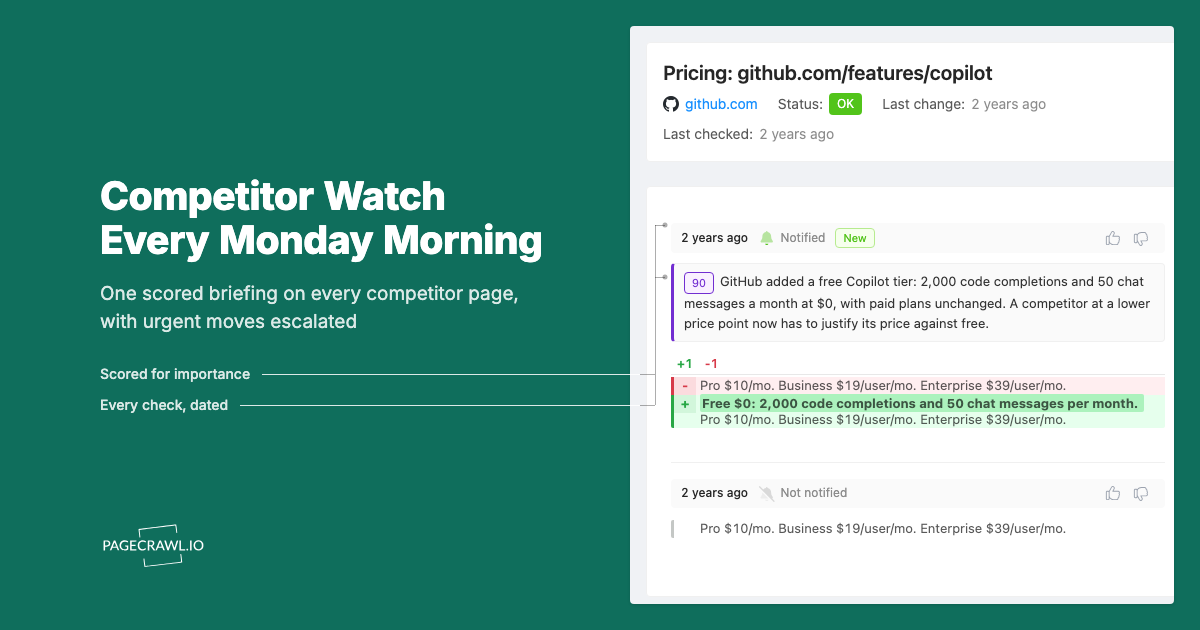
Recommendation development. The highest-value CI work is not describing what competitors did but recommending what your company should do in response. Move from "Competitor X lowered prices by 20%" to "Competitor X lowered prices by 20%, which affects our mid-market segment. We recommend creating a mid-market bundle at a comparable price point while emphasizing our superior support and integration capabilities."
Dissemination Workflow
Intelligence that stays in the CI team is worthless. Design distribution for different audiences.
Fast alerts. Critical competitive changes (pricing adjustments, product launches, positioning shifts) routed to affected teams via Slack, Telegram, or email as soon as a check detects them. Configure PageCrawl webhook automations to trigger alerts directly in your team communication tools.
Weekly summaries. A brief digest of competitive activity, observations, and recommendations distributed to sales, marketing, and product leaders. Keep it to one page. Focus on "so what" rather than "what happened."
Monthly deep-dives. A more comprehensive analysis of competitive trends, pattern recognition, and strategic implications. Presented to leadership and cross-functional teams.
Battle cards. Living documents maintained for each primary competitor. Updated as new intelligence arrives. Battle cards should include competitor overview, strengths, weaknesses, common objections, and recommended positioning. Sales teams use these during active deals.
Competitor profiles. Comprehensive competitor profiles maintained in the knowledge base. These provide baseline context for everyone in the organization. Updated quarterly or when significant changes occur.
Creating CI Deliverables
The deliverables your CI program produces determine its perceived value. High-quality, actionable deliverables build credibility and drive program investment.
Battle Cards
The most operationally valuable CI deliverable. A good battle card includes:
Overview. One paragraph summarizing the competitor, their target market, and their current positioning.
Key differentiators. What they do well. Be honest. Pretending competitors have no strengths undermines credibility with sales reps who hear prospects praising those very strengths.
Weaknesses. Where they fall short. Include evidence from customer reviews, analyst reports, and prospect feedback. Not assumptions.
Common objections and responses. Specific statements prospects make about the competitor and recommended responses. Written in conversational language that sales reps can use directly.
Pricing comparison. Current pricing versus your pricing, including structure differences and total cost of ownership comparisons.
Win/loss trends. Recent patterns in deals involving this competitor. What factors correlate with wins? What factors correlate with losses?
Update battle cards monthly at minimum. Stale battle cards are worse than no battle cards because they create false confidence.
Competitive Newsletters
A weekly or biweekly email newsletter keeps the broader organization informed. Structure:
Headlines. Three to five most significant competitive developments in brief.
Analysis. Deeper dive on one or two developments with implications and recommendations.
Trends. Emerging patterns observed across multiple competitors or market segments.
Upcoming. Events, releases, or dates that may generate competitive activity (conferences, earnings calls, product launches).
Keep newsletters concise. One to two pages maximum. Link to detailed analysis for readers who want depth.
Competitive Dashboards
Visual dashboards that track competitive metrics over time. Useful for leadership and strategy reviews. Include:
- Competitor pricing trends
- Feature parity comparisons
- Win/loss rates by competitor
- Competitor website change frequency (an indicator of activity level)
- Social media and content activity levels
Use the PageCrawl REST API and webhooks to feed website change data into your business intelligence tools. This creates automated dashboards that always reflect current competitive activity.
Measuring CI Program ROI
CI programs that cannot demonstrate value get cut during budget reviews. Build measurement into the program from the start.
Quantitative Metrics
Win rate improvement. Compare competitive win rates before and after the CI program launched. Segment by competitor for more granular insight.
Revenue influence. Track deals where CI intelligence was cited as a contributing factor. If a sales rep used a battle card to address a competitor objection and won the deal, attribute partial influence to the CI program.
Time-to-awareness. Measure how quickly the organization learns about competitive changes. Before the CI program, it might take weeks to discover a competitor's pricing change. After, it might take hours.
Collection efficiency. How many competitive signals does the program capture per month? What percentage of those signals are actionable?
Qualitative Metrics
Stakeholder satisfaction. Survey sales, marketing, and product teams quarterly on the usefulness of CI deliverables.
Strategic contribution. Track instances where CI insights directly influenced product roadmap decisions, pricing changes, or go-to-market strategy.
Executive engagement. Are leaders requesting CI briefings? Are CI insights referenced in board presentations or strategic planning sessions?
Scaling the CI Program
Start small and expand based on demonstrated value.
Phase 1: Foundation (Months 1-3)
- Define Tier 1 competitors (3-5 companies)
- Set up automated monitoring with PageCrawl
- Create initial battle cards for each primary competitor
- Establish a Slack channel or email workflow for sharing intelligence
- Begin weekly competitive summaries
Phase 2: Expansion (Months 4-6)
- Add Tier 2 competitors to monitoring
- Expand intelligence categories (product, pricing, marketing, talent)
- Create first competitive dashboard
- Train sales team on using battle cards
- Implement win/loss tracking in CRM
Phase 3: Optimization (Months 7-12)
- Add automated analysis and trending
- Build self-serve intelligence resources (internal wiki, competitor profiles)
- Integrate CI data into sales enablement tools
- Expand monitoring to include news, social media, and financial intelligence
- Measure and report program ROI
Phase 4: Strategic Integration (Year 2+)
- Embed CI insights into strategic planning processes
- Build predictive capabilities (anticipating competitor moves)
- Expand to include market intelligence beyond direct competitors
- Develop scenario planning for major competitive threats
- Build CI community of practice across the organization
What are the most common CI program mistakes?
The most common mistakes are collecting without analyzing, ignoring distribution, confirming existing beliefs, overcomplicating the tool stack, and crossing ethical lines. Each one can derail an otherwise well-intentioned CI effort.
Collecting everything, analyzing nothing. Tools make collection easy. The hard part is analysis. A CI program drowning in data but producing no insights is worse than useless because it consumes resources without delivering value.
Ignoring distribution. Intelligence that nobody reads has zero impact. Invest as much effort in distribution and format as you do in collection and analysis.
Bias toward confirming existing beliefs. Good CI challenges assumptions. If every CI finding confirms what leadership already believes, something is wrong. Actively seek disconfirming evidence.
Overcomplicating the technology stack. You do not need ten tools to run a CI program. PageCrawl for automated monitoring, a knowledge management tool for storing intelligence, and your existing communication tools for distribution will handle most programs well.
Neglecting ethical boundaries. CI is not espionage. All intelligence should come from publicly available sources. Never misrepresent yourself to obtain competitor information. Never use stolen or leaked data. Ethical violations destroy CI program credibility and create legal liability. The professional association SCIP publishes a code of ethics that is worth adopting as your program's baseline.
Choosing your PageCrawl plan
PageCrawl's Free plan lets you monitor 6 pages with 220 checks per month, which is enough to validate the approach on your most critical pages. Most teams graduate to a paid plan once they see the value.
| Plan | Price | Pages | Checks / month | Frequency |
|---|---|---|---|---|
| Free | $0 | 6 | 220 | every 60 min |
| Standard | $8/mo or $80/yr | 100 | 15,000 | every 15 min |
| Enterprise | $30/mo or $300/yr | 500 | 100,000 | every 5 min |
| Ultimate | $99/mo or $999/yr | 1,000 | 100,000 | every 2 min |
Annual billing saves two months across every paid tier. Enterprise and Ultimate scale up to 100x if you need thousands of pages or multi-team access.
Standard at $80/year is a straightforward investment against the cost of a single lost deal attributed to intelligence gaps: the scenario that opens this guide. With 3-5 Tier 1 competitors and 5-10 Tier 2 competitors, each with pricing, product, blog, and careers pages monitored, 100 pages covers a properly structured CI program through Phase 2 with capacity to spare. Checking at 15-minute intervals makes time-to-awareness a measurable improvement over ad hoc research. Enterprise at $300/year fits Phase 3 and beyond, with 500 pages for extended competitor coverage, SSO for team access, the full API for dashboard integrations, and 5-minute check intervals for time-sensitive intelligence.
All plans include the PageCrawl MCP Server, which lets CI leads, product managers, and sales reps ask Claude to pull change summaries for any competitor over any time period directly from the monitoring archive, replacing manual wiki updates with answers drawn from the live data your program is already collecting. AI assistants can create monitors through conversation on every plan, including Free.
Getting Started
Begin today by identifying your three most important competitors. For each, find their pricing page, main product page, and blog. Set up monitoring for these pages in PageCrawl and configure alerts to a dedicated Slack channel or email address. That gives you 9-12 monitors providing continuous coverage of your most critical competitive surfaces.
PageCrawl's free tier includes 6 monitors, enough to start monitoring key pages for your top competitors and validate the approach. Standard plans at $80 per year cover 100 monitors, which supports comprehensive Tier 1 and Tier 2 competitor monitoring. Enterprise plans at $300 per year handle 500 monitors for organizations tracking extensive competitive landscapes.
Over the next two weeks, review the alerts and changes captured. You will almost certainly discover competitive developments you would have missed without systematic monitoring. Use those discoveries to build your first set of battle cards and share them with the sales team.
The companies that win competitive deals consistently are not necessarily the ones with the best products. They are the ones with the best information about their competitive landscape. A structured CI program, built on automated monitoring and deliberate analysis, transforms competitive intelligence from an occasional activity into a strategic advantage. For more on the fundamentals, explore our guide to what competitive intelligence is and our overview of competitor price tracking tools.