A SaaS company discovers their primary competitor quietly changed pricing page messaging from "enterprise-grade" to "built for startups" three weeks ago. The competitor's new landing page targets the exact mid-market segment this company spent the last quarter positioning for. The sales team finds out because prospects keep mentioning the competitor's new pitch during discovery calls. By then, the competitor has a three-week head start on the repositioning.
Marketing moves fast. Competitors launch campaigns, adjust positioning, test new messaging, publish content, and change pricing structures without announcement. The companies that catch these signals early can respond strategically. The ones that find out from their sales team or, worse, from declining conversion rates, are always playing catch-up.
This guide covers what competitive marketing intelligence is, what signals to track, how to build automated monitoring for competitor marketing assets, and how to turn that intelligence into strategic advantage.
What is competitive marketing intelligence?
Competitive marketing intelligence is the systematic collection and analysis of competitor marketing activities. It is a subset of competitive intelligence focused specifically on marketing strategy, positioning, messaging, and campaigns.
General competitive intelligence covers everything: product changes, hiring patterns, financial moves, partnerships. Marketing intelligence narrows the focus to the signals that directly affect how competitors position themselves in the market and how they attract, engage, and convert customers.
What It Is Not
Marketing intelligence is not corporate espionage. It is not accessing private systems, intercepting communications, or obtaining proprietary data through deception. Everything described in this guide uses publicly available information: websites, published content, social media profiles, and public marketing materials.
It is also not vanity monitoring. Tracking every single thing a competitor does creates noise, not insight. Effective marketing intelligence focuses on signals that indicate strategic direction and inform your own decisions.
Why It Matters Now
Three trends have made competitive marketing intelligence more critical than ever.
Market positioning converges faster. In crowded SaaS and e-commerce markets, companies constantly adjust positioning to differentiate. A competitor's repositioning can invalidate your messaging overnight. Early detection gives you time to respond or differentiate further.
Content strategy drives pipeline. SEO, content marketing, and thought leadership generate significant pipeline for most B2B companies. When a competitor launches a content push targeting your keywords or publishes a comparison page naming your product, the impact on organic traffic and buyer perception is real. You need to know when it happens.
AI search is changing visibility. How your brand appears in AI-powered search tools (ChatGPT, Perplexity, Google AI Overviews) depends partly on how competitors talk about themselves and your market. Monitoring brand mentions in AI search has become a necessary component of marketing intelligence.
What to Monitor
Effective competitive marketing intelligence requires monitoring specific assets and pages, not just general awareness of competitor activity. Here is what matters most.
Landing Pages
Landing pages are where competitive strategy becomes visible. They contain the messaging, value propositions, and calls-to-action that competitors use to convert visitors. Changes to landing pages often signal strategic shifts.
What to watch for:
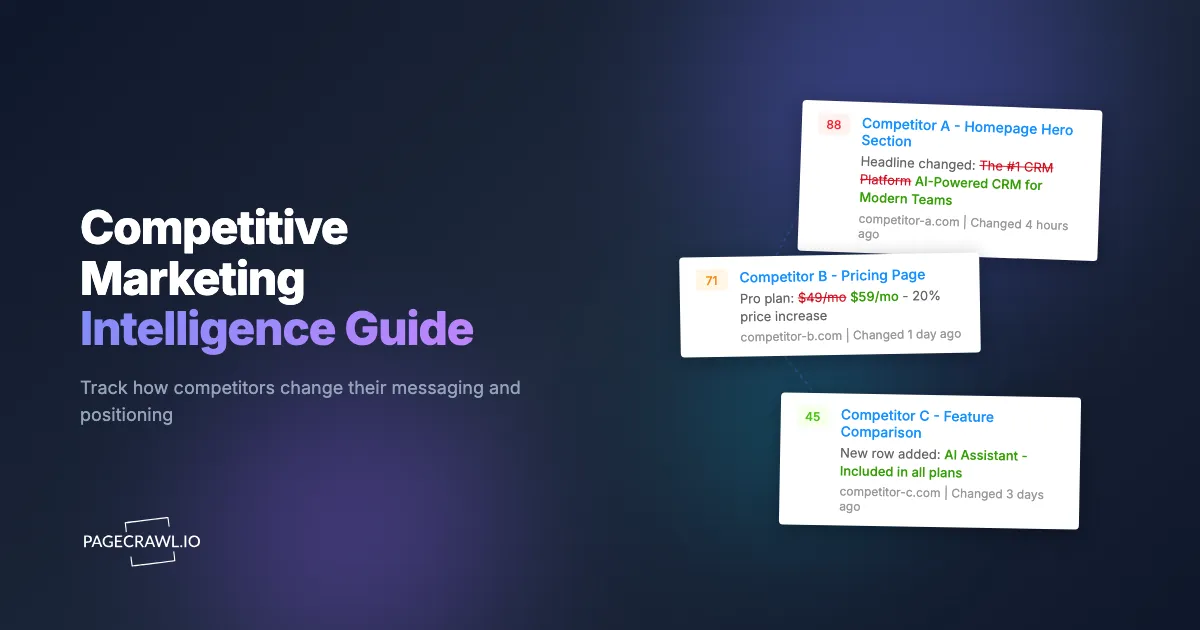
- Headline changes: A new headline signals a positioning shift. If a competitor changes from "The Enterprise Data Platform" to "Data Analytics for Growing Teams," they are targeting a different segment.
- Value proposition reordering: When a competitor moves "Security" from third bullet to first bullet, they are responding to market feedback or competitive pressure on that attribute.
- Social proof updates: New logos, testimonials, and case study references reveal which customer segments the competitor is winning and promoting.
- CTA changes: Shifts from "Request Demo" to "Start Free Trial" or from "Contact Sales" to "See Pricing" indicate changes in go-to-market approach.
Pricing Pages
Pricing pages are among the highest-signal marketing assets. Changes here directly affect competitive positioning and reveal strategic direction.
What to watch for:
- Plan structure changes: Adding, removing, or renaming tiers signals segment targeting changes.
- Feature gating shifts: Moving features between tiers reveals what the competitor considers differentiating.
- Price changes: Increases may signal market confidence. Decreases may signal competitive pressure. New discount structures indicate target segments.
- Messaging around pricing: The language surrounding pricing (comparisons, value framing, FAQ sections) often changes before prices themselves do.
For detailed approaches to pricing monitoring, see the competitor price tracking guide.
Feature and Product Pages
Product pages document what competitors offer and, more importantly, how they describe what they offer. The language used to describe features often matters more than the features themselves.
What to watch for:
- New feature announcements: Competitor feature launches that address gaps you were exploiting.
- Feature description changes: Reframing existing capabilities indicates response to market feedback.
- Comparison pages: Competitors creating direct comparison pages against your product (or updating existing ones) is a high-priority signal.
- Integration pages: New integration partnerships reveal go-to-market strategy and target customer profiles.
Blog Content and Resources
Competitor content strategy reveals long-term positioning intentions. Blog posts take time to plan, write, and publish. A new content cluster targeting specific keywords signals a deliberate strategic move, not a random tactical decision.
What to watch for:
- New posts targeting your keywords: A competitor publishing content for keywords you rank for is a direct SEO competitive move, and SEO monitoring for meta tags and on-page content changes shows when they rework a page that already ranks.
- Content themes and clusters: A series of posts on a topic reveals a content strategy pivot.
- Thought leadership positioning: How competitors position their executives and expertise in content.
- Resource updates: New whitepapers, guides, and reports indicate content marketing investment in specific topics.
Monitoring competitor blog feeds and content hubs with RSS monitoring or page monitoring catches new publications as they go live.
Social Media and Community
Competitor social media presence reveals campaign activity, audience engagement, and messaging testing. While individual posts are low-signal, patterns in social content reveal strategy.
Monitoring competitor social media profiles and LinkedIn pages catches campaign launches and messaging shifts.
Which signals indicate a strategic shift?
The highest-signal changes are complete landing page redesigns, pricing structure changes, new comparison pages, and coordinated messaging theme shifts across multiple pages. Not every change is significant, and learning to distinguish routine updates from strategic signals is what separates useful intelligence from noise.
High-Priority Signals
These changes almost always indicate deliberate strategic decisions:
Complete landing page redesigns. A full page redesign requires significant investment. It happens because the previous positioning was not working or because the company is deliberately shifting direction.
Pricing structure changes. Adding, removing, or restructuring pricing tiers is a major business decision. It signals a change in target market, competitive response, or business model evolution.
New comparison or competitor pages. When a competitor creates a page directly comparing their product to yours, they are investing in competitive positioning. This is an aggressive signal that requires attention.
Messaging theme shifts. When multiple pages change to emphasize the same new theme (security, simplicity, enterprise-readiness), the company is executing a deliberate repositioning.
Medium-Priority Signals
These changes are worth noting but may not require immediate response:
Individual blog posts on new topics. One post could be experimental. A series on the same topic indicates strategy.
Testimonial and case study updates. New social proof additions reveal which customer segments the competitor is winning. Over time, patterns emerge.
Minor copy changes. Wording tweaks on feature pages might reflect A/B testing rather than strategy. Track them, but do not overreact.
Low-Priority Signals
These are generally routine and do not warrant strategic response:
Design refreshes without messaging changes. A visual update that keeps the same positioning is aesthetic, not strategic.
Blog posts on established topics. Ongoing content production on existing themes is maintenance, not strategy.
Team page updates. Hiring announcements are interesting for general competitive intelligence but rarely indicate marketing strategy changes.
Setting Up Competitive Marketing Monitoring
Here is how to build a systematic monitoring workflow using PageCrawl.

Step 1: Identify Your Competitors and Pages
Start with 3-5 direct competitors. For each, identify the key marketing pages:
- Homepage
- Pricing page
- Primary landing pages (product overview, key feature pages)
- Comparison pages (especially any that mention your product)
- Blog or resource hub main page
For most companies, this produces 15-30 URLs to monitor. That is a manageable starting set.
Step 2: Configure Monitors
Add each URL to PageCrawl. For marketing pages, "fullpage" monitoring mode captures all content changes. For pages where you care only about the text content (ignoring navigation and footer changes), "reader" mode filters to the main content.
Set check frequency based on priority:
- Pricing pages: Daily checks. Pricing changes happen infrequently, but when they do, you want to know fast.
- Landing pages: Daily or every 12 hours. Campaign launches and repositioning happen at any time.
- Blog hubs: Daily checks catch new content publication.
- Comparison pages: Daily. Changes to pages that directly compare against you deserve quick awareness.
Step 3: Configure Team Notifications
Marketing intelligence is only useful if it reaches the people who act on it. Configure notifications to reach your team where they work.
Slack alerts work well for marketing teams. Create a dedicated channel (e.g., #competitor-intel) where all monitoring alerts land. The team sees changes as they are detected, inside their normal workflow.
For larger organizations, webhook integration pushes alerts into competitive intelligence platforms, CRMs, or internal dashboards.
Step 4: Organize by Competitor
Use labels, folders, and workspaces to group monitors by competitor. When an alert arrives, the folder tells you at a glance which competitor changed what. Over time, you can review a specific competitor's folder to see all changes in sequence, revealing patterns that individual alerts might not show.
Using AI Summaries for Strategic Analysis
Raw change detection tells you what changed. AI-powered analysis helps you understand why it matters.
Automated Change Summaries
When PageCrawl detects changes on a competitor page, AI-powered summaries and smart filtering describe the nature of the change in natural language. Instead of reading through a diff of HTML changes, you get a clear description: "The pricing page now emphasizes annual billing with a new comparison table showing savings versus monthly plans. The Enterprise tier description was expanded with three new security-related bullet points."
This summary tells the marketing team at a glance what happened without requiring anyone to visit the competitor's page and figure out what is different.
Identifying Positioning Patterns
Over weeks and months, individual changes form patterns. When you review a competitor's monitoring history, you might notice:
- They have changed three landing pages to emphasize "simplicity" in the last month
- Security-related content has doubled in the past quarter
- Their pricing page has been updated four times in six weeks (indicating active experimentation)
These patterns reveal strategic direction more clearly than any single change.
Building a Marketing Intelligence Workflow
Monitoring is the foundation. The workflow that processes intelligence into action is what creates competitive advantage.
Weekly Intelligence Review
Schedule a weekly 30-minute team review of competitor monitoring alerts. Do not just scan the alerts individually as they arrive. Batch review reveals patterns that individual alerts miss.
The review should answer:
- What did each key competitor change this week?
- Do any changes indicate a strategic shift?
- Do any changes affect our positioning or messaging?
- Should we adjust anything in response?
For teams, PageCrawl's review boards let multiple team members collaborate on detected changes. Assign changes for review, add notes, and track which changes have been addressed, all from a shared dashboard. This turns the weekly intelligence review from a meeting-dependent process into an ongoing, documented workflow.
Assign one team member to compile alerts into a brief summary before the meeting. This makes the review efficient.
Rapid Response Protocol
Some competitive changes require faster response than a weekly review allows. Define triggers for rapid response:
- Competitor launches a comparison page naming your product
- Competitor significantly changes pricing (especially price cuts)
- Competitor announces a feature that directly addresses your key differentiator
- Competitor begins targeting your primary keywords with new content
For these scenarios, the Slack notification triggers a same-day discussion rather than waiting for the weekly review.
Quarterly Strategic Assessment
Monthly and weekly reviews handle tactical intelligence. Quarterly assessments examine broader patterns:
- How has each competitor's positioning evolved over the quarter?
- Are competitors converging on similar messaging, or diverging?
- What market narrative are competitors collectively building?
- Where are positioning gaps that no competitor has claimed?
Use the accumulated monitoring history as the raw data for this assessment. PageCrawl's archive of page changes provides a factual record of how competitor messaging evolved, replacing subjective memory with documented evidence.
Which metrics should you track?
Track two kinds of metrics: intelligence metrics (signal-to-noise ratio, detection speed, coverage completeness) and impact metrics (response rate, decisions attributed to intelligence, competitive win rates). Measuring the program ensures it produces value, not just activity.
Intelligence Metrics
Signal-to-noise ratio. How many of your alerts result in actionable insights versus routine, unimportant changes? If most alerts are noise (footer copyright year changes, minor design tweaks), refine your monitoring configuration to focus on content areas that matter.
Detection speed. How quickly does your team learn about significant competitor changes? Measure the time between a competitor making a change and your team discussing a response. Automated monitoring should compress this to hours, not weeks.
Coverage completeness. Are you monitoring all key competitors and all critical page types? Periodically audit your competitor list and page inventory. New competitors emerge. Existing competitors launch new page types.
Impact Metrics
Response rate. What percentage of significant competitor changes trigger a response from your team? Not every change requires action, but if you are never responding, either the intelligence is not reaching the right people or the team is not incorporating it into decision-making.
Strategic adjustments attributed to intelligence. Track when marketing decisions are informed by competitive monitoring. Examples: "We updated our pricing page messaging after monitoring revealed Competitor X repositioned toward our segment." This demonstrates ROI for the intelligence program.
Competitive win rate trends. Over time, companies with better competitive intelligence should win more competitive deals. Track win rates in deals where specific competitors are mentioned and look for improvement.
Advanced Monitoring Techniques
Monitoring Multiple Geographies
Competitors may show different content based on visitor location. A US-focused competitor expanding internationally might launch localized landing pages that reveal their expansion strategy. Monitor competitor pages from different regions with residential proxies for geo-restricted pages if international competition matters to your business.
Archive Competitor Pages
Beyond the alerts themselves, maintaining archives of competitor pages creates a historical record of positioning evolution. PageCrawl's website archiving capability stores snapshots of monitored pages, building a competitor positioning timeline that supports strategic analysis.
Track Competitor SEO Changes
Monitor competitor pages that rank for your target keywords. When they update content that ranks well, the changes often target improved SEO performance or better conversion on that specific search intent. Combining page monitoring with SEO monitoring provides a complete view of competitor search strategy.
Monitor Online Reputation Signals
Competitor review pages, G2 profiles, and Trustpilot pages reveal customer sentiment and pain points. Online reputation monitoring for competitors surfaces negative trends you can address in your own positioning or sales conversations.
Common Mistakes
Monitoring Too Many Competitors
Start narrow. Tracking 3-5 direct competitors well produces more actionable intelligence than tracking 20 competitors poorly. Expand coverage gradually based on which competitors actually appear in competitive deals.
Reacting to Every Change
Not every competitor update warrants a response. Reactively chasing competitor moves leads to positioning whiplash. Use intelligence to inform your strategy, not to dictate it. You should lead your market positioning, using competitive intelligence to stay aware, not to follow.
Ignoring Indirect Competitors
Direct competitors are obvious monitoring targets. But companies approaching your market from adjacent spaces often pose larger long-term threats. Include one or two "emerging threat" competitors in your monitoring even if they do not appear in competitive deals today.
Keeping Intelligence Siloed
Competitive marketing intelligence loses most of its value if it stays within the marketing team. Share relevant signals with sales (battle cards, objection handling), product (feature priorities, competitive gaps), and leadership (strategic positioning). Configure notifications to reach cross-functional stakeholders for high-priority alerts.
Choosing your PageCrawl plan
PageCrawl's Free plan lets you monitor 6 pages with 220 checks per month, which is enough to validate the approach on your most critical pages. Most teams graduate to a paid plan once they see the value.
| Plan | Price | Pages | Checks / month | Frequency |
|---|---|---|---|---|
| Free | $0 | 6 | 220 | every 60 min |
| Standard | $8/mo or $80/yr | 100 | 15,000 | every 15 min |
| Enterprise | $30/mo or $300/yr | 500 | 100,000 | every 5 min |
| Ultimate | $99/mo or $999/yr | 1,000 | 100,000 | every 2 min |
Annual billing saves two months across every paid tier. Enterprise and Ultimate scale up to 100x if you need thousands of pages or multi-team access.
Standard at $80/year pays for itself the first time it catches a competitor repositioning three weeks before your sales team would have reported it through lost deal feedback. With 3-5 competitors and 5-10 marketing pages each, 100 pages covers homepages, pricing pages, primary landing pages, comparison pages, and blog hubs with room for emerging threat monitoring. Checking daily keeps the detection window tight enough for marketing teams to respond before a competitor's new messaging takes hold in the market. Enterprise at $300/year adds 500 pages for broader coverage and 5-minute checks for high-priority pages.
All plans include the PageCrawl MCP Server, so marketing leads can ask Claude to summarize how a competitor's messaging has evolved over a quarter and get a narrative built from your own archive, making quarterly strategic assessments faster and grounded in documented evidence rather than memory. AI assistants can create monitors through conversation on every plan, including Free.
Getting Started
Choose your top 3 competitors. For each, identify their pricing page, main landing page, and one or two feature pages. That gives you 9-12 URLs to start monitoring.
Set up monitors in PageCrawl using "fullpage" mode for comprehensive change detection. Configure daily checks and route alerts to a dedicated Slack channel or email address that your marketing team monitors.
Run the system for two weeks. Review the alerts. Adjust monitoring (add pages you missed, remove noisy ones, refine content focus). After a month, you will have a baseline understanding of how actively your competitors update their marketing, and you will catch every significant change going forward.
PageCrawl's free tier includes 6 monitors, enough to cover the most critical pages for your top 2-3 competitors. Standard plans ($80/year for 100 monitors) support comprehensive competitive monitoring across multiple competitors and page types. Enterprise plans ($300/year for 500 monitors) cover extensive competitive intelligence programs across large competitor sets.
Stop finding out about competitor moves from your sales team. Start catching them the same day they happen.