A SaaS company spent six months wondering why their conversion rate was dropping. Their product had improved, marketing was consistent, and website traffic held steady. The problem was pricing. A competitor had quietly dropped their prices by 30% four months earlier, and the company had no idea until a sales prospect mentioned it during a demo call.
Competitive pricing analysis is not optional. It is the foundation of sustainable pricing strategy. Whether you sell software, physical products, or services, your prices exist in a market context. Customers compare. Prospects research. And competitors adjust. If you are not systematically tracking what your market charges, you are making pricing decisions with incomplete information.
This guide covers how to build a competitive pricing analysis framework, the methods for collecting competitor pricing data, how to automate ongoing monitoring, and how to turn raw data into pricing decisions that improve margins and market position.
What is competitive pricing analysis?
Competitive pricing analysis is the systematic process of collecting, comparing, and interpreting competitor pricing data to inform your own pricing decisions. It goes beyond simply looking at a competitor's price tag.
Components of Pricing Analysis
A complete pricing analysis includes:
Price point comparison. The raw numbers: what competitors charge for comparable products or services. This includes list prices, sale prices, tiered pricing, volume discounts, and any minimum advertised price policies a brand enforces.
Value mapping. What features, quality, service levels, or benefits are included at each price point. A competitor charging less might also deliver less. A competitor charging more might offer capabilities your customers would pay for.
Pricing structure comparison. How competitors structure their pricing. Per-user, per-seat, per-transaction, flat rate, usage-based, freemium. The structure itself influences buyer perception and decision-making.
Promotional patterns. When and how competitors discount. Seasonal sales, annual promotions, discount codes, bundle offers. Understanding patterns helps you time your own pricing moves.
Price change velocity. How often competitors adjust prices and by how much. Some markets see daily changes (e-commerce). Others change quarterly or annually (B2B software). The velocity tells you how responsive you need to be.
Why It Matters More Now
Several trends make competitive pricing analysis more critical than it was five years ago:
Pricing transparency. Customers can compare prices instantly. B2B buyers research extensively before engaging with sales. B2C shoppers use comparison tools and deal sites. Uninformed pricing stands out.
Market volatility. Supply chain disruptions, inflation, and shifting consumer behavior mean pricing environments change faster than they used to. Static annual pricing reviews are insufficient.
Data availability. Your competitors can analyze your pricing just as easily as you can analyze theirs. If they are doing competitive pricing analysis and you are not, you are at a strategic disadvantage.
Building Your Pricing Analysis Framework
Before collecting data, you need a framework that turns raw competitor prices into actionable intelligence.
Step 1: Define Your Competitive Set
Not every company in your industry is a pricing competitor. Your competitive set should include:
Direct competitors. Companies selling essentially the same product to the same buyers. These are your primary pricing reference points.
Adjacent competitors. Companies selling different products that solve the same problem. Their pricing sets buyer expectations about what the solution "should" cost.
Aspirational competitors. Higher-end players whose pricing signals what premium positioning looks like in your market. You might not compete directly, but their prices influence the high end of buyer expectations.
Disruptive entrants. New players with aggressive pricing that might reshape market expectations. A startup offering a free tier can change what buyers expect to pay across the entire category.
For most businesses, 5-10 primary competitors and 5-10 secondary competitors give you a comprehensive view.
Step 2: Identify What to Track
Different business models require different pricing data points.
For e-commerce and retail:
- Product prices (regular and sale)
- Shipping costs and thresholds
- Bundle pricing and cross-sell offers
- Loyalty program pricing
- Price per unit for size/quantity comparisons
For SaaS and software:
- Plan tiers and pricing
- Per-seat or per-user costs
- Feature comparison across tiers
- Annual vs monthly pricing gap
- Enterprise pricing signals (custom quotes, "Contact us")
- Free tier or trial details
For services:
- Hourly, project, or retainer rates
- Package pricing and what is included
- Rush fees and premium service tiers
- Geographic pricing differences
For B2B products:
- List prices and published discount schedules
- Volume pricing tiers
- Contract length pricing (annual vs multi-year)
- Add-on and integration costs
Step 3: Create Your Benchmark Structure
Organize your pricing data into a benchmark that enables comparison.
A basic pricing benchmark matrix looks like this:
| Dimension | Your Price | Competitor A | Competitor B | Competitor C | Market Average |
|---|---|---|---|---|---|
| Entry tier | $X/mo | $X/mo | $X/mo | $X/mo | $X/mo |
| Mid tier | $X/mo | $X/mo | $X/mo | $X/mo | $X/mo |
| Top tier | $X/mo | $X/mo | $X/mo | $X/mo | $X/mo |
| Price per unit | $X | $X | $X | $X | $X |
Add qualitative columns for features included at each tier, support levels, and contract terms. A price-only comparison misses the value context that drives buyer decisions.
Step 4: Establish Your Pricing Position
Where do you want to sit relative to competitors?
Below market. Competing on price. Works with cost advantages, volume strategies, or market penetration goals. Risky if competitors can match your price and have deeper pockets.
At market. Matching competitor pricing and competing on other dimensions (features, brand, service, experience). The safest position but requires non-price differentiation.
Above market. Premium positioning. Requires clear value justification. Works when you offer measurable advantages that buyers will pay for.
Dynamic positioning. Adjusting relative position based on product, segment, or market conditions. Different products might occupy different positions.
Your target position should reflect your cost structure, value proposition, and growth strategy. Pricing analysis tells you where you actually sit, so you can adjust toward your target.
Data Collection Methods
Getting competitor pricing data ranges from trivial to complex depending on your market.
Manual Research
The most accessible method. Visit competitor websites, note prices, and record them in a spreadsheet.
Pros:
- Free
- No tools required
- You see the full context (features, positioning, messaging)
Cons:
- Does not scale beyond a handful of competitors
- Time-consuming to maintain
- Misses changes between your checks
- Prone to human error and inconsistent tracking
Best for: Initial competitive analysis when you are building your framework for the first time.
Mystery Shopping
For businesses where pricing is not publicly listed (custom quotes, negotiated pricing), mystery shopping provides data you cannot get from website research alone.
Pros:
- Gets real pricing from sales processes
- Reveals negotiation ranges and discount patterns
- Shows the full buying experience
Cons:
- Time-intensive
- Ethical gray area if competitors discover the practice
- Pricing may vary based on perceived buyer size or need
- Infrequent data points
Best for: B2B and services businesses where pricing is quote-based.
Industry Reports and Databases
Some industries have pricing databases, benchmarking reports, or industry analysts that publish pricing data.
Pros:
- Professional, validated data
- Often includes analysis and trends
- Covers broad market views
Cons:
- Expensive (reports can cost thousands of dollars)
- Data may be months old when published
- May not cover your specific competitors or niches
Best for: Enterprise businesses with research budgets that need market-wide perspectives.
Automated Web Monitoring
For competitors with publicly listed prices, automated monitoring provides continuous, reliable pricing data without manual effort.
Pros:
- Runs continuously without human involvement
- Catches changes on the next scheduled check
- Historical data builds automatically
- Scales to dozens of competitors and hundreds of price points
- Can feed data into existing systems via webhooks and APIs
Cons:
- Requires initial setup per competitor page
- Monthly cost for monitoring tools
- Only captures pricing displayed on a page, whether public or behind a login, not quote-based pricing negotiated through a sales process
Best for: Any business with competitors who publish pricing online. This applies to most e-commerce, SaaS, and retail businesses.
Automating Pricing Intelligence with PageCrawl
Manual price research gives you a snapshot. Automated monitoring gives you a continuous feed. Here is how to build an automated competitive pricing system.

Setting Up Competitor Price Monitoring
Step 1: Identify competitor pricing pages
For each competitor, find the specific page(s) where pricing is displayed. For SaaS companies, this is typically a /pricing page. For e-commerce, it is individual product pages. For services, it might be a pricing page or a rate card.
Step 2: Create monitors in PageCrawl
Add each competitor pricing URL as a monitor. For pricing pages with multiple tiers displayed on one page, use "Fullpage" tracking mode to capture all pricing information. For individual product pages, use "Price" tracking mode to extract the specific price element.
Step 3: Configure appropriate check frequency
Match your check frequency to the market's pricing velocity:
- E-commerce competitors: Every 4-6 hours (prices change frequently)
- SaaS pricing pages: Daily or weekly (pricing changes are less frequent but strategically significant)
- Service rate pages: Weekly (rates change infrequently)
Step 4: Set up notification routing
Route pricing change alerts to the right people:
- Sales team (via Slack or email): Needs to know when competitor prices change to adjust sales conversations
- Product/pricing team (via email or webhook): Needs data for pricing decisions
- Leadership (via email digest): Needs awareness of significant competitive moves
Step 5: Enable AI summaries
PageCrawl's AI summarizes what changed on competitor pricing pages in plain language. Instead of reviewing full-page diffs, you receive summaries like "Competitor X lowered their Pro plan from $99/mo to $79/mo" or "Competitor Y added a new Enterprise tier at $299/mo." This saves significant time when monitoring multiple competitors.
Step 6: Configure webhook output
For teams that want pricing data in their own systems, PageCrawl sends structured JSON via webhooks when changes are detected. Feed this into your CRM, BI dashboard, pricing database, or automation workflows. For details on setting up webhook integrations, see our webhook automation guide.
Monitoring Pricing Pages vs Product Pages
Pricing pages (e.g., /pricing): Best for SaaS and services where all pricing tiers are on one page. Use "Fullpage" tracking mode. Changes might include new plans, price adjustments, feature reshuffling between tiers, or messaging changes.
Individual product pages: Best for e-commerce. Use "Price" tracking mode for each product you want to compare, the approach covered in product page monitoring for spec, price, and availability changes. PageCrawl's price detection extracts the current selling price automatically.
Rate cards and downloadable PDFs: Some competitors publish pricing in downloadable documents. PageCrawl can track text changes inside PDF files directly, including supplier and distributor price lists, alerting you when the document is updated.
Building a Competitive Pricing Dashboard
Combine PageCrawl's monitoring with webhook outputs to build a living pricing dashboard:
- Set up monitors for all competitor pricing pages
- Configure webhook notifications to send data to a Google Sheet, Airtable base, or database
- Build a comparison view that shows current prices alongside your own
- Add historical trends to identify pricing patterns
This dashboard becomes your single source of truth for competitive pricing. When anyone asks "How does our pricing compare?", the answer is current and data-backed.
Analyzing Competitor Pricing Data
Collecting data is only half the job. Analysis turns data into pricing decisions.
Price Gap Analysis
Calculate the gap between your pricing and each competitor for comparable products or tiers. Express gaps as both absolute amounts and percentages.
If your mid-tier plan is $99/mo and competitors average $79/mo, your 25% premium needs justification through features, service, brand, or performance. If you cannot articulate why a buyer should pay 25% more, you have a pricing problem.
Conversely, if you are significantly below competitors without a strategic reason, you might be leaving revenue on the table.
Feature-Price Mapping
Create a matrix that maps features to price points across competitors. This reveals:
- Over-delivery: Features you include at a lower tier that competitors charge extra for
- Under-delivery: Features competitors include that you charge extra for or lack entirely
- Pricing inefficiency: Features that cost you to deliver but do not influence buyer decisions
- Differentiators: Unique capabilities that justify premium positioning
This mapping directly informs packaging and bundling decisions.
Promotional Pattern Analysis
Track competitor promotions over time to identify patterns:
- Do they discount seasonally? (Q4, back to school, fiscal year end)
- Do they run perpetual discounts that suggest list prices are inflated?
- Do they offer discounts to specific segments (startups, education, nonprofits)?
- How deep are their discounts, and for how long?
Understanding promotional patterns helps you plan your own promotional calendar and set expectations for your sales team about competitive offers they will encounter.
Price Elasticity Signals
When competitors change prices, watch what happens:
- Do they quickly revert (suggesting the change hurt them)?
- Do other competitors follow (suggesting market pressure)?
- Does the competitor's positioning or messaging change alongside the price?
These signals help you estimate market price elasticity without running your own pricing experiments.
What are the most common pricing analysis mistakes?
The five most common mistakes are comparing on price alone, ignoring total cost of ownership, reacting to every competitor move, working from stale data, and neglecting indirect competitors. Each one leads to pricing decisions that look informed but rest on a distorted picture of the market.
Comparing on Price Alone
A competitor charging half your price is not necessarily a threat if they deliver half the value. Always analyze pricing in context of what is included. The cheapest option in a market is often the worst comparison point for a quality-focused business.
Ignoring Total Cost of Ownership
Especially in B2B, the purchase price is only part of the cost. Implementation fees, ongoing support costs, required integrations, and switching costs all factor into buyer decisions. Your competitor's lower price might come with higher implementation costs that make the total spend comparable.
Reacting to Every Competitor Move
Not every competitor price change requires a response. A desperate competitor slashing prices is different from a strong competitor repositioning. Distinguish between tactical discounting (temporary, often driven by targets) and strategic pricing changes (permanent, reflects market view).
Using Stale Data
Pricing analysis done once a year is a snapshot that decays immediately. Markets move continuously. If your competitive pricing data is months old, your pricing decisions are based on outdated information. This is precisely why automated monitoring matters. For more on building a continuous competitive intelligence program, see our competitive intelligence guide.
Neglecting Indirect Competitors
Focusing exclusively on direct competitors misses the broader pricing context. Buyers often evaluate solutions from adjacent categories. A project management SaaS competes not just with other PM tools but with spreadsheets (free), all-in-one platforms (differently priced), and custom solutions (expensive). Understanding this broader context prevents tunnel vision.
Industries Where Pricing Analysis Matters Most
E-Commerce and Retail
Retail pricing analysis is constant and operationally critical. Prices change daily, margins are thin, and customers comparison-shop aggressively. Automated monitoring is not a luxury in retail. It is a competitive requirement.
For e-commerce businesses, monitoring competitor product prices directly informs daily pricing decisions. PageCrawl's price tracking mode extracts current selling prices from competitor product pages, feeding your pricing engine or alerting your team to changes. See our e-commerce monitoring guide for a detailed walkthrough.
SaaS and Technology
SaaS pricing is strategic and infrequent but high-impact. A single competitor pricing page change might signal a strategic shift that affects your entire go-to-market approach. Monitoring SaaS pricing pages captures these shifts within a check cycle, not months later.
Financial Services
Banking, insurance, and investment products have publicly listed rates that change based on market conditions. Monitoring competitor rates helps financial institutions stay competitive and identify market trends.
Travel and Hospitality
Airlines, hotels, and travel services adjust pricing continuously based on demand, competition, and inventory. Dynamic pricing in travel requires continuous fare and travel price monitoring to understand market positioning and optimize revenue.
Professional Services
Law firms, consulting firms, and agencies often publish rate information or pricing frameworks. Even when pricing is custom, monitoring published rate cards and positioning helps calibrate your own pricing approach.
Building a Pricing Analysis Process
One-time analysis delivers one-time value. Sustainable competitive advantage comes from a repeatable process.
Weekly Review
Dedicate 30 minutes per week to reviewing pricing alerts and changes detected by your monitoring. Categorize changes as:
- No action needed: Minor adjustments within normal ranges
- Monitor closely: Changes that might signal a trend
- Respond: Significant competitive moves that require pricing discussion
Monthly Analysis
Each month, update your pricing benchmark matrix. Calculate market averages, identify trends, and compare your actual position to your target position. Share findings with sales, product, and leadership teams.
Quarterly Strategy
Each quarter, conduct a deeper pricing strategy review:
- Are you achieving your target market position?
- Have market conditions changed your cost structure or competitive landscape?
- Are there packaging, bundling, or pricing structure opportunities?
- Should you adjust pricing based on accumulated competitive data?
Annual Overhaul
Once per year, rebuild your competitive set, reassess your pricing framework, and evaluate whether your monitoring coverage is sufficient. New competitors emerge, old ones pivot, and markets evolve. Your analysis should evolve with them.
Tools for Competitive Pricing Analysis
The right toolset depends on your market, budget, and team capabilities.
Spreadsheets
Still the foundation for most pricing analysis. Google Sheets or Excel for organizing, comparing, and visualizing pricing data. Every other tool feeds into a spreadsheet at some point.
Web Monitoring (PageCrawl)
Automated monitoring of competitor pricing pages. PageCrawl captures changes across all competitor pricing surfaces (web pages, PDFs, apps) and delivers alerts through multiple channels. Use the PageCrawl API to integrate pricing data into your existing tools.
Business Intelligence Platforms
Tools like Tableau, Looker, or Power BI for visualizing pricing trends and building dashboards that combine competitive pricing data with your own sales data.
CRM Integration
Feed competitor pricing intelligence into your CRM so sales teams see current competitive pricing during deals. Webhook integrations from PageCrawl make this straightforward.
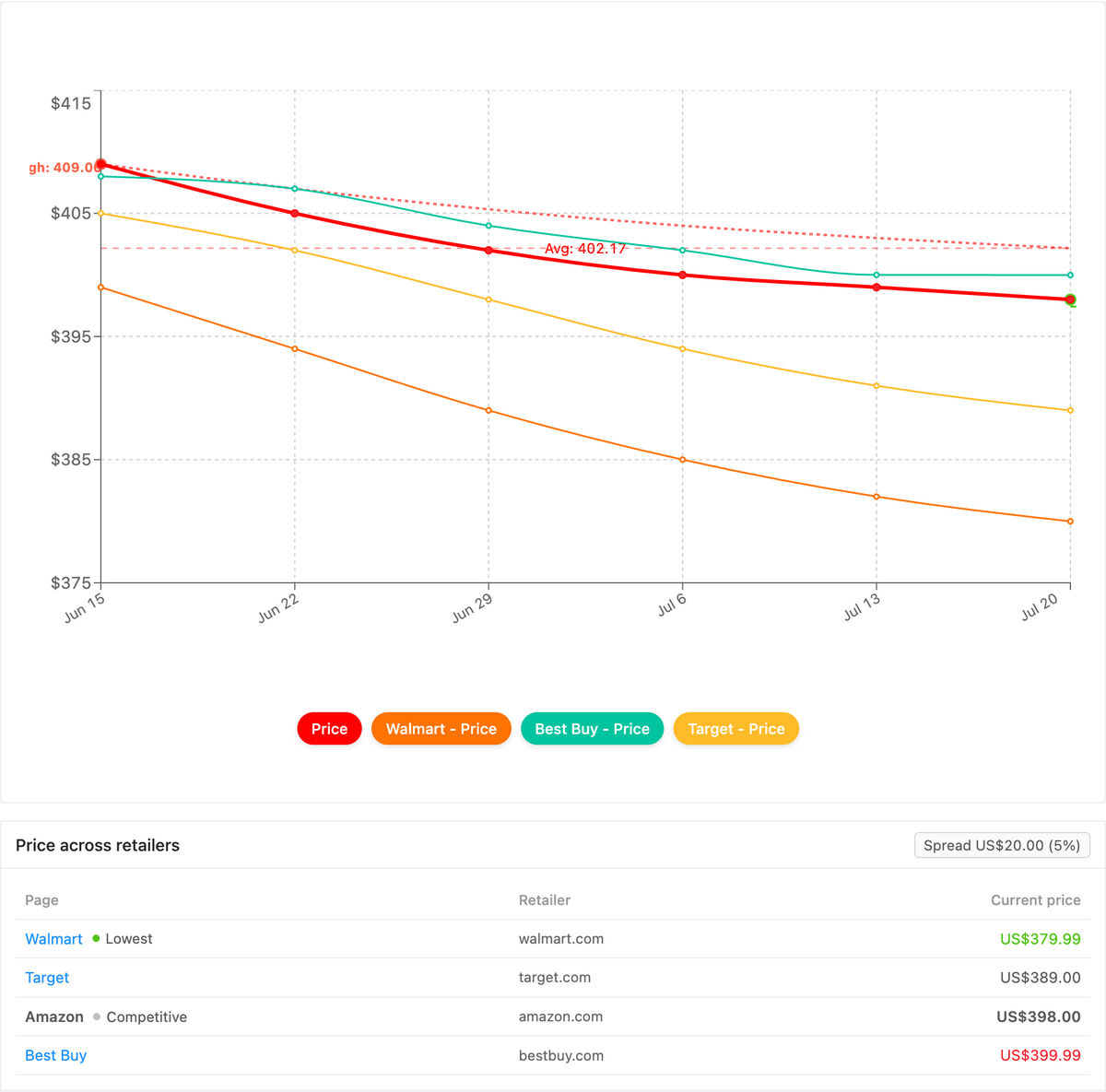
Can you benchmark one product's price across every competing retailer at once?
Yes. PageCrawl's Product Comparison capability groups the monitors for a single product across every retailer into one view, highlights the cheapest advertised price, and tracks the spread between the lowest and highest seller. That turns price-gap analysis from a spreadsheet you rebuild by hand into a live comparison, so an undercutting competitor shows up as an obvious outlier instead of a number buried on one of many product pages.
Once your per-page price monitors are running across your competitive set, Product Comparison stitches together the ones that share a product (by GTIN, UPC, SKU, brand, or your own reference tag) into a single grouped comparison. For the e-commerce and retail SKUs you compare most, every competing retailer lines up side by side, the lowest price is flagged, and the spread is a live figure. Comparison-aware alerts fit the benchmark work in this guide: a spread-threshold alert flags when the gap between you and the cheapest seller widens, and cheapest or most-expensive alerts catch a competitor moving to the top or bottom of the pack on the next check, routed to email, Slack, or a webhook. You can also export the whole grid as a spreadsheet to drop straight into your benchmark matrix. The full walkthrough lives in the cross-retailer price comparison guide, and Product Comparison is a custom capability we enable on request.
Choosing your PageCrawl plan
PageCrawl's Free plan lets you monitor 6 pages with 220 checks per month, which is enough to validate the approach on your most critical pages. Most teams graduate to a paid plan once they see the value.
| Plan | Price | Pages | Checks / month | Frequency |
|---|---|---|---|---|
| Free | $0 | 6 | 220 | every 60 min |
| Standard | $8/mo or $80/yr | 100 | 15,000 | every 15 min |
| Enterprise | $30/mo or $300/yr | 500 | 100,000 | every 5 min |
| Ultimate | $99/mo or $999/yr | 1,000 | 100,000 | every 2 min |
Annual billing saves two months across every paid tier. Enterprise and Ultimate scale up to 100x if you need thousands of pages or multi-team access.
A single missed competitor price cut can cost more in lost deals than a year of Standard at $80 - and that is before factoring in the margin you leave on the table when you fail to match a price increase. Standard covers 100 monitored pages, enough for pricing pages across a full Tier 1 and Tier 2 competitor set plus individual product pages for your most-compared SKUs. Enterprise at $300/year expands to 500 pages and adds 5-minute check frequency, which matters when your market moves fast enough that same-day response is expected.
All plans include the PageCrawl MCP Server, so AI tools like Claude can query your pricing history directly - your sales team can ask "what has Competitor X's mid-tier plan cost over the past six months?" and get an answer from your own archive rather than a stale screenshot. AI assistants can create monitors through conversation on every plan, including Free.
Getting Started
PageCrawl's monitor templates and other power-user options let you save a monitoring configuration (tracking mode, check frequency, notification channels, noise filters) and apply it to new monitors with one click. When you are setting up monitors for dozens of competitor pricing pages, this saves hours of manual configuration. Create one template for "SaaS Pricing Pages" and another for "E-commerce Product Pages," then apply the right template as you add each competitor.
Begin with your five most important competitors. Identify their pricing pages and set up automated monitoring with PageCrawl. Configure notifications to your team's preferred channels and let the system run for two to four weeks.
During that initial period, build your pricing benchmark matrix using the data collected. Identify where you sit relative to competitors and whether that position matches your strategic intent.
PageCrawl's free tier includes 6 monitors, enough to track pricing pages for several key competitors and prove the value of automated pricing intelligence. Standard plans ($80/year for 100 pages) scale for comprehensive competitive monitoring, and Enterprise plans ($300/year for 500 pages) cover large competitive sets with hundreds of products.
The companies that win on pricing are not necessarily the cheapest. They are the best informed. Automated competitive pricing analysis ensures you always know where you stand and can respond to market changes before they erode your position. For a broader look at competitor tracking tools and how to track competitor websites, explore our related guides.