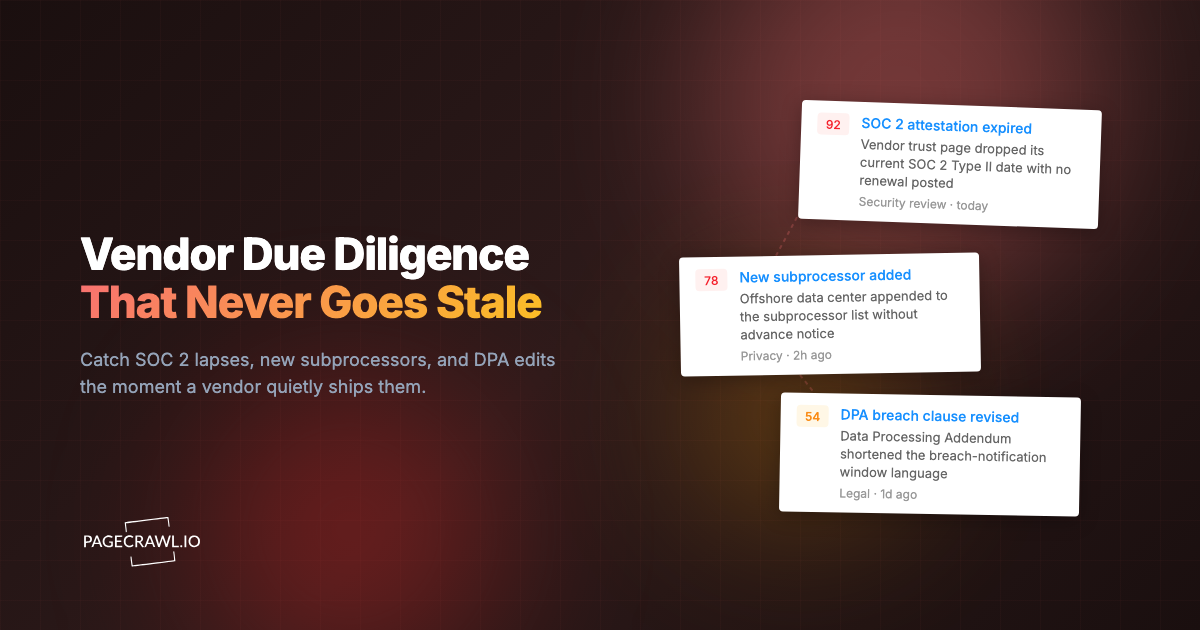
A regional bank onboarded a payroll processing vendor after a clean security questionnaire, a current SOC 2 report, and a signed data processing agreement. Eighteen months later, that vendor quietly moved customer data to a new subprocessor in a jurisdiction the bank had never assessed, updated its terms of service to extend data retention, and let its SOC 2 attestation lapse for four months. Nobody at the bank noticed, because the only control that ever ran was a point-in-time review at onboarding. The gap surfaced during an audit, and the finding was not the vendor's drift. It was that the bank had no policy requirement to detect it.
This is the failure mode that a third-party risk management (TPRM) policy is built to prevent. A good policy is not a binder that gets read once and shelved. It is the operating document that defines who owns vendor risk, how vendors are classified, what evidence is required before and during a relationship, and what happens when a vendor changes underneath you. Most TPRM programs are strong at onboarding and weak at everything after, which is exactly backwards, because vendors change continuously and your exposure changes with them.
This guide walks through every section a TPRM policy needs, gives you a reusable template outline, and shows how to turn the continuous monitoring obligation into an automated control rather than a quarterly scramble.
What is a third-party risk management policy, and why do you need one?
A third-party risk management policy is the governing document that defines how your organization identifies, assesses, monitors, and offboards the vendors, suppliers, and service providers that touch your data, systems, customers, or operations. It exists to make vendor risk decisions consistent, defensible, and repeatable instead of ad hoc.
Without a written policy, vendor decisions get made differently by every team that signs a contract. Marketing approves a tool with no security review, engineering adds a cloud dependency on a corporate card, and finance signs a processor handling payroll data on nothing more than a sales demo. A policy forces all of those decisions through one gate. It also gives auditors, regulators, and your board a single artifact that answers the question they all ask: how do you know your vendors are not your weakest link?
Regulators increasingly treat the absence of this policy as a finding in itself. Frameworks across banking, healthcare, and EU operational resilience now expect documented third-party governance with ongoing oversight, not a one-time check. If your sector touches financial services compliance monitoring or operates under DORA's operational resilience requirements, a TPRM policy is not optional, it is the spine the examiners trace through every other control.
What must a TPRM policy contain?
A complete TPRM policy contains seven core sections: scope, roles and responsibilities, risk tiering, due diligence requirements, continuous monitoring obligations, exceptions and risk acceptance, and offboarding. Each answers a specific question, and a gap in any one of them is where real incidents originate. Read them as a lifecycle, where due diligence is the entry gate, continuous monitoring is the part most programs skip (and most breaches exploit), and offboarding closes the loop so former vendors do not end up in next year's breach report. The rest of this guide expands each section in order.

How do you define the scope of a TPRM policy?
Scope defines which relationships the policy governs and which it does not. State it explicitly, because ambiguity here creates the loopholes that let high-risk vendors slip in through the side door. A strong scope statement covers the relationship types, the data and access thresholds that trigger the policy, and any deliberate exclusions.
Cover these dimensions in the scope section:
- Relationship types. SaaS vendors, cloud infrastructure, payment processors, contractors and staffing firms, professional services, resellers, and fourth parties (your vendors' subprocessors).
- Trigger thresholds. The policy applies whenever a third party stores, processes, or transmits regulated or confidential data, connects to your network, has privileged access, or supports a critical business process.
- Explicit exclusions. Low-risk relationships you deliberately leave out, such as one-off purchases with no data access, so reviewers know the omission was a decision rather than an oversight.
Fourth-party risk belongs in scope from the start. When your vendor relies on its own subprocessors, their failures become yours, and the bank in the opening scenario was undone by exactly that: a subprocessor added after onboarding. Watching for it is what subprocessor list monitoring is built to catch.
Who owns vendor risk in the policy?
The roles section assigns clear ownership for every step of the vendor lifecycle so nothing falls between teams, because vague ownership is why vendors drift unmonitored. Name the roles, not the individuals, and define what each one is accountable for and what authority it holds.
A workable RACI structure looks like this:
- Business owner. The internal sponsor who needs the vendor, owns the relationship day to day, and is accountable for the vendor's performance and risk posture.
- TPRM or risk function. Runs the vendor risk assessment process, maintains the vendor inventory, and sets the risk methodology. It advises and challenges but does not own the business outcome.
- Security, privacy, and legal reviewers. Provide domain assessments (security posture, data protection, contractual terms) and sign off within their lane.
- Approver or risk committee. Holds authority to accept residual risk above a defined threshold. Critical vendors should require senior or committee approval, not a single manager.
The single most important rule here: the business owner cannot also be the sole approver of the risk they are introducing. Separation of duties keeps a determined sponsor from waving through a vendor the risk team flagged.
How do you tier third-party risk?
Risk tiering classifies every vendor into a small number of levels (typically critical, high, moderate, and low) so the depth of due diligence and the frequency of monitoring match the actual exposure. It prevents two failures at once: over-spending scrutiny on harmless tools and under-scrutinizing the vendors that could end your business.
Tier on inherent risk, the exposure before any controls, using factors like these:
- Data sensitivity. Does the vendor handle regulated data (PII, PHI, cardholder data, financial records) or only public information?
- Access level. Network connectivity, privileged credentials, or admin access to your systems versus no access at all.
- Operational criticality. Would a vendor outage halt a core process or merely inconvenience one team?
- Volume and concentration. The number of records involved and whether you are dangerously dependent on a single provider.
- Regulatory exposure. Whether the relationship falls under specific mandates you must evidence.
Map each tier to concrete obligations. A critical vendor might require a full security assessment, an evidence-backed audit, contractual right-to-audit clauses, and continuous monitoring with monthly reviews. A low-tier vendor might need only a lightweight questionnaire and an annual recheck. Document the mapping so the tier mechanically determines the work and removes case-by-case negotiation. This is the same risk-based logic that drives mature regulatory compliance monitoring programs: spend your attention where the exposure actually lives.
What due-diligence requirements belong in the policy?
Due diligence is the evidence gate a vendor must clear before you sign and at every renewal. The policy should specify exactly what artifacts are required at each tier, who reviews them, and what disqualifies a vendor, so onboarding follows a vendor due diligence checklist rather than an argument.
Typical due-diligence requirements, scaled by tier:
- Security evidence. Current SOC 2 Type II report, an ISO 27001 certificate, penetration test summary, or a completed standardized questionnaire such as the Shared Assessments SIG or the Cloud Security Alliance CAIQ.
- Privacy and data protection. A signed data processing agreement, documented subprocessor list, data residency commitments, and breach notification terms.
- Financial and operational stability. Financial health checks for critical vendors, business continuity and disaster recovery plans, and cyber insurance evidence.
- Contractual protections. Right-to-audit clauses, security and uptime SLAs, breach notification windows, and termination and data-return obligations.
- Sanctions and integrity screening. Screening against sanctions and watchlists for critical and high-tier vendors.
State the disqualifiers plainly. A missing DPA for a vendor handling regulated data, an expired security attestation with no remediation plan, or a refusal to accept breach notification terms should block onboarding until it is resolved or formally accepted as an exception.
What does the continuous monitoring obligation mean in practice?
Continuous monitoring is the policy's requirement to detect material vendor changes between formal reviews, instead of assuming a vendor stays exactly as it was at onboarding. This is the section most programs write weakly, because vendors change their subprocessors, terms, security posture, and ownership constantly, and rarely send you a memo.
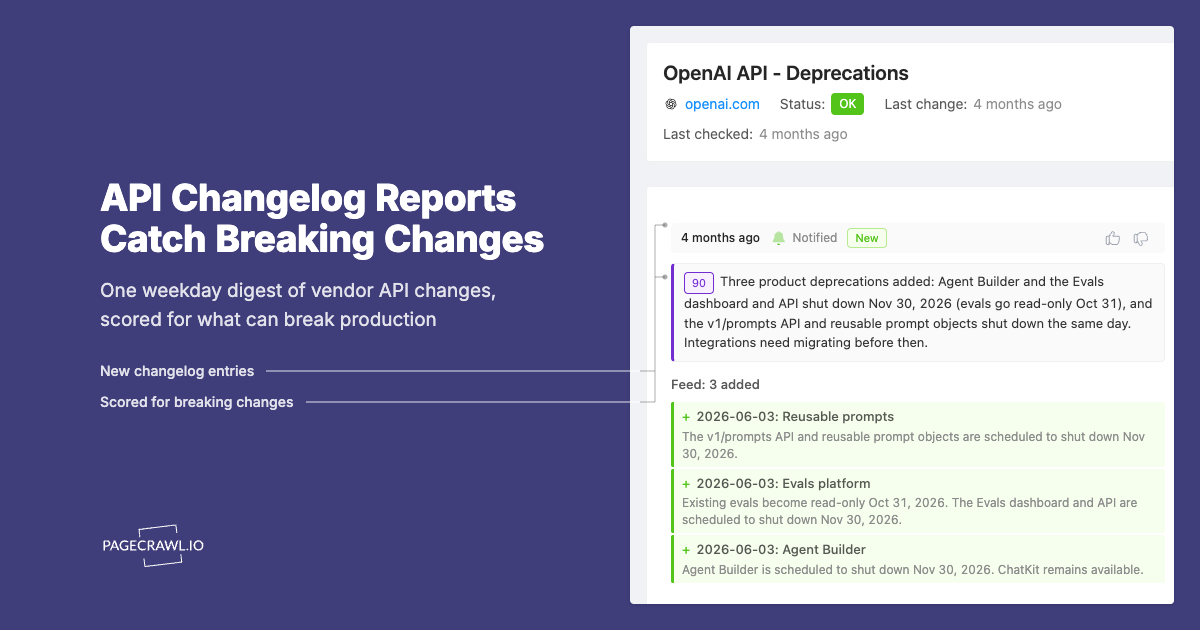
The obligation should name what you watch and how often, scaled by tier. The high-signal pages worth tracking are the subprocessor list, the trust or security page (attestation dates, certifications), the terms of service and DPA, the privacy policy, the status page, and any ownership or acquisition announcements. A change on any one of these can re-rate a vendor's risk overnight.
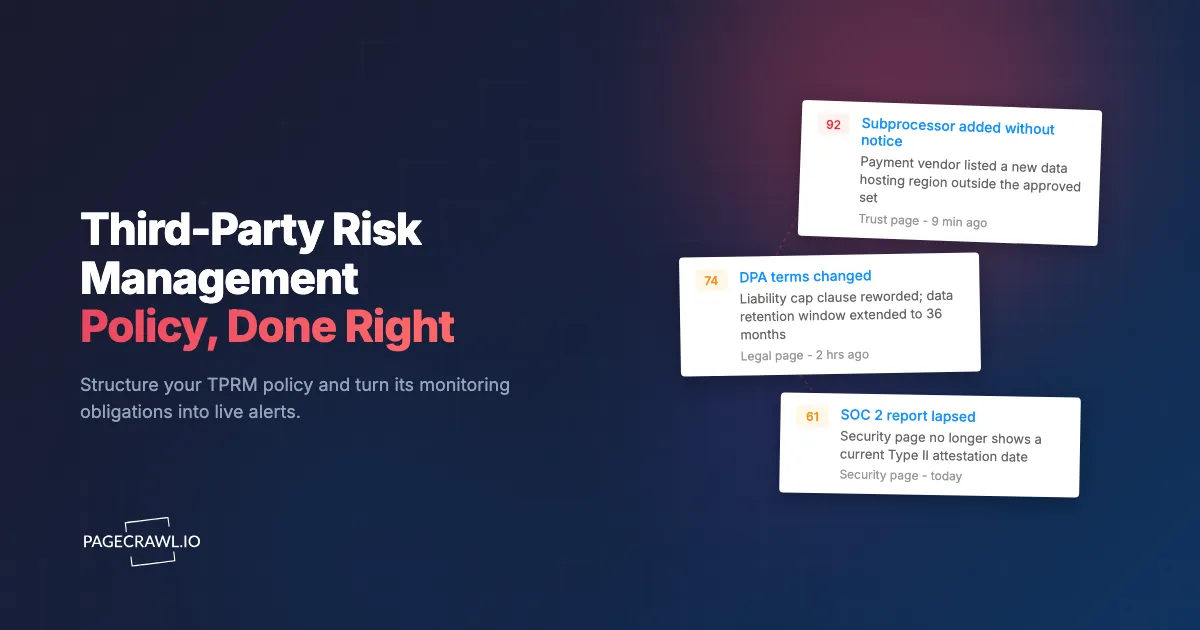
Manual quarterly review cannot satisfy this. A vendor can add a subprocessor, let a certification lapse, or rewrite a liability clause weeks before your next scheduled look. Automated change detection closes that window, which is the role of continuous vendor monitoring for TPRM and broader supply chain vendor website tracking: the policy states the obligation, and the monitor fulfills it.
Here is how to operationalize the continuous monitoring clause with PageCrawl:
Step 1: Inventory the pages. For each in-scope vendor, list the URLs that carry risk signals: subprocessor list, security/trust page, terms of service, DPA, privacy policy, and status page. A critical vendor typically contributes five to seven.
Step 2: Add each URL to PageCrawl. Use reader or content-only tracking for long-form legal and policy pages so navigation and boilerplate do not generate noise, the standard setup for terms of service and privacy policy change tracking. PageCrawl's free tier covers 6 monitors and 220 checks per month, enough to pilot continuous monitoring on your single most critical vendor before scaling.
Step 3: Tier the check frequency. Set critical-vendor pages to check daily and lower-tier pages weekly or monthly, mirroring the tiering already defined in your policy so the monitoring cadence matches the documented risk.
Step 4: Organize by vendor and tier. Group monitors into folders by vendor and tag them by tier (critical, high, moderate), following the patterns in the guide to organizing monitored pages with labels, folders, and workspaces. When a change fires, the tag tells the reviewer how fast to respond.
Step 5: Route alerts to the risk owner. Send notifications to the named business owner and the TPRM function by email, Slack, or Teams, so the change reaches an accountable person rather than a shared inbox no one reads.
Step 6: Automate the response with webhooks. For larger vendor portfolios, use webhook automation to open a ticket, append the change to the vendor's risk record, and trigger a re-assessment when a high-signal page changes, turning detection into a tracked workflow instead of an email someone might miss.
Step 7: Capture timestamped evidence. Enable screenshots so every detected change is preserved with a date, time, and URL. For stronger evidence, web archiving with WACZ stores a full, replayable snapshot of the page as it looked at that check. When an auditor asks how you knew a vendor altered its subprocessor list, you produce the dated capture from your tamper-evident web archive, not a recollection.
Because vendor terms and DPAs are the kind of long-form legal text that drifts silently, pairing this with dedicated terms of service change monitoring for SaaS vendors covers the contractual surface questionnaires never revisit.
How do you handle exceptions and risk acceptance?
The exceptions section defines how the organization knowingly accepts a risk that falls outside policy, who is authorized to approve it, and how long the exception lasts. Every mature program needs this valve, because an undocumented workaround is far more dangerous than a documented exception.
A clean exception process includes:
- A written request. The specific requirement being waived, the business justification, and the compensating controls that reduce the residual risk.
- Tiered approval authority. Higher-risk exceptions require higher sign-off, with critical-vendor exceptions escalating to a risk committee or executive owner.
- A mandatory expiry. No exception is permanent. Each carries a review date that forces re-justification, so temporary acceptances do not quietly become permanent blind spots.
- A central register. All active exceptions live in one log that the risk function reviews regularly and surfaces to auditors on request.
The discipline that makes this section work is the expiry date. Exceptions without an end date are how a "temporary" gap becomes a three-year liability nobody remembers approving.
Why does offboarding belong in a TPRM policy?
Offboarding defines what must happen when a vendor relationship ends so that access, data, and obligations are fully closed out rather than left dangling. A terminated vendor that still holds your data or retains live credentials is an open risk with no owner, which is why offboarding is a required policy section and not an afterthought.
The offboarding checklist should require:
- Access revocation. Disable all vendor credentials, API keys, VPN access, and integrations on the termination date, with verification.
- Data return or destruction. Enforce the contractual data-return or certified-destruction clause and obtain written attestation that the vendor no longer holds your data.
- Subprocessor wind-down. Confirm that any of the vendor's subprocessors holding your data have also purged it.
- Documentation and final review. Record the termination reason, lessons learned, and any open issues in the vendor's risk record, and remove the vendor from active monitoring.
Tie offboarding back to due diligence: the right-to-audit and data-return clauses you insisted on at onboarding only matter if offboarding actually exercises them.
What does a free TPRM policy template look like?
A reusable TPRM policy template follows the same seven sections in a fixed order, with a short purpose statement up front and an approval block at the end. Adapt the outline below to your sector and risk appetite. A tight, enforced policy beats a comprehensive one that no one follows.
Use this outline as your template:
- Purpose and policy statement. One paragraph on why the policy exists and the commitment it represents.
- Scope. Relationship types covered, trigger thresholds, fourth-party inclusion, and explicit exclusions.
- Roles and responsibilities. Business owner, TPRM function, domain reviewers, and approval authority, with a RACI grid.
- Risk tiering. Tier definitions, the inherent-risk factors that drive them, and the obligations mapped to each tier.
- Due diligence requirements. Required evidence by tier, reviewers, and disqualifying conditions.
- Continuous monitoring obligations. Pages and signals watched, frequency by tier, alert routing, and evidence capture.
- Exceptions and risk acceptance. Request format, approval authority, expiry, and the central register.
- Offboarding. Access revocation, data return or destruction, subprocessor wind-down, and final documentation.
- Review and governance. Policy review cadence (at least annual), metrics reported to leadership, and version history.
- Approval block. Owner, approver, effective date, and next review date.
Two sections quietly determine whether the whole policy is real: continuous monitoring and offboarding. Both depend on doing something between the headline events, and both are where automation earns its place. Specialized compliance monitoring software turns the monitoring clause from an aspiration into a control that runs on its own and produces the evidence auditors want.
Choosing your PageCrawl plan
PageCrawl's Free plan lets you monitor 6 pages with 220 checks per month, enough to validate continuous vendor monitoring on your single most critical vendor before rolling it across the portfolio.
| Plan | Price | Pages | Checks / month | Frequency |
|---|---|---|---|---|
| Free | $0 | 6 | 220 | every 60 min |
| Standard | $8/mo or $80/yr | 100 | 15,000 | every 15 min |
| Enterprise | $30/mo or $300/yr | 500 | 100,000 | every 5 min |
| Ultimate | $99/mo or $999/yr | 1,000 | 100,000 | every 2 min |
Annual billing saves two months across every paid tier. Enterprise and Ultimate scale up to 100x if you need thousands of pages or multi-team access.
A continuous monitoring clause that nobody can fulfill is just text. Standard at $80/year tracks 100 vendor pages with daily checks and timestamped screenshots, and Enterprise at $300/year handles 500 pages and dozens of critical vendors. If monitoring catches a single material change before your next quarterly review, it has already paid for the year.
Getting Started
Start with your three most critical vendors. List their subprocessor, security, terms, and DPA pages, add them to a free PageCrawl account, set critical pages to daily checks, and route alerts to the named risk owner. The first time a monitor catches a vendor changing something it never told you about, your continuous monitoring obligation stops being a paragraph and becomes a working control.
Write the policy once, then let the monitoring run itself, because the vendor you stopped watching is the one that becomes your next finding.