The rule that catches out a European payments firm is almost never a surprise to anyone who has been reading. Its outline appears in a regulator's multi-year work programme. Its substance is debated in a consultation paper long before it takes effect. Its draft text sits open for public comment for weeks. By the time it is published in the official journal, the firm has months to rebuild a customer onboarding flow that, in practice, takes longer than that. The penalty, when it comes, is not for breaking a new rule. It is for being late to one that had been visible on the horizon the whole time.
This is the recurring failure that regulatory horizon scanning exists to fix. Most compliance functions are good at reacting to a rule once it is final and dated. They are far worse at noticing it while it is still a consultation, a green paper, a speech, or a line item in an agency's annual agenda. By the time a final rule lands, the cheap window for planning, budgeting, and quiet implementation has closed. The expensive window, the one with legal review under deadline pressure and rushed system changes, is the only one left.
Horizon scanning moves the work earlier. Instead of waiting for the enforceable rule, you watch the upstream signals that reliably precede it: consultations, draft texts, regulator strategy documents, advisory committee agendas, legislative trackers, and standards-body drafts. This guide defines horizon scanning, separates it from ordinary compliance monitoring, covers the sources and cadence of a real program, and shows how to operationalize it with continuous web monitoring so nothing on the horizon goes unseen.
What is regulatory horizon scanning?
Regulatory horizon scanning is the systematic practice of watching the early, upstream signals of regulatory change, consultations, proposed rules, agency work programmes, and policy statements, so you can anticipate new obligations months or years before they become enforceable. It is forward-looking by design. Where compliance monitoring tracks the rules that already bind you, horizon scanning tracks the rules that are still forming.
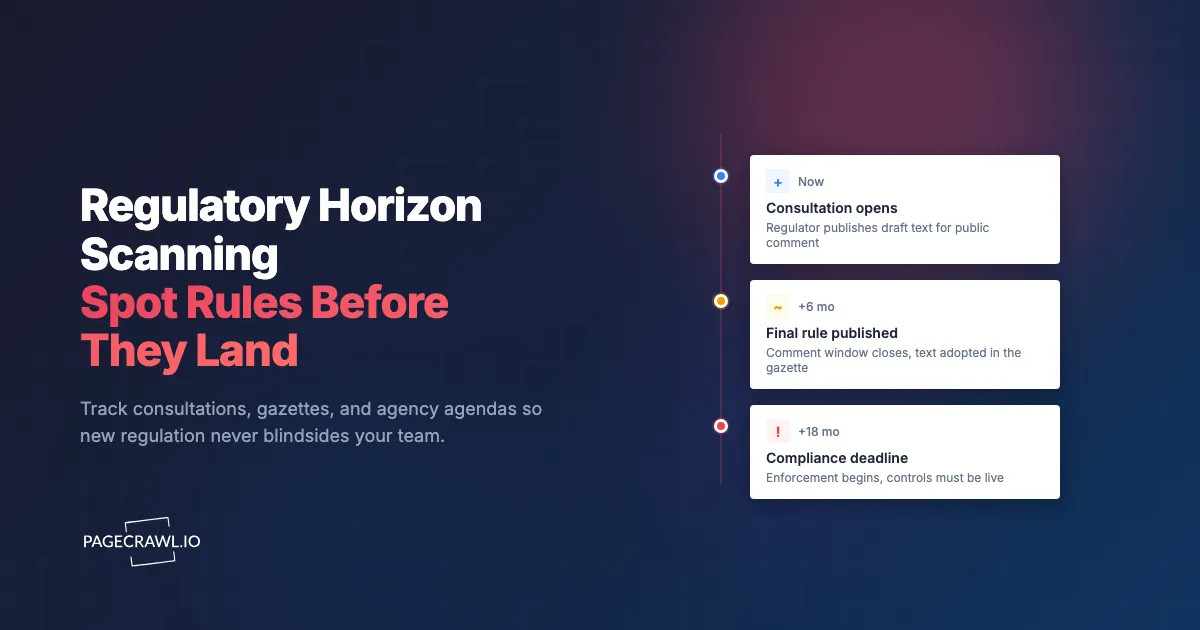
The discipline rests on a simple observation: almost no major rule arrives without warning. Regulators telegraph their intentions through a predictable sequence. A topic shows up in a strategy document or a chair's speech. It becomes a discussion paper or call for evidence. It hardens into a formal consultation with draft text. It is finalized, gazetted, and given a compliance date. Each of those stages is published, public, and watchable. Horizon scanning catches the signal at the earliest stage that gives you useful lead time.
The goal is not to react to every speech. It is to build a structured radar that surfaces the handful of developments genuinely relevant to your products and markets, ranks them by likelihood and impact, and routes them to an owner while there is still time to influence or prepare. Done well, it converts regulation from a series of fire drills into a planned pipeline.

How is horizon scanning different from compliance monitoring?
Horizon scanning and compliance monitoring sit at opposite ends of the same timeline. Compliance monitoring watches enacted, in-force rules and the enforcement actions that interpret them, so you stay aligned with what is binding today. Horizon scanning watches the upstream pipeline, consultations and drafts and agendas, so you prepare for what will be binding tomorrow. You need both, but they use different sources and different cadences.
The distinction matters because the two practices fail differently. A gap in compliance monitoring means you miss a guidance update or an enforcement signal that is already live, the kind of risk covered in our guide to regulatory intelligence monitoring. A gap in horizon scanning is quieter and more expensive: you simply never see a rule coming, and you inherit the implementation crunch that early movers avoided. Many teams invest heavily in the first and almost nothing in the second.
The sources differ too. Compliance monitoring leans on bulletins, final rules, enforcement pages, and guidance, exactly the kind of program described in our banking regulatory compliance monitoring guide. Horizon scanning leans on consultation hubs, draft and proposed rules, legislative bill trackers, forward agendas, and standards drafts. Some pages serve both: a regulator's news page carries both today's enforcement notice and tomorrow's consultation announcement, which is why a complete program watches the full lifecycle rather than a single stage.
What sources belong on a horizon-scanning radar?
The right sources are the ones that publish intent before obligation: consultation and call-for-evidence pages, proposed and draft rules, regulator work programmes and strategy documents, official gazettes and registers, advisory committee agendas, legislative bill trackers, and the draft outputs of standards bodies. Each sits earlier in the lifecycle than a final rule, so each buys you lead time. Group your radar by the stage where rules originate: the earlier the stage, the more lead time, but also the more uncertainty about whether it survives to become binding.
Consultations and calls for evidence
Consultation hubs are the single highest-value source for horizon scanning. When a regulator opens a consultation, it has usually decided to act and is signaling the direction, and the draft text is often close to the final rule. Watch each relevant regulator's consultation listing page so a new entry surfaces the day it opens, while the comment window is still open and you can still influence the outcome.
Proposed and draft rules
Proposed rules sit one step downstream of consultations and one step upstream of enforceable law. In the United States they appear in the Federal Register with comment periods; in the EU and UK, draft regulations and statutory instruments circulate before adoption. Monitoring the proposed-rules listing for your sector catches the near-final text with a defined comment window and, usually, a signposted effective date.
Work programmes, strategy documents, and agendas
Most regulators publish an annual or multi-year work programme naming the topics they intend to tackle. In the United States the equivalent is the Unified Agenda of Regulatory and Deregulatory Actions on reginfo.gov. These are the earliest credible signals you can get, often a year or more ahead of any draft. Advisory committee and board meeting agendas are similarly predictive: an item on next month's agenda frequently becomes next year's rule. These pages change infrequently, so they are cheap to watch and high in payoff.
Official gazettes, registers, and legislative trackers
Official journals and gazettes are where rules become legally real, but they also publish the procedural steps leading up to adoption, which puts them squarely in the scope of government and public records monitoring. In the EU that journal is EUR-Lex. Legislative bill trackers add the parliamentary or congressional dimension, where primary legislation can mandate entirely new regulatory regimes. Watching specific bill pages catches movement through committee, amendment, and vote, the approach detailed in our guide to legislative tracking and monitoring bills and laws. Pair these with broad government agency news monitoring so announcements that do not fit a neat category still reach you.
Standards bodies and supranational sources
For many sectors, the real horizon is set above the national regulator. The Basel Committee at the Bank for International Settlements, international accounting and securities bodies, data protection boards, and technical standards organizations publish drafts that national regulators later transpose. Topic-specific regimes, such as the staged obligations tracked in our EU AI Act monitoring guide, often originate at this level years before local enforcement. Add the standards drafts relevant to your industry to catch the earliest possible signal.
How do you build a horizon-scanning program?
A working program has four parts: sources, cadence, triage, and ownership. You assemble a watchlist of upstream pages, assign each a check frequency that matches how fast it moves, define a scoring method to rank what you find, and name an owner for every signal so nothing surfaces without someone responsible for acting on it. The structure matters more than the size.
Build the source watchlist
Start from your obligations, not from a generic list of regulators. List the jurisdictions you operate in, the products you sell, and the regimes that already bind you, then map each to the regulator and supranational body that governs it. For every one, identify the consultation page, the proposed-rules page, the work programme, and the news page. A focused mid-market firm typically lands on 20 to 50 upstream pages; a multinational across several sectors can reach several hundred.
Set cadence by source velocity
Match check frequency to how fast each source actually moves. Consultation and proposed-rule listings deserve daily checks because comment windows are time-boxed and missing the open date costs you influence. Work programmes, strategy documents, and committee agendas change rarely, so weekly or monthly checks suffice. News pages warrant daily checks because they front-run the structured pages. Spend your check budget where new entries appear most often.
Define triage and scoring
Not every signal deserves equal attention, and a radar that treats them equally just trades one kind of blindness for another. Score each development on likelihood, impact, and time to effect, then route it to act, plan, or watch. The full scoring method is below; the point at the build stage is to commit to a consistent ranking rather than reacting to whatever alert arrived most recently.
Assign ownership
Every source and every surfaced signal needs a named owner, or the program quietly decays into an unread inbox. Assign coverage by domain: a data protection lead owns privacy-regime sources, a financial crime officer owns sanctions and AML items, a product counsel owns sector-specific rulemaking. The owner triages alerts from their sources, scores them, and escalates the material ones. Coverage by person is what turns detection into decisions.
How do you set up horizon scanning with PageCrawl?
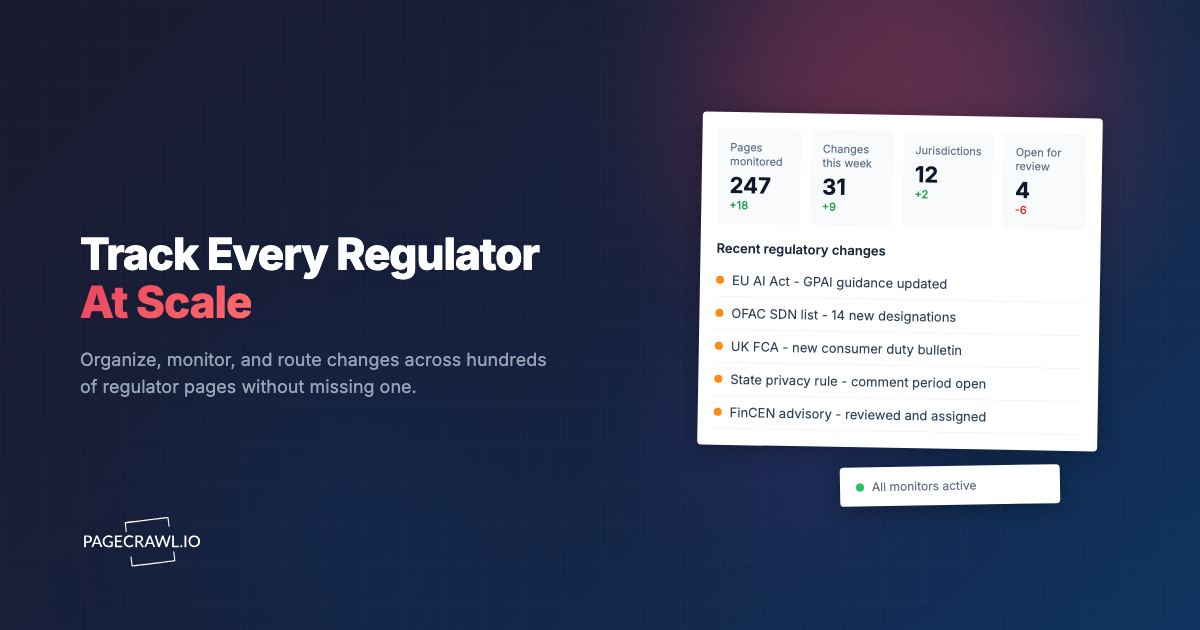
You set it up by adding each upstream page as a monitor, choosing a tracking mode that ignores layout noise, setting a check frequency that matches the source, and routing alerts to the owner responsible for that domain. PageCrawl checks each page on schedule, detects meaningful changes, and notifies you, so a new consultation or an amended draft reaches the right person automatically. Here is the concrete walkthrough.

Step 1: Assemble your upstream URLs. From the watchlist above, collect the exact URLs for each regulator's consultation listing, proposed-rules page, work programme, and news page. Use the deepest listing page that updates when new items appear, not a generic landing page that rarely changes.
Step 2: Add each URL as a monitor. Paste each URL into PageCrawl. For long consultation documents and policy PDFs, use reader mode to track the main text and ignore navigation. For listing pages where you want to catch any new entry, use fullpage mode so a freshly added consultation or draft triggers an alert. PageCrawl also monitors PDF documents, which matters because draft rules and impact assessments are frequently published as PDFs.
Step 3: Set the cadence per source. Apply daily checks to consultation and proposed-rule listings and news pages, where time-boxed windows make speed valuable. Apply weekly or monthly checks to work programmes, strategy documents, and committee agendas that move slowly.
Step 4: Organize with folders and tags. Group monitors into folders by regulator or jurisdiction, and tag them by lifecycle stage (consultation, proposed rule, agenda) and by domain (privacy, AML, prudential). Folders keep the watchlist navigable; tags let you filter every "consultation" signal across all regulators at once. See organizing monitored pages with labels, folders, and workspaces for how the three levels nest, which matters once a radar passes a hundred pages.
Step 5: Route alerts to owners. Send each domain's alerts to the responsible owner. High-urgency sources, such as an open consultation with a short window, can route to a Slack channel for same-day awareness. Slower sources can batch into a weekly change briefing so agendas and strategy updates land as a digest rather than a stream of individual emails.
Step 6: Reduce noise before it reaches people. Government and regulator sites redesign often, which can trigger alerts with no substantive change. Reader mode and keyword conditions cut most of this, and our guide to reducing monitoring false positives covers the rest. A quiet radar is one people actually read.
Step 7: Start free, then scale. PageCrawl's free tier covers 6 monitors and 220 checks per month, enough to prove the approach on your most consultation-heavy regulators. Start with the three or four sources that move fastest, establish a baseline alert volume, then add jurisdictions and slower sources as the workflow settles.
If you prefer to set monitors up by conversation, PageCrawl's MCP server lets you ask Claude to create and manage them in natural language. Describe the regulator and the page you want watched, and the assistant configures it.
How do you triage and score what horizon scanning surfaces?
You triage by scoring each development on three axes, likelihood, impact, and time to effect, then routing it into one of three tracks: act now, plan and budget, or watch and note. The score is what separates a genuine drop-everything consultation from a speculative line in a five-year agenda. Without it, every signal looks urgent and nothing gets the attention it deserves.
Likelihood asks how probable it is that the development becomes binding: an open consultation with draft text scores high, a topic mentioned once in a speech scores low. Impact asks how much it would change your products, processes, or obligations: a rule that reshapes onboarding scores high, a clarification to a regime you already exceed scores low. Time to effect asks how much runway you have, and a short comment window or near-term compliance date raises urgency regardless of the other two.
Map the combined score to action. High likelihood and high impact with a short runway goes straight to an owner with a remediation estimate and a budget line; the same with a long runway goes into your planning pipeline for the next cycle. Everything else gets logged and re-scored as it progresses. The scoring is deliberately simple; the value is in applying it consistently, so the genuinely material items never get lost in the volume.
How do you turn horizon signals into action?
You turn signals into action with a fixed weekly workflow: triage new alerts, score the material ones, assign an owner and a due date, and log everything so you have an audit trail. Detection alone changes nothing. The discipline that prevents missed rules is the routine that converts each alert into a tracked work item with a name and a date attached.
Weekly horizon review
Set a recurring weekly review where each domain owner walks their alerts from the past week. For each new consultation, draft, or agenda item, they confirm relevance, apply the three-axis score, and decide the track: act, plan, or watch. Material items get an owner, an impact estimate, and an entry in your change-management system. The meeting is short when the radar is well tuned, often fifteen minutes, because the monitoring has already done the collection work.
Influence while the window is open
Horizon scanning gives you something compliance monitoring cannot: the chance to shape the rule before it is final. Open consultations invite comment, and early detection means you have time to draft a response, coordinate with industry peers, and submit before the window closes. A rule you helped shape is cheaper to comply with than one you inherit unchanged. This is the unique payoff of watching the upstream stages rather than the final text.
Maintain an audit trail
Examiners and boards increasingly expect evidence that you watch the horizon, not just the in-force rulebook. PageCrawl's archiving capability stores timestamped snapshots of each monitored page, so you can show exactly when a consultation opened, what the draft said, and when your team was notified. The explainer on what a PageCrawl WACZ archive contains covers the signature and timestamp material that makes a snapshot defensible rather than merely stored. For regulated firms, this supports the broader compliance record auditors expect, demonstrating a systematic process rather than ad hoc awareness.
Horizon scanning tells you a rule is coming and preserves the evidence of when you knew. Interpreting what a draft means for your obligations is a job for qualified counsel; this article is informational, not legal advice.
What are the common pitfalls in horizon scanning?
The two failure modes are opposite: too narrow and you miss developments that originate outside your usual regulators; too broad and the radar drowns owners in noise until they stop reading it. A good program watches the full rule lifecycle across the right sources while filtering aggressively for relevance, so every alert that reaches a person is worth their attention.
The narrow failure usually comes from watching only your primary regulator. Major obligations increasingly originate at supranational bodies, in primary legislation, or in adjacent regimes that later cross into your sector. Court decisions can reshape how an existing rule is enforced, which is why some teams add court opinion monitoring to their radar. Casting wider at the source stage is how you avoid the rule that arrives from a direction you were not watching.
The broad failure comes from over-alerting. If every minor page edit generates a notification, owners learn to ignore the channel and a real consultation gets lost among layout tweaks. Reader mode, keyword conditions, and batched digests for slow sources keep the signal-to-noise ratio high. The metric that matters is not how many alerts you generate but how many a human actually reads and acts on.
Choosing your PageCrawl plan
PageCrawl's Free plan lets you monitor 6 pages with 220 checks per month, which is enough to validate horizon scanning on your fastest-moving consultation and proposed-rule pages. Most teams graduate to a paid plan once they see how much lead time the radar buys them.
| Plan | Price | Pages | Checks / month | Frequency |
|---|---|---|---|---|
| Free | $0 | 6 | 220 | every 60 min |
| Standard | $8/mo or $80/yr | 100 | 15,000 | every 15 min |
| Enterprise | $30/mo or $300/yr | 500 | 100,000 | every 5 min |
| Ultimate | $99/mo or $999/yr | 1,000 | 100,000 | every 2 min |
Annual billing saves two months across every paid tier. Enterprise and Ultimate scale up to 100x if you need thousands of pages or multi-team access.
Compared with the cost of a single rushed implementation or a late-to-comply penalty, horizon scanning is one of the cheapest controls a regulated firm can run. Standard at $80/year comfortably covers the consultation, proposed-rule, and agenda pages of every regulator a focused firm answers to. Enterprise at $300/year handles a multinational program spanning several jurisdictions, supranational bodies, and legislative trackers, with full change history and timestamped archives that document your process for boards and examiners.
All plans include the PageCrawl MCP Server, so your team can ask Claude to summarize every change to a specific consultation or work programme over the last quarter, pulling directly from your monitoring history and turning a sprawling radar into a queryable briefing. AI assistants can create monitors through conversation on every plan, including Free.
Getting Started
Start with the fastest stage of the lifecycle. Pick the two or three regulators whose decisions hit you hardest, and add their consultation and proposed-rule listing pages to PageCrawl with daily checks. Route the alerts to whoever owns that domain, and run it for two weeks to learn your real alert volume and tune out the noise.
Then widen the radar: add work programmes and committee agendas with weekly checks, layer in legislative trackers and supranational sources, and organize everything into folders by regulator and tags by lifecycle stage. The free tier's 6 monitors cover your highest-velocity sources; Standard at $80/year covers a full single-jurisdiction program; Enterprise at $300/year covers a multinational one with the audit trail to prove it.
The rules that will reshape your industry are already visible on the horizon. Horizon scanning is simply the practice of looking, before the deadline does the looking for you.