Congress introduces thousands of bills in every session, all of them searchable on Congress.gov, and state legislatures across all 50 states add tens of thousands more, as the National Conference of State Legislatures tracks each year. A single bill that passes committee can reshape an entire industry in months. If your business, organization, or clients are affected by legislation, finding out about a relevant bill after it becomes law is not just inconvenient. It can be expensive, disruptive, or worse.
Consider a pattern that plays out regularly. A pharmaceutical company discovers a new state labeling requirement two weeks before its effective date. The bill had been public for months, passed through several committee hearings, and was signed into law well before anyone on the regulatory team noticed, because nobody was monitoring that state's legislature. The emergency compliance effort is expensive and the product launch slips.
This guide covers why legislative tracking matters, what sources to monitor at the federal and state level, how to set up automated monitoring for bills and law changes, and strategies for managing multi-jurisdictional legislative risk.
Why does legislative tracking matter?
Because a bill you learn about at passage is a bill you can no longer shape or prepare for. Legislation affects every industry and organization, though the impact varies widely: compliance obligations, market conditions, advocacy windows, and client service all depend on knowing early. Understanding your exposure helps you prioritize monitoring.
Compliance Risk
New laws create new compliance requirements. Employment regulations mandate changes to HR policies. Environmental legislation imposes reporting requirements. Data privacy laws require technical and organizational changes. Tax code modifications affect financial planning and reporting.
The cost of non-compliance is not limited to fines. Operational disruption, reputational damage, and legal liability often exceed direct penalties. Early awareness of legislative changes gives your compliance team time to plan, budget, and implement changes before deadlines arrive.
Business Impact
Beyond compliance, legislation shapes market conditions. Tariffs such as the Section 232 duties on steel and aluminum affect supply chains. Zoning laws constrain real estate decisions. Healthcare regulations create or eliminate markets. Technology regulations influence product development priorities.
Companies that track relevant legislation through regulatory horizon scanning can anticipate market shifts rather than react to them. Early awareness of a proposed law gives you months to adapt strategy, while competitors who discover the same law at passage scramble to respond.
Advocacy and Influence
For organizations that engage in advocacy (industry associations, nonprofits, lobbying firms, corporations with government affairs teams), legislative tracking is the operational foundation. You cannot influence legislation you are not aware of. Monitoring bills as they are introduced gives you the maximum window for public comment, testimony, and stakeholder engagement.
Client Service
Law firms, consultants, and advisory firms that already rely on legal research tools serve clients who depend on legislative awareness. Proactive alerts about relevant legislation demonstrate value and build client trust. The firm that tells a client about a pending bill six months before passage delivers more value than the one that mentions it after signing.
What should you monitor at the federal level?
Three sources cover most federal exposure: Congress.gov for bill text, status, and committee activity; the Federal Register for the agency rulemaking that implements those bills; and Congressional Research Service reports for context on which issues are gaining attention.
Congress.gov
The official source for federal legislation. Congress.gov provides the full text of bills, resolution status, committee assignments, vote records, co-sponsor lists, and actions taken. Every bill introduced in the House or Senate appears here.
Key pages to monitor:
- Bill text pages: Monitor the full text of specific bills you are tracking. Changes to bill text (amendments, substitutes) appear as updates to these pages.
- Bill status pages: Track where a bill sits in the legislative process (introduced, referred to committee, reported, passed House/Senate, signed into law).
- Committee pages: Monitor committee hearing schedules and markup sessions. Bills often change significantly during committee consideration.
- Search results: Monitor search result pages for specific keywords relevant to your industry. New bills matching your keywords appear as search results update.
Federal Register
The Federal Register publishes proposed rules, final rules, and notices from federal agencies. While not legislation per se, agency rulemaking implements and interprets legislation. Many regulatory requirements come through Federal Register notices rather than statutory text.
Key pages to monitor:
- Agency-specific pages: Each federal agency has a Federal Register section. Monitor agencies relevant to your industry (EPA, FDA, SEC, FTC, DOL, etc.).
- Daily publication: The Federal Register publishes every business day. Monitor the table of contents or specific sections for new entries.
Congressional Research Service Reports
CRS reports provide non-partisan analysis of legislative issues. While not law themselves, these reports often signal which issues are gaining congressional attention and provide context for understanding complex bills. Always confirm a bill's current status and effective date on the official legislature or agency page before acting on an alert; this article is informational, not legal advice.
What should you monitor at the state level?
Monitor each state's own legislature site (bill search results, the committees that handle your industry, and the session calendar), plus cross-state aggregators such as the National Conference of State Legislatures. State tracking is harder than federal tracking because of sheer volume and because every site is structured differently.
State Legislature Websites
Every state maintains a legislative website with bill text, status tracking, committee schedules, and vote records. The quality and structure of these sites varies enormously. Some states offer modern, searchable databases. Others provide basic HTML pages that are difficult to navigate.
Key pages to monitor by state:
- Bill search results: Search for bills containing keywords relevant to your business and monitor the results page. New bills matching your search appear as the page updates.
- Committee pages: Monitor committees that handle your industry's legislation. Education committee for education businesses, judiciary committee for legal industry, health committee for healthcare companies.
- Session calendars: Monitor the legislative calendar for hearing schedules, floor votes, and session dates.
National Conference of State Legislatures (NCSL)
NCSL publishes legislative tracking reports across topics and states. Their subject-specific databases aggregate legislation from all 50 states on topics like healthcare, education, technology, and criminal justice. Monitoring NCSL topic pages provides a broad view of state legislative trends.
Multistate Tracking Services
Some organizations publish compilations of legislation across states. These aggregator pages can be monitored as a single source that covers multiple jurisdictions.
Manual vs Automated Tracking
Legislative tracking ranges from simple manual approaches to fully automated systems.
Manual Tracking
Visit legislative websites periodically, search for relevant bills, and read updates. This works for tracking a handful of specific bills you already know about.
Limitations:
- Misses new bill introductions between your checks
- Does not scale to multiple jurisdictions
- Depends on remembering to check regularly
- Committee actions and amendments happen between your visits
Email Subscriptions
Most legislative websites offer email alerts for specific bills or search terms. Congress.gov, for example, lets you create alerts for new bills matching search criteria.
Limitations:
- Limited to what the legislative site offers (not all states have robust alert systems)
- Email-only delivery (no Slack, webhook, or mobile push options)
- Alert criteria are constrained by the site's search capabilities
- Cannot combine alerts from multiple jurisdictions into one system
Dedicated Legislative Tracking Software
Commercial legislative tracking platforms (Quorum, FiscalNote, Plural, LegiScan) provide purpose-built tracking across jurisdictions. These platforms aggregate legislative data, provide analysis tools, and offer professional-grade monitoring.
Advantages:
- Purpose-built for legislative tracking
- Multi-jurisdictional coverage
- Analysis and reporting features
- Team collaboration tools
Limitations:
- Expensive, with enterprise contract pricing well above general-purpose monitoring
- May require training and onboarding
- Coverage gaps in less-active jurisdictions
- Locked into one platform's data format
Web Monitoring
General-purpose web monitoring tools like PageCrawl provide a middle ground: automated monitoring of any legislative website at a fraction of the cost of dedicated platforms. While they lack purpose-built legislative analysis features, they excel at the core task of detecting changes on specific pages and alerting you as soon as a check picks the change up. Checks run as often as every 2 minutes on paid plans and hourly on the free plan.
Setting Up Legislative Monitoring with PageCrawl
Here is how to build a legislative monitoring system using web monitoring.

Step 1: Identify Your Priority Pages
Start by listing the specific legislative pages that matter to your organization:
- Specific bills: If you are already tracking known bills, find their status pages on Congress.gov or state legislative websites.
- Committee pages: Identify committees that handle legislation relevant to your industry.
- Search result pages: Run searches on legislative websites for your keywords (e.g., "data privacy," "emissions standards," "telehealth") and save the result page URLs.
- Agency announcement pages: Federal and state agencies that affect your industry.
For multi-jurisdictional tracking, repeat this process for each state where you operate or where legislation could affect you.
Step 2: Create Monitors
Add each legislative page URL to PageCrawl. For most legislative pages, "Fullpage" tracking mode captures the complete page content. This ensures you detect any change, whether it is a new bill appearing in search results, a status update on a bill you are tracking, or a new committee hearing being scheduled.
For bill status pages where you only care about the status field (e.g., "Introduced" changing to "Reported by Committee"), use "Specific Text" mode with a CSS selector targeting the status element. This reduces noise from unrelated page changes.
Step 3: Configure Check Frequency
Legislative pages do not change continuously like e-commerce prices, but timing still matters.
- Active session, priority bills: Check every 4-6 hours. Bills can move through committee and floor votes within a single day during active sessions.
- General monitoring (search results, committee pages): Check daily. New bills are introduced daily during active sessions.
- Off-session monitoring: Check weekly. Between sessions, legislative pages update infrequently, but agencies continue publishing rules and guidance.
Adjust frequency based on the legislative calendar. During the final weeks of a session, legislation moves faster as deadlines approach. Increase frequency for priority pages during these periods.
Note: Government websites are sometimes slow to respond and may experience intermittent outages, especially during high-traffic periods (end of legislative sessions, major regulatory announcements). Daily check frequency is usually sufficient for regulatory monitoring and avoids unnecessary load on government servers. If a check fails due to a timeout, PageCrawl automatically retries on the next scheduled check.
Step 4: Set Up Notification Routing
Different stakeholders need different information:
- Government affairs team: All legislative changes via Slack or email. They need comprehensive awareness.
- Legal/compliance team: Specific bill updates and regulatory changes via email. They need detail and context.
- Executive leadership: Significant developments only (bills advancing to floor votes, new laws signed) via email summary.
- External clients: Curated alerts for legislation relevant to their industry via webhook integration with your client communication system.
Configure separate notification channels in PageCrawl for each audience. This prevents information overload while ensuring the right people see the right updates.
Step 5: Enable AI Summaries
Legislative pages are dense with information. PageCrawl's AI summaries extract the meaningful changes and present them in plain language.
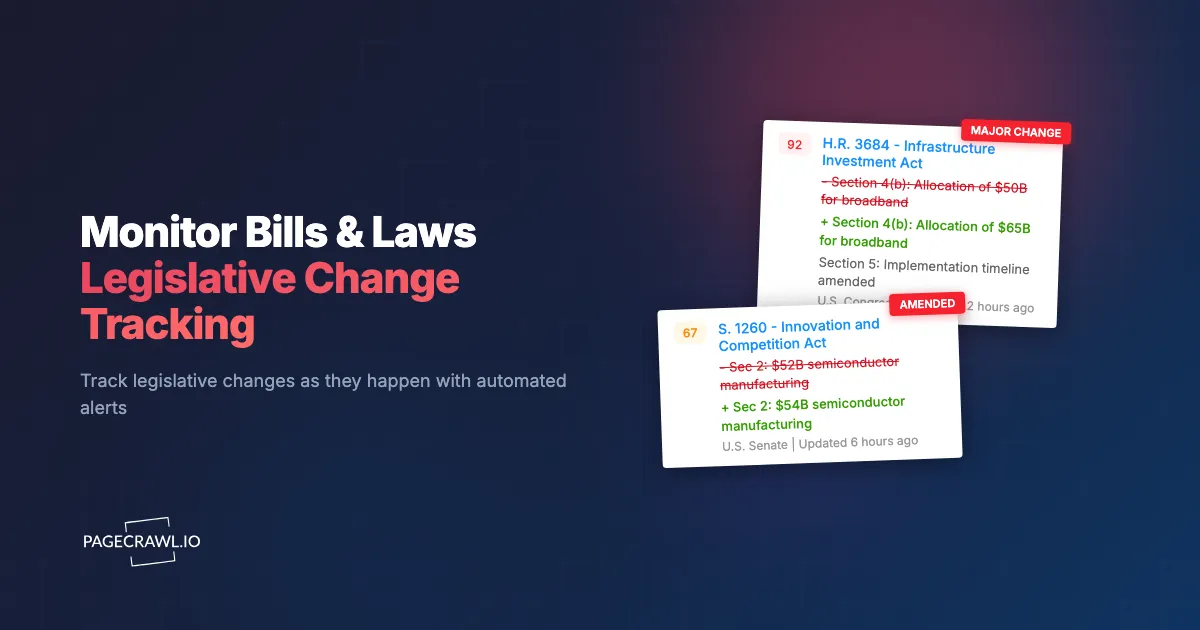
Instead of reviewing a full-page diff showing HTML changes on a committee page, you receive a summary like "Three new bills added to Senate Commerce Committee agenda for March 15 hearing" or "HR 4521 status changed from 'Referred to Committee' to 'Reported by Committee with Amendments'."
For complex legislative pages with many elements changing simultaneously, AI summaries save significant review time.
Step 6: Set Up Keyword-Based Monitoring
For proactive discovery of new legislation, monitor search result pages on legislative websites:
- Go to Congress.gov (or a state legislative site) and search for keywords relevant to your business
- Copy the URL of the search results page
- Add this URL as a PageCrawl monitor with daily frequency
- When new bills matching your keywords are introduced, the search results page changes, and you receive an alert
This approach discovers new bills automatically without you needing to check legislative databases manually.
Advanced Strategies
Multi-Jurisdictional Monitoring Matrix
For organizations operating across states, build a monitoring matrix:
| Jurisdiction | Bills Tracked | Committees Monitored | Search Keywords Active |
|---|---|---|---|
| Federal | 5 | 3 | 4 |
| California | 3 | 2 | 3 |
| New York | 2 | 2 | 3 |
| Texas | 1 | 1 | 3 |
Use PageCrawl folders to organize monitors by jurisdiction. A folder for "Federal Legislation," separate folders for each state, and a folder for "Agency Rulemaking" keeps your monitoring organized as it grows. See organizing monitored pages with labels, folders, and workspaces for nesting and per-workspace settings.
Tracking Bill Amendments and Substitutes
Bills often change substantially during the legislative process. A bill introduced as a narrow technical correction can be amended into something far more significant. Monitor both the bill status page (for procedural updates) and the bill text page (for content changes).
When PageCrawl detects a change to a bill text page, the AI summary identifies what sections changed, helping you quickly assess whether the amendment affects your interests.
On request, PageCrawl can enable audit-ready archiving for your account, so every change detection also creates a full WACZ web archive, the same open standard used by libraries and legal teams worldwide. You can replay any archived page exactly as it appeared, complete with HTML, CSS, JavaScript, and images. For legislative tracking, this provides a signed, timestamped record of bill text at each stage, which is invaluable when you need to demonstrate what a bill said on a specific date during committee review or public comment periods. The help centre explains what lands inside each snapshot in web archiving with WACZ.
Committee Hearing Monitoring
Committee hearings are where bills are debated, amended, and decided. Monitor committee hearing schedules to know when bills you are tracking will be considered. This gives your team time to prepare testimony, coordinate advocacy, or simply pay attention to the outcome.
Regulatory Implementation Monitoring
After a bill becomes law, the implementing agency publishes rules and guidance. These implementing documents often contain the specific requirements your organization must follow. Monitor the relevant agency's rulemaking pages alongside the legislation itself, so your tracking of regulators and policy bodies covers both the statute and the rules that implement it.
For example, if Congress passes a new data privacy law, monitor both the law itself and the FTC's (or other implementing agency's) rulemaking page for the regulations that specify compliance requirements.
For more on monitoring regulatory agencies specifically, see our regulatory compliance monitoring guide and compliance monitoring software overview.
Which industries need legislative tracking most?
Healthcare and pharmaceuticals, financial services, technology and data privacy, energy and environment, real estate and construction, and education. What they share is multi-jurisdictional exposure: a rule can originate in Congress, a state legislature, or an implementing agency, and each one carries its own compliance clock.
Healthcare and Pharmaceuticals
Healthcare legislation at both federal and state levels changes constantly. Drug pricing laws, telehealth regulations, insurance mandates, scope of practice rules, and FDA guidance all affect healthcare organizations. State-by-state variation means a company operating nationally must monitor dozens of jurisdictions.
Financial Services
Banking, insurance, lending, and investment regulation spans federal agencies (SEC, CFPB, OCC, FDIC) and state regulators (state banking departments, insurance commissioners). New legislation can create compliance obligations with tight implementation timelines. For monitoring SEC filings specifically, see our SEC EDGAR monitoring guide.
Technology and Data Privacy
Data privacy legislation is one of the fastest-moving areas of state law. Since California's CCPA, dozens of states have introduced or passed comprehensive privacy laws. Each has different requirements, definitions, and timelines. Technology companies need to monitor privacy legislation across all states where they have users.
AI regulation is an emerging area with bills appearing at both federal and state levels. Companies deploying AI need early visibility into potential regulatory requirements.
Energy and Environment
Environmental regulation shapes capital investment decisions worth billions. Emissions standards, renewable energy mandates, permitting requirements, and environmental review processes all flow from legislation. Energy companies monitor federal EPA actions, state environmental agencies, and local permitting bodies.
Real Estate and Construction
Zoning laws, building codes, rent control legislation, and housing policy affect real estate development and investment. These are primarily state and local, making multi-jurisdictional tracking essential for companies operating across markets.
Education
Schools, universities, and edtech companies face regulation from federal agencies (Department of Education), state legislatures, and state education boards. Funding formulas, accreditation requirements, student privacy rules, and curriculum standards all originate in legislation.
Managing Legislative Alert Volume
Multi-jurisdictional monitoring generates substantial alert volume. Here is how to manage it without drowning in notifications.
Tiered Alert Priority
Classify monitored legislation into tiers:
Tier 1 (Act same day): Bills directly affecting your operations that are advancing through the process. Deliver via Slack or Telegram so the responsible person sees them the same day.
Tier 2 (Active Monitoring): Bills in your industry area that might affect you depending on amendments. Deliver via email for review during work hours.
Tier 3 (Background Awareness): Keyword search results and broad committee monitoring. Deliver via email digest for weekly review.
Keyword Filtering
When monitoring search result pages, choose specific keywords that minimize false positives. "Data privacy notification breach" returns more relevant results than "privacy" alone. Combine industry-specific terms with regulatory language ("labeling requirements pharmaceutical" rather than just "pharmaceutical").
Team Distribution
Assign different team members to review different jurisdictions or topics. Rather than one person reviewing all alerts, distribute by expertise. Your California-focused attorney reviews California alerts. Your federal policy analyst reviews Congress.gov changes. Specialization improves review quality and reduces individual alert burden.
Regular Review Sessions
Schedule weekly 30-minute legislative review sessions where the team discusses the previous week's alerts, triages new bills, and adjusts monitoring priorities. This structured review prevents alerts from piling up unreviewed.
Monitoring Terms of Service and Policy Changes
Legislative tracking extends naturally to monitoring how laws translate into corporate policies. When new privacy legislation passes, companies update their privacy policies and terms of service. Monitoring terms of service and privacy policy pages reveals how competitors and partners interpret new legal requirements.
For organizations that need to track terms of service and privacy policy changes, see our guide to monitoring policy changes.
Choosing your PageCrawl plan
PageCrawl's Free plan lets you monitor 6 pages with 220 checks per month, which is enough to validate the approach on your most critical pages. Most teams graduate to a paid plan once they see the value.
| Plan | Price | Pages | Checks / month | Frequency |
|---|---|---|---|---|
| Free | $0 | 6 | 220 | every 60 min |
| Standard | $8/mo or $80/yr | 100 | 15,000 | every 15 min |
| Enterprise | $30/mo or $300/yr | 500 | 100,000 | every 5 min |
| Ultimate | $99/mo or $999/yr | 1,000 | 100,000 | every 2 min |
Annual billing saves two months across every paid tier. Enterprise and Ultimate scale up to 100x if you need thousands of pages or multi-team access.
Regulatory surprises are expensive. The pharmaceutical scenario at the start of this post ends in an emergency compliance effort and a delayed launch. Standard at $80/year covers 100 pages across your primary federal and state sources, which is usually enough for a focused single-industry compliance program. Enterprise at $300/year scales to 500 pages for multi-jurisdictional tracking across dozens of states with 5-minute checks.
All plans include the PageCrawl MCP Server, so your compliance team can ask Claude to summarize every change to a specific regulation over the last quarter and pull the exact diff, turning your monitoring archive into a queryable audit trail that is far easier to present to an assessor than a folder of email digests. AI assistants can create monitors through conversation on every plan, including Free.
Getting Started
Identify the three to five most important legislative sources for your organization. These might be specific bills currently in progress, key committee pages, or keyword searches on Congress.gov and your most relevant state legislative sites.
Set up monitors in PageCrawl for each source. Use daily check frequency for general monitoring and more frequent checks for bills in active consideration. Configure notifications to reach your government affairs or compliance team through their preferred channel.
PageCrawl's free tier includes 6 monitors, enough to cover a handful of critical legislative pages and prove the value of automated tracking. Standard plans ($80/year for 100 pages) support comprehensive multi-jurisdictional monitoring, and Enterprise plans ($300/year for 500 pages) cover organizations that need to track legislation across dozens of states and federal agencies.
The organizations that manage legislative risk most effectively are not necessarily the ones with the largest government affairs teams. They are the ones with the best information systems. Automated legislative monitoring ensures you know about relevant bills when they are introduced, not when they become law.