On February 24, 2022, OFAC published one of the largest single-day expansions of its SDN list in modern memory. New designations cascaded across hundreds of Russian banks, oligarchs, and entities over the course of the morning. Banks and brokerages that already screened against OFAC in near-real time froze relevant accounts within the hour. Institutions whose screening vendors batched updates overnight processed prohibited transactions that day, some of which surfaced months later in enforcement actions. The cost of those gaps ranged from regulatory letters to multi-million dollar settlements.
Sanctions lists change without warning. OFAC publishes new SDN designations and delistings on any business day, sometimes multiple times per day. The EU Council updates the Consolidated Financial Sanctions List on its own schedule, and the UK Sanctions List (UKSL) is the single source for UK designations (OFSI's separate consolidated list was consolidated into UKSL in January 2026). For banks, brokerages, exporters, crypto exchanges, and any business with material counterparty risk, missing a designation can mean processing a prohibited transaction without realizing it. The legal and reputational consequences are severe, and the audit trail demands proof you saw the change in time.
This guide covers how the three major sanctions regimes publish updates, the patterns worth watching for, and how to set up a continuous monitor that puts every designation, delisting, and program change into your compliance channel on the first check after publication. Sanctions exposure carries legal consequences, so always confirm a designation against the issuing authority's own page before acting; this article is informational, not legal advice.
Quick Setup
Pick which sanctions list to monitor and filter by program. PageCrawl alerts your compliance team as soon as a check detects a new designation or delisting, and checks run as often as every 2 minutes on paid plans and hourly on the free plan.
Why should you monitor sanctions lists directly?
You monitor the official pages directly because your screening vendor is downstream of them. Enterprise vendors ingest these lists and push updates to you, but the time between a published designation and the vendor's downstream update can be hours or longer. For high-risk sectors, that gap is operationally meaningful.
New Designations Must Be Screened Immediately
A new SDN designation effective at publication time means that any transaction processed for that entity after publication is potentially a violation. Screening vendor latency creates a window where you may be exposed without knowing it. Monitoring the publication source directly closes that window.
Delistings Allow Accounts to Resume Operations
When OFAC removes a name from the SDN list, previously frozen accounts can be re-activated. Compliance teams that catch the delisting same-day can resume customer onboarding or transaction processing faster, improving customer experience and reducing operational overhead.
Updates to Existing Entries Improve Screening Match Rates
OFAC routinely adds aliases, addresses, dates of birth, and identifiers (passports, tax IDs, crypto wallet addresses) to existing entries. These updates improve screening match rates against your customer book. Capturing them on the next check means your following screening pass uses the richest available data.
Cross-List Discrepancies Matter for Multi-Jurisdictional Counterparties
OFAC, EU, and UK regimes are often coordinated but not always identical. A name appearing on the EU list but not yet on OFAC, or vice versa, creates jurisdictional exposure for multi-region operations. Continuous parallel monitoring of all three surfaces the discrepancies as each list moves.
Official Sources
https://ofac.treasury.gov/recent-actions
https://www.consilium.europa.eu/en/policies/sanctions/different-types/
https://www.gov.uk/government/publications/the-uk-sanctions-list
OFAC's Recent Actions page is the human-readable timeline of every SDN change, designation, delisting, and general license update. The XML and CSV downloads of the full SDN list are also available for programmatic ingestion, but the Recent Actions page is what you monitor for narrative context about what changed and why.
The EU Council's sanctions page is the canonical entry point for the Consolidated Financial Sanctions List, with sub-pages for each country program (Russia, Belarus, Iran, DPRK, etc.). The UK Sanctions List (UKSL) at gov.uk is the single source for UK designations post-Brexit (OFSI's separate consolidated list was folded into UKSL in January 2026).
How do the sanctions monitoring approaches compare?
They differ mainly on latency and coverage. OFAC's own email subscription is free but slow and OFAC-only; a screening vendor covers every regime but is downstream and expensive; direct page monitoring sits between them as an early-warning layer that watches any official URL on a schedule you control.
| Approach | Cost | Latency | Coverage | Best For |
|---|---|---|---|---|
| OFAC email subscription | Free | Hours | OFAC only | Backup channel |
| Screening vendor downstream | Enterprise contract | Variable | All major regimes | Production screening |
| Manual page refresh | Free | Hours to days | Any | Spot checks |
| OFAC XML / API ingestion | Engineering time | Real-time | Programmatic | Vendors building screening |
| PageCrawl on official pages | Free tier to $300/year | 2-15 minutes | Any official URL | Compliance teams wanting an early-warning layer |
PageCrawl is not a replacement for a screening vendor. It is the early-warning layer on top of your screening stack. Knowing within minutes that a new designation has published lets the compliance team flag the screening vendor's gap, run a manual screen against high-risk accounts, and document the response. The combined approach (vendor for production screening, PageCrawl for early warning) is becoming standard practice at compliance-mature institutions.
Setting Up Sanctions Monitoring in PageCrawl

Step 1: Add the OFAC Recent Actions page
Sign in to PageCrawl, click Track New Page, and paste https://ofac.treasury.gov/recent-actions. Use content monitoring so new entries on the page are detected. Each new SDN action posts as a new entry.
Step 2: Add the EU and UK sanctions pages
Add the EU Council sanctions index page and the UK OFSI sanctions list page. The EU page links out to country-specific program updates and the UK page is the canonical OFSI list.
Step 3: Add country-program sub-pages for active regimes
For high-relevance country programs (Russia, Iran, DPRK, Venezuela, Syria), add the country-specific sub-pages on both the EU Council and OFAC sites. These often update before the main consolidated lists.
Step 4: Pick a check frequency
Sanctions monitoring is one of the few use cases where check frequency directly translates to compliance risk reduction. Reasonable defaults:
- Awareness only: 60-minute checks (Free plan). Adequate for low-volume, low-risk institutions.
- Active compliance team: 15-minute checks (Standard plan). Same-business-hour awareness on every update.
- Bank, brokerage, or crypto exchange: 2-minute checks (Ultimate plan). The tightest awareness window available, for production-grade compliance.
Step 5: Wire alerts to compliance channels
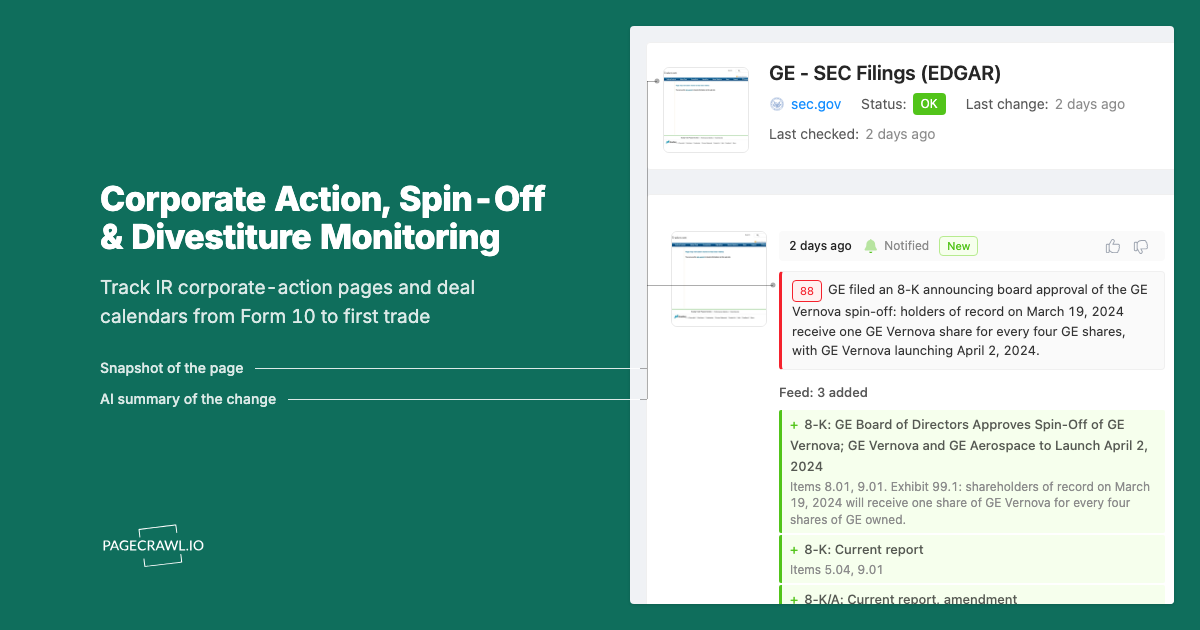
Most compliance teams route sanctions alerts to a dedicated Slack or Teams channel with a duplicate webhook into the ticketing system (ServiceNow, Jira). The webhook triggers an automatic ticket for review, and the chat message gives the team visibility as soon as the check that found the change completes. See the webhook integration guide and the help center article on sending change data to any external service for setup.
Step 6: Tag by regime and program
Use PageCrawl folders to organize your regulatory monitors by regime (ofac, eu, uk-ofsi) and by country program (russia, iran, dprk). The folder view supports rapid triage when a high-volume sanctions event lands, and the guide to organizing monitored pages with labels, folders, and workspaces covers the nesting and color-coding options.
Worked Example: A Mid-Sized Bank's Sanctions Watch
A mid-sized US bank with multinational exposure typically sets up something like this:
- Add OFAC Recent Actions, EU Council sanctions index, and UK OFSI list (3 monitors).
- Add country-program sub-pages for Russia, Iran, DPRK, Venezuela, Syria, Cuba on both OFAC and EU (12 monitors).
- Add OFAC general license publication page and FAQ updates page (2 monitors).
- Set frequency to 15 minutes on all monitors.
- Route alerts to
#sanctions-alertsTeams channel with webhook duplicates into ServiceNow. - Tag all monitors with
sanctions-watchfor easy folder review.
Total: 17 monitors at 15-minute checks. Total cost: $80/year on the Standard plan. The compliance team gets a continuous, timestamped feed of every sanctions action across the three major regimes, with audit-grade documentation of when each change was first observed.
Patterns Worth Watching For
Cluster designations. Major geopolitical events produce same-day cascades of designations. Watch for these as the highest-priority alerts because they often expand screening obligations across an entire counterparty class.
Crypto wallet identifier additions. OFAC has increasingly added blockchain addresses to SDN entries. For crypto exchanges and payment processors, these are operationally critical and require immediate ingestion into transaction monitoring.
General license updates. OFAC general licenses authorize transactions that would otherwise be prohibited. Changes to general license scope or expiration affect transaction processing materially.
Delisting reasons. Delistings sometimes signal a settlement or government-to-government negotiation. The reason field on the delisting notice can have intelligence value beyond the compliance trigger.
FAQ and interpretive guidance changes. OFAC updates FAQs and interpretive guidance regularly. These changes do not appear in the SDN list itself but shift compliance interpretation in ways that matter.
Combining Sanctions Monitoring With Other Compliance Signals
Sanctions monitoring is most powerful as part of a broader compliance early-warning stack.
Combine with AML and BSA guidance. Add FinCEN advisories and FATF statements as siblings. These often precede or contextualize sanctions actions.
Combine with export control updates. BIS Entity List monitoring, ITAR debarred list, and EU dual-use updates affect export compliance in parallel with sanctions. Monitor these in the same compliance channel.
Combine with state AG enforcement. Pair with our state AG enforcement tracking guide. Some state regulators (NY DFS especially) bring sanctions enforcement actions independently, which is why AG enforcement, docket and litigation monitoring belongs in the same feed.
Combine with FTC enforcement. Pair with our FTC consent order tracking guide. Cross-cutting consumer protection and sanctions cases sometimes intersect.
Combine with media monitoring. When a designated entity appears in news and press coverage you track for your jurisdiction, the operational risk profile shifts. Adding key wire-service sanctions tags as siblings catches these.
Who needs sanctions list change alerts?
Any organization with counterparty exposure across the OFAC, EU or UK regimes: banks and brokerages, exporters and trade compliance teams, legal and risk advisors, crypto exchanges and payment processors, multinational compliance functions, and industry associations that issue member alerts.
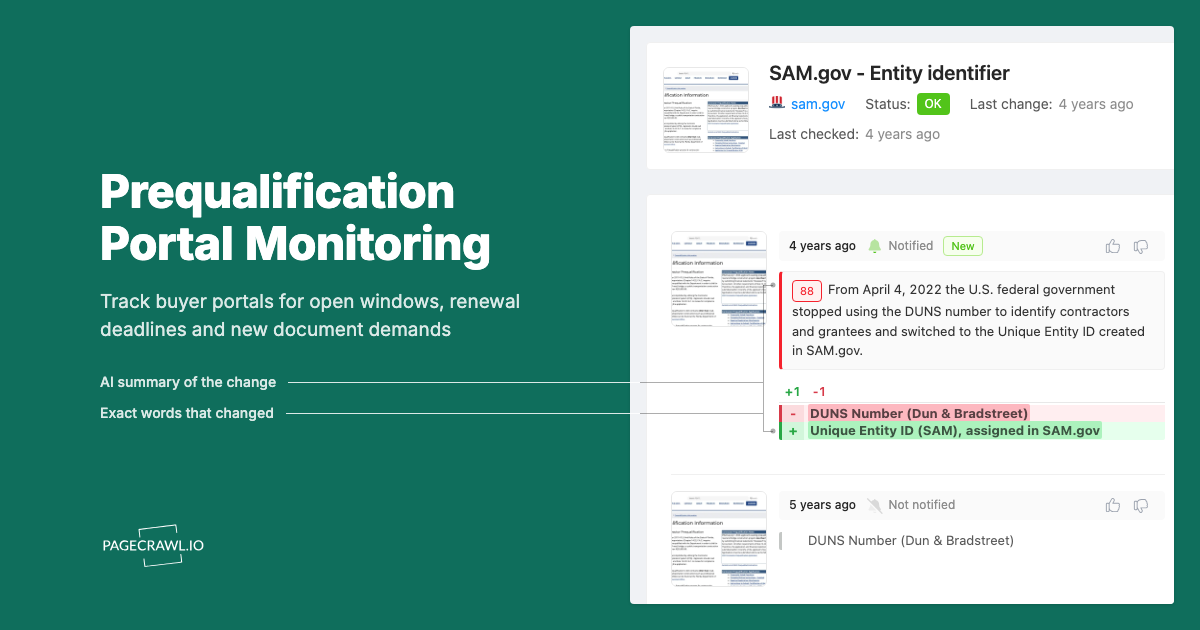
Bank and brokerage compliance. Same-day list change awareness supports customer rescreening and sharply reduces the window between designation and account action. The audit trail of "first observed at 09:14 UTC, screened at 09:23 UTC" is exactly what examiners want to see.
Exporters and trade compliance. Updates to country-specific programs trigger trade documentation review and license assessments. Exporters operating in high-risk jurisdictions check OFAC, BIS, and EU updates as a single compliance morning routine.
Legal and risk advisory. Sanctions changes are a primary input to enterprise risk assessments, sanctions opinion letters, and counterparty diligence. Outside counsel uses continuous monitoring to issue same-day client alerts on relevant actions.
Crypto exchanges and payment processors. SDN updates increasingly include digital asset addresses. Same-day awareness is essential and operationally non-negotiable. Many crypto exchanges run continuous monitoring as a regulatory and reputational requirement.
Multinational corporate compliance. Global companies operating across OFAC, EU, and UK regimes monitor all three in parallel to catch jurisdictional discrepancies before they become enforcement issues.
Trade associations and industry groups. Industry associations monitor sanctions changes to issue member alerts on actions affecting their sector.
Frequently Asked Questions
How quickly does OFAC publish the SDN list after announcing a designation? OFAC's Recent Actions page typically updates within minutes of the underlying Treasury press release. The full SDN list XML/CSV is updated on the same cadence.
Is this a substitute for a screening vendor? No. PageCrawl is the early-warning layer that tells compliance teams a designation has happened. A production screening vendor compares your customer book against the updated list. The two layers complement each other.
Can I monitor only specific country programs? Yes. Add the country-specific sub-pages on OFAC and EU rather than the consolidated index. The URLs are stable and capture program scope.
What about non-sanctions OFAC lists (NS-PLC, SSI, FSE)? OFAC maintains several sectoral and program-specific lists beyond SDN. All are linked from the Recent Actions page and most have dedicated sub-pages that can be monitored.
Does PageCrawl provide the actual screening match? No. PageCrawl alerts on changes to the list pages. Matching designated names against your customer book is a screening function handled by your KYC/AML platform.
Do I need a paid plan for sanctions monitoring? Standard at $80/year is the practical minimum because 15-minute frequency materially reduces the awareness window. The free plan at 60-minute frequency is enough for low-volume, low-risk use cases or initial validation.
Choosing your PageCrawl plan
PageCrawl's Free plan lets you monitor 6 pages with 220 checks per month, which is enough to validate the approach on your most critical pages. Most teams graduate to a paid plan once they see the value.
| Plan | Price | Pages | Checks / month | Frequency |
|---|---|---|---|---|
| Free | $0 | 6 | 220 | every 60 min |
| Standard | $8/mo or $80/yr | 100 | 15,000 | every 15 min |
| Enterprise | $30/mo or $300/yr | 500 | 100,000 | every 5 min |
| Ultimate | $99/mo or $999/yr | 1,000 | 100,000 | every 2 min |
Annual billing saves two months across every paid tier. Enterprise and Ultimate scale up to 100x if you need thousands of pages or multi-team access.
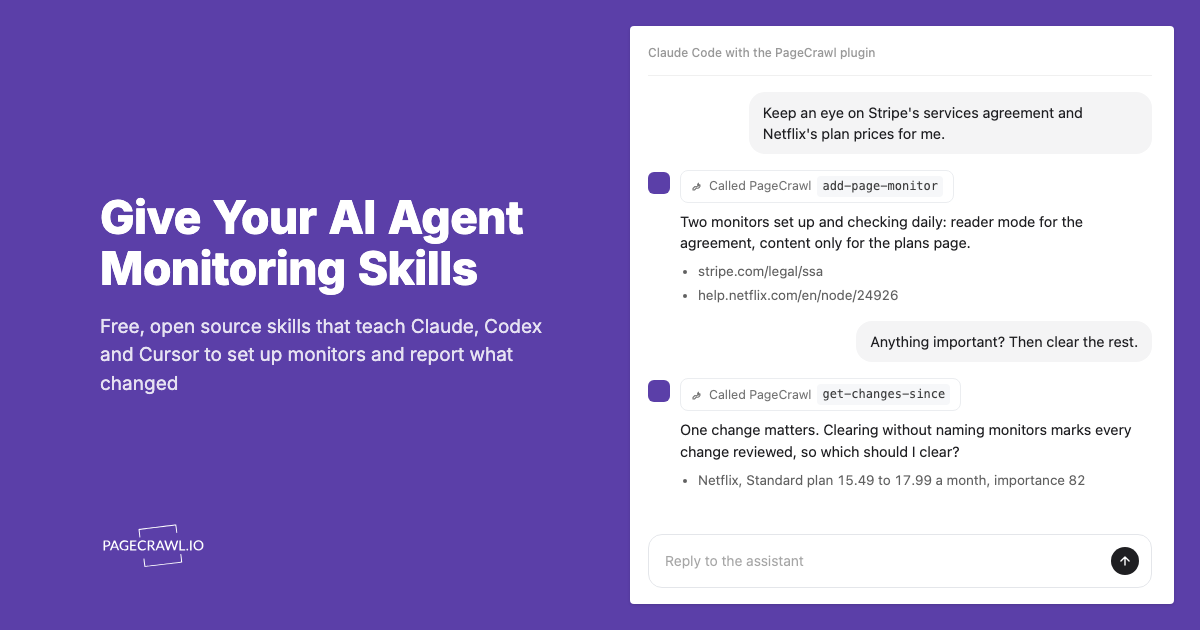
Compliance monitoring is the cheapest insurance you can buy. A single missed regulatory change can trigger fines in the tens or hundreds of thousands, not to mention the audit overhead of proving you did not see it coming. Enterprise at $300/year covers 500 regulatory pages with unlimited history and timestamped screenshots, which is usually exactly what an assessor wants to see. All plans include the PageCrawl MCP Server, so your compliance team can ask Claude to summarize every change to a specific regulation over the last quarter and pull the exact diff, turning your monitoring history into a queryable audit trail. AI assistants can create monitors through conversation on every plan, including Free. Standard at $80/year is enough to cover 100 pages across your primary regulatory bodies if your program is smaller.
Getting Started
Add the OFAC recent actions page, the EU Council sanctions page, and the UK sanctions list to PageCrawl on a 15-minute check. Create a free account and your compliance team will see the next designation on the first check that runs after it publishes.