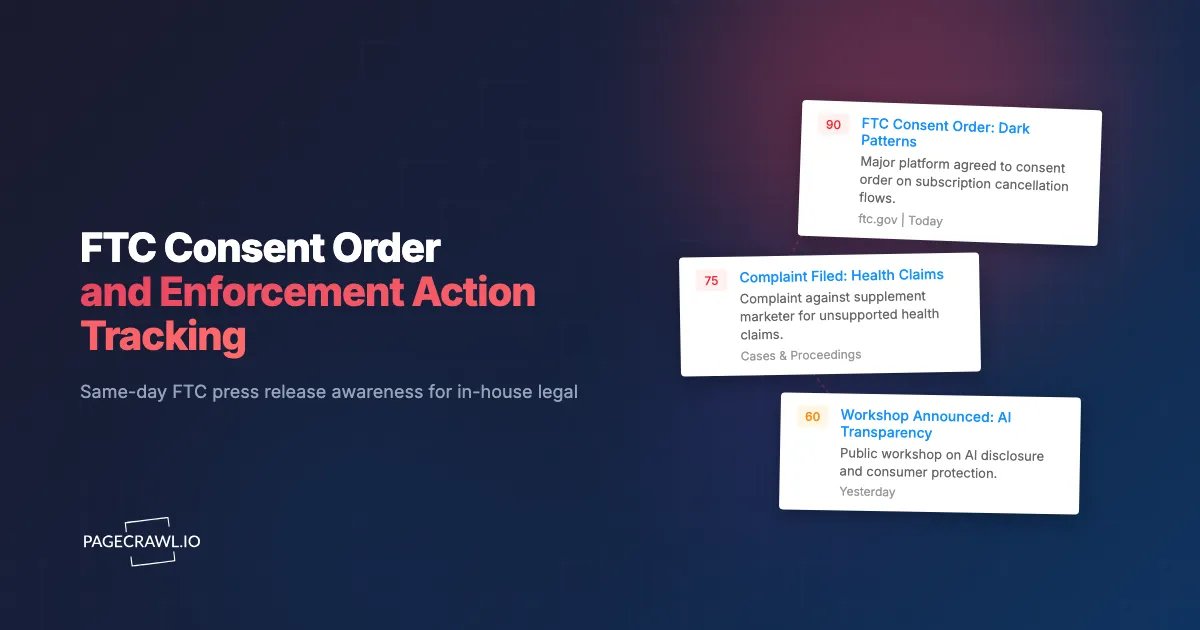
When the FTC announced its consent order against an ed-tech company over deceptive endorsement practices, the press release landed at 10:30am Eastern on a Wednesday. By noon, the trade press had stories up. By 5pm, in-house legal teams across the ed-tech sector were fielding board questions about whether their own endorsement practices were exposed. The teams that had FTC monitoring in place sent same-day briefings up the chain. The teams that did not learned about the action from their CEO forwarding a news article and asking why they had not flagged it.
The FTC's enforcement actions set the practical template for consumer protection, advertising, privacy, AI, and antitrust standards across most consumer-facing industries. New consent orders and complaints, paired with detailed press releases, establish how the agency interprets statutes in real cases. The orders themselves often contain multi-year compliance obligations that competitors adopt defensively to avoid being the next target. For in-house counsel, marketers, and product teams, same-day awareness of FTC actions in adjacent industries is often the earliest practical warning of enforcement risk.
This guide covers how the FTC publishes enforcement, the patterns worth watching for, and how to set up a continuous monitor that surfaces every new press release, consent order, and complaint into your legal channel the day it posts.
Quick Setup
Pick the topics you care about (privacy, dark patterns, antitrust, AI), choose a source page, and PageCrawl will alert your legal or compliance team within the hour of any new FTC press release or consent order.
Why should you monitor FTC enforcement actions?
Because FTC enforcement defines the practical boundary of acceptable practice across most consumer-facing industries, and the obligations in one company's consent order become the de facto standard for its competitors. Continuous monitoring turns enforcement into an early-warning input rather than an after-the-fact news consumption problem.
Consent Orders Establish Multi-Year Compliance Templates
Consent orders typically impose 20-year compliance obligations including third-party audits, certification requirements, recordkeeping mandates, and ongoing reporting. These templates spread quickly across industries as competitors adopt them defensively. Catching the template the day it lands lets your team begin defensive adaptation immediately.
Complaints Signal Where Enforcement Is Heading
Each new FTC complaint signals an enforcement priority. Pattern recognition across complaints (sectors, conduct types, statutory theories) reveals where the agency is investing investigative resources, often months before broader rulemaking or guidance.
Workshops and Policy Statements Preview Future Focus
The FTC holds workshops and publishes policy statements that preview enforcement directions before they materialize in actions. These are highest-signal documents for predicting where the next consent orders will come from.
Rulemaking Notices Create Comment Windows
The FTC's rulemaking process includes notice-and-comment windows that affect final rule scope, so the rulemaking page belongs in the same regulatory filing monitoring set as the enforcement pages. Proposed rules and their comment deadlines are published in the Federal Register, and catching the notice the day it publishes maximizes time for substantive comment preparation.
Where does the FTC publish enforcement actions?
On its own site, in two canonical places: the FTC press release feed, which is the first public surface for a new action, and the cases and proceedings library, which holds complaints, orders, and filing documents. The Business Blog is a useful third surface for practical commentary.
https://www.ftc.gov/news-events/news/press-releases
https://www.ftc.gov/legal-library/browse/cases-proceedings
https://www.ftc.gov/news-events/blogs/business-blog
The press release page is the canonical first-publish surface. New releases appear within minutes of internal distribution. The cases page is the structured database of active and recent cases with filing documents and order text. The Business Blog publishes more accessible commentary that often signals enforcement priorities for marketers and product teams.
Which FTC monitoring approach is right for your team?
It depends on how much of the agency you need to see and how fast. Manual checking and the FTC's own email subscriptions are free but coarse, legal research subscriptions are comprehensive but expensive, and page monitoring sits in between: you choose the exact URLs and the check frequency.
| Approach | Cost | Latency | Coverage | Best For |
|---|---|---|---|---|
| Manual FTC checking | Free | Days | Per-page | Casual awareness |
| FTC email subscriptions | Free | Hours | Selectable topics | Light coverage |
| Bloomberg Law / Law360 | $$$ | Hours | Comprehensive | Large firms |
| Politico Pro / Capitol Forum | $$$ | Hours | Policy-focused | Government affairs teams |
| PageCrawl on FTC pages | Free tier to $80/year | 60 minutes | Any FTC URL | In-house legal and mid-market firms |
For in-house legal teams, FTC monitoring is one of the highest-value-per-dollar applications of page monitoring. The cost is trivial compared to even one billable hour of outside counsel research time.
Setting Up FTC Monitoring in PageCrawl

Step 1: Add the FTC press releases page
Sign in to PageCrawl, click Track New Page, and paste https://www.ftc.gov/news-events/news/press-releases. Use content monitoring so new releases appear as detected changes.
Step 2: Add the cases and proceedings page
Add https://www.ftc.gov/legal-library/browse/cases-proceedings for the structured filing data.
Step 3: Add the Business Blog
The FTC Business Blog publishes practical commentary for marketers and product teams. Add it as a sibling for context.
Step 4: Pick a check frequency
FTC publishes during business hours. Reasonable defaults:
- Awareness only: Daily checks for general legal coverage.
- Active policy team: 60-minute checks for same-business-hour awareness.
- High-exposure sector: 15-minute checks for the fastest turnaround on high-priority topics.
Step 5: Wire alerts to legal and marketing channels
Route to a #ftc-watch Slack or Teams channel. For marketing teams, a parallel #marketing-compliance channel with the same alerts ensures advertising review gets the signal too. See the email alerts guide, the Slack alerts guide, and the help article on sending change notifications to a Slack channel for setup walkthroughs.
Step 6: Tag by topic
Use PageCrawl folders to organize by topic: privacy, advertising, antitrust, dark patterns, AI, health claims. Each topic owner subscribes only to relevant folders. The guide to organizing monitored pages with labels, folders, and workspaces covers how to structure this for a multi-team legal function.
Worked Example: A Consumer SaaS Company's FTC Watch
A mid-sized consumer SaaS company with privacy, marketing, and product compliance concerns typically sets up:
- Add FTC press releases, cases & proceedings, and Business Blog (3 monitors).
- Add specific topic-page indices if available (privacy, advertising) (2 monitors).
- Add the FTC's rulemaking page for active rulemakings (1 monitor).
- Add open Commission meeting agenda page (1 monitor).
- Set frequency to 60 minutes on press releases, daily on others.
- Route alerts to
#legal-alertsSlack channel with topic-specific sub-routing.
Total: 7 monitors. Total cost: $80/year on Standard, or free if limited to the most critical pages. Setup time: 15 minutes.
Patterns Worth Watching For
Consent orders in adjacent industries. When an FTC consent order lands in an adjacent industry, the obligations often spread across competitive sets defensively. Tracking adjacent-sector consent orders is one of the best early-warning signals available.
Common allegations across multiple cases. When the FTC brings several similar cases in succession, the agency is establishing a pattern. Worth flagging for senior review.
Civil penalty orders. Civil penalty orders signal that the FTC views the underlying conduct as egregious or pretextual. These are the strongest warnings.
Withdrawn settlements. When a settlement is withdrawn or modified, the underlying dispute is unresolved and the case may proceed to litigation. Watch the docket.
Commissioner statements. Individual Commissioner statements on cases often signal future enforcement direction, especially when Commissioners disagree.
Combining FTC Monitoring With Other Compliance Signals
FTC enforcement is most actionable in the context of broader compliance monitoring.
Combine with state AG enforcement. Pair with our state AG enforcement tracking guide. State AGs and the FTC often coordinate or echo each other on consumer protection, and both feed the same court docket and enforcement monitoring workflow.
Combine with sanctions monitoring. Pair with our OFAC and EU sanctions list change alerts guide for broader regulatory coverage.
Combine with FCC enforcement. Pair with our FCC filing and spectrum auction monitoring guide. Cross-agency telecom and consumer protection sometimes intersect.
Combine with HHS OIG enforcement. Add HHS OIG fraud and abuse enforcement pages for health-adjacent businesses.
Combine with industry trade press. Add Adweek, Marketing Brew, PR Newswire and Business Wire feeds, or industry-specific trade publications as siblings for context.
Use Cases
In-house legal teams. Same-day awareness of FTC actions supports proactive policy review, marketing review, and product change decisions. Most legal teams find the cost recovers itself the first time the team gets ahead of an enforcement-relevant question. Always confirm the operative text of an order or complaint on the official FTC page; this article is informational, not legal advice.
Marketing and advertising teams. Recent consent orders inform claim substantiation requirements and copy review standards. Marketing legal review benefits enormously from being current on FTC enforcement specifics.
Privacy and AI policy teams. FTC privacy and AI actions are a primary US enforcement signal. Continuous monitoring is essentially a job requirement for in-house privacy counsel.
Compliance training. Recent enforcement examples ground compliance training in current standards rather than historical patterns.
Outside counsel. Continuous FTC monitoring supports proactive client advisories, differentiating firms competing on responsiveness.
Trade associations. Industry associations monitor FTC actions to issue member alerts and coordinate industry response on rulemaking.
Frequently Asked Questions
How quickly do FTC press releases appear after announcement? Within minutes of internal distribution. The press page is the canonical first-publish surface.
Can I monitor only specific topics? PageCrawl alerts on every change to the monitored page. Most teams use AI summaries to triage by topic in the receiving channel.
What about Commission meeting transcripts? Open Commission meeting transcripts and agendas are published on a separate page. Add it as a sibling for full coverage.
Can I monitor specific docket pages for major cases? Yes. Each major case has a dedicated case page on the FTC site. Monitor specific cases you are tracking for filing updates.
Does the FTC publish on weekends? Generally no. Press releases and orders publish during business hours Eastern, with very rare weekend publication.
Do I need a paid plan for FTC monitoring? The free plan supports 6 monitors, enough for the core press and cases pages. Standard at $80/year supports a broader watch including state AG monitoring and adjacent agency pages.
Choosing your PageCrawl plan
PageCrawl's Free plan lets you monitor 6 pages with 220 checks per month, which is enough to validate the approach on your most critical pages. Most teams graduate to a paid plan once they see the value.
| Plan | Price | Pages | Checks / month | Frequency |
|---|---|---|---|---|
| Free | $0 | 6 | 220 | every 60 min |
| Standard | $8/mo or $80/yr | 100 | 15,000 | every 15 min |
| Enterprise | $30/mo or $300/yr | 500 | 100,000 | every 5 min |
| Ultimate | $99/mo or $999/yr | 1,000 | 100,000 | every 2 min |
Annual billing saves two months across every paid tier. Enterprise and Ultimate scale up to 100x if you need thousands of pages or multi-team access.
Compliance monitoring is the cheapest insurance you can buy. A single missed regulatory change can trigger fines in the tens or hundreds of thousands, not to mention the audit overhead of proving you did not see it coming. Enterprise at $300/year covers 500 regulatory pages with unlimited history and timestamped screenshots, which is usually exactly what an assessor wants to see. All plans include the PageCrawl MCP Server, so your compliance team can ask Claude to summarize every change to a specific regulation over the last quarter and pull the exact diff, turning your monitoring history into a queryable audit trail. AI assistants can create monitors through conversation on every plan, including Free. Standard at $80/year is enough to cover 100 pages across your primary regulatory bodies if your program is smaller.
How do you start tracking FTC consent orders today?
Add the FTC press releases and cases pages to PageCrawl on a daily check, route them to your legal channel, and tag them by topic. Create a free account and the next FTC enforcement action will arrive in your legal channel on the check that detects it, the same day it posts.