A 200-bed community hospital pharmacy noticed something off on a Monday morning. Their wholesaler had partially short-shipped one of their core IV antibiotics over the weekend, and the substitute they normally fell back on was also unavailable. They went to the FDA Drug Shortages database and discovered both drugs had been added to the active shortage list the previous Thursday and Friday. Three days of clinical operations had passed without the pharmacy having any notice. The therapeutic substitutions they eventually made required pharmacist-to-prescriber outreach for 47 patients, all of which could have happened earlier with same-day shortage awareness.
The FDA Drug Shortages database is the canonical US source for active shortages of human drugs, listing each shortage with its reason, estimated resolution, and affected presentations. Hospitals, retail pharmacies, GPOs, drug manufacturers, and specialty pharmacies all rely on this list. The problem is that the FDA does not push notifications. The list updates continuously throughout business hours and you have to come back to discover the changes, or build something to watch for you.
This guide covers how the FDA Drug Shortages database works, the patterns worth watching for, and how to set up a continuous monitor that surfaces every shortage addition, resolution, and status change into your pharmacy channel the day it lands.
Quick Setup
Enter a specific drug name or pick a clinical area below. PageCrawl will monitor the FDA shortage database and alert your pharmacy team when status changes.
Why should pharmacies monitor the FDA drug shortage list?
Because the FDA never pushes a notice: shortages, resolutions, and status changes land on the database silently, and a pharmacy that checks weekly can run days behind its own supply. Same-day awareness gives you time for substitution planning, prescriber outreach, and procurement adjustments before shelves run dry.
New Shortages Disrupt Formulary Planning Immediately
When a drug is added to the shortage list, every hospital and pharmacy using that drug needs to evaluate substitution. The earlier the awareness, the better the substitution decision and the more time for prescriber communication.
Resolution Notices Allow Procurement to Resume Normal Ordering
When a shortage resolves, procurement teams can return to standard ordering patterns. Catching the resolution same-day avoids continued workarounds and unnecessary substitute purchasing.
Status Changes Affect Rationing Decisions
The FDA distinguishes between "currently in shortage" and other status indicators that signal supply tightness without confirmed shortage. Status transitions matter for rationing decisions and inventory positioning.
Discontinuations Are Permanent and Require Long-Term Substitution
Discontinuation notices, often paired with shortage entries, signal that a drug will not return. These require permanent formulary substitution and patient transition planning rather than temporary workaround.
How does the FDA Drug Shortages database work?
It is a searchable, continuously updated register of active shortages of human drugs, published by the FDA and browsable without an account. Each entry carries a drug name, shortage reason, estimated resolution date, and affected presentations, and the list changes as entries are added, revised, or resolved. The database has a search and browse interface at:
https://www.accessdata.fda.gov/scripts/drugshortages/Each shortage has a detail page with the drug name, reason for shortage, estimated resolution date, affected presentations, and related information. The main page lists all active shortages and updates when entries are added, resolved, or modified.
The ASHP Drug Shortages list is a parallel resource maintained by the American Society of Health-System Pharmacists, often with deeper clinical management guidance. Monitor both for complete coverage. Always confirm shortage status and substitution options on the official FDA and ASHP pages before acting; this article is informational, not clinical advice.
Comparing Monitoring Approaches
| Approach | Cost | Latency | Coverage | Best For |
|---|---|---|---|---|
| Manual FDA checks | Free | Days | Per-drug | Casual checking |
| FDA email subscription | Free | Hours to daily | Inconsistent | Light awareness |
| ASHP digest | Free | Daily | Clinical context | Pharmacist information |
| Wolters Kluwer Lexicomp | $$$ | Variable | Comprehensive | Large hospital systems |
| Vizient supply chain alerts | $$$ | Variable | Member-only | Vizient members |
| PageCrawl on FDA URLs | Free tier to $80/year | Daily | Any FDA page | Pharmacies wanting reliable same-day alerts |
For mid-sized hospitals, community pharmacies, and specialty pharmacies, PageCrawl provides the core "alert me on shortage changes" capability at a fraction of the cost of enterprise pharmacy informatics platforms.
Setting Up Drug Shortage Monitoring in PageCrawl

Step 1: Add the FDA Drug Shortages search page
Sign in to PageCrawl, click Track New Page, and paste https://www.accessdata.fda.gov/scripts/drugshortages/. Use content monitoring so the shortage list is tracked.
Step 2: Monitor specific drug detail pages for your top formulary items
For drugs you actively dispense or use, monitor the specific FDA shortage detail page. The detail page changes when status, reason, or resolution date updates.
Step 3: Add the ASHP shortages list as a parallel monitor
ASHP provides clinical context and substitution guidance. Add the ASHP shortages list page as a sibling for clinical decision support.
Step 4: Pick a check frequency
Shortage updates are not minute-sensitive. Daily checks support same-day procurement and clinical adjustment.
- Awareness only: Daily checks for general pharmacy operations.
- Critical-drug focus: 60-minute checks for high-impact formulary items.
- Large hospital system: 15-minute checks on the main FDA page for fastest awareness.
Step 5: Wire alerts to pharmacy channel
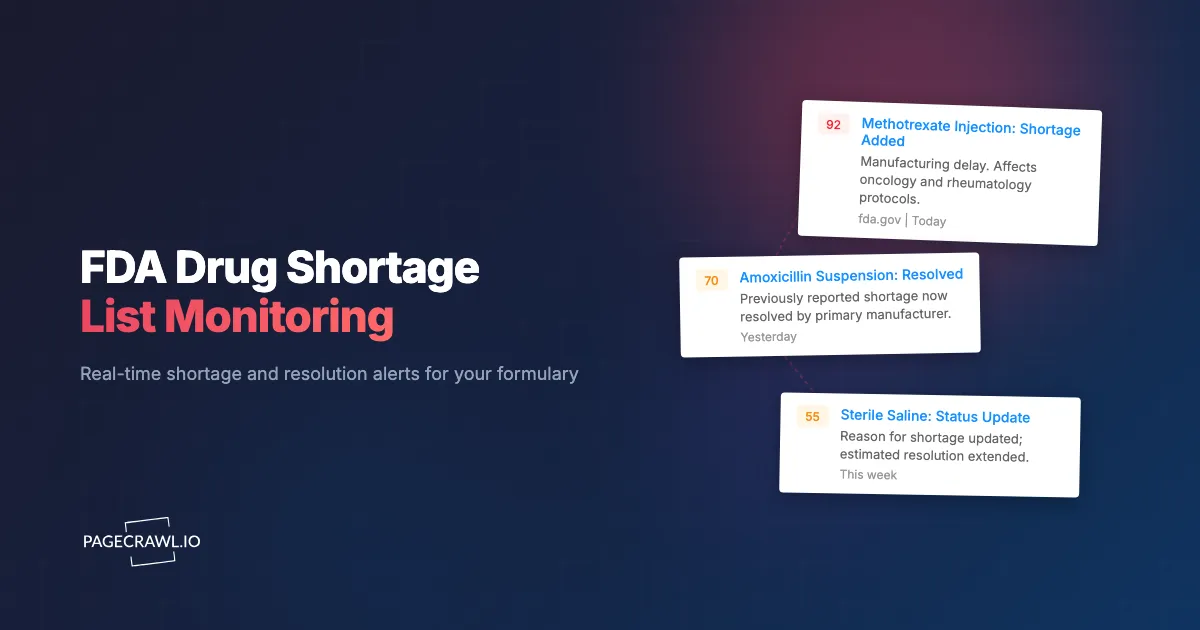
Route to a #pharmacy-alerts Teams or Slack channel. Each alert goes out as soon as a check detects the change, so the delivery window matches the frequency you picked in Step 4. PageCrawl's AI change summaries describe the drug and status change so pharmacists can triage quickly. See the Teams alerts guide and the help centre walkthrough on sending change notifications to a Microsoft Teams channel for setup.
Step 6: Tag by clinical area
Use PageCrawl folders to organize monitors by clinical area: ICU, oncology, infectious disease, anesthesia. Each clinical service subscribes only to relevant alerts. The guide to organizing monitored pages with labels, folders, and workspaces covers how to structure this for a multi-service pharmacy.
Worked Example: A Mid-Sized Hospital Pharmacy's Shortage Watch
A 400-bed community hospital pharmacy typically sets up:
- Add the main FDA Drug Shortages page (1 monitor).
- Add the ASHP shortages list (1 monitor).
- Add specific detail pages for top 20 critical-formulary drugs (20 monitors).
- Set frequency to daily on detail pages, 60 minutes on main pages.
- Route alerts to
#pharmacy-shortage-watchTeams channel with clinical service tagging.
Total: 22 monitors. Total cost: $80/year. The pharmacy gets continuous awareness across critical drugs and the full shortage list with a single channel.
Patterns Worth Watching For
New shortages in critical formulary drugs. Highest priority. Same-day awareness drives immediate substitution planning.
Estimated resolution dates drifting forward. When the FDA pushes back a resolution date, the shortage is likely to last longer than expected. Worth flagging for extended substitution planning.
Reason transitions (manufacturing to demand). When a shortage reason changes from manufacturing problems to demand spike, the underlying supply tightness is structural and may signal broader market issues.
Multiple drugs from a single manufacturer. When several drugs from the same manufacturer enter shortage simultaneously, the underlying issue is plant-level and may affect more products.
Resolution notices. Catching resolution same-day allows procurement to resume standard ordering.
Combining Shortage Monitoring With Other Pharmacy Signals
Drug shortage monitoring is most actionable in the broader pharmacy intelligence context, sitting alongside other regulatory signals like FDA drug label and boxed warning changes.
Combine with FDA recall alerts. Pair with our FDA MAUDE and medical device recall alerts guide for cross-cutting safety and supply awareness.
Combine with EMA/MHRA monitoring. Pair with our EMA and MHRA drug approval monitoring guide for international supply context.
Combine with formulary plan changes. Pair with our health insurance marketplace plan and formulary monitoring guide for payer-side formulary visibility.
Combine with wholesaler allocation pages. Some wholesalers publish allocation status on member portals. Add these as siblings where accessible.
Combine with manufacturer back-order pages. Some manufacturers publish supply status on product-specific pages, which stock availability monitoring tracks the same way it tracks retail restocks. Worth monitoring for high-impact drugs.
Use Cases
Hospital pharmacy. Same-day shortage awareness supports formulary substitution and patient care continuity. Most pharmacies find the cost recovers itself the first time the team gets ahead of a shortage by even a day.
GPO procurement. Same-day alerts inform allocation, contracting, and member communication. GPO members rely on timely shortage information for purchasing decisions.
Pharmaceutical manufacturers. Competitor shortages flag market opportunities for substitute products. Manufacturer commercial teams use shortage monitoring as a competitive intelligence input.
Specialty pharmacy. Patient-specific shortage alerts support proactive outreach for patients on chronic therapy. Specialty pharmacies often have closer patient relationships and benefit from same-day awareness.
Drug supply chain consultants. Continuous shortage monitoring is foundational to supply chain advisory work in healthcare.
Health system supply chain. Multi-hospital systems aggregate shortage monitoring across facilities for system-wide awareness and coordinated response, which extends naturally into supplier and supply chain monitoring across the wholesalers and manufacturers behind each product.
Frequently Asked Questions
How quickly do new shortages appear on the FDA page? Within hours of manufacturer reporting. The FDA updates the database multiple times per day during business hours, and its drug shortages program page explains how manufacturers report supply interruptions.
Can I monitor a specific drug detail page? Yes. Each shortage has a stable detail URL. Monitor specific drug pages for your top formulary items.
What about the ASHP list? ASHP maintains a parallel list with clinical management context. Many pharmacists prefer the ASHP list for clinical decision support. Monitor both.
Does the FDA publish on weekends? Generally no. Most updates happen during business hours Eastern.
Can I get alerts only for specific drug classes? PageCrawl alerts on every change. AI summaries identify the drug so you can filter by class in your channel.
Do I need a paid plan for shortage monitoring? The free plan supports 6 monitors, enough for the main FDA page plus a handful of critical drugs. Standard at $80/year supports a full formulary watch.
Choosing your PageCrawl plan
PageCrawl's Free plan lets you monitor 6 pages with 220 checks per month, which is enough to validate the approach on your most critical pages. Most teams graduate to a paid plan once they see the value.
| Plan | Price | Pages | Checks / month | Frequency |
|---|---|---|---|---|
| Free | $0 | 6 | 220 | every 60 min |
| Standard | $8/mo or $80/yr | 100 | 15,000 | every 15 min |
| Enterprise | $30/mo or $300/yr | 500 | 100,000 | every 5 min |
| Ultimate | $99/mo or $999/yr | 1,000 | 100,000 | every 2 min |
Annual billing saves two months across every paid tier. Enterprise and Ultimate scale up to 100x if you need thousands of pages or multi-team access.
Compliance monitoring is the cheapest insurance you can buy. A single missed regulatory change can trigger fines in the tens or hundreds of thousands, not to mention the audit overhead of proving you did not see it coming. Enterprise at $300/year covers 500 regulatory pages with unlimited history and timestamped screenshots, which is usually exactly what an assessor wants to see. All plans include the PageCrawl MCP Server, so your compliance team can ask Claude to summarize every change to a specific regulation over the last quarter and pull the exact diff, turning your monitoring history into a queryable audit trail. AI assistants can create monitors through conversation on every plan, including Free. Standard at $80/year is enough to cover 100 pages across your primary regulatory bodies if your program is smaller.
Getting Started
Add the FDA Drug Shortages search page and the detail pages for your top formulary drugs to PageCrawl on a daily check. Create a free account and the next shortage change will arrive in your pharmacy channel the day it lands.