A specialty pharmacy serving patients with chronic inflammatory conditions discovered on a Wednesday that one of their largest payers had moved a key biologic from tier 3 to tier 4 with a new prior authorisation requirement, effective the first of the following month. The pharmacy's account team scrambled to identify all 240 affected patients, contact prescribers for PA documentation, and coordinate transitions with the manufacturer's patient assistance program. The formulary update had actually been published on the insurer's site three weeks earlier. The pharmacy found out only when the first PA rejection came back. Three weeks of preparation time had been available, and lost.
Health insurers update plan details, formularies, and provider networks on a continuous schedule throughout the year, not just at open enrollment. For benefits consultants, brokers, employer benefits teams, patient advocacy organizations, and specialty pharmacies, knowing when an insurer changes coverage or moves a drug between tiers is operationally important. The insurers do not push notifications to outside parties when these changes happen. The formulary PDFs and HTML pages update silently, and downstream stakeholders find out through rejected claims, member complaints, or trade press summaries days or weeks later.
This guide covers how insurer plan and formulary pages publish updates, the patterns worth watching for, and how to set up a continuous monitor that surfaces every material formulary, network, and benefit change into your benefits channel the week it posts.
Quick Setup
Pick an insurer and the drug classes you cover, and PageCrawl will watch the formulary page for tier changes, prior-auth additions, and product removals.
Why should you monitor plan and formulary pages?
Because plan details directly affect patient access, prescription cost, and employer renewal economics, and insurers publish those changes without notifying outside parties. Continuous compliance and policy page monitoring turns a silent tier move, prior authorisation addition, or network termination into an actionable signal the week it posts, instead of a rejected claim weeks later.
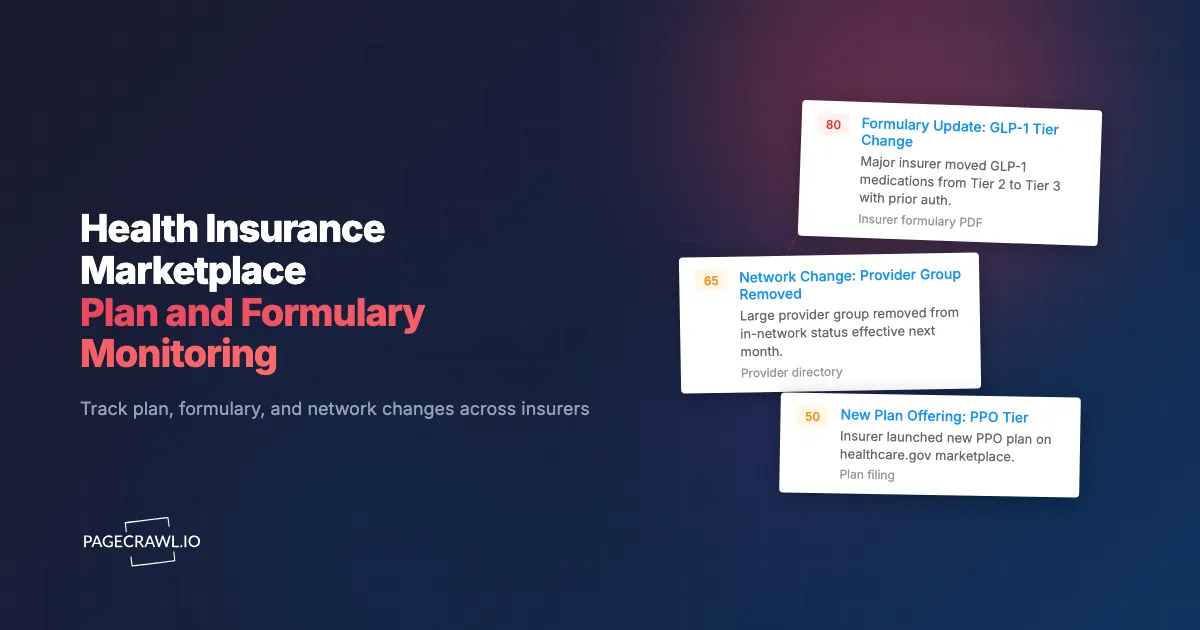
Formulary Changes Can Move Drugs to Higher Tiers or Remove Them
Tier movements (especially to non-preferred or specialty tiers) significantly change member out-of-pocket cost. Removals require formal step therapy or prior authorisation. Same-week awareness allows pharmacies, prescribers, and patients to prepare.
Network Changes Can Drop Providers Patients Depend On
Provider network terminations affect continuity of care, particularly for patients with established specialist relationships. Same-week awareness allows benefits teams to communicate proactively and assist with provider transitions.
Premium and Cost-Share Updates Affect Renewal and Open Enrollment
For employer benefits teams and brokers, plan-side premium and cost-share changes feed directly into renewal modelling and open enrollment communications. Same-week awareness gives benefit advisors time to prepare member-facing materials.
New Plan Offerings Create Alternative Options
When insurers add new plan designs or product offerings, brokers and consultants gain alternatives to recommend. Continuous monitoring keeps the advisor's recommended-plan list current.
How do insurer plan and formulary pages publish updates?
Insurers publish formularies as PDFs or HTML pages, typically updated quarterly with mid-cycle revisions for material changes. There is no push notification to outside parties: the document is replaced or a notice is added, and you only see it if you are watching the page. The formulary index pages list current documents and historical versions:
https://www.{insurer}.com/.../formulary
https://www.healthcare.gov/see-plans/
Provider directory pages often expose searchable network status by specialty and region. Plan detail pages on healthcare.gov and state government marketplaces publish member-facing benefit summaries, and the Centers for Medicare & Medicaid Services publishes the marketplace rules those pages have to follow.
Many insurers publish formulary update notices on a separate communications or pharmacy update page, which is often the highest-signal page to monitor. Add the update notices page in addition to the formulary index.
Comparing Monitoring Approaches
| Approach | Cost | Latency | Coverage | Best For |
|---|---|---|---|---|
| Manual insurer checks | Free | Days to weeks | Per-page | Casual checking |
| Insurer email subscriptions | Free | Inconsistent | Per-insurer | Limited reliability |
| Managed care intelligence platforms | $K+/year | Hours | Comprehensive | Large pharma market access |
| PBM consultant updates | $$$ | Variable | PBM-focused | Plan sponsors |
| PageCrawl on insurer URLs | Free tier to $80/year | Weekly | Any insurer page | Pharmacies, brokers, patient advocacy |
PageCrawl gives mid-sized stakeholders the core "alert me on coverage changes" capability without enterprise-tier market access intelligence pricing.
Setting Up Plan and Formulary Monitoring in PageCrawl

Step 1: Add insurer formulary index pages
Sign in to PageCrawl, click Track New Page, and paste each major insurer formulary index URL. New formulary documents appear as new links.
Step 2: Add formulary update notices pages
Many insurers publish update notices on a dedicated page. Add these for the highest-signal awareness of material changes.
Step 3: Add provider directory pages for specific specialty or region
For benefits teams concerned about specific provider categories (oncology, mental health, primary care), add the relevant directory search pages.
Step 4: Add healthcare.gov plan landing pages
For ACA marketplace plans, monitor the plan detail pages for material updates.
Step 5: Pick a check frequency
Plan updates are not minute-sensitive. Weekly checks support timely member communication.
- Awareness only: Weekly checks for general benefits oversight.
- Specialty pharmacy / patient advocacy: Daily checks on formulary update pages for fastest awareness.
- Active plan migration period: 60-minute checks during open enrollment.
Step 6: Wire alerts to benefits or pharmacy channel
Route to a #benefits-watch or #formulary-alerts Slack or Microsoft Teams channel. PageCrawl's AI change summaries describe the update in one line for triage.
Worked Example: A Mid-Sized Specialty Pharmacy's Formulary Watch
A specialty pharmacy serving multiple chronic disease populations typically sets up:
- Add formulary index pages for top 10 payers (10 monitors).
- Add formulary update notices pages for top 5 payers (5 monitors).
- Add specific drug class formulary pages where insurers expose drug-class views (5 monitors).
- Set frequency to daily on update notices, weekly on formulary index.
- Route alerts to
#formulary-watchTeams channel with payer-specific tagging.
Total: 20 monitors. Total cost: $80/year. The pharmacy gets continuous awareness across major payers with a single channel.
Patterns Worth Watching For
Tier movements for high-utilization drugs. Moves from preferred to non-preferred or specialty tiers significantly change member cost. Highest-priority alerts.
New prior authorisation requirements. PA additions create administrative burden and access delay. Same-week awareness allows pharmacy and prescriber prep.
Drug removals from formulary. Removals require step therapy alternatives or non-formulary exception processes. Patient transition planning is essential.
Network terminations of major provider groups. Network changes affecting health systems or large specialist groups create significant access disruption.
New plan designs at open enrollment. New product launches reveal insurer strategy and broker recommendation opportunities.
Combining Plan Monitoring With Other Healthcare Signals
Plan and formulary monitoring is most actionable in the broader healthcare context.
Combine with drug shortage monitoring. Pair with our FDA drug shortage list monitoring guide for cross-cutting supply and coverage awareness.
Combine with EMA/MHRA monitoring. Pair with our EMA and MHRA drug approval monitoring guide for international regulatory context affecting US formulary decisions.
Combine with FDA medical device monitoring. Pair with our FDA MAUDE and medical device recall alerts guide for combination product context.
Combine with PBM update pages. Express Scripts, CVS Caremark, and Optum publish PBM-specific updates that often precede plan-level formulary changes.
Combine with manufacturer copay assistance pages. Manufacturer patient support programs change in response to formulary moves. Monitor for support program updates.
Who needs formulary and plan change alerts?
Anyone downstream of a payer decision: benefits consultants and brokers, specialty pharmacies, patient advocacy organizations, employer HR teams, pharmaceutical market access teams, and health system pharmacies. They all learn about coverage changes through rejected claims or member complaints unless something is watching the payer's own pages.
Benefits consultants and brokers. Same-week plan change awareness supports renewal modelling, client communication, and proactive plan recommendation.
Specialty pharmacy. Formulary tier changes affect prior authorisation and patient cost. Same-week awareness allows proactive PA prep and patient outreach.
Patient advocacy organizations. Formulary changes affect access for chronic disease patients. Continuous monitoring supports advocacy response and member alerts.
Employer HR and benefits teams. Network and formulary changes drive member communications during the plan year. Same-week awareness allows proactive HR messaging.
Pharmaceutical market access. Manufacturer market access teams monitor formulary positioning as a primary commercial input.
Health system pharmacy. Hospital outpatient pharmacies need awareness of commercial and Medicare and Medicaid formulary changes for patient discharge medication planning.
Frequently Asked Questions
How often do insurers update formularies? Formularies typically update quarterly with mid-cycle revisions for material changes. Many insurers publish update notices on dedicated communication pages.
Can PageCrawl monitor PDF formularies? Yes. PageCrawl tracks text changes inside PDF files, so you can point a monitor at the formulary PDF itself. Where the insurer publishes a new file each quarter under a new URL, also monitor the HTML index page so you catch each new version as it posts.
What about provider directory changes? Most insurer directories expose searchable pages with filter URLs. Monitor specific specialty or region pages for network changes.
Can I monitor state marketplace plans? Yes. Both healthcare.gov and state marketplaces expose plan pages at stable URLs that can be monitored.
Do I need a paid plan for formulary monitoring? The free plan supports 6 monitors, enough for the top 2-3 payers. Standard at $80/year supports a full multi-payer watch.
Can I get alerts only for specific drug classes? PageCrawl alerts on every change. AI summaries describe the update so you can filter by drug class in your channel.
Choosing your PageCrawl plan
PageCrawl's Free plan lets you monitor 6 pages with 220 checks per month, which is enough to validate the approach on your most critical pages. Most teams graduate to a paid plan once they see the value.
| Plan | Price | Pages | Checks / month | Frequency |
|---|---|---|---|---|
| Free | $0 | 6 | 220 | every 60 min |
| Standard | $8/mo or $80/yr | 100 | 15,000 | every 15 min |
| Enterprise | $30/mo or $300/yr | 500 | 100,000 | every 5 min |
| Ultimate | $99/mo or $999/yr | 1,000 | 100,000 | every 2 min |
Annual billing saves two months across every paid tier. Enterprise and Ultimate scale up to 100x if you need thousands of pages or multi-team access.
Compliance monitoring is the cheapest insurance you can buy. A single missed regulatory change can trigger fines in the tens or hundreds of thousands, not to mention the audit overhead of proving you did not see it coming. Enterprise at $300/year covers 500 regulatory pages with unlimited history and timestamped screenshots, which is usually exactly what an assessor wants to see. All plans include the PageCrawl MCP Server, so your compliance team can ask Claude to summarize every change to a specific regulation over the last quarter and pull the exact diff, turning your monitoring history into a queryable audit trail. AI assistants can create monitors through conversation on every plan, including Free. Standard at $80/year is enough to cover 100 pages across your primary regulatory bodies if your program is smaller.
Getting Started
Add the insurer formulary index pages and key plan detail pages to PageCrawl on a weekly check. Create a free account and the next formulary or network change will arrive in your channel the week it posts. Coverage details are plan-specific, so always confirm tier, prior authorisation, and network status in the insurer's official plan documents; this article is informational and not medical or benefits advice.