When the European Medicines Agency's CHMP issued a positive opinion on a novel oncology agent in late 2023, the announcement appeared on the EMA news page on a Friday morning Brussels time. Within hours, generics teams across Europe had updated their patent challenge timelines, originator commercial teams had revised launch sequencing, and market access teams in pricing-restricted markets had started pricing prep for the eventual EC decision two months later. Companies relying on weekly trade press summaries learned about the opinion three or four days later, by which point the competitive landscape had already shifted.
The European Medicines Agency and the UK Medicines and Healthcare products Regulatory Agency publish drug approvals, safety notices, and committee decisions on a continuous schedule that runs partially independent of FDA cycles. For pharmaceutical companies, generics manufacturers, distributors, market access teams, and clinical research organizations operating in European markets, same-day awareness of EMA and MHRA actions affects launch coordination, supply, and competitive strategy. Post-Brexit, the MHRA runs its own timeline that often diverges from EMA in ways that matter for UK-specific market planning.
This guide covers how the EMA and MHRA publish decisions, the patterns worth watching for, and how to set up a continuous monitor that surfaces every CHMP opinion, marketing authorisation, and safety update into your regulatory channel the day it lands.
Quick Setup
Pick the authority (EMA, MHRA, or both), select your therapeutic areas, and PageCrawl will alert your regulatory team when new CHMP opinions, marketing authorisations, or safety updates land.
Why should you monitor EMA and MHRA decisions?
Monitor them because European decisions set launch, pricing, and supply timelines, and they often lead or lag FDA actions by weeks. A CHMP opinion gives roughly two months of warning before the formal authorisation, safety committee outcomes can force label changes, and the UK now decides separately from the EU.
CHMP Opinions Signal Upcoming Approvals Weeks Ahead
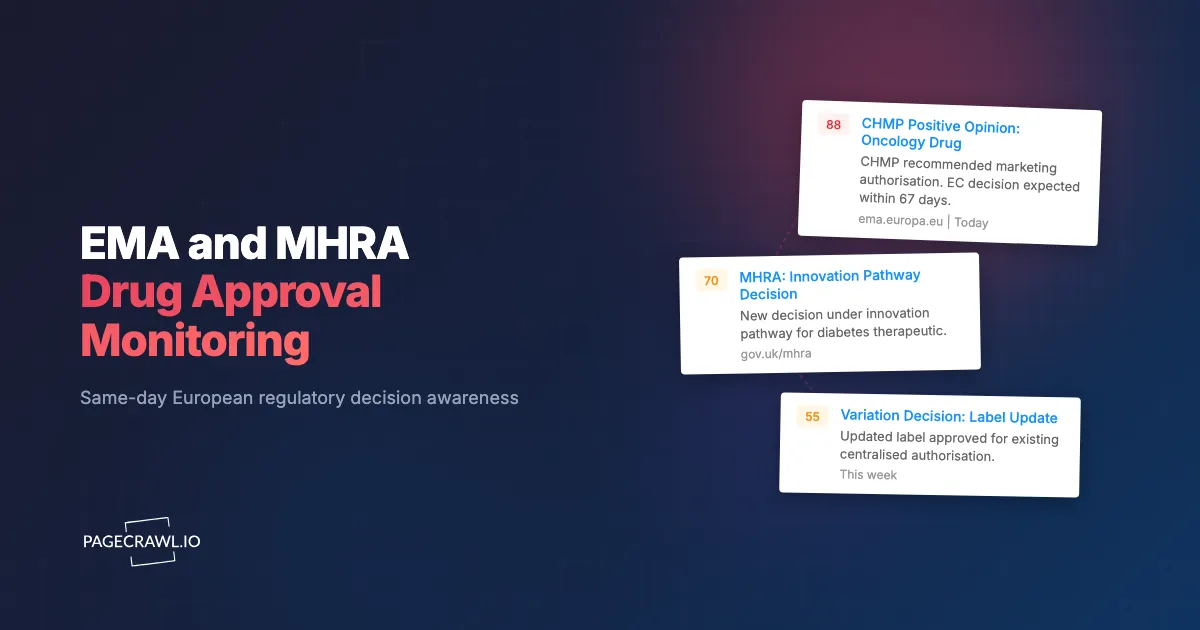
The European Medicines Agency's Committee for Medicinal Products for Human Use issues opinions that precede European Commission marketing authorisation decisions: under EU pharmaceutical legislation the Commission adopts its decision within 67 days of receiving the opinion, just over two months. CHMP positive opinions therefore give regulatory and commercial teams meaningful lead time on competitor approvals.
New Marketing Authorisations Affect Competitive Positioning
Final marketing authorisations from the EC and equivalent MHRA decisions are the trigger for launch preparation, pricing submission, and commercial activation. Same-day awareness allows competitive response teams to update positioning and messaging.
Safety Notices and Signal Assessments Affect Risk Management
PRAC (Pharmacovigilance Risk Assessment Committee) signal assessments and safety notices affect ongoing product risk management plans, sometimes requiring label updates or restricted indications.
MHRA Post-Brexit Decisions Run on Independent Timelines
Since Brexit, the MHRA operates as an independent regulator. Decisions on the UK market sometimes precede or lag EMA decisions in meaningful ways. The Innovative Licensing and Access Pathway (ILAP) and other MHRA-specific schemes create UK-specific opportunities worth tracking separately.
How do the EMA and MHRA publish their decisions?
Both publish first to their own news pages: the EMA posts agency announcements and CHMP plenary outcomes to its news feed, while the MHRA publishes UK decisions and safety updates through its gov.uk organisation page. Individual authorised medicines also have their own EMA page carrying status, variations, and assessment history.
The major public-facing pages for European regulatory monitoring are:
https://www.ema.europa.eu/en/news
https://www.gov.uk/government/organisations/medicines-and-healthcare-products-regulatory-agency
The EMA news page is the canonical first-publish surface for agency announcements, including CHMP opinion outcomes that are summarised there at the end of each monthly plenary. The MHRA page on gov.uk publishes UK decisions and safety updates.
Each authorised medicine also has a dedicated EMA medicine page with status, variations, and assessment history. Monitor specific medicine pages for variation decisions affecting indication, label, or dosing. Always confirm a decision on the official EMA or MHRA page before acting on it; this article is informational and not regulatory, legal, or medical advice.
Comparing Monitoring Approaches
| Approach | Cost | Latency | Coverage | Best For |
|---|---|---|---|---|
| Manual EMA/MHRA checks | Free | Days | Per-page | Casual checking |
| EMA email subscriptions | Free | Daily | Inconsistent | Light awareness |
| Citeline / Evaluate / Cortellis | $K+/year | Hours | Comprehensive analytics | Large pharma |
| RAPS / Regulatory Focus | Free / membership | Daily | Industry coverage | Regulatory professionals |
| PageCrawl on EMA/MHRA URLs | Free tier to $80/year | 60 minutes | Any agency page | Mid-sized pharma wanting reliable alerts |
The major pharma intelligence platforms offer rich analytics but at enterprise pricing. PageCrawl provides the core "alert me on relevant decisions" capability at a fraction of the cost for any EMA or MHRA URL.
Setting Up EMA and MHRA Monitoring in PageCrawl

Step 1: Add the EMA news page
Sign in to PageCrawl, click Track New Page, and paste https://www.ema.europa.eu/en/news. New announcements appear as new entries.
Step 2: Add the CHMP meetings highlights page
Add the EMA news page filtered to CHMP outcomes for monthly opinion summaries.
Step 3: Add the MHRA news page
Add the MHRA news page at gov.uk for UK-specific decisions.
Step 4: Add product-specific medicine pages
For drugs you manufacture, compete with, or have material market access exposure to, monitor the EMA medicine page for status and variation changes.
Step 5: Pick a check frequency
European agency publications happen during European business hours. Reasonable defaults:
- Awareness only: Daily checks for general regulatory coverage.
- Active regulatory team: 60-minute checks for same-business-hour awareness.
- Launch-critical product: 15-minute checks during decision windows.
Step 6: Wire alerts to regulatory channel
Route to a #regulatory-alerts Teams or Slack channel; the help centre walks through sending change notifications to a Microsoft Teams channel. PageCrawl's AI change summaries describe each decision in one line for triage, so the channel stays readable during heavy plenary weeks.
Worked Example: A Specialty Pharma Company's EMA/MHRA Watch
A specialty pharma company with five marketed products in Europe typically sets up:
- Add EMA news, CHMP meetings highlights, and MHRA news pages (3 monitors).
- Add specific medicine pages for own marketed products (5 monitors).
- Add specific medicine pages for top 10 competitor products (10 monitors).
- Add PRAC meeting highlights page for safety updates (1 monitor).
- Set frequency to 60 minutes on news pages, daily on medicine pages.
- Route alerts to
#eu-regulatory-watchTeams channel with product tagging.
Total: 19 monitors. Total cost: $80/year. The regulatory team gets continuous awareness across own products, competitors, and agency activity.
Which patterns are worth watching for?
Five patterns carry most of the signal: CHMP positive opinions for competitor products, variation decisions on your own products, PRAC signal assessment outcomes, suspensions and withdrawals, and MHRA ILAP decisions. Narrow the noise with notification conditions and keyword filters so only your therapeutic areas page the team.
CHMP positive opinions for competitive set products. Highest-signal alert for competitive intelligence on rival products and messaging. Drives commercial response planning.
Variation decisions on own products. Variation approvals (Type IA, IB, II) affect label, indication, and dosing. Monitor own product pages for these.
PRAC signal assessment outcomes. Safety signal assessments can result in label changes or restricted use. Monitor PRAC outcomes for own and competitor products.
Suspensions and withdrawals. Suspensions of competitor products create market opportunities. Withdrawals require permanent commercial response.
MHRA ILAP decisions. Innovative Licensing and Access Pathway decisions reveal UK-specific commercial opportunities for innovative products.
Combining EMA/MHRA Monitoring With Other Regulatory Signals
European regulatory monitoring is most actionable in the broader global regulatory context, alongside monitoring of other agency filing pages for new documents and status changes.
Combine with FDA drug shortage monitoring. Pair with our FDA drug shortage list monitoring guide for cross-Atlantic supply visibility.
Combine with FDA medical device monitoring. Pair with our FDA MAUDE and medical device recall alerts guide for combination product context.
Combine with EU and UK procurement. Pair with our UK Find a Tender and Contracts Finder monitoring guide for NHS and EU public market opportunities.
Combine with NICE and HAS health technology assessment pages. The UK's National Institute for Health and Care Excellence and France's Haute Autorité de Santé publish HTA decisions that follow regulatory approval and affect market access.
Combine with national competent authority pages. Member state agencies (BfArM, AIFA, AEMPS) publish national decisions that complement EMA centralised actions.
Use Cases
Pharmaceutical regulatory affairs. Same-day EMA and MHRA decision awareness supports competitive intelligence, labeling strategy, and variation planning. Regulatory teams find monitoring essential for European portfolio management.
Market access. Approval timing affects pricing preparation, P&R submission, and reimbursement strategy. Same-day awareness allows market access teams to prepare submissions in time.
Generics teams. Originator approval decisions inform generic launch planning and patent challenge timing. Continuous monitoring is operationally important for generics business development.
Clinical operations. Safety notices and PRAC signal assessments affect ongoing clinical trial conduct and protocol amendments.
Pharma business development. Approval landscape monitoring informs licensing and acquisition activity across the European market.
Pharma media and analysts. Specialist pharma publications and equity research analysts use continuous EMA/MHRA monitoring as a primary source.
Frequently Asked Questions
How quickly do CHMP opinions appear after the meeting? The meeting highlights page updates within hours of the CHMP plenary concluding, typically Friday afternoons of meeting weeks.
Can I monitor specific medicine pages? Yes. Each authorised medicine has a stable EMA URL. Variations and assessment history updates appear on the medicine page.
What about national competent authority decisions? Member state agencies publish national decisions on their own pages. Add specific NCA pages as siblings for full coverage.
Does MHRA still mirror EMA decisions post-Brexit? Sometimes, but the MHRA increasingly makes independent decisions on UK marketing authorisations. Monitor both separately.
Can I monitor PRAC and CHMP separately? Yes. Each committee has its own meeting highlights page. Add both for comprehensive committee monitoring.
Do I need a paid plan for EMA/MHRA monitoring? The free plan supports 6 monitors, enough for the core news pages plus a few medicines. Standard at $80/year supports a full European watch including competitors.
Choosing your PageCrawl plan
PageCrawl's Free plan lets you monitor 6 pages with 220 checks per month, which is enough to validate the approach on your most critical pages. Most teams graduate to a paid plan once they see the value.
| Plan | Price | Pages | Checks / month | Frequency |
|---|---|---|---|---|
| Free | $0 | 6 | 220 | every 60 min |
| Standard | $8/mo or $80/yr | 100 | 15,000 | every 15 min |
| Enterprise | $30/mo or $300/yr | 500 | 100,000 | every 5 min |
| Ultimate | $99/mo or $999/yr | 1,000 | 100,000 | every 2 min |
Annual billing saves two months across every paid tier. Enterprise and Ultimate scale up to 100x if you need thousands of pages or multi-team access.
Compliance monitoring is the cheapest insurance you can buy. A single missed regulatory change can trigger fines in the tens or hundreds of thousands, not to mention the audit overhead of proving you did not see it coming. Enterprise at $300/year covers 500 regulatory pages with unlimited history and timestamped screenshots, which is usually exactly what an assessor wants to see. All plans include the PageCrawl MCP Server, so your compliance team can ask Claude to summarize every change to a specific regulation over the last quarter and pull the exact diff, turning your monitoring history into a queryable audit trail. AI assistants can create monitors through conversation on every plan, including Free. Standard at $80/year is enough to cover 100 pages across your primary regulatory bodies if your program is smaller.
Getting Started
Add the EMA news and CHMP highlights pages plus the MHRA news page to PageCrawl on a daily check. Create a free account and the next European regulatory decision will arrive in your channel the day it posts.