A competitive intelligence lead at a mid-size biotech learned about a rival's Phase 3 readout from a banker, two days after the company quietly updated its pipeline page. By then the rival's stock had moved, sell-side analysts had published, and the company's own medical affairs team was fielding questions it could not answer. The information had been sitting in public the entire time, on a pipeline table the CI team checked manually once a quarter. The signal was there. Nobody was watching the page on the day it changed.
This is the recurring failure mode of pharma and biotech competitive intelligence. The signals that matter, a candidate advancing a phase, a trial status flipping to active, a label expanding to a new indication, a market-access page adding a payer restriction, all appear on public web pages first. They appear before the press release, before the conference, before the analyst note. The teams that see them first get days of lead time on positioning, messaging, and strategy. The teams that check quarterly get surprised.
This guide shows how to build that practice across five web sources: pipeline pages, trial registries, regulatory label and approval pages, conference abstracts, and market-access surfaces. For each, you will learn what to watch, how often, and how to turn raw page changes into intelligence your commercial and medical teams can act on.
Why does pharma competitive intelligence need its own playbook?
Pharma CI needs its own playbook because the competitive surface is regulated, scientific, and slow-moving in public but fast-moving at inflection points. Unlike SaaS, where pricing pages change weekly, a pharma competitor's pipeline page may sit unchanged for months and then shift in a single afternoon when a trial reads out. You cannot watch it by hand.
The value concentrates at a handful of binary events: a phase transition, a primary endpoint result, a regulatory decision, a label change, a reimbursement update. Each is preceded or accompanied by a change to a public web page. The window between the page changing and the market noticing is your entire competitive advantage, and it is often measured in hours.
That is why systematic web monitoring matters more in pharma than almost anywhere else. The general principles of building a competitive intelligence program still apply, including tiering competitors and distributing findings, but the sources are different and the cost of missing one event is far higher. A missed pricing change in SaaS costs you a deal; a missed Phase 3 readout in oncology costs you a quarter of strategic surprise.
What competitor sources should a pharma CI team monitor?
A pharma CI team should monitor five categories of public web source: competitor pipeline and R&D pages, public clinical trial registries, regulatory approval and label databases, scientific conference abstract listings, and market-access and pricing pages. Each carries a different class of signal, and together they cover the full lifecycle from preclinical asset to commercial product.
Competitor pipeline and R&D pages
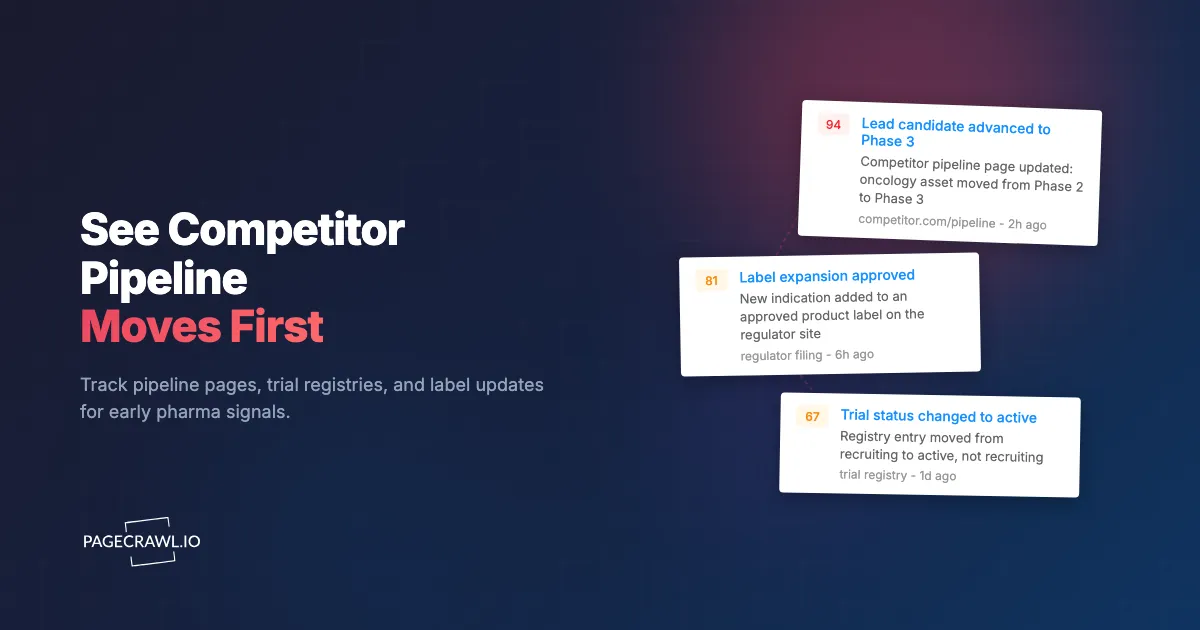
Every pharma and biotech company publishes a pipeline page or chart showing assets by phase, indication, and modality. It is the single richest CI source because companies update it to signal progress to investors. A row moving from Phase 1 to Phase 2, a new indication under an existing molecule, or a candidate quietly disappearing (a failed program) are all high-value signals.
Public clinical trial registries
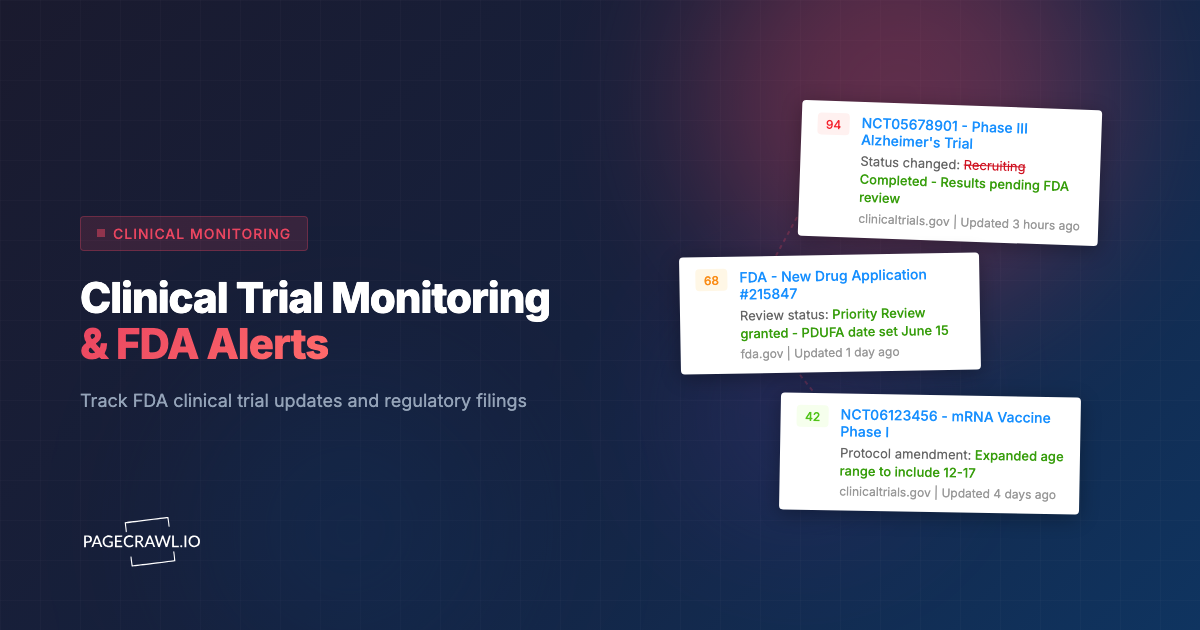
Trial registries such as ClinicalTrials.gov publish protocol details, enrollment status, primary endpoints, estimated completion dates, and results. Changes to a competitor's registry entries reveal trial design, when data is expected, and whether a study is recruiting, active, or terminated. Registry monitoring overlaps heavily with regulatory work, which is why a dedicated clinical trial and FDA alert workflow is foundational to pharma CI.
Regulatory approval and label pages
Approval databases and label documents from regulators, including the FDA and the European Medicines Agency, show new approvals, indication expansions, boxed warnings, and dosing changes for competitor products. A label change can open or close a market segment overnight. Monitoring EMA and MHRA drug approval pages alongside their US equivalents gives you a multi-region view of the same molecule's progress.
Scientific conference abstracts
Major medical congresses publish abstract titles and session listings weeks before the meeting. For oncology, immunology, and rare disease, the abstract listing is often the first public disclosure of trial results. Watching the abstract search pages, like conference and CFP deadline pages, tells you what a competitor will present before the embargo lifts.
Market-access and pricing pages
Payer coverage policies, formulary status pages, and price transparency disclosures reveal how a competitor product is being positioned commercially. A formulary tier change or a new prior-authorization requirement is a direct commercial signal. Our guide to hospital and drug price transparency monitoring covers the access surfaces in detail.
How do you monitor a competitor's pipeline page for pipeline changes?
Monitor a competitor's pipeline page by setting up full-page text monitoring on the exact URL of the pipeline chart or table, checking daily, and configuring alerts that fire only when meaningful content changes. The goal is to catch a row moving phases, a new asset appearing, or a program disappearing, without drowning in cosmetic edits.

Pipeline pages come in two forms. Static HTML tables are easiest: any change to the table text triggers an alert. Interactive charts load asset data dynamically, so the data may render after the page loads. PageCrawl captures dynamically rendered content the same way a visitor sees it, so those asset rows are tracked too.
To cut noise, focus the monitor on the pipeline table itself rather than the whole page. If the page wraps the chart in a marketing layout that changes often (rotating banners, news teasers), target just the table region so footer and header edits do not trigger false alerts. Pair that with conditional alert rules so a change only escalates when keywords like "Phase 3," "Filed," "Approved," or a specific indication name appear in the diff. This turns a raw page-change feed into a phase-transition feed.
How do you track clinical trial registry changes?
Track clinical trial registry changes by monitoring the specific registry search-result or study-detail URLs for your competitors' programs, checking daily, and alerting on status, date, and enrollment fields. The highest-value diffs are status transitions (recruiting to active to completed), changes to the estimated primary completion date, and edits to primary or secondary endpoints.
Start with a saved registry search scoped to a competitor sponsor or a specific intervention, then monitor that results URL: when a new study appears or a status changes, you get alerted. For the pivotal trials you care about most, also monitor the individual study-detail page so you catch granular edits to endpoints, arms, and completion dates a results list might not surface.
The completion-date field deserves special attention. When a competitor pulls a primary completion date forward, it signals faster-than-expected enrollment and an earlier readout; when it slips, it signals trouble. Either way it reshapes your forecast. Because this overlaps with approval timing, run it alongside your FDA and clinical trial alert setup so registry changes and regulatory milestones land in the same stream.
How do you catch label expansions and new approvals?
Catch label expansions and new approvals with regulatory filing monitoring on the regulator's approval database and product label pages for each competitor molecule, checking daily, and alerting on any change to indication, dosing, or warnings text. A new approval or an expanded indication is one of the most consequential competitive events in pharma, and it appears on the regulator's site the day it happens.
Monitor three things per competitor product: the approval or product detail page (which updates when a new indication is granted), the current label or prescribing information document on the regulator's site or a label repository such as DailyMed (where indication and dosing language lives), and the regulator's "recently approved" or decisions listing (a catch-all for products you are not yet tracking individually). Because labels are frequently PDFs, use document monitoring so a change inside the PDF triggers an alert the same way an HTML change would; the walkthrough on tracking text changes in PDF files covers the setup. Always confirm any label or approval detail against the official regulator record before acting on it; this article is informational, not medical or regulatory advice.
Run this across regions. A molecule approved in Europe months before the US gives your team a preview of the likely US label and a head start on positioning. Monitoring EMA and MHRA approval pages next to US sources builds that multi-region picture. Add adjacent regulatory surfaces that affect competitive dynamics, like the drug shortage list, where a competitor product entering shortage can open immediate commercial opportunity for yours.
Patents are the other side of the approval coin. A competitor's loss of exclusivity reshapes a market, so pair label monitoring with patent and trademark watch alerts to track expiry and challenge timelines that decide when generics or biosimilars arrive.
How do you monitor conference abstracts and congress data?
Monitor conference abstracts by watching the congress abstract search or program pages for your competitors' assets, increasing the check frequency in the weeks before the meeting, and alerting on any new session or abstract title that names a competitor molecule. For many therapeutic areas the abstract listing is the first public hint of trial results, often weeks ahead of the formal presentation.
Congresses publish abstract titles and authors before the meeting, then release fuller abstracts on a set date, so the same academic research and publication monitoring cadence applies. Monitor the abstract search results filtered to a competitor's product or your therapeutic area, plus the program or session schedule. When a late-breaking abstract or competitor session appears, you know what will be disclosed and can brief medical affairs before the room is full. The mechanics mirror our approach to conference and submission-deadline monitoring: watch the listing page daily, then tighten to a near-continuous cadence in the two weeks around the embargo lift when titles and full texts post.
How do you watch market-access and pricing signals?
Watch market-access signals by monitoring payer coverage policy pages, formulary status listings, and price transparency disclosures for competitor products, checking weekly, and alerting on tier changes, prior-authorization edits, and price movements. These are the commercial signals that tell you how a competitor product is actually selling, not just whether it was approved.
Coverage and formulary pages reveal restrictions that shape real-world uptake. A competitor product moving to a preferred tier, or shedding a step-therapy requirement, is a direct threat to your share. The reverse, a new prior-authorization hurdle on their product, is an opening for yours. Price transparency disclosures, covered in our drug and hospital price transparency guide, add the list-and-net pricing context. These pages change less often than pipeline or registry data, so weekly checks usually suffice, except during a competitor launch, when access policies update rapidly and a tighter cadence pays off.
How do you set up pharma CI monitoring in PageCrawl?
Set up pharma CI monitoring in PageCrawl by creating one monitor per competitor source, choosing the right tracking mode for each page type, and routing alerts to the channel your CI team already uses. You can validate the whole approach on the free tier, which includes 6 monitors and 220 checks per month, before scaling to full competitor coverage.
Here is a concrete walkthrough for your first competitor:
List your priority sources. For one Tier 1 competitor, write down their pipeline page URL, the trial registry search URL for their lead assets, the regulator approval page for their marketed products, the relevant congress abstract page, and one market-access or pricing page. That is five monitors for one competitor.
Create the pipeline monitor. Add the pipeline page URL, choose full-page text tracking, and set a daily check. If the page wraps the chart in changing marketing content, narrow the monitor to the pipeline table region so only asset changes trigger alerts.
Create the trial registry monitor. Add the saved registry search URL (scoped to the competitor sponsor or intervention) with a daily check. For pivotal studies, add the individual study-detail page as its own monitor so endpoint and date edits are captured granularly.
Create the approval and label monitor. Add the regulator approval page and the label document. Use document monitoring for PDF labels so changes inside the file are detected. Set a daily check.
Create the conference monitor. Add the congress abstract search or program page with a daily check, and plan to raise the frequency in the weeks around the meeting.
Create the market-access monitor. Add the payer policy, formulary, or pricing page with a weekly check.
Add conditional rules. Layer keyword and threshold alert rules on the pipeline and registry monitors so a change only escalates when high-signal terms (Phase 3, Filed, Approved, Completed, an indication name) appear in the diff.
Route the alerts. Connect webhook automations to push high-priority changes straight into your team's Slack, Teams, or CI inbox. Critical events reach the people who act on them on the check that detects the change.
Review on a shared board. Use PageCrawl's Kanban-style Review Board so the whole CI team sees every detected change in one place, marks items reviewed, and leaves notes, instead of each analyst checking pages independently.
Repeat steps 2 through 6 for each competitor as you expand: five monitors per Tier 1 competitor means the free tier covers one end to end, and a paid plan covers a full set.
How do you turn pharma signals into intelligence?
Turn pharma signals into intelligence by triaging each detected change for significance, connecting changes into patterns, and distributing a clear "so what" to commercial, medical, and leadership teams within hours, not weeks. Raw page diffs are data; intelligence is the assessment of what a change means for your strategy and what to do about it.
Triage first. A competitor fixing a typo on a pipeline page is not intelligence. A row moving to Phase 3 is. PageCrawl scores and summarizes changes so high-significance events surface first, and your CI lead can route them to the right owner: registry and label changes to regulatory and medical affairs, market-access changes to commercial, pipeline changes to strategy.
Then connect the dots. A competitor advancing a candidate to Phase 3, posting a late-breaking abstract, and pulling a completion date forward are three signals that together mean a readout is imminent and a launch is being prepared. No single change tells that story; the pattern does. Maintain a living competitor profile per molecule, updated as alerts arrive.
Finally, distribute with discipline. A weekly one-page brief of the most significant moves, plus real-time alerts for binary events like an approval or a Phase 3 readout, keeps the organization current without drowning it. Lead every item with the implication, not the observation. "Competitor X advanced its lead asset to Phase 3, putting a likely readout in Q2 and a launch ahead of ours" is intelligence. "Pipeline page changed" is not.
Choosing your PageCrawl plan
PageCrawl's Free plan lets you monitor 6 pages with 220 checks per month, enough to validate pharma CI on one competitor's core sources before you scale. Most teams move to a paid plan once they see the first event they would otherwise have missed.
| Plan | Price | Pages | Checks / month | Frequency |
|---|---|---|---|---|
| Free | $0 | 6 | 220 | every 60 min |
| Standard | $8/mo or $80/yr | 100 | 15,000 | every 15 min |
| Enterprise | $30/mo or $300/yr | 500 | 100,000 | every 5 min |
| Ultimate | $99/mo or $999/yr | 1,000 | 100,000 | every 2 min |
Annual billing saves two months across every paid tier. Enterprise and Ultimate scale up to 100x if you need thousands of pages or multi-team access.
For pharma CI the math is straightforward. Five sources per competitor means Standard at $80/year covers roughly 20 competitors end to end, with 15-minute checks that cut time-to-awareness on a Phase 3 readout from days to minutes. Enterprise at $300/year suits larger pipelines across regions, adding 500 pages, SSO for cross-functional access, and the full API for feeding change data into competitive dashboards.
All plans include the PageCrawl MCP Server, which lets CI leads, medical affairs, and commercial teams ask Claude to pull change summaries for any competitor molecule over any time period directly from the monitoring archive. Instead of manually updating a competitor wiki, your team queries live data. AI assistants can create monitors through conversation on every plan, including Free.
Getting Started
Begin today by picking your single most important competitor and listing five URLs: their pipeline page, a trial registry search for their lead asset, the regulator approval page for their marketed product, the relevant congress abstract page, and one market-access page. Set up all five in PageCrawl and route alerts to your CI channel. That is one competitor fully covered inside the free tier.
Over the next two weeks, watch what comes through. You will almost certainly catch a registry status change, a label edit, or an abstract listing you would otherwise have learned about late. Use those first signals to prove the value, then expand to your full competitive set.
In pharma, the team that sees the pipeline move first wins the quarter. Make sure that team is yours.