A senior researcher was preparing a paper for a major venue with a published abstract deadline of March 1. On February 24, the conference organizers updated the CFP page to add a new workshop track with its own February 28 abstract deadline, which would have been a better fit for the researcher's work and offered an additional acceptance path. The change was announced in a single line of the CFP page and a short post on the conference Twitter account. The researcher's lab subscribed to the conference's general mailing list, which sent the update on March 2. The window had closed. The paper went to the main track, which was a marginal fit, and was rejected.
This is the CFP monitoring problem in microcosm. Academic and industry conference CFP pages are the canonical source of truth for submission deadlines, track additions, deadline extensions, and submission window changes, but the announcement channels (mailing lists, social media accounts) lag behind the page itself. Researchers and industry speakers managing 5-15 active submission tracks across multiple venues have no realistic way to manually check 30+ CFP pages for changes, and miss meaningful signal as a result.
This guide covers what's monitorable on conference CFP pages, why direct page monitoring beats mailing-list reliance, and how to set up a system that surfaces CFP changes and new openings within the week they happen.
Quick Setup
Pick conference types and a topic, we'll surface new CFPs and deadline changes daily.
Why does monitoring CFP pages directly matter?
Monitoring the CFP page directly matters because the page is the authoritative source for deadlines and tracks. Email announcements lag, are filtered into low-priority folders, or are sent only to past attendees. Direct page monitoring is the only deterministic way to catch changes.
Deadline Extensions Open Submission Windows
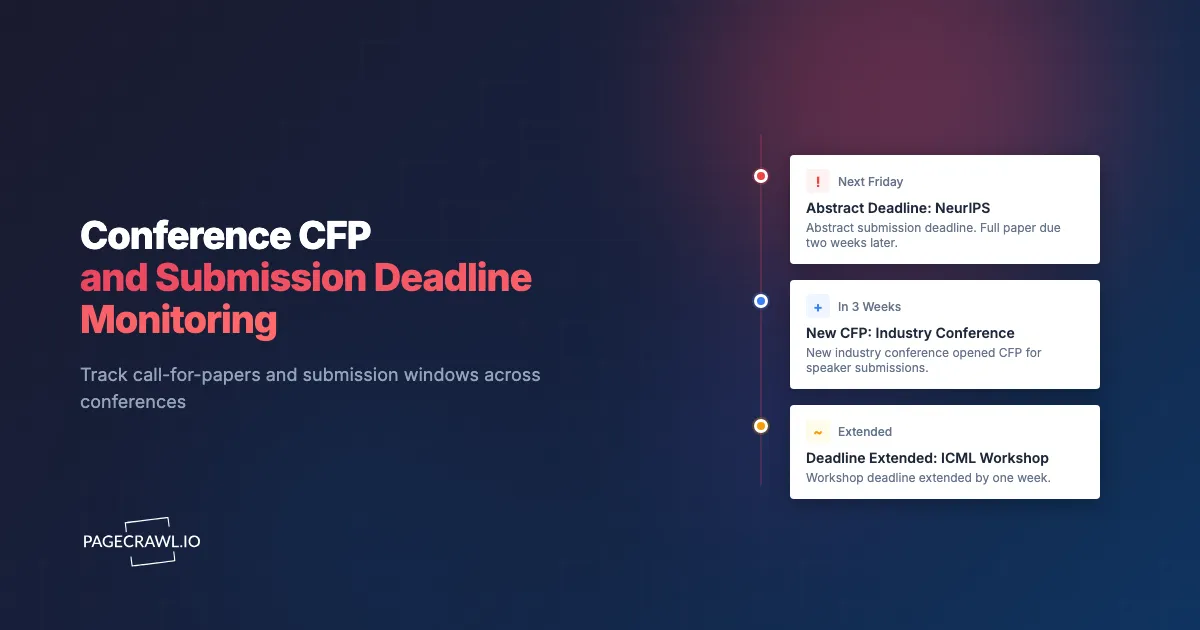
Conferences regularly extend submission deadlines (typically 1-2 weeks) when initial submission volume is lower than target. The extension is announced on the CFP page and in a mailing list, but the mailing list often arrives days after the page updates. Researchers with a partial draft can use the extension to finish and submit, but only if they know about it in time.
New Track Additions Open Fit-Improving Opportunities
Conference organizers occasionally add workshops, special tracks, or new submission categories late in the planning cycle. These additions often have different deadlines than the main track and can be a better fit for specific work.
Submission Portal Openings Have Their Own Schedule
The CFP date is one thing; the actual submission portal opening (often a CMT, EasyChair, or OpenReview URL) is another. Portals sometimes open later than expected, and the CFP page is updated when the portal is live.
Brand-New Conference CFPs Surface Submission Opportunities
New conferences, workshops, and venues launch every year. Tracking aggregator sites and per-organization announcement pages surfaces new submission opportunities that an existing tracking list would miss.
How do conference CFP pages work?
CFP pages vary in structure by conference, but they all publish the same monitorable signals: submission deadlines, track lists, and portal links. The monitoring pattern is consistent.

Conference homepage. The conference website (e.g., acm.org/conferences/[conf]) typically has a CFP section that updates as deadlines approach.
Dedicated CFP page. Many conferences publish a /cfp or /call-for-papers page with the full submission details.
Aggregator sites. WikiCFP, Papers With Code venue listings, and field-specific aggregators list CFPs across venues with topic and date filtering.
Workshop and special-track pages. Major conferences often publish workshop CFPs as separate sub-pages or sub-sites (e.g., [conf-name].org/workshops/[track]).
A typical conference CFP URL looks like this:
https://[conference-domain]/[year]/cfpWhen deadlines change, tracks are added, or the submission portal opens, the page content reflects the change.
Comparing Monitoring Approaches
| Approach | Cost | Latency | Coverage | Best For |
|---|---|---|---|---|
| Conference mailing lists | Free with subscription | Days | Per-conference | Casual researchers |
| Twitter / Bluesky conference accounts | Free | Variable | Per-conference | Active community members |
| WikiCFP email digests | Free | Daily | Aggregated | Field-wide awareness |
| Field-specific lists (e.g., DBWorld) | Free | Variable | Field-specific | Established researchers in mature fields |
| PageCrawl on CFP URLs | Free tier to $80/yr | 1-7 days | Any CFP page | Researchers and speakers managing multiple active submissions |
The field-specific lists (DBWorld for databases, SIGCOMM for networking, etc.) remain useful but require active subscription management and don't catch deadline-extension updates that happen between digest cycles. PageCrawl gives direct page-level monitoring with daily-to-weekly granularity.
Setting Up CFP Monitoring in PageCrawl
Step 1: Build your conference tracking list
List the 20-50 conferences relevant to your research area or industry beat. Include the main conference, top workshops within it, and adjacent venues.
Step 2: Add each CFP URL as a monitor
Use the canonical CFP URL for each conference. Add each as a content monitor.
Step 3: Add aggregator pages for broader discovery
Add relevant WikiCFP topic pages and field-specific aggregator pages for surfacing new venue openings. Example:
http://www.wikicfp.com/cfp/call?conference=machine%20learningStep 4: Pick the right check frequency
CFP changes aren't minute-sensitive, so use check scheduling to layer frequency by urgency. A reasonable layering:
- Active-submission CFP pages (close to your deadline): Daily checks. Catches deadline extensions and portal openings.
- Future CFP pages (deadline 2+ months out): Weekly checks.
- Aggregator pages for new CFP discovery: Weekly checks.
- Workshop and special-track sub-pages within active conferences: Daily during the submission window.
Step 5: Use AI summaries to filter the noise
Conference CFP pages contain a lot of static text. PageCrawl's AI-powered change detection and smart filtering describes what specifically changed (deadline date, new track, portal opening), so alerts are actionable without re-reading the full page.
Step 6: Route alerts to a research/lab channel
For research labs and university departments, route alerts to a shared Slack channel where postdocs and grad students share submission opportunities. For solo researchers, email or personal Telegram works.
Worked Example: A Research Lab's CFP Tracking Setup
A computer science research lab covering machine learning and systems set up the following:
- Twenty-five top ML and systems conference CFP pages on daily checks during active windows
- Twelve workshop CFP sub-pages on daily checks during their submission windows
- Five WikiCFP and field-specific aggregator pages on weekly checks
- Three workshop organizing-call pages on weekly checks for surfacing workshop-proposal opportunities
- All alerts routed to a shared #cfp Slack channel for the lab
- Folders organized by submission cycle and venue tier
Over an academic year, the lab caught 9 deadline extensions that opened additional submission opportunities, 4 new workshop CFPs that resulted in lab submissions, and 2 new venues launched in adjacent areas. Standard plan cost: $80.
Patterns Worth Watching
Deadline extensions 7-14 days before original deadline. Conferences with under-target submission volume often extend 1-2 weeks before the original date.
Late workshop additions. Workshops are sometimes added to major conferences 4-8 weeks before the conference date with their own short submission windows.
Submission portal opening delays. The CFP date and portal opening date sometimes diverge. Monitoring catches the actual portal availability.
Topic and track expansions. Conferences occasionally expand their topic list mid-cycle to attract submissions in growth areas. New topics on a CFP page indicate strategic positioning.
Special issue and journal-conference partnerships. CFP pages often announce special-issue partnerships with academic journals, which open additional publication paths.
Advanced Patterns: Beyond Single-Conference CFPs
A complete CFP monitoring workflow extends past individual conference pages.
Combine with grant solicitation monitoring. Research funding often aligns with conference cycles, so the same setup can watch grant portals, funding announcements, and deadline changes. The NIH and NSF grant solicitation monitoring pattern applies.
Combine with journal submission window monitoring. Some journals open and close submission windows. The open-access journal monitoring pattern covers this.
Combine with industry conference speaker submission pages. Industry conferences (AWS re:Invent, KubeCon, Strata) have speaker submission portals that open and close on published cycles.
Combine with university speaker invitation pages. Some universities post upcoming speaker invitations with submission windows for their colloquium series.
Who benefits from CFP monitoring?
Anyone managing more than a handful of submission deadlines benefits: researchers, industry speakers, organizers, and administrators who need same-week awareness of CFP changes without manually rechecking dozens of pages.
Academic researchers. Multi-venue submission tracking is essential for productive publication strategy, and it sits naturally alongside academic research monitoring for journals, preprint servers, and new publications. Catching deadline extensions and workshop additions improves both submission volume and venue fit.
Industry conference speakers. Speakers covering tech, business, or specialized fields like pharma manage submission windows across 10-20 conferences per year, often alongside ongoing competitive intelligence monitoring. Monitoring catches submission openings and deadline shifts.
Conference organizers. Tracking peer-conference CFP timing informs your own scheduling and avoids deadline conflicts.
Travel and budget planners. University departments and industry travel coordinators benefit from same-week awareness of CFP windows that drive conference attendance budget planning.
PhD students and postdocs. Early-career researchers benefit from broad CFP awareness for venue selection.
Research administrators. Department-level submission tracking and reporting benefits from continuous CFP monitoring.
Frequently Asked Questions
How far in advance are CFPs typically published? Most major conferences publish CFPs 4-9 months before the conference date, with abstract deadlines 4-6 months before the conference.
Do all conferences extend deadlines? No. Top-tier venues with strong submission volume rarely extend; mid-tier and emerging venues extend more frequently.
Can I monitor closed-loop CFP systems like EasyChair and OpenReview? The CFP page typically lives on the conference website; the submission portal lives on the system. Both are monitorable, but the conference website CFP is the primary signal source.
What about workshop proposal deadlines vs paper submission deadlines? Workshop proposal calls are typically posted 8-12 months before the conference, then specific workshop CFPs are posted 3-6 months before. Both are worth monitoring depending on your role.
Do I need a paid plan? For a 6-venue tracking list at weekly frequency, the free plan works. For a serious research-lab program covering 30-50 venues at daily frequency, Standard at $80/year is the right tier.
Will I get noise alerts on minor CFP page changes? With AI summaries enabled, no. PageCrawl distinguishes between deadline changes, track additions, and trivial UI shifts.
Choosing your PageCrawl plan
PageCrawl's Free plan lets you monitor 6 pages with 220 checks per month, which is enough to validate the approach on your most critical pages. Most teams graduate to a paid plan once they see the value.
| Plan | Price | Pages | Checks / month | Frequency |
|---|---|---|---|---|
| Free | $0 | 6 | 220 | every 60 min |
| Standard | $8/mo or $80/yr | 100 | 15,000 | every 15 min |
| Enterprise | $30/mo or $300/yr | 500 | 100,000 | every 5 min |
| Ultimate | $99/mo or $999/yr | 1,000 | 100,000 | every 2 min |
Annual billing saves two months across every paid tier. Enterprise and Ultimate scale up to 100x if you need thousands of pages or multi-team access.
In event-driven strategies, minutes matter. One actionable signal surfaced before the broader market reacts can return more than a year of Ultimate. Standard at $80/year covers the core IR, press, and filings pages for a handful of positions. Enterprise at $300/year scales to a full watchlist.
Getting Started
List the 10-20 conferences you actually submit to or follow. Add each CFP page to PageCrawl on weekly checks (daily during active submission windows). Create a free account and route alerts to a shared lab channel or personal email.
Over the first submission cycle, you'll see how often CFP pages change and develop a feel for which conferences extend, add workshops, or modify their tracks. Once you see the value, expand to cover aggregator pages and adjacent-field venues. The Standard plan at $80/year handles a serious research-lab program, and Enterprise at $300/year covers department-level CFP tracking with shared visibility.