A mid-career PI in computational biology missed a perfect-fit NIH R01-equivalent solicitation by 18 days. The Funding Opportunity Announcement (FOA) was posted to the NIH Guide on a Tuesday. The PI's institutional grants office subscribed to the NIH Guide weekly digest, which arrived the following Monday. By the time the digest hit the PI's inbox, they were already deep in the prep cycle for a different application with a closer deadline. When they finally read the FOA on the following Wednesday, the standard prep cycle (specific aims development, budget development, letters of support, internal review) wouldn't fit in the remaining window. The FOA was a single-issue solicitation with no expected re-issuance. The lab waited another full cycle for an analogous opportunity that never materialized.
This is the institutional grants office reality. NIH posts a steady stream of Funding Opportunity Announcements through the NIH Guide, NSF publishes program-specific solicitations on a rolling schedule across directorates, and Grants.gov aggregates federal opportunities across all funding agencies. The volume is high enough that no individual PI or grants administrator can manually review the feeds, and the institutional digest workflows lag by days. Missing a perfectly-fit opportunity by one week is functionally the same as missing it entirely, because grant prep cycles don't compress.
This guide covers what's monitorable on the NIH Guide, NSF program pages, and Grants.gov, why direct page monitoring beats digest reliance, and how to set up alerts that surface new solicitations within the day they're posted.
Quick Setup
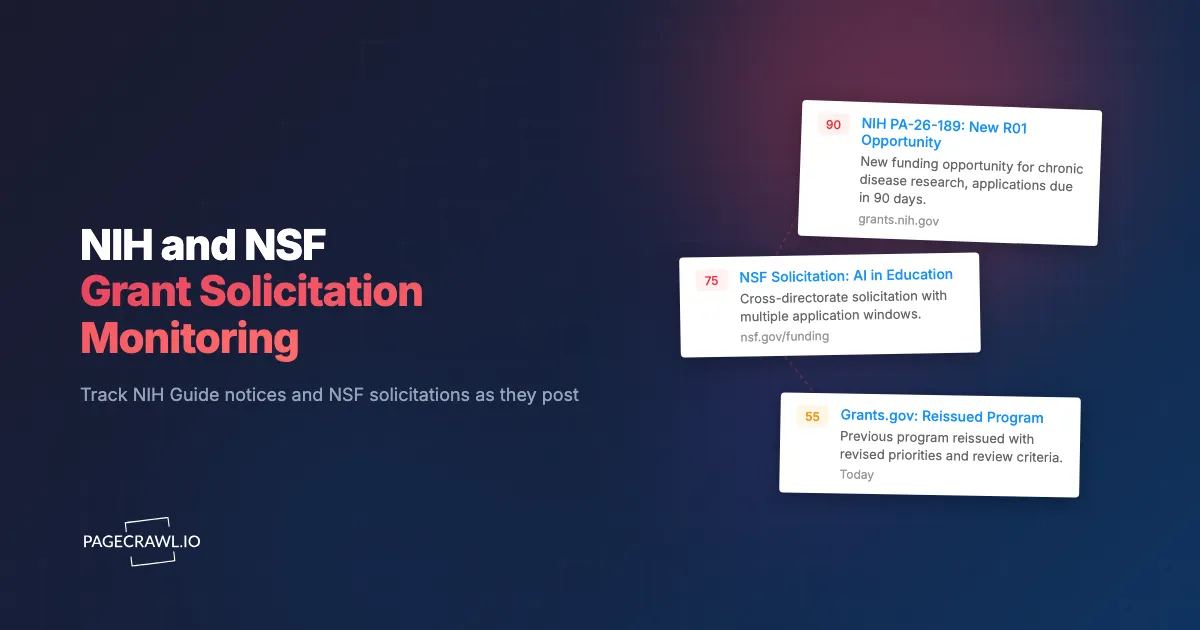
Pick an agency and your research area, we'll surface new NIH or NSF solicitations as they post.
Why does continuous grant page monitoring matter?
Because the grant prep cycle is the binding constraint, not the deadline. Awareness of an opportunity 7 days after posting is meaningfully different from awareness 1 day after, and single-issue FOAs, deadline changes, program officer turnover, and reissued priorities all move without a separate announcement.
Single-Issue FOAs Don't Re-Issue
Many NIH Funding Opportunity Announcements are single-issue (one submission window, no expected re-issuance). Missing the window means missing the opportunity entirely. PA (Program Announcements) re-issue periodically, but the prep cycle for each issuance is the same.
Deadline Changes and Extensions Are Common
NIH and NSF occasionally adjust deadlines after initial posting. Knowing about an extension can rescue an application that initially seemed impossible to prep in the available time.
Program Officer Changes Affect Pre-Submission Communication
Successful applications often involve pre-submission outreach to program officers. When a program officer changes (announced on the program page), the relationship-building and pre-submission conversation needs to restart with the new contact.
Reissued Programs With Revised Priorities
When a program reissues with revised research priorities, the priority shifts often signal what kinds of applications are likely to be competitive. PIs who catch the priority shift early can position applications appropriately.
How do the NIH Guide, NSF, and Grants.gov pages work?
All three expose stable, parameterised URLs you can point a monitor at: NIH Guide saved searches filtered by institute and activity code, NSF directorate funding pages, and Grants.gov searches filtered by agency or CFDA number. The three primary monitoring targets each have distinct page structures.
NIH Guide. The NIH Guide search page (grants.nih.gov/searchGuide/search_guide.cfm) supports filtering by institute, activity code, and date. Saved-search URLs are stable and monitorable. The Guide also publishes a weekly listing page that updates as FOAs post.
NSF program pages. Each NSF directorate maintains program pages under nsf.gov/funding. Directorate-specific funding pages list current solicitations and deadlines.
Grants.gov. Federal-wide aggregator at grants.gov. The search URL with filter parameters is stable and monitorable. Filtering by Catalog of Federal Domestic Assistance (CFDA) number narrows to specific agency programs.
Specific FOA / solicitation URLs. Individual FOAs at NIH have stable URLs (grants.nih.gov/grants/guide/[type]-files/[FOA-number].html). NSF solicitations follow nsf.gov/funding/pgm_summ.jsp?pims_id=[id].
A typical NIH Guide search URL filtered for a specific institute looks like this:
https://grants.nih.gov/searchGuide/search_guide.cfm?ic=NCI&activitycodes=R01When new FOAs matching the filter post, they appear in the results.
Which grant monitoring approach gives the fastest awareness?
Monitoring your own filtered search URLs is fastest, surfacing new solicitations within a day of posting. Agency digests and institutional grants office round-ups are free and useful, but they run on weekly or multi-day schedules that do not match an individual prep cycle.
| Approach | Cost | Latency | Coverage | Best For |
|---|---|---|---|---|
| NIH Guide weekly digest | Free with subscription | Up to 7 days | NIH only | Casual awareness |
| NSF email updates | Free with subscription | Variable | NSF only | Casual awareness |
| Grants.gov search and saved alerts | Free | Daily | Federal-wide | Researchers willing to manage their own filter |
| Institutional grants office digests | Included with affiliation | Days to weeks | Whatever the office curates | Researchers happy with curated subset |
| PageCrawl on filtered search URLs | Free tier to $80/yr | 1-2 days | Any URL you choose | PIs and grants offices wanting same-day awareness |
The institutional digests are valuable but operate on schedules that don't match individual prep cycles. Direct monitoring of search URLs filtered to your priorities surfaces opportunities within the day they post.
Setting Up Grant Monitoring in PageCrawl

Step 1: Identify your filter criteria
For NIH, the relevant filters are typically institute (NCI, NIAID, NHLBI, etc.) and activity code (R01, R21, K99, U01). For NSF, the relevant filter is directorate (CISE, BIO, ENG) and program. For Grants.gov, the relevant filter is agency and CFDA number.
Step 2: Build filtered search URLs
For each combination of filters that matters to your research, construct the search URL with parameters. Example NIH Guide URL for NCI R01s:
https://grants.nih.gov/searchGuide/search_guide.cfm?ic=NCI&activitycodes=R01Step 3: Add each search URL as a monitor
Add each filtered URL as a content monitor in PageCrawl.
Step 4: Add specific FOA pages for current submissions
When you're actively preparing a submission, add the specific FOA URL as a per-page monitor. This catches FOA updates (deadline changes, requirement clarifications) that affect your submission.
Step 5: Pick the right check frequency
Grant solicitations aren't minute-sensitive. A reasonable layering, which you can set per monitor using check scheduling:
- Filtered search URLs for your active research areas: Daily checks. Catches new FOAs within 24 hours of posting.
- Specific FOA pages during active prep: Daily checks. Catches deadline changes and requirement clarifications.
- Program officer and directorate pages: Weekly checks. Catches program officer changes and program reissuances.
- Grants.gov saved search URLs: Daily checks.
Step 6: Route alerts to a grants channel
For institutional grants offices, route alerts to a shared Slack channel where the office team can triage and forward to relevant PIs. For solo PIs, email or personal Telegram works.
Worked Example: An Institutional Grants Office Setup
Here is how a research university grants office covering biomedical, engineering, and social sciences might set this up:
- Twelve NIH Guide filtered search URLs (one per institute / activity code combination relevant to faculty research) on daily checks
- Six NSF directorate funding pages on daily checks
- Four Grants.gov CFDA-filtered search URLs for non-NIH/NSF federal funders (DOD, DOE, USDA, NEH) on daily checks
- Eight specific FOA pages for active institutional submissions on daily checks
- All alerts routed to a #grants-feed Slack channel; the office manager triaged alerts daily and forwarded to relevant faculty
- Folders organized by institute and directorate
Across a fiscal year, a filtered set that size surfaces hundreds of new FOAs. A minority are worth forwarding to faculty as direct opportunities, a smaller share become submitted applications, and a handful get funded. Thirty monitors on daily checks fit comfortably inside the Standard plan at $80.
Patterns Worth Watching
Quarterly NIH FOA cycle peaks. NIH posts FOA volume tends to concentrate in March, June, September, and December as institute fiscal cycles align.
End-of-fiscal-year NSF solicitations. NSF often posts solicitations in the August-September window as the federal fiscal year closes, with submission deadlines 2-4 months out.
Special / single-issue FOAs around policy announcements. When NIH or NSF announces a research priority area (cancer moonshot, climate research, AI), single-issue FOAs related to the priority tend to follow over the months that come after.
Reissuance of expired program announcements. When a PA expires, a reissuance with revised priorities often follows a year or two later. Monitoring catches the reissuance.
Program officer change announcements. Director and program officer changes are announced on directorate and program pages. Catching these supports relationship continuity.
Advanced Patterns: Beyond Federal Funding
A complete grant and funding opportunity monitoring workflow extends past NIH and NSF.
Combine with private foundation funding pages. HHMI, Sloan, Simons, RWJF, and other major private foundations publish RFP and LOI calls on their funding pages. Each is monitorable.
Combine with international funding agency monitoring. ERC, Wellcome Trust, MRC, and other international funders publish solicitations on their websites.
Combine with congressional and federal policy monitoring. Research priorities follow policy announcements. Monitoring relevant policy pages and congressional committee announcements provides upstream signal.
Combine with conference CFP monitoring. Research funding and conference timelines often align, and the same setup extends to academic journal and preprint monitoring. The conference CFP monitoring pattern applies.
Use Cases
Principal investigators. Same-day awareness of NIH and NSF solicitations matching your research area is the highest-leverage funding intelligence available. The monitoring pays for itself the first time it surfaces a fit opportunity in time to prepare a competitive application.
Institutional grants offices. Centralized solicitation monitoring across the institutional research portfolio reduces the lag between FOA posting and faculty awareness.
Research administrators. Pipeline planning around solicitation cycles benefits from continuous monitoring.
Consulting firms specializing in grant proposal preparation. Client-specific solicitation alerts support proactive engagement and prep timeline planning.
Department chairs and research deans. Department-level funding opportunity awareness supports strategic faculty hiring and area-building decisions.
Postdocs and early-career researchers. Awareness of K99, F32, and other early-career mechanisms supports application timing decisions.
Frequently Asked Questions
How often does NIH post new FOAs? Several per business day across all institutes. The NIH Guide weekly digest typically lists dozens of new notices per week, so confirm current volume on the NIH Guide itself.
Can I monitor specific NIH study sections? Study section composition is on CSR pages and changes annually. Monitoring catches assignment and roster changes.
What about contract solicitations (RFPs) vs grant solicitations? Both NIH and DOD post contract RFPs through separate channels. Grants.gov aggregates many but not all. Monitoring the agency-specific RFP pages directly catches contract opportunities.
Are there filters for specific career stages? Yes. The NIH Guide search supports filtering by activity code (K99, F32, R21, R01, etc.), which correlates with career stage.
Do I need a paid plan? For a 4-6 filtered search URL setup at daily frequency, the free plan works. For an institutional grants office covering multiple agencies and detailed filters, Standard at $80/year or Enterprise at $300/year is the right tier.
Will I get noise alerts on minor page changes? With AI-powered change detection and smart filtering enabled, minor shifts are summarised rather than escalated, so new FOA postings and deadline changes stand out from trivial UI churn.
Choosing your PageCrawl plan
PageCrawl's Free plan lets you monitor 6 pages with 220 checks per month, which is enough to validate the approach on your most critical pages. Most teams graduate to a paid plan once they see the value.
| Plan | Price | Pages | Checks / month | Frequency |
|---|---|---|---|---|
| Free | $0 | 6 | 220 | every 60 min |
| Standard | $8/mo or $80/yr | 100 | 15,000 | every 15 min |
| Enterprise | $30/mo or $300/yr | 500 | 100,000 | every 5 min |
| Ultimate | $99/mo or $999/yr | 1,000 | 100,000 | every 2 min |
Annual billing saves two months across every paid tier. Enterprise and Ultimate scale up to 100x if you need thousands of pages or multi-team access.
For grant monitoring, the payoff is prep time rather than speed. One well-fit solicitation caught early enough to build a competitive application outweighs a year of subscription cost. Standard at $80/year covers a serious individual-PI filter set across NIH, NSF, and Grants.gov. Enterprise at $300/year scales to an institutional grants office covering many institutes and directorates.
Getting Started
Build 3-5 NIH Guide and NSF filtered search URLs that match your research area. Add each to PageCrawl on daily checks. Create a free account and route alerts to a personal email or shared lab channel.
Over the first 60 days, you'll see how many FOAs match your filters and develop a feel for which institutes and directorates are most relevant. Once you see the value, expand to cover Grants.gov for non-NIH/NSF agencies and private foundation pages. The Standard plan at $80/year handles a serious individual-PI grant monitoring program. Enterprise at $300/year covers institutional grants office programs with multi-faculty coverage.