Danielle runs proposals at a facilities services company in Mississauga. Twelve days into writing a response for a hospital maintenance contract, she opens the opportunity page for a routine pre-submission check and finds Addendum 3, posted six days earlier: the mandatory site visit has been rescheduled, and attendance at the new date is a condition of a compliant bid. The visit is tomorrow morning. Her operations lead makes it with fourteen hours' notice, but the near-miss changes how the company works. Nobody on a bid team should be discovering addenda by accident, and no discovery process should depend on someone remembering to reload a page.
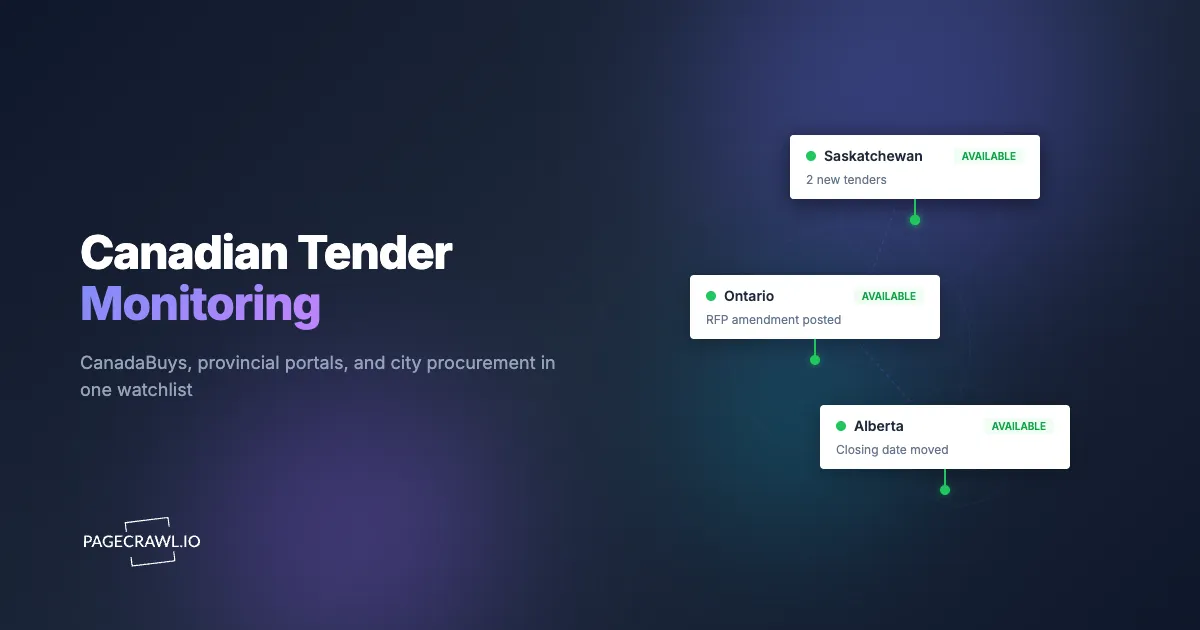
Selling to government in Canada means watching a lot of separate websites. Federal opportunities publish on CanadaBuys, each province runs its own portal (Ontario, Alberta Purchasing Connection, SaskTenders, Quebec's SEAO, BC Bid, and the rest), and below them sit hundreds of municipal and agency procurement pages: universities, health authorities, school boards, and cities, each posting bids on its own site, on its own schedule. No single feed covers them all, and the suppliers who win consistently are the ones who see matching opportunities in the first days of the response window and catch every amendment on the bids they are writing.
This guide covers how to turn that scatter of portals into one monitored pipeline: new opportunity alerts, amendment tracking on live bids, a concrete setup walkthrough, and the publication patterns Canadian bid teams learn to read.
How do you get alerts for new Canadian government tenders?
Monitor a filtered search page on each portal you sell into. Build the search that describes your business on CanadaBuys or a provincial portal, commodity codes, keywords, and region, then add the results URL as a monitor. When a new opportunity enters the results, you get an alert with the new entry highlighted on the next check after it posts.
Most portals offer their own email subscriptions, and monitoring does not replace them so much as sit above them: one dashboard across every portal, alerts in a shared channel instead of one inbox, and a history of what entered and left each search. The practical difference shows up in coverage, because portal subscriptions depend on each site's categories matching your business, while a monitored search is exactly as precise as the query you built.
Daily checks match how these portals publish, and a morning digest turns discovery into a five-minute triage instead of a portal-by-portal patrol. An AI focus prompt keeps the alerts to actual opportunities and closing-date changes, filtering out the result counts and interface noise procurement platforms generate on their own.
How do UNSPSC codes work on CanadaBuys?
CanadaBuys classifies every tender notice with UNSPSC codes, the United Nations commodity taxonomy, and your federal searches should be built on the code families buyers actually use for your work. UNSPSC is hierarchical (segment, family, class, commodity), and searching at the family level usually gives the right balance between coverage and noise.
The same caveat applies as on any classified portal: buyers code inconsistently. A civil engineering assignment might publish under 81101500 (civil engineering services), 72141000 (heavy construction services), or a project-management family, depending on who drafted the notice. Pull the notices you wish you had bid over the past year, list every UNSPSC code they carried, and build one monitored search per code family. Add one keyword search (two or three distinctive terms, filtered to your regions) as a net for miscoded notices.
Provincial portals each have their own taxonomy, which is precisely why the monitor-per-search pattern works better than trying to master five subscription systems: you build each search once, in each portal's own language, and from then on they all behave identically in one watchlist.
How do you set up Canadian tender monitoring in practice?
A first watchlist takes about half an hour: build each portal search, copy its URL, add it as a monitor, and route the alerts. The sequence below works identically for CanadaBuys, every provincial portal, and any municipal buyer page.
Step 1: Build the search on the portal
On CanadaBuys, use the tender search with your UNSPSC families, regions of delivery, and any keywords, filtered to open opportunities and sorted by publication date. On a provincial portal, use whatever filter set it offers. Aim for a search returning five to thirty open notices; hundreds means the query needs narrowing.
Step 2: Copy the results URL
The address bar after you apply filters captures the search state and is replayable. Copy it into a small coverage spreadsheet (URL, portal, commodity family, owner). That sheet documents what you watch, which matters when someone asks why an opportunity was missed, or proves one was not.
Step 3: Add the URL as a monitor
In PageCrawl, click Track New Page and paste the URL. Content tracking on the results list means new opportunities appear as added rows in the diff. Trigger a first check to capture the baseline; every alert after that is a genuine change against it.
Step 4: Set the check frequency
Daily for discovery searches. Hourly (Standard plan and up) for the opportunity pages of bids you are actively writing, where an addendum or a moved closing date is time-critical. Frequency is a budget: spend it on the live bids, not the browsing.
Step 5: Route notifications
Discovery alerts go to a shared Slack, Teams, or email destination the bid team triages each morning. Per-bid amendment alerts go directly to the named bid owner. This routing is what saved Danielle's successor from the Addendum 3 problem: the alert reaches the person accountable, within hours of posting.
Step 6: Organize with folders and labels
A folder per portal or region (Federal, Ontario, Alberta, Municipal West), a label per commodity family or line of business, following the guide to organizing monitored pages with labels, folders, and workspaces. When several teams share the watchlist, labels let each slice it by their lane, and adding a new province later is a batch of monitors dropped into a new folder.
Can you track amendments and closing date changes?
Yes, and on Canadian portals it is where monitoring earns its keep. Amendments are routine: closing dates move, addenda land, mandatory site-visit details change, and question deadlines get extended, the same deadline-shift problem grant and funding opportunity monitoring solves on the funding side. For every bid you are actively writing, monitor the opportunity's own page at a faster cadence, so an addendum posted on day twelve reaches the bid owner within hours instead of surfacing during a final compliance check.
The two-tier structure keeps this manageable: discovery monitors on filtered searches run daily; per-opportunity monitors on live bids run hourly. Every notice on CanadaBuys and the provincial portals has a stable URL, so the tier-two monitor points at the opportunity itself, catching each amendment as a highlighted diff.
When the bid closes, retire the monitor and the change history remains as part of the bid record: a timestamped sequence of every addendum, which is exactly the evidence you want if an amendment dispute or a debrief question ever arises.
Can you monitor bid documents that are PDFs?
Yes. Solicitation documents, amendments, and Q&A logs are usually PDFs attached to the opportunity, and PageCrawl can monitor a PDF URL directly, alerting you when its text content changes. That covers the quiet failure case where a buyer replaces a document at the same URL without a visible amendment notice.
During a live bid, the highest-value document monitor is the question-and-answer log, because answers to competitors' questions modify scope in ways the notice text never reflects. Monitor the opportunity's attachment list page as well: it changes whenever a new file is uploaded, so it catches documents the amendment feed lags on.
Note: some portals put documents behind a supplier login. For those, monitor the public opportunity page (which still shows the amendment count and dates) and treat the alert as the trigger to log in and pull the new files.
What does a real supplier's watchlist look like?
Consider a 40-person civil engineering firm in Calgary bidding across Alberta and Saskatchewan: municipal roadworks, water infrastructure, and bridge inspection as its three service lines. A working watchlist for a firm like this is around 22 monitors, comfortably inside a Standard plan.
- Two CanadaBuys searches by UNSPSC family (civil engineering services, infrastructure construction), filtered to Alberta and Saskatchewan delivery (2 monitors).
- Filtered searches on Alberta Purchasing Connection and SaskTenders, one per service line where the portal's categories allow it (4 monitors).
- The bid opportunity pages of the cities of Calgary, Edmonton, Red Deer, Saskatoon, and Regina, plus two rural municipality associations (7 monitors).
- The procurement pages of two watershed authorities and one university the firm has framework history with (3 monitors).
- Per-opportunity monitors on live bids, typically four to six at any time, hourly checks, retired at submission (4 to 6 monitors).
Discovery alerts land in a #bids channel triaged by the business development coordinator each morning; amendment alerts go straight to the engineer owning each bid. Labels split the watchlist by service line so the water lead never wades through roadworks notices. Total cost: $80 a year on Standard, against a pipeline where one mid-sized municipal contract covers a decade of monitoring.
What patterns do Canadian bid teams learn to read?
Continuous monitoring turns the portals from a list of open bids into a stream of market intelligence, and experienced teams start reading the metadata. Four patterns repay attention.
Advance Contract Award Notices (ACANs). An ACAN says the buyer intends to award to a named supplier unless someone objects with a credible challenge. Even when you do not challenge, ACANs in your commodity codes map who holds sole-source relationships with which buyers, which is capture intelligence you cannot buy.
RFIs and requests for supplier feedback preceding RFPs. A Request for Information in your lane typically signals a real procurement six to eighteen months out. Responding shapes the eventual RFP and puts your name in front of the buyer before the competition starts.
Standing offers and supply arrangements refreshing. Federal and provincial standing offers reopen on knowable cycles, and the refresh is often the only realistic entry point for years. Award notices tell you when the current arrangement started; a calendar of expected refreshes means the reopening never surprises you.
Amendment-heavy solicitations. An opportunity amended four or five times before closing usually signals an unstable requirement. Sometimes that argues for a no-bid; sometimes it is an opening for a supplier willing to help the buyer converge, especially where a site visit or Q&A round exposes the confusion early.
How does monitoring compare with MERX and other aggregators?
Commercial aggregators like MERX, Biddingo, and bids&tenders resell and consolidate public notices, and portal-native subscriptions cover single sites. Page monitoring is a different layer: it watches any URL, including the municipal and agency pages aggregators skip, and routes everything through one alert convention.
| Approach | Cost | Latency | Coverage | Best for |
|---|---|---|---|---|
| CanadaBuys / portal email alerts | Free | Daily digest, per portal | One portal each | Single-market awareness |
| MERX / Biddingo subscriptions | Roughly $200 to $1,500+/yr | Hours to a day | Broad but not complete | Teams wanting a consolidated feed |
| bids&tenders vendor accounts | Free to register | Per-buyer emails | Buyers on that platform | Municipal-focused suppliers |
| Manual portal sweeps | Staff time | Days | Whatever gets checked | Nobody, past a handful of portals |
| PageCrawl monitoring | Free tier to $80/yr | Next check (down to minutes on live bids) | Any URL: federal, provincial, municipal, PDFs | Teams wanting one pipeline across every source |
The structural advantage of monitoring is that a CanadaBuys search, a SaskTenders search, a city's plain HTML bid page, and a specification PDF are all just URLs. One watchlist covers sources no aggregator carries, including the below-threshold and buyer-direct work where the bidder pool is smallest.
How do you cover municipal and agency procurement pages?
Add them as ordinary page monitors, because most municipal buyers have no alert system at all, the same gap government and public records monitoring closes for agency and municipal sites generally. Cities, regional districts, school boards, universities, and health authorities post bids on plain web pages, sometimes as a table, sometimes as PDF links, and checking them manually is exactly the kind of repetitive polling that never survives a busy quarter. A monitor per buyer page, grouped into a folder per region, gives you the same coverage the big portals get.
This long tail is where the least-contested opportunities live. Below-threshold and local work draws fewer bidders precisely because discovering it is inconvenient, so the supplier who automated discovery competes in a smaller field. Teams bidding across borders can apply the same playbook to US federal opportunities on SAM.gov, UK portals, EU TED searches, and AusTender and GETS.
How should a bid team organize the watchlist?
One workspace for procurement, a folder per portal or region, and alerts routed to the people who own that pipeline. Discovery alerts go to a shared channel where new opportunities get triaged; per-bid amendment alerts go to the bid owner directly. Labels for commodity families let you slice the same watchlist by line of business when several teams share it.
Two habits keep the pipeline trustworthy. Review the watchlist monthly and retire searches that have gone stale, a search nobody triages is coverage theater. And keep each monitored search narrow enough that a change is inherently interesting: one commodity family per monitor beats one giant query that alerts on everything and gets read as nothing.
Choosing your PageCrawl plan
PageCrawl's Free plan lets you monitor 6 pages with 220 checks per month, enough to cover CanadaBuys plus your home province and a few municipal buyers while you prove the workflow. Most teams graduate to a paid plan once the value is obvious and the watchlist grows.
| Plan | Price | Pages | Checks / month | Frequency |
|---|---|---|---|---|
| Free | $0 | 6 | 220 | every 60 min |
| Standard | $8/mo or $80/yr | 100 | 15,000 | every 15 min |
| Enterprise | $30/mo or $300/yr | 500 | 100,000 | every 5 min |
| Ultimate | $99/mo or $999/yr | 1,000 | 100,000 | every 2 min |
Annual billing saves two months across every paid tier. Enterprise and Ultimate scale up to 100x if you need thousands of pages or multi-team access.
One contract found early, or one amendment caught before it invalidated a bid, pays for years of monitoring. Standard at $80/year covers 100 monitors, enough for federal and provincial searches plus a long tail of municipal buyer pages and every live bid. Enterprise at $300/year fits bid teams covering multiple provinces and sectors, with shared workspaces and SSO. All plans include the PageCrawl MCP Server, so a bid manager can ask an AI assistant what entered a tracked search in the last month and get the answer from your own monitoring history.
Getting Started
Start with two monitors: your best CanadaBuys search and your home province's portal. Add them to a free PageCrawl account with daily checks, route alerts to the bid team's channel, and run two weeks alongside your current process, counting which opportunities the monitors surfaced first.
Then grow the tree: a folder per region, the municipal buyers you actually sell to, and a per-opportunity monitor the day a bid goes live. The goal is a pipeline that does not depend on anyone remembering to look, because the portals will keep publishing whether your team is watching or not.