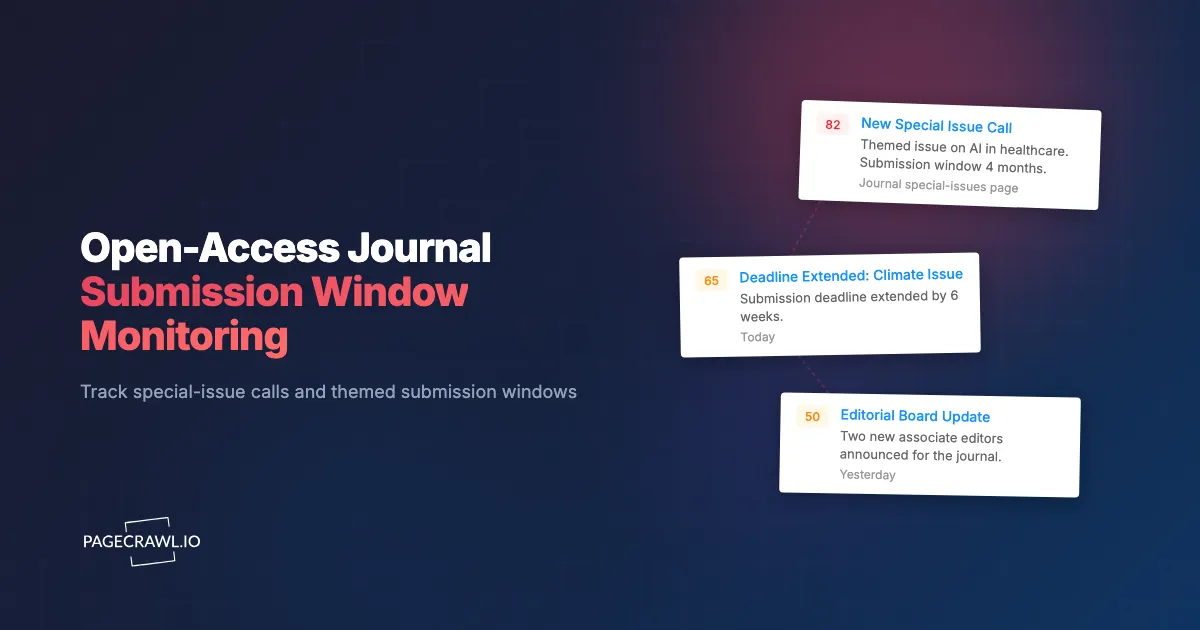
A research group working on a focused topic in environmental science had a strong dataset and a draft manuscript ready for submission, but no clear publication target. Three months after the manuscript was ready, a high-impact open-access journal in their field opened a themed special issue on exactly their topic. The CFP was posted on the journal website on a Wednesday with a 3-month submission window. The group's PI was on conference travel and didn't see the announcement until a colleague mentioned it in passing 6 weeks later. The remaining 6 weeks weren't enough to revise the manuscript to fit the special issue scope (which had specific framing requirements), so the group submitted to the journal's regular track instead, missed the special-issue bump in visibility, and lost the curated peer review and editorial attention that special issues typically receive.
This is the open-access special issue blind spot. Open-access journals (MDPI, Frontiers, PLOS, BMC, Nature Communications, Cell Reports, eLife, and field-specific OA venues) publish themed special issues on continuous schedules, with submission windows typically 3-6 months. Special issues offer better visibility, faster review, and curated editorial attention compared to regular-track submissions. The CFPs are published on the journal special-issues page and announced through journal newsletters, but the newsletter cycle lags the page itself, and the volume of journals plus the volume of special issues per journal exceeds what any individual researcher can manually track.
This guide covers what's monitorable on open-access journal special-issue pages, why direct page monitoring beats newsletter reliance, and how to set up academic research and journal monitoring alerts that surface new special-issue calls within the week they post.
Quick Setup
Pick a journal and topic, we'll alert you when matching special issues open or deadlines shift.
Why does monitoring journal special-issue pages matter?
Monitoring journal special-issue pages matters because themed calls open on the journal's own page first, weeks before newsletters and aggregators repeat them. Submission windows run 3-6 months, which is roughly the same time a manuscript needs. Seeing a call in its first week is what makes the fit worth pursuing.
Special Issues Offer Better Visibility Than Regular Tracks
Articles published in a themed special issue are grouped together on the journal page, cross-promoted as a collection, and often receive coordinated editorial attention and social amplification. A paper published in a relevant special issue typically receives more citations and more visibility than the same paper in the regular submission track.
Submission Windows Are Often Shorter Than Manuscript Prep Time
Special issue submission windows are typically 3-6 months. Manuscript preparation, internal review, and submission readiness often take similar time. Same-week awareness of a CFP opening is necessary to align prep cycles.
Themed Issues Match Specific Research Topics
Special issues are organized by topic and editorial scope. A themed issue on your specific research area is a higher-fit publication path than the regular journal scope.
Editorial Board and Editor Changes Affect Scope and Review
Special issue guest editors are typically established researchers in the topic area. Knowing the editorial team supports relationship-building and informs submission framing.
How do open-access journal special-issue pages work?
Open-access journals publish special issues through a small, predictable set of pages: a special-issues index, one page per themed call, author submission guidelines, and an editorial board listing. Most publishers keep a consistent URL structure for each, which is what makes them straightforward to monitor.
Journal special-issues index page. Most OA journals have a dedicated /special-issues or /topics page listing current and upcoming themed calls.
Specific special-issue CFP pages. Each special issue has its own page with topic scope, submission deadline, and guest editor details.
Author submission pages. Submission portal information is on the main author guidelines page or a dedicated submit page.
Editorial board pages. Journal editorial board listings, often at /editorial-board, show current editors.
Examples across major OA publishers:
https://www.mdpi.com/journal/[journal-name]/special_issues
https://www.frontiersin.org/journals/[journal-name]/research-topics
https://onlinelibrary.wiley.com/page/journal/[journal-id]/homepage/special_issues
When new special issues post or existing CFP details change, the page content reflects the change.
Which monitoring approach catches CFPs earliest?
Direct page monitoring on the journal's own special-issues index is the earliest signal, because that is where the call is published first. Newsletters and mailing lists lag by days or weeks, and aggregator databases like the Directory of Open Access Journals are built for discovery rather than active tracking.
| Approach | Cost | Latency | Coverage | Best For |
|---|---|---|---|---|
| Journal email newsletters | Free with subscription | Days to weeks | Per-journal | Casual awareness |
| Field-specific mailing lists | Free | Variable | Field-aggregated | Established researchers |
| Aggregator databases (DOAJ, ResearchGate) | Free | Variable | Broad but lagging | Discovery rather than active tracking |
| ScholarSphere or similar paid tools | $$ | Variable | Curated | Researchers willing to pay |
| PageCrawl on journal pages | Free tier to $80/yr | 1-7 days | Any URL you choose | Researchers and labs managing active submission targets |
The journal newsletter is useful but slow. Direct page monitoring catches CFP openings within days, supporting realistic manuscript prep cycles.
Setting Up Journal Monitoring in PageCrawl

Step 1: Build your journal tracking list
List the 10-30 open-access journals where you actively submit or might submit. Include field-leading journals, mid-tier specialty journals, and adjacent-field journals.
Step 2: Add the special-issue index page for each journal
For each tracked journal, find the special-issues or research-topics index URL and add it as a content monitor. New special issues appear on this page when they open.
Step 3: Add specific CFP pages for tracked special issues
When you're actively considering or preparing for a specific special issue, add the CFP page as a per-page monitor. This catches deadline extensions, scope clarifications, and editorial team updates.
Step 4: Add editorial board pages for strategic journals
For top-tier journals in your field, add the editorial board page as a low-frequency monitor (monthly). Editorial board changes signal strategic shifts in the journal's positioning.
Step 5: Pick the right check frequency
Journal updates aren't minute-sensitive, and alerts arrive when the next scheduled check picks up the change, so pick a cadence that matches your prep cycle. The guide to check scheduling covers restricting checks to specific days and hours. A reasonable layering:
- Journal special-issue index pages: Weekly checks.
- Specific CFP pages during active prep: Weekly checks.
- Editorial board and aims/scope pages: Monthly checks.
Step 6: Route alerts to a research-lab channel
For research groups and labs, route alerts to a shared Slack channel where the PI and group members can discuss fit and timing; the help centre walks through connecting a Slack incoming webhook. For solo researchers, email or Telegram works.
Worked Example: A Research Group's Special-Issue Tracking
A research group in computational neuroscience covering 4 active research threads set up the following:
- Twenty open-access journal special-issue index pages on weekly checks
- Six specific special-issue CFP pages they were actively considering on weekly checks
- Four field-leading journal editorial board pages on monthly checks
- Three field aggregator and DOAJ pages on weekly checks for broader discovery
- All alerts routed to a shared #publications Slack channel
- Folders organized by research thread
Over an academic year, the group caught 31 special-issue CFPs matching their threads. The PI evaluated each for fit; 9 were forwarded as candidate submission targets; 5 resulted in submitted manuscripts; 3 were accepted. Standard plan cost: $80.
Patterns Worth Watching
Quarterly special-issue cycle peaks. Many major OA publishers post new special-issue calls in March, June, September, and December.
Field-shift special issues. When a research field experiences a paradigm shift (new method, new discovery, new policy area), special issues typically follow within 6-18 months.
Guest editor announcements. Special issues are typically led by guest editors who are established in the topic area. Knowing the guest editor supports manuscript framing and pre-submission outreach.
Deadline extensions on themed issues. Special issues with under-target submission volume extend deadlines, opening additional submission windows for slower-prep work.
Editorial board renewals. Journal editorial board renewals on multi-year cycles can shift the journal's positioning and scope. Catching the renewal informs whether the journal remains the right fit for your research.
Advanced Patterns: Beyond Special Issues
A complete publication strategy monitoring workflow extends past individual journal pages.
Combine with conference CFP monitoring. Conferences and journals together form the publication landscape. The conference CFP monitoring pattern applies.
Combine with funding agency announcements. NIH and NSF funding and grant announcements often inform what topics will see special issues. The NIH and NSF grant monitoring pattern provides upstream signal.
Combine with preprint server monitoring. bioRxiv, arXiv, and ChemRxiv topic pages reflect what's being submitted to journals. Topic-level monitoring informs publication timing decisions.
Combine with journal aims/scope pages. Beyond special issues, journals occasionally update their aims and scope. Monitoring these changes catches strategic shifts that affect submission decisions.
Use Cases
Individual researchers. Same-week awareness of special-issue opportunities in your research area is the primary use case. Catching even one fit special issue per year materially improves publication outcomes.
Research groups and labs. Centralized monitoring across multiple journals and threads reduces lag and improves submission strategy across the group.
Postdocs and early-career researchers. Special issues often offer better visibility than regular tracks, supporting career-building publication strategy.
Department chairs and program directors. Department-level awareness of major special-issue calls supports strategic publication planning across the unit.
Library and research-support staff. Faculty publication support workflows benefit from continuous monitoring of major OA venues.
Journal editors. Peer-journal special-issue timing informs your own publication scheduling and avoids topic conflicts.
Frequently Asked Questions
How many special issues do major OA journals run per year? High-volume publishers can have dozens of special issues open per journal at once, while Frontiers, BMC, and PLOS journals run fewer but more curated themed issues. Field-specific OA venues vary widely, so check the journal's own special-issues index rather than assuming a number.
Are special issues subject to the same peer review as regular tracks? Generally yes. Most reputable OA journals apply identical peer review standards to special-issue submissions, with guest editors managing the process under the journal's standard policies.
Can I propose a special issue? Yes. Most OA journals accept special-issue proposals from researchers. The proposal process is typically described on the journal's editorial pages.
What about article processing charges (APCs)? Special-issue APCs typically match the journal's regular APC. Some journals offer APC waivers for guest editors and contributors. The CFP page usually clarifies.
Do I need a paid plan? For a 5-6 journal tracking list at weekly frequency, the free plan works. For a research group or lab covering 20-40 journals plus aggregator pages, Standard at $80/year is the right tier.
Will I get noise alerts on minor journal page changes? With AI summaries enabled, no. PageCrawl distinguishes between new special-issue postings, deadline changes, editorial board updates, and trivial UI shifts.
Choosing your PageCrawl plan
PageCrawl's Free plan lets you monitor 6 pages with 220 checks per month, which is enough to validate the approach on your most critical pages. Most teams graduate to a paid plan once they see the value.
| Plan | Price | Pages | Checks / month | Frequency |
|---|---|---|---|---|
| Free | $0 | 6 | 220 | every 60 min |
| Standard | $8/mo or $80/yr | 100 | 15,000 | every 15 min |
| Enterprise | $30/mo or $300/yr | 500 | 100,000 | every 5 min |
| Ultimate | $99/mo or $999/yr | 1,000 | 100,000 | every 2 min |
Annual billing saves two months across every paid tier. Enterprise and Ultimate scale up to 100x if you need thousands of pages or multi-team access.
In event-driven strategies, minutes matter. One actionable signal surfaced before the broader market reacts can return more than a year of Ultimate. Standard at $80/year covers the core IR, press, and filings pages for a handful of positions. Enterprise at $300/year scales to a full watchlist.
Getting Started
List the 10-15 open-access journals where you actively submit or might submit. Add each journal's special-issue index page to PageCrawl on weekly checks. Create a free account and route alerts to a shared lab Slack channel or personal email.
Over the first quarter, you'll see how many special-issue CFPs match your research and develop a feel for which journals produce material signal. Once you see the value, expand to cover specific CFP pages during active prep, editorial board pages for top-tier journals, and aggregator pages for broader discovery. The Standard plan at $80/year handles a serious research-group publication-strategy program.