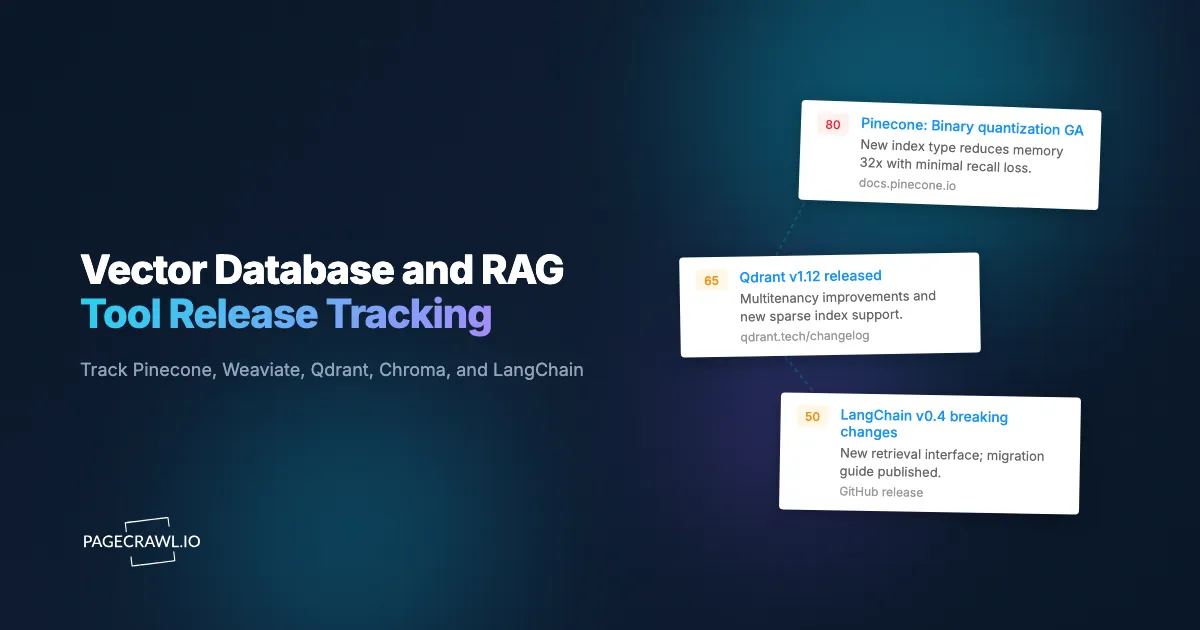
In September 2023, Qdrant rolled out binary quantization. The release dropped recall by a few percentage points on most embedding models but cut storage costs by roughly 32x, since each 32-bit float in a vector collapses to a single bit. Teams running RAG at scale who were already monitoring Qdrant's changelog had A/B benchmarks running within the first week. The teams who found out two months later through a casual Hacker News thread had already paid for two extra months of vector storage at the old cost basis.
The vector database and RAG tooling space ships faster than any other layer of the modern AI stack. Pinecone, Weaviate, Qdrant, Chroma, Milvus, and LanceDB all release every few weeks with new index types, breaking client changes, performance improvements, and pricing updates. On the orchestration side, LangChain, LlamaIndex, Haystack, and LiteLLM ship even faster, sometimes daily. For AI platform teams running a production RAG pipeline, same-week release awareness is the difference between a planned upgrade and an emergency patch.
This guide covers how the major vector DB and RAG release channels work, the patterns worth watching for, and how to set up a continuous monitor that surfaces every meaningful release across your stack within hours of publication.
Quick Setup
Pick which vector databases and RAG frameworks to track, and preview your release-note and breaking-change alerts.
Why should you monitor vector DB and RAG releases?
Because a single release can change your cost-recall economics, break a client integration, or add an embedding provider you have been waiting for, and none of that reaches you unless someone is watching the release notes and changelog pages. The pace of change in this space is too fast for ad-hoc tracking. A release lands, your team finds out three weeks later, and by then the recommended upgrade path has shifted again. A continuous monitor turns that chaos into a predictable weekly review cycle.
New Index Types Change Cost and Recall Economics
HNSW parameter improvements, scalar quantization, binary quantization, product quantization, and IVF variants all materially shift the cost-recall curve. A new index type from your vector DB can move your monthly bill substantially or shift your top-K recall by several percentage points. Worth knowing about before the bill arrives or the relevance metrics drift.
Breaking Client Library Changes Affect Production Integrations
Vector DB clients are not always semver-strict. A minor version bump can change function signatures, default behaviors, or response shapes. Catching breaking changes before they hit your dependabot PR is the difference between a planned migration and a Friday outage.
New Embedding Model Integrations Affect Provider Choice
When Pinecone adds first-class support for a new embedding provider or Weaviate ships a new module, your embedding choice and ingest pipeline gain new options. These rarely make headlines but routinely unlock quality improvements.
Performance and Pricing Updates Drive Architecture Decisions
Pricing changes, free-tier limits, and benchmark improvements all factor into longer-term architecture choices. Learning that a managed vector service has expanded its free tier or introduced a serverless plan matters when you are evaluating where to land your next workload.
How do these tools publish their releases?
Most vector DBs and RAG frameworks publish releases through one of three channels: a dedicated docs changelog page, GitHub releases, or a hosted blog. The canonical URLs are stable and addressable:
https://docs.pinecone.io/release-notes
https://docs.weaviate.io/weaviate/release-notes/
https://qdrant.tech/changelog/
https://github.com/chroma-core/chroma/releases
https://github.com/langchain-ai/langchain/releases
https://github.com/run-llama/llama_index/releases
https://github.com/milvus-io/milvus/releases
https://github.com/lancedb/lancedb/releases
https://github.com/BerriAI/litellm/releases
GitHub releases pages list each release with its version number, date, and full release notes, and each of these repositories publishes the same list as an Atom feed at github.com/{owner}/{repo}/releases.atom. PageCrawl's Feed mode reports each new release in that feed as its own item. The feed also includes pre-releases (betas and release candidates) and tags that have no Release. You can also paste the GitHub releases pages above into Track New Page as they are: PageCrawl follows the same feed. Docs-based changelogs put new entries at the top of the page, and PageCrawl detects them as a content change.
Which release monitoring approach should you choose?
Pick GitHub Watch if you track a single GitHub-hosted project, Dependabot or Renovate if you only care about the upgrade PR, and a page monitor if you need docs changelogs, blogs, and GitHub releases in one place routed to a team channel. The table compares the trade-offs.
| Approach | Cost | Latency | Coverage | Best For |
|---|---|---|---|---|
| Manual checking | Free | Variable | Per-tool | Hobbyist tracking |
| GitHub watch (Releases) | Free | Minutes | GitHub-hosted only | Single-tool tracking |
| RSS via reader | Free | Hours | Tools with feeds | Personal use |
| Dependabot / Renovate | Free | Daily | Repos you build from | Production upgrade gating |
| PageCrawl | Free tier to $80/year | 15-60 minutes | Any release page | Multi-tool, multi-channel routing |
GitHub Watch is the standard answer but produces email noise, does not route to Slack or webhooks natively, and only covers GitHub-hosted projects. Dependabot is useful for the actual upgrade PR but does not surface architectural information from the release notes themselves. PageCrawl sits between the two: it tells you what changed, routes the alert where your team already works, and supports both GitHub releases and API and documentation pages.
Setting Up Vector DB and RAG Monitoring in PageCrawl

Step 1: Inventory your stack
List every vector DB, embedding provider, and orchestration framework your production RAG pipeline depends on. For most teams this is 4-8 components. Add any inference frameworks (vLLM, TGI) and adjacent infra (Redis vector, pgvector, Elasticsearch vector) if they are in the path.
Step 2: Add each release feed or changelog page
Sign in to PageCrawl, click Track New Page, and paste each release URL. For GitHub releases, use Feed mode: under Alert me about:, Items added is always on, so every new release is reported as its own item, and the first check records the existing releases as a baseline without alerting. For docs changelogs, use Full Page Text with Content only, and PageCrawl detects new entries at the top of the page. The help centre guide to monitoring GitHub and GitLab repositories covers tag and commit feeds and raw file addresses too.
Step 3: Pick a check frequency
Releases are not minute-sensitive but you want same-day awareness. Reasonable defaults:
- Awareness only: 60-minute checks (Free plan). Catches everything within an hour.
- Production platform team: 15-minute checks (Standard plan). Same-morning awareness for releases that drop overnight in another timezone.
- High-velocity research: 5-minute checks (Enterprise plan). Useful when you are actively riding the bleeding edge of a specific framework.
Step 4: Wire alerts to your AI platform channel
A #ai-platform-releases Slack or Discord channel keeps the team in one place. Use the Slack alerts guide for the walkthrough, or the help centre steps for sending change notifications to a Slack channel if you are wiring up the incoming webhook yourself. PageCrawl's AI change summaries describe what shipped in the release without making you open the changelog page.
Step 5: Pair with model integration providers
Add LiteLLM, LlamaIndex, and any orchestration framework release pages you depend on as siblings. Cross-stack releases sometimes overlap (a new embedding provider supported by LiteLLM in the same week as a new Pinecone index type) and the cluster reveals natural upgrade moments.
Step 6: Tag and group by layer
Use PageCrawl folders to organize monitors by layer: vector-db, embedding-provider, orchestration, inference. The guide to labels, folders, and workspaces covers nesting and per-workspace notification settings if different layers belong to different teams. The folder view at a glance shows you which layer is moving fastest, which is sometimes a leading indicator of where the next architecture decision will land.
Worked Example: A Full Production RAG Stack Watch
A typical AI platform team running production RAG monitors something like:
- Vector DB: Pinecone release notes, Qdrant changelog, Weaviate release notes (3 monitors).
- Embedding providers: OpenAI changelog, Cohere release page, Voyage AI changelog (3 monitors).
- Orchestration: LangChain releases, LlamaIndex releases, LiteLLM releases (3 monitors).
- Inference: vLLM releases, TGI releases (2 monitors).
- Adjacent: pgvector releases, Redis Stack releases (2 monitors).
Total: 13 monitors at 15-minute checks. Total cost: $80/year on the Standard plan. Setup time: about 20 minutes. The team gets a single Slack channel showing every release across the stack with AI summaries describing what changed.
Patterns Worth Watching For
Breaking changes in minor releases. Some projects (LangChain especially) ship breaking changes in non-major versions. Catching these in the release notes before the dependabot PR opens lets you plan the migration rather than rush it.
New quantization or index features. Binary quantization, scalar quantization, matryoshka embeddings, and new index types like DiskANN routinely change cost-recall tradeoffs by a meaningful amount. Worth a benchmark cycle.
Default behavior changes. Default model changes, default chunking changes, and default similarity-metric changes often go unmentioned in the release headline. Reading the full release notes catches these before they affect retrieval quality.
New embedding model support. When your vector DB or orchestration framework ships first-class support for a new embedding model, that often unlocks a quality experiment that was previously stuck.
Pricing or free-tier changes. Cost economics for vector storage and embedding inference move regularly. Worth tracking even if you are not actively re-evaluating providers.
Combining Release Monitoring With Other Signals
The full picture comes from layering release monitoring with other AI infrastructure signals.
Combine with HuggingFace model releases. Pair with our HuggingFace Hub model release monitoring guide. New embedding models often appear on HuggingFace first and are added to vector DB integrations weeks later.
Combine with API provider changelogs. Add OpenAI, Anthropic, Cohere, and Google docs changelogs as siblings. Embedding API changes from upstream providers ripple through your vector pipeline quickly.
Combine with cloud provider AI service releases. Bedrock, Vertex AI, and Azure OpenAI all publish service-level changes that affect production RAG infrastructure choices.
Combine with GitHub issue activity on the underlying repos. For high-velocity OSS projects, the issue tracker often surfaces breaking changes before they land in releases.
Use Cases
AI platform engineering. Same-week release awareness supports planned upgrade cycles rather than reactive patching. The team can budget one focused upgrade morning per week instead of fire-fighting throughout.
RAG product teams. New features in the stack often unblock previously-stuck quality experiments. Knowing within the week that a new index type is available means the experiment lands in the next sprint, not the next quarter.
Cost optimization. Pricing changes and quantization improvements directly affect cost-per-query. Continuous awareness lets ops teams pick up cost wins as they ship.
Vendor evaluation. Teams actively evaluating vector DBs use continuous release tracking to weight roadmap velocity into their choice. A vendor releasing weekly is a different commitment than a vendor releasing twice a year.
Research teams. Researchers building on RAG infrastructure benefit from same-week awareness of new capabilities that affect experimental design.
Compliance and security. CVE-disclosed releases for vector DBs require same-week patching in regulated environments. Continuous monitoring keeps these out of the next pentest report.
Frequently Asked Questions
How quickly do new releases appear on the release pages? Within minutes of the GitHub tag or docs publish. PageCrawl picks up the change on the next check cycle.
Can I monitor only major releases and skip patch releases? PageCrawl alerts on every detected change. AI change summaries describe the release scope so you can scan and skip patches quickly without opening the page.
Do GitHub release pages render reliably? Yes, and the release feed (github.com/{owner}/{repo}/releases.atom) is the most reliable way to follow them, one item per release. Do not treat its first entry as the latest stable release, though: the feed also lists pre-releases and tags without a Release, and it is ordered by day rather than by exact publish time. Each alert lists the new releases by name, which usually makes a release candidate easy to tell apart from a stable release.
What about projects that publish on a blog instead of a changelog? Add the blog index page. New blog posts appear as new entries and PageCrawl detects them. Some teams (Weaviate, Pinecone) publish significant release context on their blog separately from the changelog.
Can I get a weekly digest instead of an alert for each change? Configure PageCrawl notifications to a daily or weekly digest channel. The AI summaries combine well into a weekly platform review.
Do I need a paid plan to start? No. The Free plan is enough to try release tracking on a core vector DB plus the orchestration layer. Standard at $80/year supports the full multi-layer stack with 15-minute checks.
Choosing your PageCrawl plan
PageCrawl's Free plan lets you monitor 6 pages with 220 checks per month, which is enough to validate the approach on your most critical pages. Most teams graduate to a paid plan once they see the value.
| Plan | Price | Pages | Checks / month | Frequency |
|---|---|---|---|---|
| Free | $0 | 6 | 220 | every 60 min |
| Standard | $8/mo or $80/yr | 100 | 15,000 | every 15 min |
| Enterprise | $30/mo or $300/yr | 500 | 100,000 | every 5 min |
| Ultimate | $99/mo or $999/yr | 1,000 | 100,000 | every 2 min |
Annual billing saves two months across every paid tier. Enterprise and Ultimate scale up to 100x if you need thousands of pages or multi-team access.
At an engineering hourly rate, Standard at $80/year pays for itself the first time you catch a breaking API change, a deprecated endpoint, or a silent config change before it takes down production. 100 monitored pages is enough to cover the changelogs and docs of every third-party API your stack depends on. Enterprise at $300/year adds 5-minute checks and 500 pages. All plans include the PageCrawl MCP Server, which plugs directly into Claude, Cursor, and other MCP-compatible tools. Developers can ask "what changed in the Stripe API docs this month?" and get a summary pulled from your own monitoring history. AI assistants can create monitors through conversation on every plan, including Free, turning your tracked pages into a living knowledge base instead of a pile of alert emails.
Getting Started
Add the release pages for the vector DBs and RAG frameworks in your stack to PageCrawl on a daily check. Create a free account and the next release will arrive in your AI platform channel the day it ships.