Consider a familiar pattern in device safety: the FDA issues a Class I recall on a specific lot of intra-aortic balloon pumps after a cluster of adverse event reports has quietly accumulated in MAUDE over the preceding months. Hospitals that had been monitoring MAUDE for their device inventory noticed the cluster forming weeks before the formal recall and had already begun risk-stratifying their fleet. Hospitals that learned of the recall through the FDA Class I alert had to scramble: identify affected units, pause cases, contact the manufacturer for replacement timelines, and communicate with patients who had received the device.
The FDA publishes medical device adverse events in the MAUDE database and recalls in the Medical Device Recalls list. These are the primary public sources for medical device safety signals. Hospitals, manufacturers, group purchasing organizations, and clinical researchers all use them as foundational inputs to safety, procurement, and competitive intelligence. The FDA does not push notifications for either database. Safety signals often appear in MAUDE weeks or months before a formal recall, and recalls themselves require same-day operational response.
This guide covers how MAUDE and the recall list work, the patterns worth watching for, and how to set up a continuous monitor that surfaces relevant adverse events and recalls into your risk channel the day they post.
Quick Setup
Pick the device classes and specialty areas you cover, and PageCrawl will alert your safety, regulatory, or procurement team as soon as a check picks up new FDA recalls or adverse-event spikes.
Why should hospitals monitor MAUDE and the FDA recall list?
Because safety signals on medical devices often appear in MAUDE weeks or months before a formal recall, and neither database sends notifications. Watching both gives risk, biomed, and procurement teams lead time to risk-stratify a fleet before a Class I notice forces an overnight response. Always verify device status on the official FDA pages before clinical action; this article is informational, not clinical or regulatory advice.
Adverse Event Cluster Patterns Predict Recalls
When adverse event reports for a specific device cluster over a short period, the device often heads toward a recall or field safety notice. Continuous MAUDE monitoring catches the cluster early, giving risk teams lead time on potential operational response.
Class I, II, and III Recalls Require Differentiated Response
Class I recalls (serious health consequences or death) require immediate device removal and patient notification. Class II recalls involve products that may cause temporary or medically reversible adverse health consequences, where the probability of serious adverse consequences is remote. Class III recalls involve products unlikely to cause adverse health consequences (often technical or labeling defects). Same-day awareness of recall class is essential for appropriate operational response.
Updated Recall Scope Adds Additional Lots or Products
Recalls are frequently expanded as the manufacturer investigates. Initial recall scope often broadens to include additional lots, additional products, or earlier production dates. Monitoring the recall page catches the scope expansion as it happens.
Manufacturer Field Notices Sometimes Precede Recalls
Manufacturer-initiated field safety notices and corrections sometimes precede formal recalls. These are visible on the FDA recall page and provide leading indication of potential recall escalation.
How do MAUDE and the FDA recall list work?
MAUDE is the FDA's register of reported device adverse events, searchable by device, manufacturer, product code, or event type. The Medical Device Recalls list is a separate register of recall actions with class, date, manufacturer, and affected product details. Both are public, both update on the FDA's schedule, and both are addressable at stable URLs:
https://www.fda.gov/medical-devices/medical-device-safety/medical-device-recalls
https://www.accessdata.fda.gov/scripts/cdrh/cfdocs/cfmaude/
The recall page lists current and recent recalls with class, date, manufacturer, and affected product details. MAUDE search results can be filtered by device, manufacturer, product code, or event type with filter state captured in the URL.
Each individual recall has a detail page with full scope, affected lots, and action instructions. Monitor specific recall pages for scope changes once a recall affects your inventory.
Comparing Monitoring Approaches
| Approach | Cost | Latency | Coverage | Best For |
|---|---|---|---|---|
| Manual FDA checks | Free | Days | Per-device | Casual checking |
| FDA email subscriptions | Free | Inconsistent | Class I only | Backup awareness |
| ECRI Institute alerts | $$$ | Hours | Comprehensive | Large hospital systems |
| MD&DI / RAPS digest | Free / paid | Daily | Industry context | Regulatory professionals |
| PageCrawl on FDA URLs | Free tier to $80/year | Daily | Any FDA page | Hospitals and manufacturers wanting reliable alerts |
ECRI provides comprehensive device safety intelligence but at enterprise pricing. PageCrawl gives mid-sized hospitals and manufacturers the core "alert me on relevant recalls" capability at a fraction of the cost.
Setting Up Device Recall Monitoring in PageCrawl

Step 1: Add the FDA Medical Device Recalls page
Sign in to PageCrawl, click Track New Page, and paste https://www.fda.gov/medical-devices/medical-device-safety/medical-device-recalls. New recalls appear as new entries.
Step 2: Add MAUDE search pages for high-volume devices
Build MAUDE searches filtered by device or manufacturer for your high-volume or high-risk inventory. Copy each search URL and add as a monitor.
Step 3: Add specific recall detail pages once a recall affects you
Once a recall is published that affects your inventory, monitor the specific recall detail page to catch scope expansion.
Step 4: Pick a check frequency
Recall updates are not minute-sensitive but same-day awareness matters for Class I responses.
- Awareness only: Daily checks on the main recall page.
- Active recall response: 60-minute checks on specific recall pages with active scope expansion.
- Large hospital system: 15-minute checks on the main recall page for fastest awareness.
Step 5: Wire alerts to risk and biomed channels
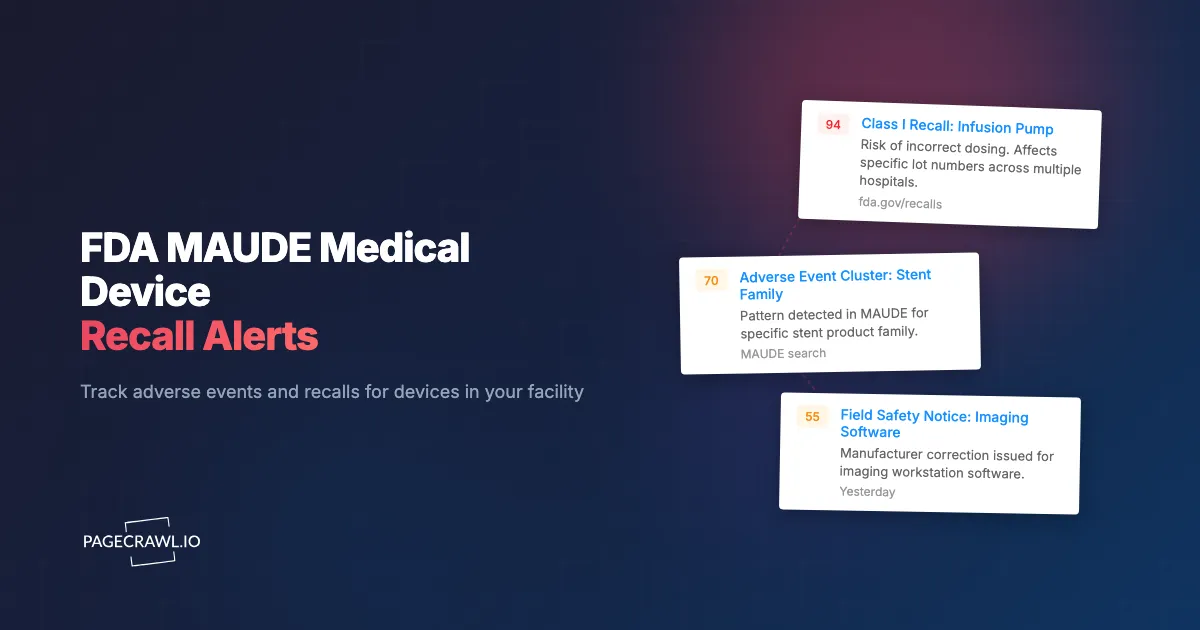
Route to a #device-safety Teams or Slack channel. Alerts go out as soon as a check detects the change, so the delivery window follows the frequency you set in Step 4. PageCrawl's AI change summaries describe the device and recall class so risk managers can triage quickly, and notification conditions and filters let you restrict alerts to keywords like a product code or a manufacturer name.
Step 6: Group by clinical area
Use PageCrawl folders to organize device monitors by service line: cardiology, surgery, imaging, infusion, anesthesia. Each clinical service subscribes only to relevant alerts. The guide to organizing monitored pages with labels, folders, and workspaces shows how to nest service lines under a single device-safety workspace.
Worked Example: A Mid-Sized Hospital's Device Safety Watch
A 500-bed hospital typically sets up:
- Add the main FDA Medical Device Recalls page (1 monitor).
- Add MAUDE searches for top 10 device manufacturers or product codes in inventory (10 monitors).
- Add active recall detail pages as they affect inventory (rolling, 2-5 typical).
- Set frequency to daily on main page, 60 minutes on active recall pages.
- Route alerts to
#device-safety-watchTeams channel with clinical service tags.
Total: 13-16 monitors. Total cost: $80/year. Risk and biomed teams get continuous awareness with a single channel.
Patterns Worth Watching For
Class I recalls in your inventory. Highest priority. Same-day awareness drives immediate device removal protocols.
Adverse event clusters. When MAUDE shows a cluster of similar events for a single device, the device may be heading toward recall. Worth flagging for proactive risk-stratification.
Expanded recall scope. When a recall adds lots or products, your inventory exposure may change. Monitor active recall pages for scope updates.
Manufacturer corrections and field safety notices. These often precede formal recalls and provide leading indication.
Same-manufacturer multi-product recalls. When several products from one manufacturer recall simultaneously, the underlying issue is structural and may affect more products.
Combining Device Recall Monitoring With Other Healthcare Signals
Device safety is most actionable in the broader healthcare safety context, alongside drug-side signals like boxed warning and drug label monitoring.
Combine with drug shortage monitoring. Pair with our FDA drug shortage list monitoring guide for cross-cutting supply and safety awareness.
Combine with EMA/MHRA monitoring. Pair with our EMA and MHRA drug approval monitoring guide for international device regulatory context.
Combine with formulary monitoring. Pair with our health insurance marketplace plan and formulary monitoring guide for payer-side coverage changes.
Combine with manufacturer safety pages. Many manufacturers publish safety communications on their own sites. Monitor for high-impact device lines.
Combine with international device regulator pages. Health Canada, the UK MHRA, and Australia's Therapeutic Goods Administration publish recall information that often parallels FDA action.
Use Cases
Hospital risk and biomed. Same-day awareness supports device removal, patient notification, and biomed inventory action. Most hospitals find the cost recovers itself the first time the team gets ahead of a Class I recall by even a day.
Group purchasing organizations. Recall monitoring across member catalogs supports member alerts and coordinated response.
Device manufacturers. Competitor recall intelligence informs commercial strategy and product positioning, which is competitive intelligence monitoring applied to the safety record rather than the price list. Manufacturer safety teams monitor competitor recalls as part of broader market intelligence.
Clinical research. Adverse event signals affect ongoing clinical trial design and IRB safety reporting obligations.
Health system supply chain. Multi-hospital systems coordinate recall response across facilities for system-wide awareness.
Health system legal and compliance. Documented monitoring of device safety supports defensive positioning in product liability and patient safety cases, and pairs with court docket and litigation monitoring on the cases themselves.
Frequently Asked Questions
How quickly do recalls appear on the FDA page? Class I recalls typically appear within hours of FDA classification. Class II and III may take a day or two for full publication.
Can I monitor specific MAUDE search URLs? Yes. MAUDE search URLs capture filter state and can be monitored. Each new event matching the filter appears as a new row.
What about international device regulators? Health Canada, MHRA, and TGA all publish device safety information on their own pages. Add as siblings for international coverage.
Can I monitor specific manufacturers? Yes. Both the recall page and MAUDE search support manufacturer filters. Build filtered URLs and monitor.
Does the FDA publish device safety updates on weekends? Generally no, except for emergency Class I recall communications.
Do I need a paid plan for device safety monitoring? The free plan supports 6 monitors, enough for the main recall page plus a few high-volume devices. Standard at $80/year supports a full inventory watch.
Choosing your PageCrawl plan
PageCrawl's Free plan lets you monitor 6 pages with 220 checks per month, which is enough to validate the approach on your most critical pages. Most teams graduate to a paid plan once they see the value.
| Plan | Price | Pages | Checks / month | Frequency |
|---|---|---|---|---|
| Free | $0 | 6 | 220 | every 60 min |
| Standard | $8/mo or $80/yr | 100 | 15,000 | every 15 min |
| Enterprise | $30/mo or $300/yr | 500 | 100,000 | every 5 min |
| Ultimate | $99/mo or $999/yr | 1,000 | 100,000 | every 2 min |
Annual billing saves two months across every paid tier. Enterprise and Ultimate scale up to 100x if you need thousands of pages or multi-team access.
Compliance monitoring is the cheapest insurance you can buy. A single missed regulatory change can trigger fines in the tens or hundreds of thousands, not to mention the audit overhead of proving you did not see it coming. Enterprise at $300/year covers 500 regulatory pages with unlimited history and timestamped screenshots, which is usually exactly what an assessor wants to see. All plans include the PageCrawl MCP Server, so your compliance team can ask Claude to summarize every change to a specific regulation over the last quarter and pull the exact diff, turning your monitoring history into a queryable audit trail. AI assistants can create monitors through conversation on every plan, including Free. Standard at $80/year is enough to cover 100 pages across your primary regulatory bodies if your program is smaller.
Getting Started
Add the FDA Medical Device Recalls page plus MAUDE search URLs for your top devices to PageCrawl on a daily check. Create a free account and the next recall or adverse event will arrive in your risk channel the day it posts.