Consider a pattern that repeats every few months: a coalition of state attorneys general files coordinated enforcement actions against a major platform over child safety design. One office posts its press release on a Tuesday morning. The California, New York, and Massachusetts releases follow within hours, each adding state-specific claims. Companies in the adjacent sector that already monitored AG press pages had general counsel briefings drafted by end of day. Companies that found out through the trade press on Thursday were two news cycles behind on a story their customers were already asking about.
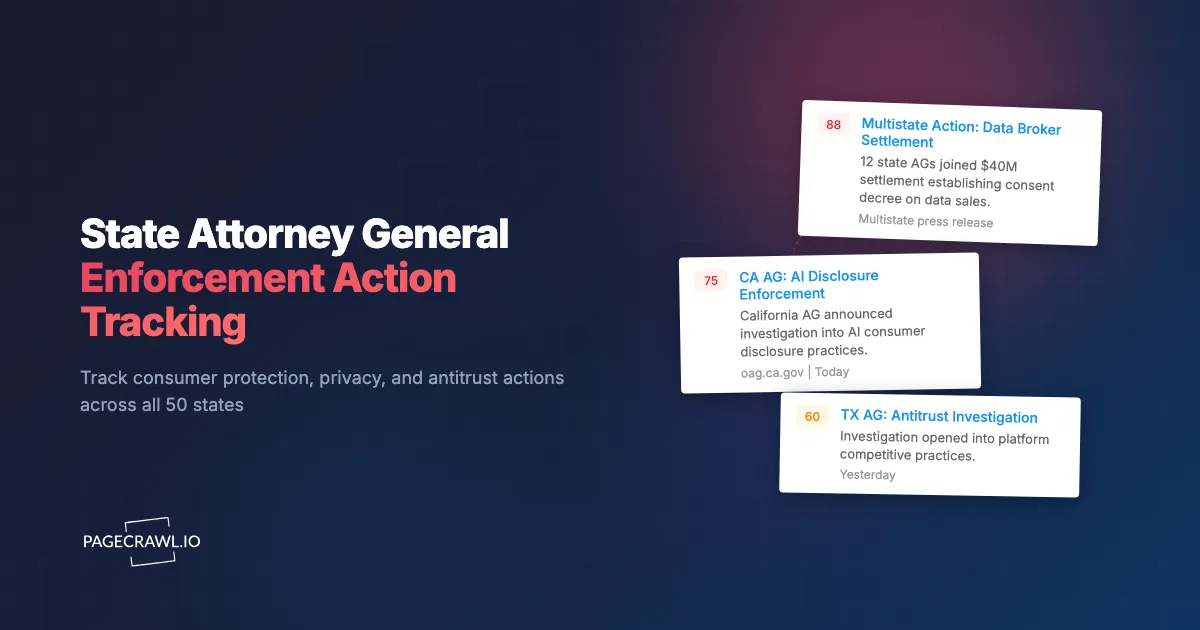
State attorneys general have become some of the most active enforcers in the US on consumer protection, privacy, antitrust, and AI policy. Each of the 50 AG offices publishes enforcement actions, settlements, and investigations on its own press page, on its own schedule, with no central feed and no consistent format. For in-house legal teams, policy teams, and outside counsel, monitoring all 50 sites manually is impractical, and the email subscriptions that some AG offices offer are inconsistent and noisy.
This guide covers how state AG press pages work, the patterns worth watching for, and how to set up a continuous monitor that puts every relevant enforcement action into your legal channel the day it lands, across whichever subset of states matters to your business.
Quick Setup
Pick the states you care about, the topics that matter (privacy, antitrust, consumer protection, AI), and PageCrawl will alert you each time those AG offices publish a new press release or enforcement action.
Why should you track state AG enforcement actions?
Because state AG actions move faster than federal enforcement, reach narrower industries, and increasingly set the template for what federal regulators do later. Same-day awareness gives legal, policy, and marketing teams a working day to prepare a position before the story reaches the trade press or a customer inbox.
Privacy and Data Security Cases Set Industry Templates
State AGs (California, New York, Texas, Washington) routinely settle data security cases with consent decrees that establish multi-year compliance obligations. These templates spread quickly across the industry as compliance teams adopt them defensively. Same-day awareness of a relevant consent decree lets your team get ahead of the question general counsel is about to ask.
Antitrust Investigations Often Precede Federal Action
Multistate antitrust investigations sometimes precede DOJ or FTC action by months. The state AG announcements signal the direction federal enforcement is likely to go, giving affected companies meaningful lead time to prepare.
Consumer Protection Settlements Establish Marketing and Claim Standards
Settlement language in consumer protection cases (especially around health claims, advertising substantiation, and deceptive design) becomes the practical standard for what is and is not acceptable. Marketing legal review benefits enormously from being current on what state AGs have recently challenged.
Multistate Actions Signal Coordinated Enforcement Priorities
When 10 or 20 state AGs file a coordinated action, the underlying concern has reached enforcement consensus. Multistate actions are leading indicators of where federal rulemaking is likely to go.
How do state AG press pages work?
Every state AG office publishes a press releases or news page at a stable URL, and that page is the primary source: it lists recent releases in reverse chronological order with a title, date, and brief summary. The offices for California, New York, and Texas all follow this shape. Examples:
https://oag.ca.gov/news
https://ag.ny.gov/press-releases
https://www.texasattorneygeneral.gov/news/releases
https://www.mass.gov/news/press-releases
https://www.michigan.gov/ag/news
Some offices also publish dedicated enforcement, investigation, or settlement pages separate from the general press feed. Where these exist, they are the highest-signal pages to monitor. Most offices update during business hours in their respective time zones, with new releases appearing within minutes of distribution.
Comparing Monitoring Approaches
| Approach | Cost | Latency | Coverage | Best For |
|---|---|---|---|---|
| Manual checking | Free | Days | Per-state | Single-jurisdiction focus |
| AG email subscriptions | Free | Hours to daily | Inconsistent | Light awareness |
| Bloomberg Law / Westlaw | $5K+/year | Hours | Full + analysis | Large law firms |
| State AG RSS (where available) | Free | Hours | Limited | Personal use |
| LexisNexis State Net | $K+/year | Hours | Comprehensive | Government affairs teams |
| PageCrawl on AG pages | Free tier to $300/year | Hours | Any AG page | In-house legal and mid-market firms wanting consistent multi-state coverage |
The major legal research platforms cover this well but at price points that make sense only for large firms. PageCrawl provides the core "alert me on relevant AG actions" capability for a fraction of the cost, and works for any AG page you can point at.
Setting Up AG Monitoring in PageCrawl

Step 1: Pick your target states
For most businesses, the relevant universe is 10-15 states: the largest markets (CA, NY, TX, FL, IL), the most active enforcement offices (CA, NY, MA, WA, DC), and any states where you have material operations or customer base.
Step 2: Find each state's press page
Each AG office publishes at a stable URL. Most are obvious (oag.ca.gov/news, ag.ny.gov/press-releases). Some require a couple of clicks to find. Bookmark each URL.
Step 3: Add each press page as a content monitor
Sign in to PageCrawl, click Track New Page, and paste the URL. Choose content monitoring so the press release list is tracked. New releases appear as new entries on the page.
Step 4: Pick a check frequency
AG enforcement is not minute-sensitive. Daily or hourly checks are usually sufficient.
- Awareness only: Daily check is enough for most legal teams.
- Active policy monitoring: 60-minute checks for same-business-hour awareness.
- Crisis response or high-exposure sector: 15-minute checks so a release is in your channel within the same hour it posts.
Step 5: Wire alerts to legal channel
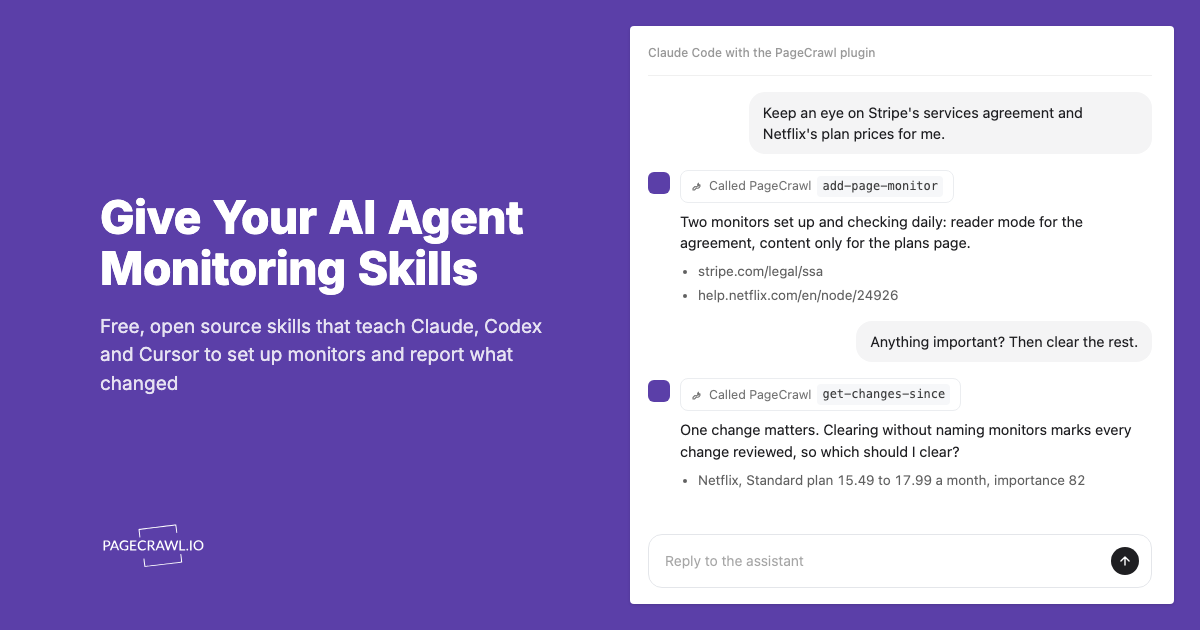
Most legal teams route to a #regulatory-alerts or #ag-watch Slack/Teams channel. PageCrawl's AI change summaries describe the new press release in one sentence so legal can triage by topic. See the email alerts setup guide and Slack alerts guide for channel-specific walkthroughs.
Step 6: Group by region or topic
Use PageCrawl folders to organize by region (Northeast, West, South, Midwest) or by practice area (privacy, antitrust, consumer protection). Each lawyer subscribes to the folders relevant to their practice. The help centre covers how labels, nested folders, and workspaces fit together if you are structuring a watch list for more than one practice group.
Worked Example: A SaaS Company's AG Watch
A mid-sized B2B SaaS company with national customers typically sets up something like this:
- Add press pages for the 15 largest-market states (10 monitors for the largest, 5 for next-tier).
- Add the National Association of Attorneys General (NAAG) press page for multistate action coverage (1 monitor).
- Add the dedicated enforcement pages for CA OAG and NY OAG (which publish enforcement separately from general press) (2 monitors).
- Set frequency to daily for most, 60 minutes for CA and NY.
- Route alerts to
#legal-alertsSlack channel. - Tag everything by practice area for filtering.
Total: 18 monitors at mixed frequency. Total cost: $80/year on the Standard plan. The legal team gets a continuous stream of state AG actions filtered by relevance, with the option to dig into specific monitors when an action requires deeper review.
Which AG announcements are worth watching for?
Five categories carry the most signal: settlements and consent decrees, multistate coalition filings, investigation announcements, amicus briefs in federal cases, and formal guidance documents. Each one tells you something different about where enforcement is heading, and all five appear on the same press pages you are already monitoring.
Settlement and consent decree announcements. These establish industry templates and often signal where future enforcement is going. Watch for industry-specific language that may spread to other AGs.
Multistate coalition actions. When five or more state AGs file together, enforcement consensus has crystallized. Multistate filings are the strongest signal of where federal action is likely to follow.
Investigation announcements. Some state AGs publish investigation announcements even before charges. These reveal at-risk sectors months ahead of formal action.
Amicus briefs in federal cases. State AGs file amicus briefs in federal cases that signal their enforcement priorities. Worth tracking even though they are not enforcement actions themselves.
Policy statements and guidance documents. Some state AGs publish guidance documents that function as informal rulemaking. California's privacy guidance is a recurring example.
Combining AG Monitoring With Other Compliance Signals
State AG actions are most actionable in the context of broader regulatory signals.
Combine with FTC enforcement. Pair with our FTC consent order tracking guide and the Federal Trade Commission newsroom itself. State AGs and the FTC often coordinate or echo each other on consumer protection issues.
Combine with sanctions monitoring. Pair with our OFAC and EU sanctions list change alerts guide. NY DFS in particular often pursues sanctions-adjacent enforcement.
Combine with federal procurement. Pair with our SAM.gov federal contract opportunity monitoring guide if state contracts or grants are also relevant.
Combine with state legislature tracking. State AG enforcement often pairs with new state law. Monitoring relevant state legislature pages catches legislative changes that may trigger AG enforcement priorities.
Combine with industry trade press. Add key sector trade publications as siblings to catch industry context around AG actions.
Use Cases
In-house legal and compliance. Same-day awareness of relevant state AG actions supports policy review, marketing review, and product change decisions. Most legal teams find the cost of monitoring is recovered the first time the team gets ahead of a customer or board question by a day.
Privacy and AI policy teams. State AG enforcement is currently one of the most active sources of US privacy and AI guidance. Continuous monitoring is essentially a job requirement for in-house privacy counsel.
Outside counsel. Continuous monitoring supports proactive client advisories, which differentiate firms competing on responsiveness. Many firms now run AG watch as a standard client service alongside docket, opinion, and enforcement tracking.
Government affairs and policy. AG actions inform federal advocacy positions and state-level engagement. Government affairs teams use multistate action tracking as a leading indicator of federal regulatory direction, paired with regulatory intelligence across agencies and jurisdictions.
Trade associations. Industry associations monitor AG actions to issue member alerts and coordinate industry response.
Academic and policy research. Researchers studying state-level enforcement trends use continuous AG monitoring to build their dataset.
Frequently Asked Questions
How quickly do AG press releases appear on the press page? Within minutes of internal distribution. Most state AG offices push to their press page as the first step in announcing an action.
Can I monitor multiple states with a single tool? Yes. PageCrawl monitors any number of state AG pages in parallel and routes alerts to a single channel.
What if an AG office has multiple press pages (general, enforcement, settlements)? Monitor all relevant pages. Many offices publish enforcement actions on a dedicated page separate from general press, and the enforcement page is usually higher-signal.
Do all 50 state AGs publish regularly? No. Activity varies significantly. The most active offices (CA, NY, MA, TX, WA, IL, MI, DC, PA, FL) publish weekly or more. Smaller states may publish monthly or less.
Can I get only privacy-related alerts and skip the rest? PageCrawl alerts on every change by default, but notification conditions and keyword filters let a monitor fire only when a release mentions terms like privacy, data breach, or CCPA. AI change summaries describe the topic as well, so you can filter a second time in your alert channel.
Is an AG alert enough to act on? No. An alert tells you an office published something relevant and gives you the diff and a timestamp. Always read the underlying release and filings on the issuing office's own site before advising anyone; this article is informational and not legal advice.
Do I need a paid plan to monitor all 50 states? The free plan supports 6 monitors, which covers the most active offices. Standard at $80/year supports the full 50-state watch with room for sub-pages and trade press siblings.
Choosing your PageCrawl plan
PageCrawl's Free plan lets you monitor 6 pages with 220 checks per month, which is enough to validate the approach on your most critical pages. Most teams graduate to a paid plan once they see the value.
| Plan | Price | Pages | Checks / month | Frequency |
|---|---|---|---|---|
| Free | $0 | 6 | 220 | every 60 min |
| Standard | $8/mo or $80/yr | 100 | 15,000 | every 15 min |
| Enterprise | $30/mo or $300/yr | 500 | 100,000 | every 5 min |
| Ultimate | $99/mo or $999/yr | 1,000 | 100,000 | every 2 min |
Annual billing saves two months across every paid tier. Enterprise and Ultimate scale up to 100x if you need thousands of pages or multi-team access.
Compliance monitoring is the cheapest insurance you can buy. A single missed regulatory change can trigger fines in the tens or hundreds of thousands, not to mention the audit overhead of proving you did not see it coming. Enterprise at $300/year covers 500 regulatory pages with unlimited history and timestamped screenshots, which is usually exactly what an assessor wants to see. All plans include the PageCrawl MCP Server, so your compliance team can ask Claude to summarize every change to a specific regulation over the last quarter and pull the exact diff, turning your monitoring history into a queryable audit trail. AI assistants can create monitors through conversation on every plan, including Free. Standard at $80/year is enough to cover 100 pages across your primary regulatory bodies if your program is smaller.
How do you start an AG watch this week?
Pick the top 10 state AG offices that matter to your business and add each press page to PageCrawl on a daily check, then wire the alerts to the channel your legal team already reads. Create a free account and the next enforcement action reaches your legal channel on the check that follows publication, which for a daily schedule means the same working day.