
A sales team spent five months working a $240,000 deal. The economic buyer was bought in, the technical evaluation was clean, and the contract was sitting with procurement. Then the champion went quiet. Three weeks later the rep finally learned why: the prospect had hired a new Chief Revenue Officer, and in his first month he brought in a vendor he had used at his previous company. The deal was dead before anyone on the sales side even knew the org chart had changed.
The signal was not hidden. The new CRO appeared on the company's leadership page, in a press release, and in a LinkedIn post that earned 400 reactions. That information was public for eleven days. Nobody was watching the right pages, so nobody acted.
Leadership changes are among the highest-value, lowest-effort signals in competitive intelligence, sales, and investing. A new executive rewrites buying criteria, vendor relationships, product roadmaps, and budgets. A departure can signal an acquisition, an internal crisis, or a strategic pivot months before it shows up in results. The catch is that these signals are scattered across half a dozen public surfaces and appear quietly. This guide shows you where executive changes surface first and how to monitor each source automatically, so you find out in hours instead of weeks.
Why do executive and leadership changes matter as a signal?
Executive changes are leading indicators of strategy shifts. A new CRO rewrites vendor relationships and buying criteria. A new CFO triggers budget reviews and cost cutting. A departing founder hints at an acquisition or pivot. Catching these moves early gives sales, competitive intelligence, and investment teams weeks of lead time before the consequences become obvious to everyone else. Executives bring their patterns with them: they re-platform onto tools they trust, re-org the teams they inherit, and re-prioritize the roadmap around their own thesis.
For sales and account teams
A new decision-maker at a target account resets the entire buying process. Your champion may lose influence overnight, or a stalled deal may reopen because the incoming executive wants a visible early win. Knowing within hours that a VP changed lets you re-engage with the right message before a competitor does.
For competitive intelligence
When a rival hires a Chief Product Officer from a company known for AI, or a CMO from a category leader, you are watching their next strategy take shape. Leadership moves are one of the clearest competitive intelligence signals available, because they predict where a competitor will invest long before the product or campaign ships.
For investors and dealmakers
Executive turnover is a material event. A CFO resigning ahead of earnings, a string of senior departures, or a sudden Chief Restructuring Officer all move valuations and inform diligence. Catching the filing first is the difference between acting on information and reacting to a price move.

Which leadership changes are worth tracking?
Focus on the roles whose decisions reshape budgets, vendors, and direction: the full C-suite (CEO, CFO, CRO, CTO, CMO, COO), VPs in the function you sell into or compete against, board members, and founders. Net-new roles matter as much as departures, because a company's first-ever Chief AI Officer or VP of Data signals a brand-new investment area that did not exist on the org chart before.
Not every personnel change is intelligence; a lateral middle-management move rarely changes anything you care about. Prioritize by impact:
- CEO and founder changes. The highest-signal events. They reset strategy, culture, and often the entire executive bench beneath them.
- CFO changes. Frequently precede budget overhauls, cost cutting, fundraising, or an exit. A CFO leaving right before an earnings date deserves immediate attention.
- CRO, VP Sales, and CMO changes. The most actionable signals for sellers and marketers, because they directly rewrite vendor and agency relationships.
- CTO, CPO, and VP Engineering changes. Predict roadmap and platform shifts. Pair these with hiring data to confirm the direction.
- Net-new senior roles. A title that never existed before (Head of Partnerships, Chief AI Officer) tells you the company is opening a new front.
- Board and director changes. Often the earliest sign of investor pressure or an impending transaction.
Where do executive changes actually show up first?
Leadership changes leak across five public surfaces, usually in roughly this order: the company's own leadership or team page, LinkedIn profiles and company pages, the company newsroom and press releases, news and trade-press coverage, and regulatory filings for public companies. Each surface has a different latency and reliability, so monitoring several at once catches the change at its earliest possible appearance.
| Source | Typical latency | Reliability | Best for |
|---|---|---|---|
| Leadership / team page | Hours to days | Very high | Confirmed hires and departures |
| LinkedIn (profiles + company) | Real time | High, but harder to access | First-person announcements |
| Job postings / careers page | Before the change | Medium | Early warning of moves |
| Press release / newsroom | Same day | Very high | Official framing and dates |
| SEC filings (public companies) | Within 4 business days | Authoritative | Legally required confirmation |
No single source is enough on its own. The leadership page is reliable but slow to register quiet departures, LinkedIn is fast but noisy, and filings are authoritative but only exist for public companies. Watching three or four surfaces in parallel gives you both speed and confirmation.
How do you monitor a company's leadership and team page?
The leadership page is the most reliable source because the company controls it and updates it deliberately. Find it at URLs like /about, /team, /leadership, /company, or /about/management, then monitor the full page content for text changes. You will catch new names, removed names, and changed titles within hours of the company publishing them, with no ambiguity about whether the change is real.

Some companies maintain a separate investor-relations management page that updates faster than the marketing site, so check both. Set up a monitor that tracks the page text rather than a single element, because executive shuffles often reorder the whole bio grid at once.
Two patterns are worth watching for. Arrivals are loud: a new name, photo, and bio appear together. Departures are quiet: a name simply disappears, often with no announcement anywhere else. Full-page text monitoring catches both, including the silent removals that no press release will ever mention. For the broader playbook on watching a rival's web presence, see our guide to tracking competitor websites.
How do you track LinkedIn for executive moves?
LinkedIn is where executives announce moves first and most candidly, often before their employer updates its own website. Monitor the target company's LinkedIn page for new senior hires it celebrates, and watch specific executive profiles for changed positions and announcement posts. Because executives narrate their own transitions there, LinkedIn frequently gives you the earliest and most detailed read on a move.
There are practical caveats. LinkedIn restricts access and changes its layout often, so it is less of a set-and-forget source than a company's own site. The most durable approach is to monitor the company page's "Posts" and "People" surfaces for new appointment announcements, then corroborate against the leadership page. Our dedicated guide to monitoring LinkedIn pages covers the setup and access limitations. Treat LinkedIn as your fast first alert and the leadership page or a press release as your confirmation.
What about job postings as an early warning?
Job postings are the leading edge of leadership change, often visible before any announcement exists. A company quietly backfilling a VP role tells you the incumbent is on the way out. A brand-new "Head of" or "Chief" requisition signals a new function is being built. A sudden cluster of director-level reqs under one department usually means a freshly hired executive is assembling a team.
This is the signal that arrives before the signal. By the time a leadership page updates, the decision is months old; the careers page exposes intent while it is still forming. Watch the senior-level roles on a competitor's careers page and the major job boards, and read the pattern: who is being replaced, what is being built, and where the budget is moving. Our guide to competitor job-posting and hiring-signal monitoring covers filtering for the leadership and director roles that predict org changes, instead of drowning in every open req.
How do you catch leadership changes in press releases and news?
Public companies and well-funded startups announce executive appointments through their newsroom and PR wires, usually with a quote and an effective date. Monitor the company's press or newsroom page directly, and add keyword rules for phrases like "appoints," "names," "joins as," "steps down," and "to retire." This gives you the official framing and timeline straight from the source.
The newsroom is high-signal but only covers the changes a company wants to publicize, which skews toward arrivals and planned departures. To catch the messier, unannounced moves, pair it with broader news monitoring and keyword filters so you are only alerted when a check contains leadership language. Setting up conditional keyword alerts means a routine press-release edit will not page you, but a genuine "Chief Financial Officer to step down" headline will. For the full approach to watching corporate communications, see our guide to press release and PR monitoring.
How do you monitor SEC filings for executive changes at public companies?
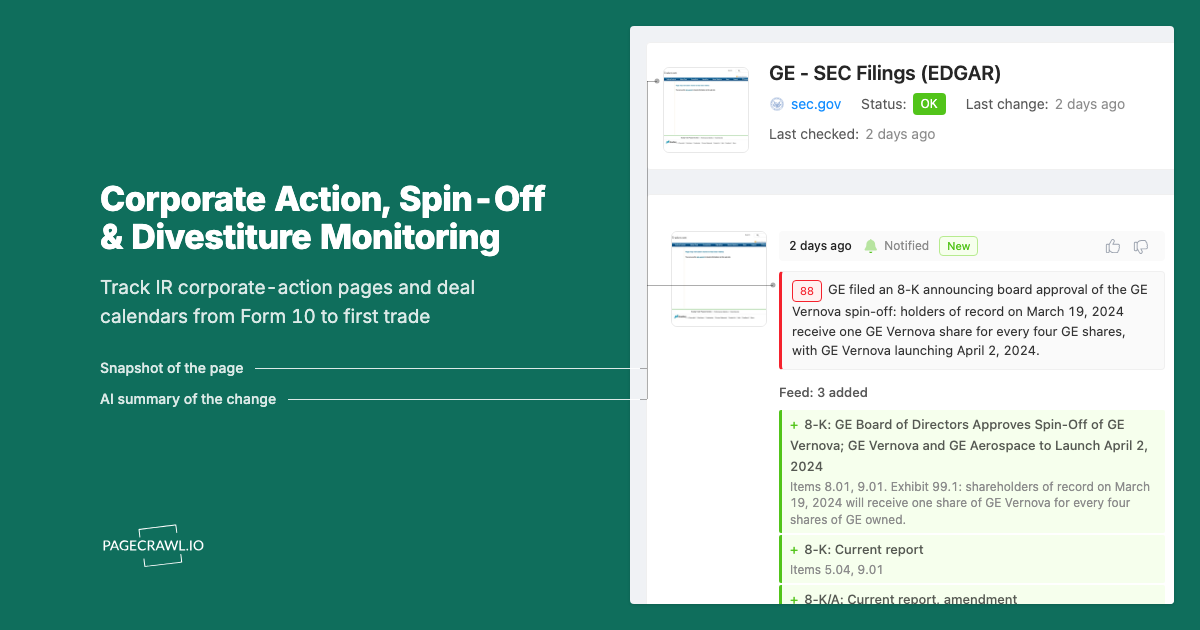
For US public companies, senior departures and appointments are legally required disclosures, which makes filings the most authoritative source you have. Form 8-K Item 5.02 reports the departure or election of directors and principal officers within four business days of the event. The annual proxy statement (DEF 14A) lays out the full board, named executive officers, and their compensation. Both are published on the SEC's EDGAR database, and monitoring them gives you time-stamped, legally binding confirmation.
Filings will not be the first place you hear about a change, but they are where you can act with confidence, because the company is on the record. An 8-K is especially useful for catching abrupt, unspun departures that never make the newsroom. The proxy statement is where you spot board reshuffles, new directors, and the compensation packages that reveal how a company is really betting on a new hire. Our guide to proxy statement (DEF 14A) change monitoring covers tracking these documents year over year. Always confirm what a filing actually says on the SEC's own website; this article is informational and is not investment advice.
Setting up executive monitoring in PageCrawl, step by step
Here is a repeatable setup covering every surface above. PageCrawl's free tier includes 6 monitors and 220 checks per month, enough to fully cover one or two priority companies' core leadership surfaces before you scale up.
Step 1: List your target companies. Pick the accounts, competitors, or holdings where a leadership change would change your behavior. Start with three to five, with two to four monitors each depending on how much public footprint the company has.
Step 2: Add the leadership page. Create a new monitor, paste the company's /team, /leadership, or /about URL, and set it to track the full page text. This is your most reliable monitor, so add it first for every target. Enable screenshots for a visual record of who was on the page and when.
Step 3: Add the newsroom with keyword rules. Create a monitor for the company's press or newsroom page, then add notification conditions and filters so you are only alerted when the new content contains leadership terms such as "appoints," "names," "steps down," or "departs." This keeps routine marketing announcements out of your alerts.
Step 4: Add the careers page for senior roles. Monitor the careers page, ideally filtered to the director-and-above listings, so a backfilled VP or a brand-new "Chief" role reaches you as an early warning before any formal announcement.
Step 5: Add LinkedIn coverage where it matters most. For your highest-priority targets, add a monitor for the company's LinkedIn posts or specific executive profiles, accepting that this source needs more maintenance.
Step 6: Add filings for public companies. If the target is publicly traded, add a monitor for its SEC filing index or investor-relations page so 8-K and proxy changes are captured automatically.
Step 7: Set frequency per source. Check newsroom, careers, and filing pages daily, and leadership pages every few hours to daily. There is no benefit to checking a quarterly proxy every five minutes, and over-checking burns your monthly allowance.
Step 8: Route the alerts. Connect each monitor to the channel the relevant team actually reads, whether that is a shared inbox, a Slack channel, or an automation that updates your CRM.
Step 9: Review and refine. After two weeks, look at what fired. Tighten keyword rules on noisy newsroom monitors, drop low-value pages, and add any leadership surfaces you discovered along the way.
How do you route leadership alerts to the right team?
Route each signal to the channel where the people who can act on it already work. A competitor's new CRO should land in the sales or CI Slack channel as soon as a check picks it up; a portfolio company's CFO departure should hit the investment team's alert feed. The goal is to put the change in front of a human who can act on it, not into another dashboard nobody opens.
PageCrawl pushes changes through email, Slack alerts, and other team channels, so a detected leadership change appears where your team is already paying attention. For anything more involved, webhook automation lets an alert trigger a downstream workflow: create a CRM task on the affected account, post to a war-room channel, or kick off a deeper research job. The signal stops being a notification and becomes the first step of a process.
How do you keep the signal clean and avoid false alarms?
Keep the signal clean by tracking the right content and filtering for leadership language, not by checking more often. A leadership page wrapped in dynamic banners, cookie notices, or rotating testimonials will fire on noise unless you narrow what you track. Keyword rules and a focus on senior-only job listings do most of the de-noising.
Three habits keep executive monitoring trustworthy. First, monitor the stable part of each page (the team grid, the press body) rather than the whole document when a site has heavy dynamic chrome, or exclude the noisy sections outright. Second, lean on keyword conditions so a check only alerts on appointment or departure language. Third, treat some sources as confirmation, not discovery: let LinkedIn or the careers page tip you off, then treat the leadership page or an 8-K as the source of truth before you act. For tactics that complement leadership monitoring, see our overview of competitive intelligence sources and tactics.
Choosing your PageCrawl plan
PageCrawl's Free plan lets you monitor 6 pages with 220 checks per month, enough to fully cover one or two priority companies' leadership, press, and careers pages before scaling to a wider set.
| Plan | Price | Pages | Checks / month | Frequency |
|---|---|---|---|---|
| Free | $0 | 6 | 220 | every 60 min |
| Standard | $8/mo or $80/yr | 100 | 15,000 | every 15 min |
| Enterprise | $30/mo or $300/yr | 500 | 100,000 | every 5 min |
| Ultimate | $99/mo or $999/yr | 1,000 | 100,000 | every 2 min |
Annual billing saves two months across every paid tier. Enterprise and Ultimate scale up to 100x if you need thousands of pages or multi-team access.
Standard at $80/year is the natural home for most teams. With three to four monitors per company (leadership page, newsroom, careers, and filings), 100 pages covers roughly 25 companies with full coverage, and 15-minute checks make time-to-awareness a genuine edge over manual checking. Enterprise at $300/year fits CI and investment teams tracking large competitive landscapes or portfolios, with 500 pages, 5-minute checks, SSO, and the full API for feeding leadership signals into your own systems.
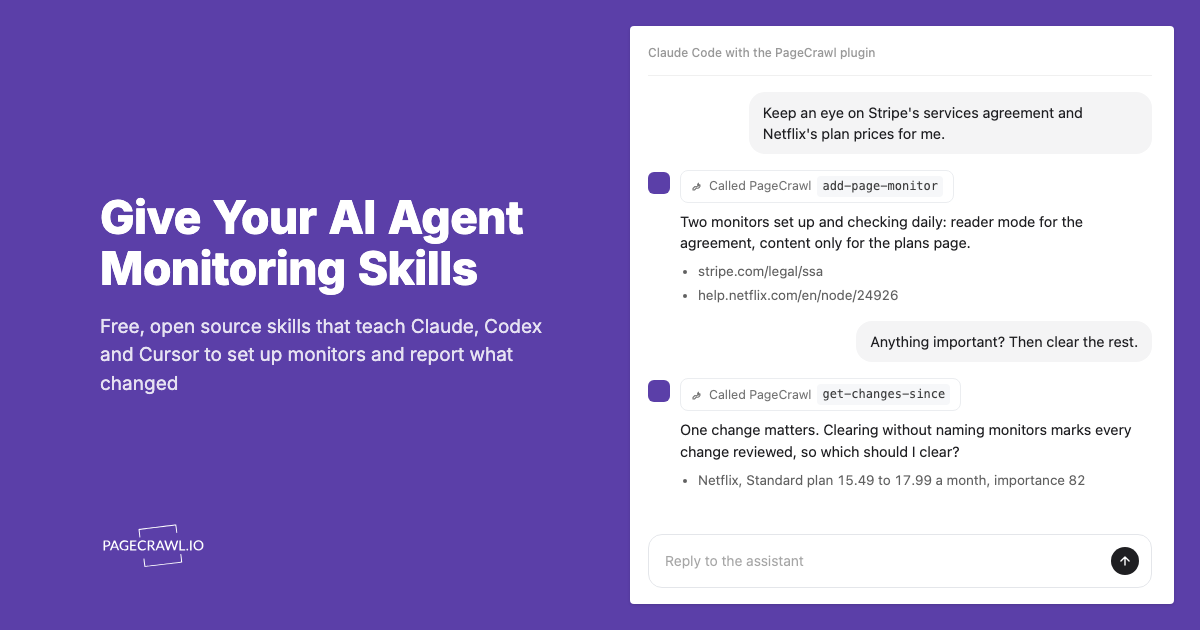
All plans include the PageCrawl MCP Server, which lets analysts, account teams, and investors ask Claude to pull leadership-change summaries for any tracked company over any period directly from the monitoring archive, replacing the manual "who changed roles this quarter" list with answers drawn from the data you are already collecting. AI assistants can create monitors through conversation on every plan, including Free.
Getting Started
Start with one company that matters to you today. Open its footer, find the leadership page, and set up a PageCrawl monitor on it in the next five minutes. Add the newsroom and the careers page, point the alerts at the channel your team reads, and you have continuous coverage of the moves that reshape budgets and buying decisions before your competitors notice them.
The free tier's 6 monitors are enough to prove the value on your single most important target. Within two weeks you will almost certainly catch a hire, a departure, or a new role you would have missed entirely, usually worth far more than the time it took to set up.
The companies and investors who win are not the ones with the most information. They are the ones who see the org chart change first.