In April 2024, Tesla filed a DEF 14A asking shareholders to re-ratify Elon Musk's 2018 compensation package. The proxy contained the full record of the board's deliberation, the response to the Delaware court ruling, and the proposed move to Texas. Coverage exploded the same afternoon, but the contents were available on the SEC's EDGAR filing system hours before the first analyst piece. The detail that mattered most to governance investors, the precise structure of the re-ratification vote, was buried deep in the document.
The annual proxy statement is the only document a public company is required to file that explains in detail how its executives are paid, who is on the board, what shareholders are voting on this year, and which related-party transactions occurred. DEF 14A filings drop on EDGAR ahead of every annual meeting and carry information that often does not make it into earnings calls or annual reports. Proxy season concentrates between mid-March and June; the documents land in waves, the news cycle is overwhelmed, and most material details get a single news cycle of attention before disappearing into the archive.
This guide covers how DEF 14A filings appear on EDGAR, the specific patterns worth watching, and how to set up a continuous monitor that surfaces new proxies and amendments within hours of filing.
Quick Setup
Enter a ticker to see a sample DEF 14A alert with CEO compensation and board nominee diffs.
Why should you monitor DEF 14A filings?
Because the proxy statement is the source document for governance, compensation, and shareholder activism intelligence. It is the only annual filing that sets out how executives are paid, who is standing for the board, and what shareholders are voting on. Much of that detail appears nowhere else in the SEC filing system.
Executive Compensation Disclosure Is Definitive
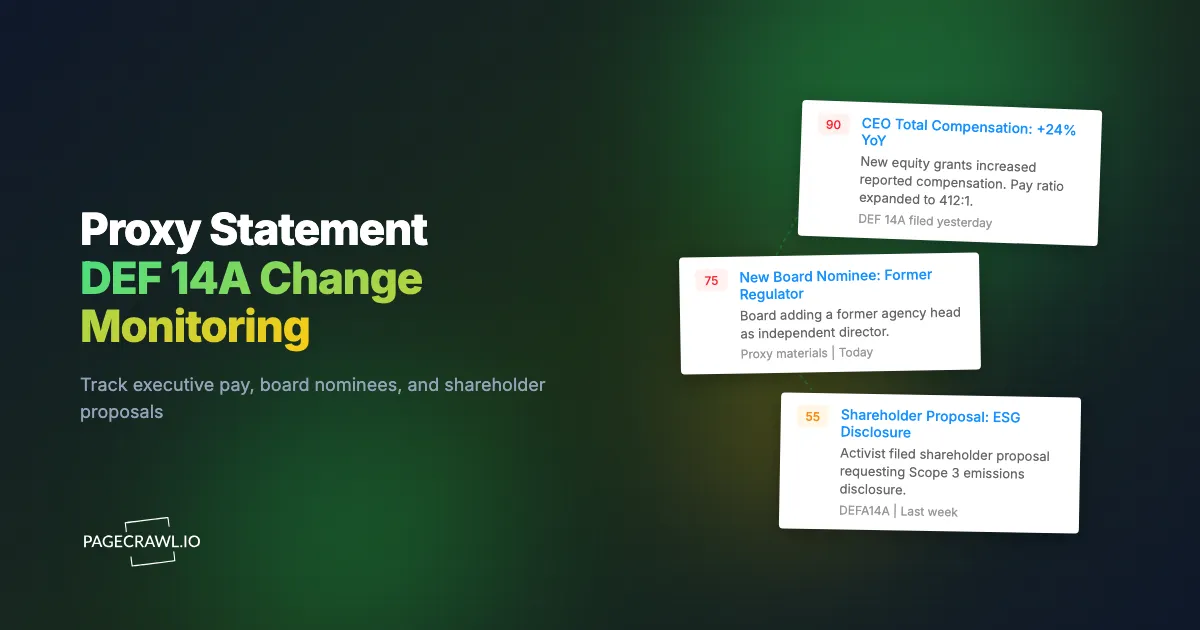
DEF 14A contains the audited Summary Compensation Table, the equity grant detail, and the pay-versus-performance disclosures the Securities and Exchange Commission has required since the 2023 proxy season. Year-over-year changes in CEO pay, pay-ratio disclosures, and the structure of performance shares are the most-covered numbers in any proxy but also the most likely to contain quiet shifts in incentive design.
Board Composition Signals Strategic Direction
New director nominees, retirements, committee reshuffles, and other executive and leadership changes all appear in DEF 14A. Audit and compensation committee changes are particularly informative because they touch the governance functions most likely to be flagged by proxy advisers such as ISS and Glass Lewis. A new director with public-company audit experience joining the audit committee, for example, often follows recent restatement risk or auditor pressure.
Shareholder Proposals Reveal Activist Intent
Every shareholder proposal on the ballot appears in DEF 14A with the company's response and recommended vote. The full text of activist proposals, governance proposals (declassification, simple majority voting), and ESG proposals (climate disclosure, lobbying disclosure) becomes public as soon as the proxy is filed.
Related-Party Transactions Surface Quietly
Newly disclosed related-party transactions, transactions with insiders, family members, or affiliated entities, often appear without separate press coverage. The diff between this year's proxy and last year's is sometimes the only place these surface in real time.
How do DEF 14A filings appear on EDGAR?
A DEF 14A is filed annually ahead of the company's shareholder meeting and shows up as a new row on that company's EDGAR filing list, keyed to its CIK number. You can point a regulatory filing monitor at a URL filtered to the DEF 14A form type so only proxy filings trigger an alert. The filtered URL pattern:
https://www.sec.gov/cgi-bin/browse-edgar?action=getcompany&CIK={CIK}&type=DEF+14A&dateb=&owner=include&count=40Related form types are worth watching alongside DEF 14A: PRE 14A (preliminary proxy), DEFA14A (additional definitive material, often supplements during the voting window), DEFM14A (merger-related definitive proxy), and PREM14A (preliminary merger proxy). Each shows up as a separate filing entry. Activist and contested situations especially produce DEFA14A supplements throughout the voting window.
To capture every relevant filing type for a company, monitor either the unfiltered filing page (and filter alerts downstream) or build the URL with the specific form types using EDGAR's filter parameters.
Which proxy monitoring approach should you choose?
It depends on whether you need voting recommendations or filing awareness. Institutional stewardship desks buy ISS or Glass Lewis for vote research. Everyone else, activists, researchers, counsel and journalists, mainly needs to know when a proxy or supplement lands, which a page monitor on EDGAR does for a fraction of the cost.
| Approach | Cost | Latency | Coverage | Best For |
|---|---|---|---|---|
| Manual EDGAR refresh | Free | Hours to days | Per-company | Casual checking on a few names |
| ISS Voting Analytics | Institutional pricing | Same-day | Comprehensive proxy data | Stewardship teams, large funds |
| Glass Lewis | Institutional pricing | Same-day | Comprehensive proxy data | Institutional stewardship |
| Proxy Insight (Diligent) | Subscription | Daily | Voting and governance data | Governance research |
| PageCrawl on EDGAR | Free tier to $80/year | 5-15 minutes per check | Any company you set up | Activist funds, governance researchers, in-house counsel, journalists |
ISS and Glass Lewis are the institutional default for proxy voting recommendations and are the right product for large funds with stewardship obligations. For activist investors, governance researchers, compensation consultants, journalists, and in-house counsel monitoring peer-company proxies, PageCrawl is dramatically cheaper and gives faster alerts on the filing itself.
Setting Up Proxy Monitoring in PageCrawl

Step 1: Identify the company's CIK
Search EDGAR by ticker to find the 10-digit CIK. Save it.
Step 2: Add the filtered EDGAR URL
Build the filtered URL using the pattern above. Paste it into PageCrawl as a content monitor. New DEF 14A or DEFA14A filings produce a new row in the table and trigger an alert.
Step 3: Add the full HTML proxy as a baseline
Once the proxy is published, copy the HTML link from the filing index and add it as a second monitor. Amendments and supplements will diff cleanly against this baseline, surfacing the exact paragraphs that changed.
Step 4: Layer on the company's IR page
Companies often post proxy materials, voting recommendations, and ISS/Glass Lewis response letters on their investor relations page. Add the IR page as a third monitor through the voting window, so proxy materials sit alongside the rest of your SEC filing and investor relations tracking. Supplemental investor materials sometimes appear here before they reach EDGAR.
Step 5: Check daily during proxy season, hourly during contested situations
Proxy season concentrates between mid-March and June. A daily check is enough for most companies; the documents are not minute-sensitive. For contested or activist situations where DEFA14A supplements may land at any time, switch to hourly checks.
Step 6: Configure notifications
For research teams and counsel, email digests are typically the right channel; proxy filings are deliberative documents and rarely require minute-level response. For active stewardship situations, route to a dedicated #proxy-watch Slack channel so the whole desk sees a filing at the same time.
Worked Example: Tracking a 50-Company Governance Panel
Take a governance researcher tracking the S&P 100 plus 50 mid-cap names where activism is plausible. The setup looks like this:
- Pull the 150 CIKs (about 45 minutes for a clean list).
- Build the DEF 14A filtered URL for each name (150 monitors).
- Use PageCrawl bulk import to add all 150.
- After each filing season, add baseline HTML monitors for the priority 30 names.
- Set daily checks year-round, hourly during March-June.
- Route to a
#governance-feedSlack channel. - Enable AI summaries to flag the specific change (new shareholder proposal, board addition, comp structure change).
Total cost: Enterprise plan at $300/year covers the full 150-name panel plus baseline monitors. For a small stewardship desk, an in-house corporate counsel comparing peer disclosures, or a financial journalist covering governance, this is the cheapest credible setup.
What changes in a proxy statement are worth watching for?
The highest-signal diffs are compensation table changes, new equity awards, board nominee and committee changes, the shareholder proposal list, auditor changes, related-party transactions, and DEFA14A supplements filed during the voting window. Each of the following is worth a dedicated look every season.
Pay ratio and total compensation table changes. Year-over-year changes in CEO pay and the pay-ratio number are the most-covered figures in any proxy. Even small structural changes (mix shift from cash to equity, new performance metrics) carry real signal.
New equity awards. Sign-on grants for new executives, mega-grants to founders, and modifications to existing performance shares are signals about board confidence and incentive design.
Board nominee changes. New nominees, retirements, and committee reshuffles, especially audit and compensation committees. New audit-committee members often follow specific audit concerns.
Shareholder proposals. The full list on the ballot with the company's recommended vote. Categories matter: governance, ESG, executive compensation, lobbying disclosure.
Auditor changes. Disclosed in the audit committee report. Changes in auditor are sometimes flagged as routine and sometimes signal serious underlying concerns.
Related-party transactions. Additions to the related-party section deserve attention regardless of dollar size; the diff against last year's proxy is the cleanest way to spot them.
DEFA14A supplements. Definitive additional materials filed during the voting window. In activist situations, these are the daily artifact and warrant near-real-time alerting.
Combining Proxy Monitoring With Other Signals
The full value of DEF 14A monitoring shows up when you cross-reference it with other public datasets.
Combine with Form 4 insider trading. Pair the proxy monitor with our Form 4 alerts guide. The proxy discloses vest dates and grant cycles; Form 4 captures the resulting transactions. The combination distinguishes mechanical vest sales from discretionary trading.
Combine with 10-K and 10-Q diffs. Use our 10-K / 10-Q diff monitor to see whether proxy compensation structure changes coincide with disclosure-language shifts in MD&A. The combination is sometimes the earliest read on management's evolving narrative.
Combine with 13F institutional positioning. Pair with our 13F holdings change monitor. Major holder positioning around the record date affects voting outcomes; same-day awareness matters in contested situations.
Combine with press releases. Add the company's IR press page and any activist firm's letters page. In activist situations, both sides issue press through the voting window; monitoring both gives you a complete picture.
Use Cases
Corporate governance researchers. A monitored panel of S&P 500 proxies builds a clean dataset for pay-vs-performance and board composition studies. PageCrawl's monitoring history doubles as a longitudinal proxy archive.
ESG and stewardship teams. Voting research benefits from real-time alerts as proxies and supplements are filed. For teams handling thousands of votes per season, even modest workflow improvements compound across the panel.
Activist investors. New shareholder proposals, board nominee changes, and bylaws amendments are core inputs to engagement strategy. Same-day alerts on contested situations affect the cadence of public communication.
Legal and compliance. Compensation lawyers and benefits consultants benefit from same-day alerts when peer companies update their plans. The proxy is the authoritative source for comp benchmarking, and changes propagate across an industry quickly.
Financial journalists. Beats covering corporate governance, executive compensation, and shareholder activism use proxy filings as a primary source. Same-day alerts mean faster, more accurate coverage.
In-house corporate counsel. Monitoring peer-company proxies helps benchmark your own disclosure decisions ahead of the next filing cycle.
Frequently Asked Questions
How quickly do DEF 14A filings appear on EDGAR? Within minutes of acceptance. The filtered listing page updates once the filing is accepted, and your PageCrawl monitor catches the new row on the next scheduled check.
What is the difference between PRE 14A and DEF 14A? PRE 14A is the preliminary proxy filed with the SEC for review. DEF 14A is the definitive version that goes to shareholders. The two often have similar contents but the definitive version is the one that matters legally.
How do I track contested or activist situations? Monitor the company's full filing page (not filtered) to catch all DEFA14A, PRE 14A, PREN14A, and proxy-fight filings. Add the activist firm's press page as a sibling monitor.
What about international issuers? Foreign private issuers file proxy materials on Form 6-K rather than DEF 14A. Substitute the form type in the EDGAR URL pattern.
Do I need a paid plan? The Free plan supports 6 monitors, enough for a focused tracking list of 2-3 priority names. Standard at $80/year covers 30-50 names comfortably. Enterprise at $300/year covers the S&P 100+ governance panel.
Can AI summaries identify what changed in a 200-page proxy? Yes. AI-powered change detection focuses on substantive diffs and describes them in plain language ("Added new shareholder proposal on lobbying disclosure; revised performance share targets for FY2026"). For long documents this is the difference between actionable and overwhelming.
Choosing your PageCrawl plan
PageCrawl's Free plan lets you monitor 6 pages with 220 checks per month, which is enough to validate the approach on your most critical pages. Most teams graduate to a paid plan once they see the value.
| Plan | Price | Pages | Checks / month | Frequency |
|---|---|---|---|---|
| Free | $0 | 6 | 220 | every 60 min |
| Standard | $8/mo or $80/yr | 100 | 15,000 | every 15 min |
| Enterprise | $30/mo or $300/yr | 500 | 100,000 | every 5 min |
| Ultimate | $99/mo or $999/yr | 1,000 | 100,000 | every 2 min |
Annual billing saves two months across every paid tier. Enterprise and Ultimate scale up to 100x if you need thousands of pages or multi-team access.
In event-driven strategies, minutes matter. One actionable signal surfaced before the broader market reacts can return more than a year of Ultimate. Standard at $80/year covers the core IR, press, and filings pages for a handful of positions. Enterprise at $300/year scales to a full watchlist. All plans include the PageCrawl MCP Server, so you can ask Claude to summarize every material change across a company's IR, press, and filings over any period you care about and get the evidence pulled straight from your monitoring archive. AI assistants can create monitors through conversation on every plan, including Free. Ultimate at $999/year adds 2-minute frequency and web archiving, which matters if you need provable timestamps for a thesis.
Getting Started
Add the filtered DEF 14A EDGAR URL for one company plus its IR page. Create a free account, enable email alerts, and the next proxy filing or amendment will arrive in your inbox the day it lands.
Once proxy season starts in March, expand to a panel of 25-50 names that matter to your work, plus 5-10 priority baselines for sentence-level diff monitoring. The Standard plan at $80/year covers a serious panel for an analyst or in-house counsel; Enterprise at $300/year covers the full S&P 100 plus a mid-cap tail. For governance researchers, stewardship teams, and activists who treat proxy disclosure as a real input to engagement decisions, the cost recovers itself the first time a quietly added shareholder proposal or compensation change leads to a meaningful position or vote.