When Berkshire Hathaway's Q1 2024 13F dropped showing a new $6.7 billion position in Chubb, the insurance stock rallied sharply over the next trading sessions. The position had been built quietly over the prior quarters under confidential treatment from the SEC. When confidential treatment expired and the position appeared in the regular Q1 2024 13F-HR in May 2024, anyone with an alert on Berkshire's CIK saw the position as soon as their next check ran, well before most commentary caught up.
Form 13F is filed quarterly by every institutional investment manager with more than $100 million under management. The filing discloses long positions in US-listed equities, options, and certain other securities, with a 45-day reporting lag from quarter end. It is the only mandated, comprehensive look at how the largest pools of capital are positioned in US equities, and it remains a primary input for fundamental research, factor analysis, and idea generation across the buy-side, where it sits in the same feed as SEC filings, IR pages, and earnings tracking.
This guide covers how 13F filings work on EDGAR, the analytical patterns that turn raw filings into actionable signal, and how to set up automated monitoring for any manager you want to track.
Quick Setup
Pick a manager below and PageCrawl will monitor their 13F filings page. You will be alerted on the first check after the next filing lands.
Why do 13F filings matter?
13F gives you a snapshot of long positions in 13F-eligible securities. The lag is real (45 days from quarter end), but the dataset's depth and consistency make it one of the most-studied sources of investment intelligence.
Idea Sourcing From Trusted Investors
Watching what respected long-term investors are accumulating is a well-established starting point for fundamental work. New entries in a Buffett, Klarman, Greenlight, or Pershing Square portfolio routinely trigger derivative analysis across the buy-side. The "coattail" strategy of replicating selected positions has a sufficient academic literature to be taken seriously: research such as the "Best Ideas" work of Cohen, Polk, and Silli documents outperformance from following the highest-conviction positions of skilled managers.
Crowding and De-Crowding Signals
When several uncorrelated funds initiate the same position in the same quarter, the consensus carries information about narrative shifts and sector rotation. When the same funds simultaneously reduce exposure to a previously-crowded name, the de-crowding signal often precedes broader weakness. Both patterns are visible in quarter-over-quarter 13F diffs.
Exit Signals
A large reduction or full exit from a high-conviction position often precedes weakness in the underlying name, especially when the manager has historically held positions for years. The exit is not always informational (rebalances, fund flows, and tax events all matter), but a full exit from a top-10 position by a long-tenured holder is a flag worth checking.
Sector Rotation Pattern Detection
Aggregating position changes across a panel of managers reveals sector and factor rotation in real time. Aggregated across 20-30 managers, a clear lean into industrials or away from megacap tech becomes visible within days of the filings landing, weeks before the consensus narrative catches up.
How do 13F filings appear on EDGAR?
Each institutional manager has a CIK and a filing index page on EDGAR. The 13F-filtered URL pattern is:
https://www.sec.gov/cgi-bin/browse-edgar?action=getcompany&CIK=0001067983&type=13F&dateb=&owner=include&count=40CIK 0001067983 is Berkshire Hathaway. Swap in any manager's CIK to track theirs. New 13F-HR filings appear as new rows in the filing table, and 13F-HR/A amendments show up alongside as the manager corrects errors or unveils confidential positions.
The full filing exposes structured XML tables listing each position: CUSIP, security name, value, share count, put/call indicator (for options), discretion category, and voting authority. The XML is machine-readable, so downstream tools can compare quarter-over-quarter to produce a clean delta.
Important: 13F Reporting Lag and Confidential Treatment
13F is filed within 45 days of quarter end. Managers can request confidential treatment for new positions still being built, which delays disclosure of specific positions for up to one year. When confidential treatment expires, the original 13F is amended (13F-HR/A) with the previously-hidden positions. This is when "stealth" buys like Berkshire's Chubb position become public.
Comparing 13F Monitoring Approaches
| Approach | Cost | Latency | Coverage | Best For |
|---|---|---|---|---|
| Manual EDGAR refresh | Free | Hours to days | Per-manager | Casual checking |
| WhaleWisdom | Free / paid tiers | Same-day | Comprehensive | Browsing aggregated data |
| Stockcircle, Dataroma | Free | Hours | Best-investor panels | Beginners watching star investors |
| Bloomberg HCSA | $30K/year | Minutes | Full historical | Institutional desks |
| PageCrawl on EDGAR | Free to $80/year | 15-60 minutes | Any manager | Building custom watchlists |
WhaleWisdom is the most common free alternative but only refreshes during EDGAR's batch processing windows. PageCrawl gives you per-manager control with frequency you choose, plus webhook output for downstream analytics.
Setting Up 13F Monitoring in PageCrawl

Step 1: Find the manager's CIK
Search EDGAR full-text search by manager name, filtering to form 13F-HR. Each result links to the filer's full filing index, which includes the CIK in the URL. Save the CIK for each manager you want to monitor.
Step 2: Build the filtered URL
Use the pattern above with the CIK and type=13F. This restricts the monitored page to 13F filings only, so amendments (13F-HR/A) and routine notices do not generate noise. If you want amendments too, use type=13F-HR%2C13F-HR%2FA.
Step 3: Add the monitor
Paste the URL into PageCrawl as a content monitor. Use full-page text mode so the filings table is captured. PageCrawl detects when a new row appears.
Step 4: Set frequency by filing window
13F-HR filings cluster within the two-week window starting 30 days after each quarter end:
- Q1 filings: arrive mid-February through mid-May
- Q2 filings: arrive mid-May through mid-August
- Q3 filings: arrive mid-August through mid-November
- Q4 filings: arrive mid-November through mid-February
Run hourly checks during these windows and back off to daily outside them.
Step 5: Layer managers into a folder
Create a folder named "Managers Watchlist" in PageCrawl, using the same labels, folders, and workspaces that keep a large watchlist legible. Add a monitor per manager. The folder view shows all 13F filings across your watchlist on one page, useful for visual cluster detection across managers.
Step 6: Webhook into a downstream tool
For analytical workflows, route PageCrawl webhooks into a spreadsheet, database, or n8n flow that pulls the actual 13F XML, parses positions, and computes the quarter-over-quarter delta. See our n8n monitoring guide for an end-to-end automation walkthrough, and the REST API and webhook reference for developers for the payload fields you can request.
Worked Example: A 25-Manager Smart-Money Panel
A typical buy-side analyst smart-money panel looks like this:
Tier 1 (long-tenured, concentrated): Berkshire, Pershing Square, Greenlight, Markel, Davis, Polen, Akre, Baupost, Yacktman, Tweedy Browne.
Tier 2 (sector specialists): Soros (macro), Tiger Global (growth/tech), Coatue (tech), Maverick (long/short tech), Lone Pine (growth), ValueAct (activist).
Tier 3 (large quant for crowding signal): Renaissance, AQR, Two Sigma, Millennium, Citadel.
Build 25 filtered 13F URLs (one per manager CIK). Bulk-add to PageCrawl, tag all 25 with smart-money, organize in a "Managers Watchlist" folder. Set frequency to hourly during filing windows, daily otherwise. Route alerts to a shared #13f-watch Slack channel.
Total setup: about an hour. Total cost: $80/year on the Standard plan (which supports 100 monitors, leaving room for sibling monitors on IR pages, 8-K filings, and other signals).
What should you look for in a new 13F?
When a 13F alert fires, check new positions, large size changes, sector rotation, crowding overlap with other managers, and confidential-treatment reveals. The analytical workflow is short and well-defined:
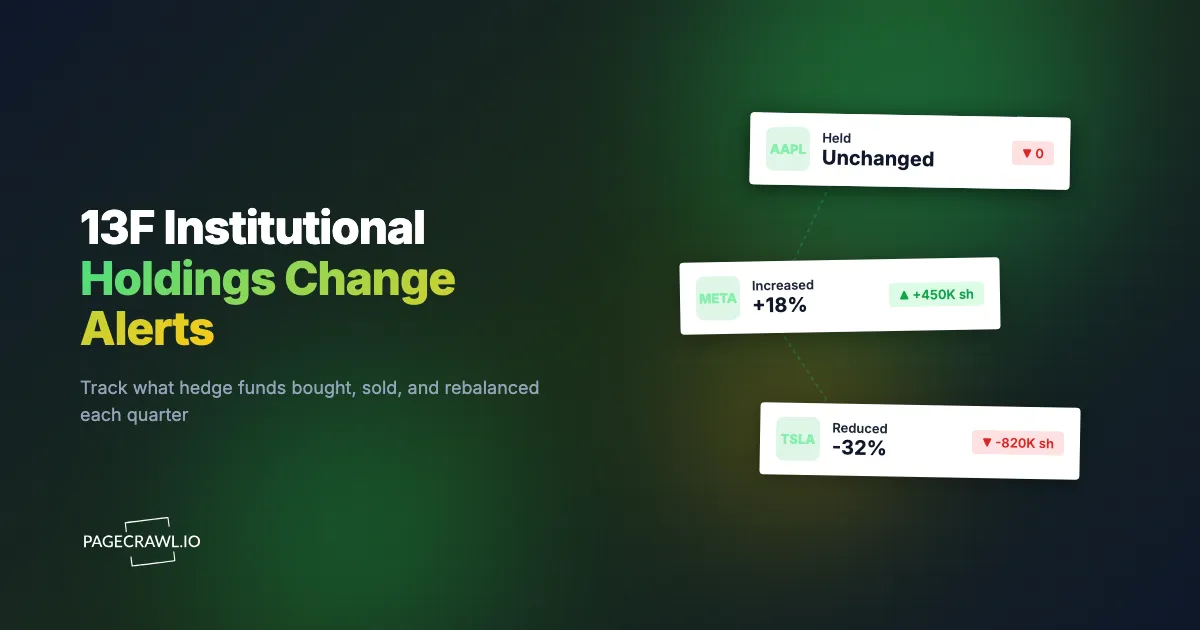
New positions. Names that did not exist in the prior quarter are the strongest signal of fresh conviction. Filter to top-N new positions by dollar value first.
Position size changes. A 20% or larger increase or decrease in an existing position is more meaningful than a small rebalance. A full liquidation often signals a thesis change, especially for long-tenured positions.
Sector rotation. Aggregate the changes by sector or by 11 GICS sectors to see whether the manager is leaning into or out of a theme.
Crowding overlap. Compare the new filing against other managers in your watchlist. Multiple respected investors entering the same position in the same quarter is the strongest signal the dataset offers.
Confidential treatment expirations. Amendments (13F-HR/A) sometimes reveal previously-hidden positions, which can be the highest-value signal in a filing cycle. Berkshire's Chubb position was disclosed exactly this way.
Options positioning. The put/call indicator on derivative positions can signal directional hedging or expression of a thesis with leverage. Bridgewater and other macro funds often express views through index ETFs and options visible in 13F.
Note: 13F data is a research input, not investment advice. Confirm the underlying filing on SEC EDGAR and account for the 45-day reporting lag before acting on any position change.
Advanced Patterns: Combining 13F With Other Signals
13F's quarterly cadence and 45-day lag make it a slower signal than insider filings or earnings reports. The value increases when combined with other data:
Pair with Form 4 insider activity. Our Form 4 monitoring guide walks through insider filings. When a respected fund initiates a position and corporate insiders are buying in the same quarter, the alignment is strong.
Pair with 13D/G filings. 13D filings precede 13F additions by weeks for activist positions. Add 13D-filtered EDGAR URLs as siblings for the same managers when activist accumulation is in scope.
Pair with proxy voting records. Some managers publish proxy voting records on their websites. When ValueAct or Engine No. 1 vote against a board nominee, the position is signaling intent.
Pair with manager letters. Most concentrated long-only managers publish quarterly letters. Add the letter index page as a sibling monitor. The narrative justification for new positions in the letter pairs with the position list from the 13F.
Pair with sector ETF flows. When a basket of managers rotates into a sector, the corresponding sector ETF often sees inflows over the following weeks. The ETF flows data confirms the thesis or reveals whether the funds are early.
Use Cases
Long-only equity funds. Build a panel of 15-30 managers whose process you respect. Watch for cluster entries and exits across the panel, and use the alignment to inform position sizing decisions.
Quantitative strategies. Combine 13F changes with price, volume, and short-interest data to build crowding and de-crowding factors. Net buyer count by name is a documented mid-frequency factor.
Activist research. New 13D or 13G filings often precede 13F entries by weeks. Pair both monitors at known activist managers for early signaling.
Financial media. New positions from high-profile managers (Buffett, Burry, Ackman, Loeb) are reliable content drivers. Fast alerts on the next check let you publish same-day coverage. The Wall Street Journal, FT, and CNBC all run beat coverage on major 13F filings.
Investor relations. Public-company IR teams monitor 13Fs to see who is building or trimming positions in their stock, useful for prepping earnings calls and investor day outreach.
Asset allocators. Family offices and fund-of-funds use manager 13Fs to verify that a hired manager is executing the strategy they pitched.
Frequently Asked Questions
Why is 13F filed 45 days after quarter end? The lag was set in 1978 and never updated. It exists to give managers time to compile and verify holdings while still providing meaningful disclosure. Critics argue the lag is now far too long given modern systems; defenders argue it protects active management from front-running.
Are short positions disclosed in 13F? No. 13F only covers long positions in 13F-eligible securities. Short positions, swaps, and most derivatives are not disclosed. This is the dataset's main limitation: managers like Bridgewater that express views primarily through short exposure or swaps show only a fraction of their portfolio in 13F.
What does "discretion" mean on a 13F filing? Each position has a discretion category (Sole, Shared, None) indicating whether the filing manager has discretion over the holding. For most analytical purposes, focus on Sole-discretion positions.
Can I monitor confidential filings? Confidential treatment expires after up to one year, at which point the original filing is amended (13F-HR/A) and the previously-hidden positions become public. Monitoring the manager's filing page with type=13F-HR%2C13F-HR%2FA catches these amendments on the next check after they post.
Is there a free alternative to monitoring 13F directly? WhaleWisdom offers free aggregated 13F data with a refresh delay of a few hours. For per-manager precision and faster alerts, PageCrawl on the EDGAR page is the simpler self-managed alternative.
How do I handle managers that change CIK? This is rare but happens when funds merge or restructure. Set up a sibling monitor on the manager's website press page; any restructuring will be announced there first.
Choosing your PageCrawl plan
PageCrawl's Free plan lets you monitor 6 pages with 220 checks per month, which is enough to validate the approach on your most critical pages. Most teams graduate to a paid plan once they see the value.
| Plan | Price | Pages | Checks / month | Frequency |
|---|---|---|---|---|
| Free | $0 | 6 | 220 | every 60 min |
| Standard | $8/mo or $80/yr | 100 | 15,000 | every 15 min |
| Enterprise | $30/mo or $300/yr | 500 | 100,000 | every 5 min |
| Ultimate | $99/mo or $999/yr | 1,000 | 100,000 | every 2 min |
Annual billing saves two months across every paid tier. Enterprise and Ultimate scale up to 100x if you need thousands of pages or multi-team access.
In event-driven strategies, minutes matter. One actionable signal surfaced before the broader market reacts can return more than a year of Ultimate. Standard at $80/year covers the core IR, press, and filings pages for a handful of positions. Enterprise at $300/year scales to a full watchlist. All plans include the PageCrawl MCP Server, so you can ask Claude to summarize every material change across a company's IR, press, and filings over any period you care about and get the evidence pulled straight from your monitoring archive. AI assistants can create monitors through conversation on every plan, including Free. Ultimate at $999/year adds 2-minute frequency and web archiving, which matters if you need provable timestamps for a thesis.
Getting Started
Start with five managers whose process you respect. Pull their CIKs from EDGAR, build the filtered 13F URLs using the pattern above, and add them to PageCrawl. Create a free account, set hourly checks during the next 13F filing window, and route alerts to your inbox or Slack. The next round of 13F-HRs will arrive in your channel within an hour of filing, and you will start to develop a feel for the rhythm of each manager's portfolio activity.
Once you see the value, expand to a 20-30 manager panel. The Standard plan at $80/year covers 100 monitors at 15-minute checks, which is enough room for the full smart-money panel plus sibling monitors on IR pages, 13D filings, manager letters, and sector ETFs. For analysts who treat 13F as a real input to research, the cost recovers itself the first time a clustered position change leads to a thesis update, position trim, or new entry.