At 1:00 PM Eastern on a typical Tuesday, the US Treasury closes the 4-week bill auction. By 1:03, results are posted to TreasuryDirect: the high yield, the bid-to-cover ratio, the percentage allotted to indirect bidders. Minutes later, those numbers have made it into a wire headline. The short gap between page publication and the first wire is exactly the window where you want to see the data, especially if you are managing a short-rate book or planning a Treasury bill ladder.
Every week the US Treasury auctions bills, notes, and bonds on a published schedule. The auction calendar, the announcement details, and the awarded yields are all posted publicly on TreasuryDirect, often before they appear in news aggregators. For fixed-income desks, individual TreasuryDirect investors, macro analysts, and corporate treasurers, the time between publication and the first headline is the most valuable few minutes of the auction day. The problem is that TreasuryDirect does not push notifications. You have to come and get the data, and most retail investors find out about new issuance only when the bidding window has already closed.
This guide covers how Treasury auctions are published on TreasuryDirect, what each auction artifact contains, and how to set up a continuous monitor that surfaces new auction announcements and results within minutes of publication.
Quick Setup
Pick the maturities you trade and we'll show you the announcement + awarded-yield alerts you'd receive.
Why should you track the Treasury auction calendar?
Because auction sizes, awarded yields, and bid-to-cover ratios are the raw inputs into rate expectations, Treasury market liquidity, and short-end positioning. They are published on TreasuryDirect before they reach news aggregators, so watching the source gives you the numbers first.
Auction Size Changes Signal Financing Strategy
When the Treasury raises the size of a regular auction (say, the 10-year note moves from $39 billion to $42 billion), it telegraphs a financing decision that affects supply absorption for weeks. Quarterly refunding announcements set the broad path, but mid-cycle adjustments to bill sizes happen with little fanfare. Same-day awareness lets desks adjust positioning before the next dealer auction.
Awarded Yields Set the On-The-Run Benchmark
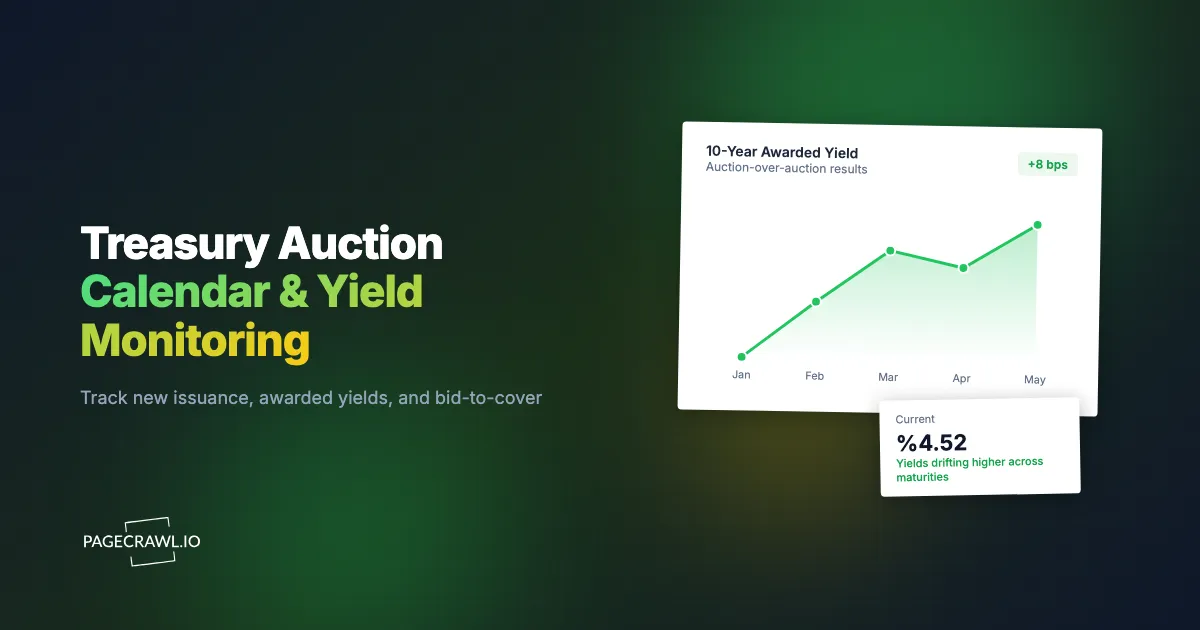
The yield at which a new note or bond clears auction becomes the on-the-run benchmark for the next week of trading in that maturity. The when-issued market trades on expectations, but the auction result is the print. A tail (auction clears above the when-issued level) or a stop-through (clears below) is a direct read on real-money demand.
Bid-to-Cover and Indirect Bid Reveal Demand
Bid-to-cover measures total demand against the offering size. Indirect bids capture foreign central bank and large institutional demand. A bid-to-cover collapse or an indirect bid below recent averages is one of the cleaner real-time signals of foreign-demand softness, and it shows up in the auction-results page before the first wire post.
Cash Management Bills Signal Funding Pressure
Schedule additions outside the regular cycle, especially cash management bills (CMBs), often signal short-term Treasury financing pressure or a tax-receipts mismatch. They are also opportunities for short-dated bill buyers to pick up incremental yield. Catching the CMB announcement same-day matters because the bidding window is often only one or two business days.
How does TreasuryDirect publish auction data?
TreasuryDirect posts every auction through three artifacts on a small number of stable URLs: an announcement page a few business days ahead, a results page minutes after the auction closes, and an issuance page on the settlement date. The calendar and results live here:
https://www.treasurydirect.gov/auctions/upcoming/
https://www.treasurydirect.gov/auctions/auction-query/
https://www.treasurydirect.gov/auctions/announcements-data/
Each auction has three artifacts: an announcement page (released a few business days before the auction), a results page (released minutes after the auction closes), and an issuance page (released on the settlement date). All follow predictable URL patterns by CUSIP and date, and all are indexed on the auction-query page.
The upcoming auctions page lists the next 30-60 days of scheduled auctions with size and tenor. The auction-query page is searchable by date and security type and contains the awarded results, which is the page you want for real-time alerts. Each auction page links to a PDF and a structured XML feed for downstream automation.
How do the monitoring approaches compare?
Institutional terminals give real-time coverage at institutional prices, the Treasury's own feeds are free but slower and incomplete, and page monitoring sits in between: you choose the pages and the check frequency, and pay a fraction of terminal cost.
| Approach | Cost | Latency | Coverage | Best For |
|---|---|---|---|---|
| Manual TreasuryDirect refresh | Free | Same-day with effort | Full schedule | Casual investors |
| Bloomberg Terminal | Institutional subscription | Real-time | Full coverage | Institutional fixed-income desks |
| LSEG Workspace (formerly Refinitiv Eikon) | Institutional subscription | Real-time | Full coverage | Institutional desks |
| Treasury RSS feeds | Free | Hours, sometimes a day | Major announcements | General awareness |
| PageCrawl on TreasuryDirect | Free tier to $80/year | 2-15 minutes | All auction pages | Active rates investors, retail bill buyers, corporate treasury |
The Treasury's own RSS feed exists, but in practice it trails the auction-results page and does not surface CMB schedules or unscheduled changes reliably. PageCrawl gives you per-page control with a frequency you choose, plus webhook output that plugs straight into a spreadsheet, Discord channel, or rates dashboard.
Setting Up Treasury Auction Monitoring in PageCrawl
Step 1: Monitor the upcoming auctions calendar
Add https://www.treasurydirect.gov/auctions/upcoming/ to PageCrawl as a content monitor. New entries appear as the Treasury announces additional auctions, including off-schedule CMBs. A daily check is enough for the calendar; off-schedule announcements are rare but material.
Step 2: Monitor the auction query page
Add https://www.treasurydirect.gov/auctions/auction-query/ as a second monitor. The auction-query page lists recent auctions with their awarded yields. A new row means a fresh result has posted. This is the page you want on a frequent check schedule.
Step 3: Use a 15-minute check on auction days
Results post within minutes of the 1:00 PM Eastern auction close, and an alert goes out on the first check that sees the new row. A 15-minute check schedule catches the result inside the first quarter hour after publication. On the Free plan with 60-minute checks, you will catch most auctions within the hour, which is still meaningfully ahead of retail awareness. The help centre explains how to confine checks to auction days and hours in check scheduling.
Step 4: Enable AI summaries
PageCrawl's AI change summaries describe the new auction row in plain language: "4-week bill auctioned at 5.32%, bid-to-cover 3.1, indirects 65%." This saves you from opening the auction-query page for every alert. See AI-powered change detection and smart filtering for how to turn it on and tune what it reports.
Step 5: Configure notifications
For trading desks, Telegram and Discord are the fastest channels once a check detects the new result. For retail TreasuryDirect bidders, email is fine; the bidding window typically gives you several hours after the announcement. See our Telegram alerts setup guide for fast-channel configuration.
Step 6: Pair with the FRBNY operating calendar
For traders, add the New York Fed open market operations calendar (https://www.newyorkfed.org/markets/desk-operations) as a sibling monitor. The Treasury auction calendar plus the SOMA operations calendar covers the full short-rate flow picture in a single folder, and the same approach extends to regulator and supervisory page monitoring across the Fed, OCC, and FDIC.
Worked Example: Building a Rates-Desk Auction Monitor
Take a small rates desk that needs same-minute awareness of every auction result. The setup looks like this:

- Add the upcoming auctions, auction query, and announcements pages as three separate monitors.
- Add the FRBNY desk operations page as a fourth monitor.
- Add the Treasury Statement of Debt monthly release page as a fifth monitor.
- Set 15-minute checks on the auction query page; daily checks on the rest.
- Route alerts to a dedicated
#rates-deskSlack channel. - Enable AI summaries on each monitor to flag the specific tenor and yield change.
Total setup time: about 15 minutes. Total cost: Standard plan at $80/year (the 15-minute frequency is the bottleneck). For the desk, the cost recovers itself the first time a bid-to-cover surprise prompts a defensive trade ahead of the first wire post.
Patterns Worth Watching For
Cash management bill announcements. CMBs outside the regular cycle often signal short-term financing pressure and short bidding windows. Same-day awareness matters disproportionately for these.
Quarterly refunding changes. Adjustments to coupon sizes (10-year, 30-year, 20-year) are usually telegraphed in the refunding announcement but sometimes update between cycles. Watch the announcements page for size changes.
Auction tails and stop-throughs. A noticeable gap between the awarded yield and the when-issued level (a tail above or stop-through below) signals real-money demand surprise. The auction-query page shows both numbers.
Indirect bid collapse. A sudden drop in the indirect bid percentage from recent averages is one of the cleaner signals of softer foreign demand. Track it cycle to cycle.
TIPS and FRN reopenings. Reopenings of inflation-protected and floating-rate notes attract different demand profiles. New entries in the upcoming calendar deserve attention if your strategy includes either.
Combining Auction Monitoring With Other Macro Signals
The full value of TreasuryDirect monitoring shows up when you cross-reference it with other public macro datasets.
Combine with FOMC statement diffs. Pair an auction monitor with our FOMC statement change-detection guide. When auction demand softens in the days after a hawkish FOMC pivot, the alignment is meaningful.
Combine with 10-K risk factor changes. Use our 10-K / 10-Q diff monitor for the large banks and primary dealers. New risk disclosures around interest-rate exposure sometimes precede measurable bidding shifts.
Combine with ETF holdings flow. Pair with our ETF holdings change alerts on TLT, IEF, and SHV. ETF flow into duration is a real-money positioning signal that often aligns with auction demand.
Combine with press releases. The US Treasury press room (https://home.treasury.gov/news/press-releases) carries refunding announcements and policy statements. Add it as a sibling monitor for the broader narrative context around any auction surprise.
Who uses Treasury auction monitoring?
Rates desks, retail TreasuryDirect bidders running bill ladders, macro analysts, corporate treasurers, asset allocators, and financial journalists all use it. What they share is a need to see auction announcements and awarded yields on the day they post rather than in the next morning's recap.
Fixed-income trading desks. Real-time auction results inform end-of-day positioning, overnight repo strategy, and the next morning's relative-value view. PageCrawl is a low-cost way to get the same auction-print awareness that Bloomberg gives, on the specific pages you care about, alongside SEC filing and IR page tracking for the issuers the desk trades.
Retail TreasuryDirect investors. New issuance windows for 4-week, 8-week, and 13-week bills are short; alerts make sure you do not miss the bidding window. For investors running a bill ladder, this is the difference between a smooth roll and a missed week.
Macro analysts and economists. Issuance trends over months tell a deficit-financing story that complements Treasury Statement of Debt analysis. A monitored panel of auction sizes by tenor over 12 months is a free dataset that institutional shops pay for.
Corporate treasurers. Cash managers timing investments around regular Treasury auctions benefit from same-minute schedule alerts. A monthly bill ladder built on auction-day awareness is materially better-yielding than one built on stale data.
Asset allocators. Yield-curve positioning decisions across long-duration and short-duration funds benefit from same-day awareness of issuance schedule changes that affect supply.
Financial journalists. Beats covering rates and Treasury markets benefit from a real-time monitor on the auction-results page; coverage gets faster and more accurate.
Frequently Asked Questions
How quickly do auction results post after the 1:00 PM close? Most auction results post within minutes of the close. Off-the-run or unusual auctions sometimes take longer. The auction-query page is the first surface to update, and your alert follows on the next scheduled check.
Does TreasuryDirect have an official API or RSS? Yes, both, but they lag the page updates in practice and do not surface all auction artifacts (especially CMBs and reopenings). Monitoring the pages directly with PageCrawl gives faster, more complete coverage.
Can I monitor specific tenors only? PageCrawl monitors the full page; AI summaries can be configured to highlight only the tenors you care about. If you want absolute precision, monitor the per-auction announcement pages by CUSIP after the first announcement appears.
What about secondary market yield data? TreasuryDirect publishes auction prints, not secondary-market yields. For those, the Federal Reserve H.15 selected interest rates release is the right page to monitor; it updates daily.
Do I need the Standard plan for auction monitoring? Only if you need 15-minute checks. The Free plan at 60-minute checks catches every auction result within an hour, which is plenty for retail bill buyers and most macro analysts. Trading desks should run Standard for the faster cadence.
Will PageCrawl alert me on rerun or reopened auctions? Yes. New rows in the auction-query page trigger alerts regardless of whether they represent new auctions or reopenings. AI summaries help distinguish the two in the alert text.
Choosing your PageCrawl plan
PageCrawl's Free plan lets you monitor 6 pages with 220 checks per month, which is enough to validate the approach on your most critical pages. Most teams graduate to a paid plan once they see the value.
| Plan | Price | Pages | Checks / month | Frequency |
|---|---|---|---|---|
| Free | $0 | 6 | 220 | every 60 min |
| Standard | $8/mo or $80/yr | 100 | 15,000 | every 15 min |
| Enterprise | $30/mo or $300/yr | 500 | 100,000 | every 5 min |
| Ultimate | $99/mo or $999/yr | 1,000 | 100,000 | every 2 min |
Annual billing saves two months across every paid tier. Enterprise and Ultimate scale up to 100x if you need thousands of pages or multi-team access.
In event-driven strategies, minutes matter. One actionable signal surfaced before the broader market reacts can return more than a year of Ultimate. Standard at $80/year covers the core IR, press, and filings pages for a handful of positions. Enterprise at $300/year scales to a full watchlist. All plans include the PageCrawl MCP Server, so you can ask Claude to summarize every material change across a company's IR, press, and filings over any period you care about and get the evidence pulled straight from your monitoring archive. AI assistants can create monitors through conversation on every plan, including Free. Ultimate at $999/year adds 2-minute frequency and web archiving, which matters if you need provable timestamps for a thesis.
Getting Started
Add the TreasuryDirect upcoming auctions and auction query pages to PageCrawl on a 15-minute schedule. Create a free account, wire alerts to email or Slack, and the next auction announcement or result will reach you on the first check after TreasuryDirect updates. Auction data is informational, not investment advice; confirm every figure on TreasuryDirect before you bid or trade on it.
Once you see the cadence, expand to the announcements page, the Treasury press room, and the FRBNY operations calendar. The Standard plan at $80/year is the right step up for any active rates investor or corporate treasurer. For desks treating auction prints as a real input to positioning, the cost recovers itself the first time an indirect-bid surprise or a CMB announcement leads to a same-day trade or a clean ladder roll.