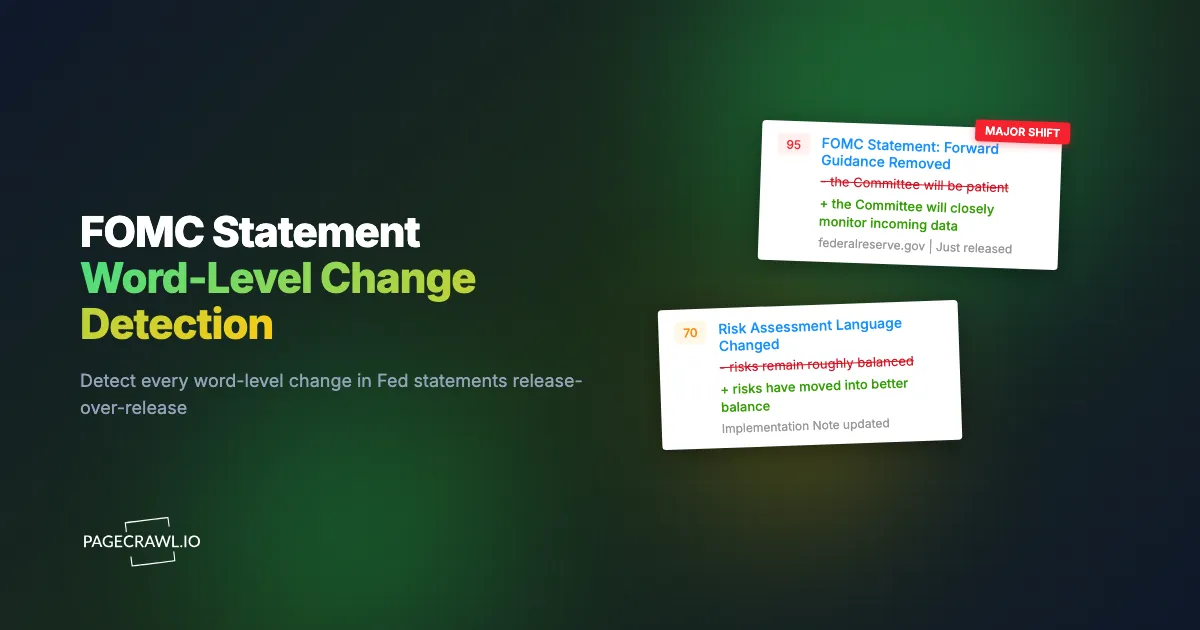
At 2:00 PM Eastern on January 31, 2024, the FOMC removed the phrase "any additional policy firming that may be appropriate" from its statement, marking the formal pivot away from a hiking bias. Treasuries and equities repriced sharply in the minutes that followed. Rates traders who had a side-by-side diff against the December statement saw the change before they finished reading the new statement.
The FOMC statement is the single most market-moving document published on a predictable schedule anywhere in the world. Eight times a year, the committee releases a short text, usually well under a thousand words, that economists and rates traders compare word-for-word against the previous version. The convention is so well established that the Federal Reserve Bank of Atlanta publishes a redlined version after every meeting, and the Brookings Institution Hutchins Center publishes scholarly analysis of language drift.
This guide covers exactly how the Fed publishes statements, the language patterns worth watching for, and how to set up a word-level diff that fires on the first check after the statement releases. Always read the statement itself on the Federal Reserve's own page before acting on a diff; this article is informational, not investment advice.
Quick Setup
Pick which Fed document you want to track. The tool counts down to the next FOMC meeting and previews exactly what your alert will look like.
Why does word-level FOMC monitoring matter?
Because the Fed deliberately changes language slowly, the diff against the prior statement is the cleanest summary of what actually changed. A handful of removed qualifiers can reframe the entire implied rate path. Analysts and traders read the diff first, then read the new statement in full only if the diff suggests they should.
Forward Guidance Shifts
Removing or adding qualifiers like "for some time," "patient," "data dependent," "considerable period," or "additional policy firming" reframes the implied rate path. Each phrase carries decades of accumulated meaning from previous cycles. The December 2014 statement retired "considerable time," the January 2024 statement dropped "additional policy firming," and both moves were widely read as pivots.
Risk Assessment Changes
Wording around inflation and labor market risks being "balanced" versus "tilted to the upside" or "well anchored" versus "elevated" is one of the most-watched signals in macro. The phrase "risks remain roughly balanced" has appeared and disappeared in patterns that track market expectations of policy direction.
Voting Record Changes
New dissents at the bottom of the statement signal cracks in committee consensus. A regional Fed president dissenting toward a different direction (especially a dovish dissent in a hawkish cycle) often presages a softening of guidance at subsequent meetings.
Section-Specific Patterns
The statement has predictable paragraphs: economic assessment, inflation outlook, balance of risks, policy action, and forward guidance. Wording shifts in each section have different implications. A change to the economic assessment is descriptive (reflecting what staff observed); a change to forward guidance is prescriptive (telegraphing what the committee intends to do).
How does the Fed publish FOMC statements?
FOMC statements are released at 2:00 PM Eastern on the second day of each two-day meeting, on the Federal Reserve's monetary policy press releases page, alongside an Implementation Note and, on quarterly meetings, the Summary of Economic Projections. The publication URL pattern follows a stable structure:
https://www.federalreserve.gov/newsevents/pressreleases/monetary.htm
https://www.federalreserve.gov/newsevents/pressreleases/monetary{YYYYMMDD}a.htm
The first URL is the press releases index page where the new statement appears as a new entry at 2:00 PM ET sharp. The second URL is the date-specific permalink, useful for archiving a baseline for the next-meeting diff.
The Fed also publishes:
- Implementation Note at the same minute, covering open-market operations, the IORB rate, and the discount window.
- Summary of Economic Projections (SEP), the so-called "dot plot," at the same minute on the quarterly meetings (March, June, September, December).
- Press conference transcript and Q&A posted within hours of the chair's 2:30 PM press conference.
Each surface is monitorable independently. The statement and Implementation Note together tell the full policy story; the SEP and press conference add nuance.
Comparing FOMC Monitoring Approaches
| Approach | Cost | Latency | Diff Quality | Best For |
|---|---|---|---|---|
| Manual refresh of Fed page | Free | Same minute | None | Reading the raw statement |
| Atlanta Fed redline | Free | Hours | Excellent | After-the-fact analysis |
| Bloomberg Fed Watch | $30K/year | Seconds | Excellent | Institutional desks |
| Reuters / WSJ live blog | Free | Seconds | Manual highlights | News-led coverage |
| PageCrawl with reader mode | Free to $80/year | 2-15 minutes | Clean text diff | Self-managed monitoring |
The Atlanta Fed redline is the canonical reference but takes hours to publish. PageCrawl gives you the same diff capability on a minutes-level delay, since the alert goes out when the next scheduled check detects the new statement, with webhook output into your own systems.
Setting Up FOMC Monitoring in PageCrawl

Step 1: Monitor the press releases index page
Add the monetary.htm URL above as a content monitor. New entries at the top of the page represent new statements, speeches, or operational notices. Use a 2-minute check frequency on the Ultimate plan for FOMC days; 15-minute checks on Standard work for non-meeting days.
Step 2: Add the statement permalink as a baseline
After each FOMC meeting, copy the permalink for the just-released statement (the URL pattern above with the meeting date) and add it as a second monitor. PageCrawl's diff view will show exactly which words and phrases changed at the next meeting six weeks later.
Step 3: Use reader mode for text-only diffs
When configuring the monitor, choose reader mode. This extracts just the statement body and ignores Fed page chrome (navigation, footer, sidebars), so the diff focuses purely on the policy language. The reference on available tracked element types covers the other modes if you want to watch a specific paragraph instead.
Step 4: Add the Implementation Note as a sibling
The Implementation Note covers open-market operations and administered rates. Add the date-specific permalink as a sibling monitor. The two documents together tell the full operational story.
Step 5: Route to fast notification channels
Rates traders typically route to Telegram or Discord; the help centre covers sending change notifications to a Telegram chat, group, or channel step by step. Newsletter authors and macro podcast hosts route to email plus a Notion or Roam capture. Compliance teams route to a dedicated audit channel for the timestamped change history.
Step 6: Pre-stage SEP and press conference monitors
For quarterly meetings (March, June, September, December), add the SEP page as a third monitor. Once the meeting concludes, add the press conference transcript URL as a fourth monitor for Q&A coverage.
Worked Example: FOMC Day Setup
A typical FOMC day setup for a macro-focused team:
- 9:00 AM ET: Verify monitors are active for the press releases index, the most recent statement permalink (baseline for diff), and the Implementation Note.
- 1:55 PM ET: Tighten check frequency on all four monitors to 2-minute checks for the next hour.
- 2:00 PM ET: Statement releases. PageCrawl alert fires within 1-3 minutes with the word-level diff against the prior statement.
- 2:01 PM ET: Trader has the diff in Telegram before completing the first reading of the full statement.
- 2:30 PM ET: Press conference starts. Chair's responses to journalist questions begin showing up on the transcript page over the next hour.
- 4:00 PM ET: Loosen check frequency back to baseline.
Total cost for this setup: $80/year on the Standard plan. The 2-minute frequency for FOMC days requires Ultimate at $999/year for maximum speed, though 15-minute checks on Standard still typically catch the change within minutes of release.
Language Patterns Worth Watching
Patience and timing qualifiers. "Patient," "for some time," "considerable period," "additional policy firming." These standard phrases moving in or out of the statement are the cleanest signal. Each phrase carries a multi-year history.
Inflation language. Whether inflation is described as "elevated," "moderating," "transitory" (now retired), "well anchored," or "running below objective" reframes the policy stance. The shift away from "transitory" in late 2021 was one of the most-discussed language changes in recent memory.
Labor market language. Tightness, balance, and risk wording on employment is the other half of the dual mandate. "Strong" vs "robust" vs "easing" each carries policy implications.
Balance sheet language. Changes to the paragraph about Treasury and MBS holdings (the runoff schedule) signal QT pace adjustments.
Dissents. A new dissenter, especially a regional Fed president dissenting toward a different direction, can flip the perceived bias of the committee.
Advanced Patterns: Combining FOMC With Other Signals
Pair with Treasury auction monitoring. Our Treasury auction guide covers auction calendar tracking. Awarded yields immediately after an FOMC statement contain the market's first reaction to the new guidance.
Pair with SEC filings and corporate guidance. Our 10-K and 10-Q diff guide helps when corporate forward guidance language shifts in the same window as FOMC language. Coordinated shifts in language are often noticed before macro themes show up in price, which is why desks running SEC filing and earnings monitoring read both feeds side by side.
Pair with ETF holdings shifts. Our ETF holdings monitor catches rotation in rates-sensitive sectors (utilities, banks, REITs) after FOMC days.
Pair with regional Fed speeches. Each regional Fed publishes speeches and remarks on a dedicated page. Add the speech pages for the dissenting member's home Fed as a sibling monitor.
Use Cases
Rates traders. A diff that lands in Telegram a couple of minutes after publication is faster than scrolling through the full statement during a moving market.
Macro research. Annotated diffs across a full year of statements build a clean dataset for tracking the committee's evolving stance. Many macro newsletters now reference saved diffs from monitoring tools.
Economic commentary. Newsletter authors and macro podcast hosts drop the redline straight into their post-meeting recap. Having the diff within minutes of release supports same-day publication.
Compliance and risk. Asset managers attach the diff to their meeting notes for the audit trail. The timestamped capture supports both internal reviews and external audits.
Treasury and corporate finance. Corporate treasurers and CFOs watch FOMC language to inform timing of debt issuance, hedge ratio changes, and cash management, usually alongside bank regulator and supervisory monitoring across the OCC, FDIC, and ECB.
Investor education. Financial advisors use the diff in client communications to explain rate environment shifts in concrete terms.
Frequently Asked Questions
How quickly does PageCrawl detect a new FOMC statement? With 2-minute checks (Ultimate plan), typical detection is 1-3 minutes after the 2:00 PM ET release. With 15-minute checks (Standard plan), detection is within 15 minutes.
Why use reader mode for the statement? The Fed page has navigation, sidebar, and footer content that changes independently of the statement. Reader mode extracts just the main text body, so the diff focuses on actual policy language changes.
Can I monitor minutes from the previous meeting? Yes. The meeting minutes (released three weeks after each meeting) follow a similar URL pattern. Add the minutes index page or the date-specific minutes permalink as a separate monitor.
What about the Summary of Economic Projections? The SEP is published on quarterly meetings (March, June, September, December) at the same minute as the statement. The SEP page is monitorable. The dot plot itself is rendered as a chart image, so for that you would want to watch for the SEP PDF to appear on the Fed page.
Does this work for the Bank of England, ECB, BoJ, BoC? Yes. The same approach works for any central bank that publishes statements at a stable URL. The European Central Bank monetary policy decision page is a particularly good complement to the FOMC monitor.
How do I avoid noise from non-FOMC press releases? The press releases index page includes speeches, operational notices, and other items. To filter, monitor the date-specific permalink of each statement separately, or use PageCrawl's AI summaries to filter alerts for statement-specific content.
Choosing your PageCrawl plan
PageCrawl's Free plan lets you monitor 6 pages with 220 checks per month, which is enough to validate the approach on your most critical pages. Most teams graduate to a paid plan once they see the value.
| Plan | Price | Pages | Checks / month | Frequency |
|---|---|---|---|---|
| Free | $0 | 6 | 220 | every 60 min |
| Standard | $8/mo or $80/yr | 100 | 15,000 | every 15 min |
| Enterprise | $30/mo or $300/yr | 500 | 100,000 | every 5 min |
| Ultimate | $99/mo or $999/yr | 1,000 | 100,000 | every 2 min |
Annual billing saves two months across every paid tier. Enterprise and Ultimate scale up to 100x if you need thousands of pages or multi-team access.
In event-driven strategies, minutes matter. One actionable signal surfaced before the broader market reacts can return more than a year of Ultimate. Standard at $80/year covers the core IR, press, and filings pages for a handful of positions. Enterprise at $300/year scales to a full watchlist. All plans include the PageCrawl MCP Server, so you can ask Claude to summarize every material change across a company's IR, press, and filings over any period you care about and get the evidence pulled straight from your monitoring archive. AI assistants can create monitors through conversation on every plan, including Free. Ultimate at $999/year adds 2-minute frequency and web archiving, which matters if you need provable timestamps for a thesis.
Getting Started
Add the Fed press releases index plus the latest statement permalink to PageCrawl on a 2-minute check schedule for FOMC days. Create a free account, wire alerts to Telegram or your team's incident channel, and the next FOMC redline will arrive within minutes of the embargo lifting. Run the setup through one full meeting cycle to develop a feel for the language pattern: the diff highlights exactly what changed, and the saved baselines build a quarter-over-quarter history of language drift that becomes its own analytical asset over time.
The Standard plan at $80/year is the natural step up once you add the Implementation Note, the press conference transcript, and a few regional Fed speech pages as sibling monitors. For macro-focused teams, the cost recovers itself the first time the language diff informs a position change ahead of the broader market reaction.